
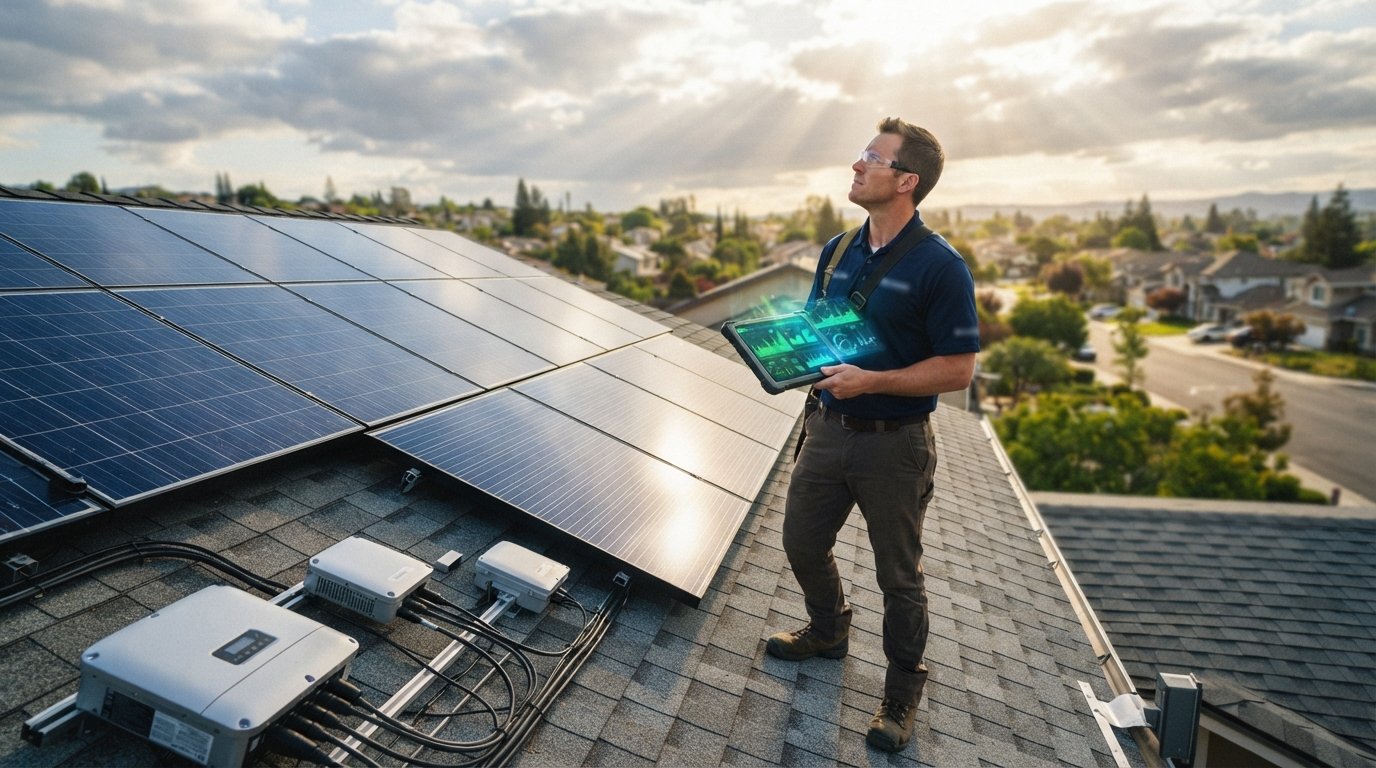
AI Machine Learning Solar Energy Optimization Guide
Machine learning is transforming solar forecasting, fault detection, and maintenance. Call (833)-212-3715 to explore ai machine learning solar energy optimization for your home.

By Julia Walsh
Learn more about Solar Panel Installation and Repair for guides, costs, and what to expect.
Compare Solar Panel Installation and Repair Pros Near You
Enter your ZIP code to compare top-rated local professionals and request free quotes.
Solar panels are now the cheapest source of electricity in many parts of the world, but a solar array is only as good as its ability to predict, adapt, and perform under real-world conditions. Clouds roll in, dust accumulates, inverters overheat, and suddenly the carefully calculated savings on paper do not match the utility bill. This is where ai machine learning solar energy optimization enters the picture. By combining sensor data, weather models, and historical performance, machine learning algorithms can squeeze more value out of every ray of sunlight, catching problems before they become expensive repairs and forecasting production with a precision that traditional tools cannot match.
For homeowners and businesses exploring renewable energy, understanding how AI and machine learning fit into the solar equation is no longer a niche curiosity. It is a practical way to evaluate monitoring platforms, compare installer capabilities, and set realistic expectations for system performance. This article breaks down the core mechanisms, from forecasting and fault detection to predictive maintenance and the next generation of residential monitoring apps, so you can make informed decisions about the technology that will manage your energy assets for decades.
How Machine Learning Improves Solar Production Forecasting Accuracy
Traditional solar forecasting relies on physics-based models that simulate sunlight hitting a panel under clear-sky conditions. These models are decent on a sunny day, but they struggle with passing clouds, seasonal haze, soiling, and sudden temperature swings. Machine learning flips the approach: instead of simulating physics from scratch, it learns patterns from historical data, including irradiance measurements, satellite imagery, weather station feeds, and the actual output of thousands of solar systems. The result is a forecast that adapts to local microclimates and improves over time.
Consider a residential system in a region with frequent afternoon thunderstorms. A physics model might predict full production until the storm arrives, while a machine learning model trained on years of local data can anticipate the cloud build-up and adjust the forecast hour by hour. This accuracy matters because it directly affects battery dispatch, grid interaction, and the homeowner's bottom line. When a forecast is off by 20 percent, a battery might charge at the wrong time or a home might draw from the grid during peak rates. Better forecasting reduces those errors.
Here is how machine learning forecasting typically works in a solar context:
- Data collection: The system gathers historical production data, local weather observations, satellite cloud cover, and sometimes sky camera imagery.
- Feature engineering: Algorithms identify the most relevant inputs, such as time of day, season, humidity, and aerosol levels, that correlate with output.
- Model training: Neural networks, gradient boosting, or recurrent models learn the relationship between inputs and actual production across many sites.
- Continuous updating: As new data arrives, the model fine-tunes its predictions, adapting to panel degradation or changing shade patterns.
The practical benefit for a homeowner is a monitoring app that says, with confidence, how much energy the system will produce tomorrow and how much battery storage will be needed. For installers, accurate forecasting is a sales tool: it demonstrates real-world performance rather than ideal-world estimates. And for the grid, better forecasts mean smoother integration of distributed solar, reducing the need for spinning reserves. If you are comparing installer proposals, asking whether they use machine learning forecasting is a smart way to separate leading-edge providers from those still relying on static estimates. You can also use a solar provider comparison tool to see how different companies stack up on technology and service.
AI-Driven Fault Detection in Inverters and Arrays
Inverters are the heart of a solar system, converting direct current from the panels into usable alternating current. When an inverter fails, production stops, and the homeowner may not notice until the next utility bill arrives. AI-driven fault detection changes that dynamic by continuously analyzing electrical signals, temperature readings, and performance ratios to spot anomalies in real time. Machine learning models can distinguish between a passing cloud and a failing string of panels, a distinction that rule-based monitoring often misses.
At the array level, fault detection can identify soiling, shading, cracked panels, and loose connections before they escalate. For example, a machine learning model might notice that one string of panels consistently underperforms its neighbors by 5 percent on sunny days, flagging a possible connector issue. Traditional monitoring might simply average the output and miss the subtle deviation. The AI approach preserves the granularity needed to catch small problems early, when repairs are cheap and downtime is minimal.
For inverter manufacturers, embedding AI fault detection is becoming a competitive necessity. For homeowners, the benefit is a monitoring app that sends a specific alert, such as "String 3 underperforming, likely soiling or shading," rather than a generic "system error." That specificity helps service technicians arrive with the right tools and parts, reducing truck rolls and repair time. It also empowers homeowners to take simple actions, like cleaning panels or trimming vegetation, without waiting for a service visit.
The economic impact is significant. A 2023 study by the National Renewable Energy Laboratory found that predictive fault detection can reduce operations and maintenance costs by up to 30 percent over the life of a system. For a typical residential array, that translates to hundreds of dollars in avoided service calls and recovered production. As AI models become more accessible through cloud platforms, even small installers can offer these capabilities without building their own data science teams.
Predictive Maintenance and How It Lowers Service Costs
Predictive maintenance takes fault detection a step further by forecasting when a component will fail, rather than waiting for it to fail. Machine learning models analyze degradation trends, operating conditions, and historical failure data to estimate the remaining useful life of inverters, optimizers, and batteries. This allows service providers to schedule maintenance during low-production periods, bundle repairs, and avoid emergency call-outs that carry premium labor rates.
For a homeowner, predictive maintenance means fewer surprises. Instead of a sudden inverter failure on a holiday weekend, the monitoring system might alert the installer weeks in advance that a fan bearing is wearing out. The replacement can be scheduled at a convenient time, often under warranty, and production loss is minimized. For the installer, predictive maintenance improves scheduling efficiency and reduces the cost of emergency repairs, savings that can be passed on to customers or reinvested in better service.
The battery is another critical component where predictive maintenance shines. Lithium-ion batteries degrade based on charge cycles, temperature, and depth of discharge. Machine learning models can estimate state of health and predict when capacity will drop below a threshold, helping homeowners plan for replacement or adjust charging habits to extend life. In a solar-plus-storage system, that foresight is valuable because battery replacement is a major expense.
Here is how predictive maintenance typically delivers savings:
- Early detection: Models flag components with abnormal degradation patterns before failure occurs.
- Optimized scheduling: Maintenance is planned for low-production seasons or combined with routine cleaning visits.
- Warranty alignment: Alerts are generated while components are still under warranty, reducing out-of-pocket costs.
- Reduced downtime: Proactive repairs keep the system producing at peak capacity, maximizing lifetime savings.
The cumulative effect is a lower levelized cost of energy for the homeowner and a more predictable service business for the installer. As AI tools become integrated into monitoring platforms, predictive maintenance is shifting from a premium add-on to a standard expectation. When evaluating solar proposals, ask whether the monitoring package includes predictive maintenance alerts and how those alerts are acted upon. A provider that embraces these tools is likely to offer better long-term value.
What AI Means for Future Residential Solar Monitoring Apps
The residential solar monitoring app of tomorrow will look less like a dashboard of charts and more like a personal energy assistant. Machine learning is enabling apps to learn a household's consumption patterns, predict energy needs, and automate battery dispatch to minimize costs. Instead of simply showing how much energy was produced yesterday, the app will tell you what to do today: charge the battery before the peak rate period, delay the electric vehicle charge until the sun comes up, or reduce usage during a grid stress event.
These apps will also integrate with smart home devices and time-of-use rates, creating a holistic energy management system. For example, an AI-powered app might learn that your heat pump runs most in the early morning and pre-cool the house while solar production is high, reducing evening grid draw. It might also detect anomalies in appliance energy use, alerting you to a failing refrigerator before it spoils food. The solar system becomes the centerpiece of a smarter, more resilient home.
Another emerging capability is automated fault reporting to installers. Instead of the homeowner calling a service line, the app can generate a diagnostic report and schedule a technician automatically, with the homeowner's approval. This reduces friction and ensures that small issues are addressed before they become big ones. For installers, the data stream from these apps creates a feedback loop that improves their own service offerings and helps them target marketing to customers most likely to need upgrades or add-ons.
As you plan a solar investment, consider how the monitoring platform will evolve. Ask potential installers about their software roadmap, data ownership policies, and whether the app supports open standards like SunSpec. A system with a robust, AI-ready monitoring platform is more likely to deliver value over its 25-year lifespan. And if you are also planning a move, resources like Moving.Homes relocation guides can help you understand how solar systems factor into home sales and what to look for in a new property.
The convergence of AI, machine learning, and solar energy is still in its early chapters, but the direction is clear. Systems that learn, predict, and adapt will outperform static ones, delivering better savings and fewer headaches. Whether you are a homeowner evaluating your first installation or a business optimizing an existing fleet, the smart approach is to ask hard questions about data, algorithms, and service integration. The solar industry is rapidly becoming a data industry, and the providers who embrace that shift will be the ones you want on your roof.