
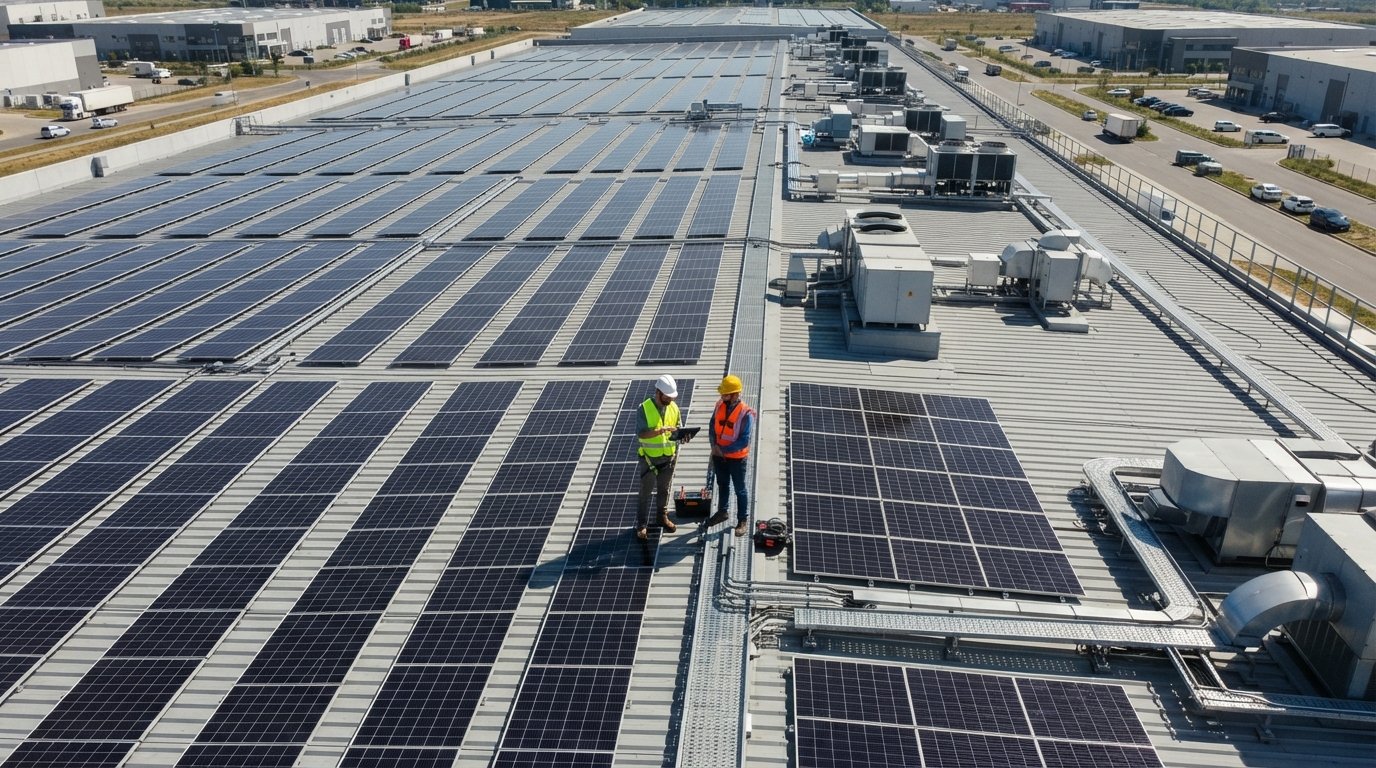
Best Commercial Solar Panel Brands for Businesses 2026
Compare the best commercial solar panel brands for businesses 2026 and cut operating costs for decades. Call 8332123715 for expert guidance.

By Alex Carter
Learn more about Solar Panel Installation and Repair for guides, costs, and what to expect.
Compare Solar Panel Installation and Repair Pros Near You

Enter your ZIP code to compare top-rated local professionals and request free quotes.
Commercial electricity rates have climbed steadily across most U.S. markets, and for many businesses, the monthly utility bill has become one of the largest controllable operating expenses. In 2026, installing a commercial solar array is no longer just an environmental statement: it is a financial strategy. The brand of panel you choose determines how much power your system produces over 25 to 30 years, how quickly it pays for itself, and how much maintenance it demands along the way. Picking the wrong manufacturer can mean lower yields, warranty headaches, and a slower return on investment.
This guide breaks down the best commercial solar panel brands for businesses in 2026, explains what separates a true commercial-grade panel from a residential one, and shows you how to match a brand to your building, your budget, and your energy goals. Whether you operate a warehouse, a retail chain, a manufacturing facility, or a multi-tenant office building, the right panel brand can turn your roof into a revenue-generating asset.
What Makes a Solar Panel Commercial Grade
Commercial solar panels are not simply bigger versions of the panels you see on suburban rooftops. They are engineered for higher voltage systems, longer depreciation schedules, and harsher operating conditions. A commercial array typically runs between 200 kW and 5 MW, which means the panels must handle greater electrical stress while maintaining efficiency across decades of daily cycling.
When evaluating brands for a business installation, focus on four core technical benchmarks. First, module efficiency: commercial panels in 2026 generally range from 20 percent to 23 percent, and higher efficiency means more kilowatts per square foot of roof or land. Second, temperature coefficient: panels lose output as they heat up, and a lower coefficient (closer to -0.30 percent per degree Celsius) protects production during hot summer afternoons when commercial demand charges peak. Third, degradation rate: top-tier manufacturers guarantee no more than 0.45 percent annual output loss, which compounds significantly over a 30-year horizon. Fourth, warranty structure: commercial installations deserve at least a 12-year product warranty and a 25-year performance warranty, with some brands extending coverage to 30 years.
Beyond the spec sheet, commercial buyers should weigh bankability. A panel brand backed by a strong balance sheet, a U.S. distribution network, and a track record of honoring claims is worth a small efficiency premium. If a manufacturer exits the market, your warranty may become worthless, and replacement panels in the same form factor can be difficult to source.
The Best Commercial Solar Panel Brands for Businesses in 2026
The brands below represent the strongest options for commercial and industrial buyers in 2026, based on efficiency, durability, warranty support, and real-world performance in U.S. installations. Each has a distinct strength, so the right choice depends on your site conditions and financial priorities.
- SunPower (Maxeon): Best for space-constrained roofs where every square foot must produce maximum power. Efficiency ratings above 22 percent and an industry-leading 40-year performance warranty make it a premium pick.
- REC Group: Best overall balance of price, efficiency, and durability. The REC Alpha Pure series offers high power density and a 25-year product warranty that covers labor in some markets.
- Panasonic: Best for businesses that prioritize long-term reliability and a strong U.S. service network. The EverVolt line pairs well with commercial storage.
- Q CELLS: Best for large-scale commercial portfolios where consistent supply and competitive pricing matter. The Q.TRON line delivers strong low-light performance.
- Canadian Solar: Best for budget-conscious projects that still need tier-one quality. Wide availability and bankability make it a favorite for multi-site rollouts.
- Trina Solar: Best for ground-mount and utility-scale commercial projects. The Vertex series offers high wattage per panel, reducing racking and labor costs.
- JinkoSolar: Best for buyers who need massive volume quickly. The Tiger Neo series uses N-type TOPCon cells for high efficiency and low degradation.
SunPower and REC tend to lead on efficiency, which matters most when roof area is limited and you are trying to offset a high load. Panasonic and Q CELLS sit in the sweet spot for most commercial buildings, offering strong warranties without the highest price tag. Canadian Solar, Trina, and JinkoSolar compete aggressively on cost per watt, which can shorten payback periods on large, unshaded sites. Many businesses end up comparing quotes across two or three of these brands to see which one pencils out best for their specific utility rate structure.
How to Compare Brands Without Getting Lost in Specs
Spec sheets can overwhelm even experienced facility managers. A simpler approach is to score each brand on the factors that actually move your financial model. Start with the levelized cost of energy (LCOE), which combines panel price, efficiency, degradation, and expected maintenance into a single number. Then layer in warranty terms and local service availability.
A practical comparison framework looks like this: for each brand, write down the cost per watt, the efficiency percentage, the annual degradation rate, the product warranty length, and the nearest authorized service partner. Brands that score well on all five are usually safe bets. Brands that win on price but lag on warranty or service may still work for a short-term hold, but they carry more risk over a 25-year ownership period. If you are early in the process and still gathering pricing, a structured approach to understanding commercial solar quotes can help you compare offers on equal footing instead of chasing the lowest headline number.
Panel Technology Trends Shaping 2026 Buying Decisions
The commercial solar market has shifted decisively toward N-type cells, which outperform the older P-type technology on nearly every metric. N-type panels degrade more slowly, handle high temperatures better, and produce more power in low-light conditions such as early morning and overcast days. TOPCon and heterojunction (HJT) are the two dominant N-type architectures, and both are now widely available from tier-one manufacturers.
Bifacial panels are another trend worth understanding. These modules generate electricity from both the front and back, capturing reflected light from white roofs, gravel, or ground cover. On a commercial flat roof with a reflective membrane, bifacial panels can add 5 to 15 percent more energy production without requiring more space. The premium is modest, and the payback improvement is often worth it.
Finally, panel-level power electronics are becoming standard. Microinverters and DC optimizers allow module-level monitoring and rapid shutdown, which many commercial building codes now require. Some brands integrate these features directly, while others rely on partners like Enphase or SolarEdge. Understanding this ecosystem helps you avoid compatibility surprises during installation.
Matching the Right Brand to Your Business Type
Different businesses have different solar priorities, and the best brand for a data center is rarely the best brand for a farm or a retail plaza. The table below summarizes common commercial profiles and the brand characteristics that fit them best, though every project deserves a custom analysis.
- Warehouses and distribution centers: Large, unshaded roofs favor high-wattage panels from Trina or JinkoSolar, where cost per watt and racking efficiency drive savings.
- Manufacturing facilities: High daytime loads and demand charges reward panels with excellent temperature coefficients, such as REC or Panasonic.
- Retail and office buildings: Limited roof space and aesthetic considerations favor high-efficiency SunPower or Q CELLS modules.
- Agricultural operations: Ground-mount and bifacial setups from Canadian Solar or Trina work well where land is available and dust or soiling is manageable.
- Multi-site portfolios: Standardization matters more than peak efficiency, so brands with national distribution and consistent supply, like Q CELLS or Canadian Solar, simplify rollouts.
Beyond the building type, consider your financing structure. Businesses that own their systems outright tend to prioritize long-term durability and warranty strength. Businesses using a power purchase agreement (PPA) or lease may care more about upfront cost and production guarantees, since the developer retains ownership and maintenance responsibility. Either way, the panel brand affects the economics for both parties, and it is worth discussing with your installer before signing.
It also helps to think about future expansion. If you plan to add panels or batteries in five years, choosing a brand with a stable product line and backward-compatible mounting hardware will save you money and headaches. Some manufacturers change form factors frequently, which can make matching older arrays difficult.
Warranties, Service, and Long-Term Support
A solar panel warranty is only as good as the company standing behind it. In 2026, the strongest commercial warranties come from manufacturers with deep U.S. operations and dedicated commercial support teams. SunPower, Panasonic, and REC are known for responsive claims handling, while Q CELLS and Canadian Solar offer broad service networks through their distributor partners.
Read the fine print on performance warranties. Most guarantee a specific percentage of original output at year 25 or 30, but the slope of degradation matters. A panel that degrades 0.25 percent per year will outperform one that degrades 0.55 percent per year by a meaningful margin over three decades. Also check whether the warranty covers labor, shipping, and removal of the failed panel. Some premium warranties include these costs, which can save thousands of dollars on a large array.
Serviceability is another factor. If a panel fails in year 12, how quickly can a replacement be sourced? Brands with U.S. warehouses and active distribution channels typically resolve claims in weeks rather than months. For businesses where downtime is expensive, that speed is worth paying for. Ask your installer which brands they stock locally and how they handle warranty replacements.
How to Vet a Commercial Solar Brand Before You Buy
Before committing to a brand, run a simple due diligence checklist. It takes an hour and can prevent years of regret.
- Verify the manufacturer's financial stability using public filings, industry reports, or credit ratings.
- Confirm the panel appears on a recognized tier-one list, such as BloombergNEF or PV-Tech.
- Check that the warranty is transferable if you sell the building.
- Ask for at least three commercial references in your region and contact them.
- Review the datasheet for temperature coefficient, degradation rate, and certification to UL 61730 and IEC standards.
If a brand cannot pass these checks, it is not worth the savings. Commercial solar is a 25-year commitment, and the panel is the one component you cannot easily swap out later. For broader context on how equipment choices fit into overall project economics, resources like SolarEnergy.ai provide independent analysis and tools that can help you benchmark your assumptions.
It is also wise to ask your installer how they handle brand substitutions. Supply chains can shift, and a panel you specify today may be discontinued next year. A good installer will propose an equivalent or better alternative and document it in the contract, so you are not left with mismatched modules or a voided warranty.
Financing and Incentives That Affect Brand Choice
The federal investment tax credit (ITC) remains a major driver of commercial solar economics in 2026, and businesses can often pair it with accelerated depreciation to recover a substantial portion of project cost in the first few years. State and utility incentives vary widely, and some programs favor certain equipment or domestic content. If your project qualifies for a bonus credit tied to U.S.-made components, that can shift the brand decision toward manufacturers with domestic assembly.
Financing options include cash purchase, commercial loans, PPAs, and leases. Each structure changes who owns the panels and who captures the tax benefits, which in turn affects how much weight to put on upfront price versus long-term performance. A brand with a slightly higher price but a stronger warranty may be the better choice under a cash purchase, while a PPA developer may prioritize cost per watt to keep the rate competitive.
Before you finalize a brand, model the full financial picture: installed cost, incentives, expected production, utility rate escalation, and maintenance. Small differences in degradation and efficiency compound over time, and the brand that looks cheapest today is not always the cheapest over 25 years.
The best commercial solar panel brands for businesses in 2026 are the ones that match your site, your load profile, and your ownership horizon. Start with efficiency and warranty, validate bankability and service, and then let the numbers decide. A well-chosen panel brand turns your roof into a predictable, low-cost power plant for decades, and that is a competitive advantage no utility rate hike can erase.