
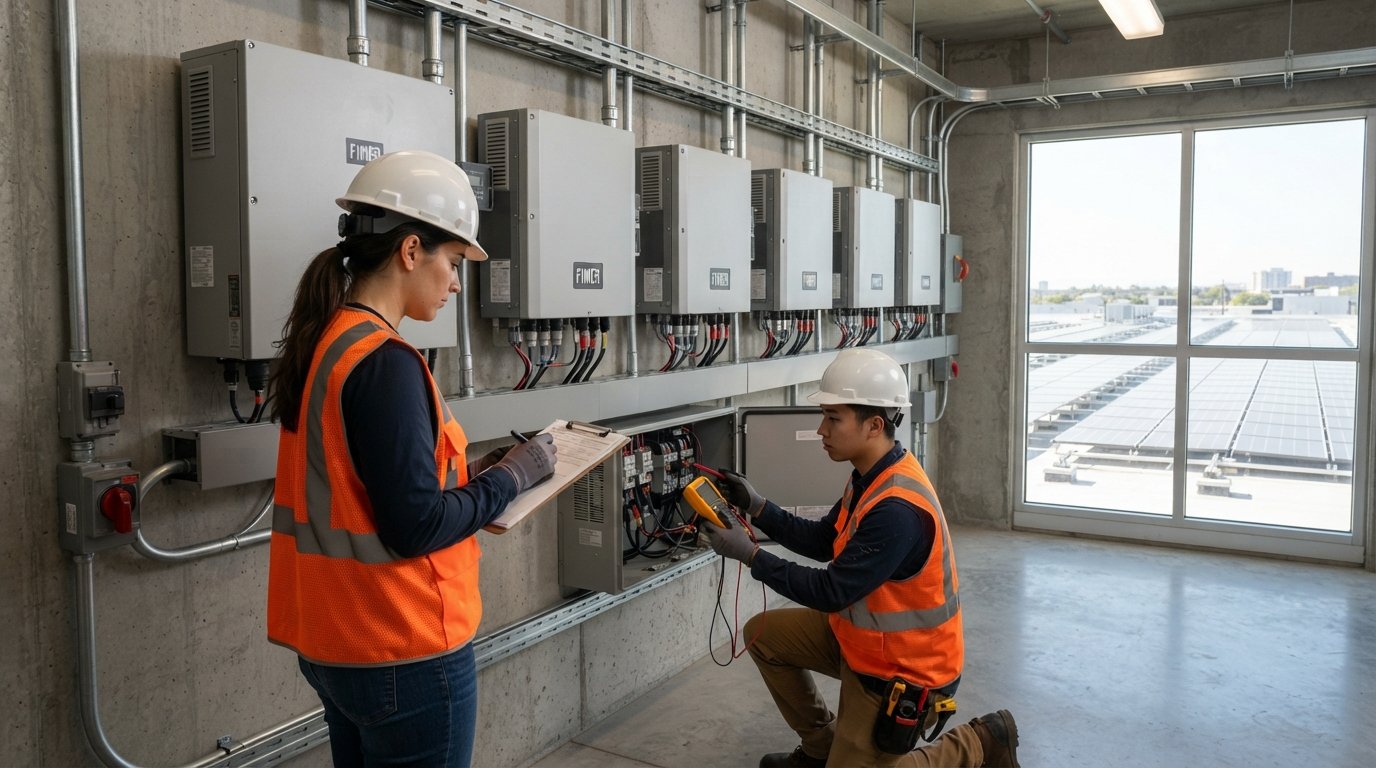
Best Solar Inverters for Commercial Installations 2026
Compare the best solar inverters for commercial installations 2026, from string and hybrid units to microinverters, and learn how to match one to your building.
By Scott Thompson
Learn more about Solar Panel Installation and Repair for guides, costs, and what to expect.
Compare Solar Panel Installation and Repair Pros Near You

Enter your ZIP code to compare top-rated local professionals and request free quotes.
Choosing the right inverter is arguably the most consequential decision in a commercial solar project. While panels get most of the attention, the inverter is the brain of the system: it converts the direct current (DC) electricity your panels produce into the alternating current (AC) that your building actually uses. In 2026, the commercial inverter market has matured around three distinct architectures, and picking the wrong one can cost you tens of thousands of dollars in lost generation, premature replacement, and service headaches. This guide breaks down the best options for commercial installations this year, explains how to match inverter type to your site, and shows you where to start when you are ready to request quotes from certified installers.
Why Commercial Inverters Deserve More Scrutiny Than Panels
Commercial solar systems are not just bigger versions of residential systems. They operate under different utility rate structures, different roof constraints, and different financial pressures. A commercial inverter typically has a 10 to 15 year design life, while the panels it serves will last 25 to 30 years. That means you will almost certainly replace your inverter at least once during the life of the array, and the choice you make now determines how expensive that replacement will be.
Inverter efficiency also matters more at commercial scale. A one percent efficiency difference on a 500 kW system can mean thousands of kilowatt hours lost every year. Add in demand charge management, which many commercial inverters now support through smart features, and the inverter becomes a financial tool as much as an electrical one. If you want a refresher on the fundamentals before diving into commercial specifics, our guide on solar inverter function explains how these devices power your home or business and why they are the heart of any photovoltaic system.
Finally, consider serviceability. Commercial rooftops are harder to access than residential roofs, and a failed inverter can take down an entire string of panels. The best commercial inverters in 2026 are designed with modular replacement in mind, remote monitoring as standard, and warranties that actually cover the labor to swap a unit when it fails.
The Three Inverter Architectures Competing in 2026
Every commercial solar installation uses one of three inverter architectures. Each has a distinct cost profile, maintenance profile, and best-fit scenario. Understanding these trade-offs is the single most important step in narrowing your options.
- String inverters: Centralized units that handle many panels in series. Lowest upfront cost, easiest to service because all the electronics are in one place, but a single point of failure can reduce output across the whole array.
- Microinverters: One small inverter per panel. Maximum energy harvest on complex roofs with shading, but the highest upfront cost and the most devices to monitor and potentially replace.
- Hybrid and battery-ready inverters: String inverters with integrated battery connections and smart grid features. Growing fast in commercial settings where demand charge reduction and backup power are priorities.
For most commercial rooftops in 2026, string inverters remain the default choice because of their cost per watt and serviceability. Microinverters make sense when shading is unavoidable or when panels are spread across multiple roof planes with different orientations. Hybrid inverters are becoming the standard for businesses that want to add storage later without replacing the entire conversion system.
Top Commercial Inverter Picks for 2026
The following picks reflect the models that commercial installers are specifying most often in 2026, based on efficiency, warranty terms, monitoring capabilities, and real-world reliability. Pricing varies by region and project size, so treat any figures as directional and confirm current numbers with your installer.
Best Overall for Most Commercial Rooftops
Three-phase string inverters in the 50 kW to 125 kW range dominate commercial installations. The leading models in this class combine efficiency ratings above 98.5 percent with integrated arc fault detection, rapid shutdown compliance, and native monitoring. They are designed to be stacked in parallel, which means you can size a system precisely to your load without overbuying capacity. Installers like them because a single failed unit can be swapped in under an hour without touching the panels.
When evaluating these units, focus on three specs: the CEC weighted efficiency, the maximum DC input voltage, and the warranty length. A 10-year warranty is table stakes in 2026, and several manufacturers now offer 12 or 15 years with optional extensions. The difference in lifetime cost between a 10-year and a 15-year warranty can exceed the upfront price difference, so run the numbers before defaulting to the cheapest unit.
Best for Shaded or Multi-Orientation Roofs
Microinverters have closed much of the cost gap with string inverters over the past few years. For commercial buildings with dormers, HVAC equipment, or adjacent structures that cast shadows, microinverters can recover 10 to 25 percent more energy than a string system of the same panel count. The trade-off is more devices on the roof, which means more potential failure points, but modern microinverters carry 25-year warranties and rarely need service.
Enphase remains the dominant name in this category, with competitors offering similar architecture at lower price points. If your roof has any meaningful shading between 9 a.m. and 3 p.m., run a shading analysis before assuming a string inverter is cheaper. The energy harvest difference often pays back the cost premium within five to seven years.
Best for Businesses Planning to Add Storage
Hybrid inverters are the fastest-growing segment of the commercial market in 2026. These units combine a high-efficiency string inverter with a battery interface and smart controls that can discharge stored energy during peak demand periods. For businesses on demand-charge rate structures, this feature alone can cut utility bills by 20 to 40 percent, often paying for the storage system within a few years.
The key differentiator among hybrid inverters is the software. Look for units with open APIs, time-of-use scheduling, and the ability to participate in utility demand response programs. Hardware specifications matter less than the control layer, because the value of a hybrid system comes from how intelligently it dispatches stored energy. Confirm that your chosen inverter supports the battery chemistry you plan to use, and check whether the manufacturer has a track record of software updates.
How to Match an Inverter to Your Commercial Site
Inverter selection should follow a site assessment, not precede it. Before comparing models, gather the following information about your building and its energy profile. This list covers the essentials that any reputable installer will ask for during a site visit.
- Roof layout and shading: How many roof planes, what orientations, and what obstructions cast shadows during peak sun hours?
- Electrical service size: What is your existing service amperage, and does the utility require a dedicated interconnection or a line-side tap?
- Load profile: When does your building use the most electricity, and how does that align with solar production?
- Future plans: Do you expect to add battery storage, EV charging, or expand the array within five years?
- Utility rate structure: Are you on a demand-charge tariff, a time-of-use plan, or a flat rate? This determines how much value smart inverter features can deliver.
Once you have these answers, the inverter choice usually narrows to two or three models. A 200 kW rooftop with a single south-facing plane and no shading calls for a different solution than a 75 kW system spread across three orientations with a parking structure in the way. Do not let an installer talk you into a specific brand before they have walked the site and reviewed at least 12 months of utility bills.
Efficiency, Monitoring, and Warranty: What Actually Matters
Marketing materials for commercial inverters tend to emphasize peak efficiency, but peak efficiency is measured under ideal conditions that rarely occur in the field. The metric that matters is CEC weighted efficiency, which averages performance across a range of real-world conditions. Look for units rated at 98 percent or higher on this scale. The difference between 97 percent and 98.5 percent on a 500 kW system is roughly 7,500 kWh per year, which at commercial rates can be worth several thousand dollars annually.
Monitoring is the second pillar. Every commercial inverter sold in 2026 includes some form of remote monitoring, but the quality varies widely. The best platforms provide panel-level or string-level data, automatic alerts when production drops below expectations, and integration with third-party energy management systems. If you plan to claim the federal investment tax credit, you will need production data to document system performance, so choose an inverter with robust data export capabilities.
Warranty terms deserve the same scrutiny. A 10-year standard warranty sounds generous until you realize that labor to remove and replace a rooftop inverter can cost more than the unit itself. Look for manufacturers that cover labor, or budget for a service contract that does. Some manufacturers also offer extended warranties that push coverage to 20 years, which can align with the expected life of the array.
Cost Expectations and Financial Incentives in 2026
Commercial inverter costs in 2026 range from roughly $0.08 to $0.20 per watt of system capacity, depending on architecture and features. For a 250 kW system, that translates to $20,000 to $50,000 for the inverter alone, before installation labor, wiring, and commissioning. Microinverter systems sit at the higher end of that range, while basic string inverters sit at the lower end. Hybrid inverters with storage interfaces fall in the middle.
These costs do not exist in isolation. The federal investment tax credit continues to cover a significant percentage of commercial solar project costs in 2026, and many states offer additional incentives. Depreciation schedules, utility rebates, and state-level programs can further improve the economics. Because incentives change frequently and vary by location, verify current programs with your tax advisor and your utility before finalizing a budget. The team at FreeSolarPowerQuotes maintains educational resources on financing options and government incentives that can help you understand what is available in your area.
One cost that is easy to overlook is the interconnection study and any utility upgrades required to accommodate your system. Some commercial inverters have features that reduce or eliminate the need for expensive transformer upgrades, such as reactive power support and smart export limiting. If your utility has flagged potential upgrade costs, ask your installer whether a different inverter model could avoid them. The savings can be substantial.
Common Mistakes to Avoid When Selecting a Commercial Inverter
The most common mistake is treating the inverter as a commodity and selecting on price alone. Inverter failure rates are not uniform across brands, and a unit that saves $3,000 upfront but fails in year seven can cost far more in lost production and emergency service. Ask installers which brands they see most often in their service queue, and weight that feedback heavily.
The second mistake is undersizing the inverter relative to the array. A DC-to-AC ratio above 1.3 can cause clipping losses during peak sun hours, especially in sunny climates. Some clipping is economically justified because it lets you capture more energy during off-peak hours, but too much clipping wastes panel capacity. Your installer should model the specific ratio for your location and rate structure.
The third mistake is ignoring the software ecosystem. A commercial inverter is only as good as the platform that monitors and controls it. If the manufacturer has a history of abandoning software platforms or charging subscription fees for basic monitoring, factor that into your decision. Ask for a demonstration of the monitoring interface before you sign, and confirm what happens to your data if you switch to a different vendor later.
Getting Quotes and Making the Final Call
The best way to choose a commercial inverter is to get multiple quotes from certified installers who can explain why they are recommending a specific model for your site. A good quote will include the inverter make and model, the DC-to-AC ratio, the monitoring platform, the warranty terms, and a line-item breakdown of labor and equipment. If a quote does not include those details, ask for them before comparing prices.
You can start that process by requesting free, no-obligation quotes from vetted local professionals who specialize in commercial solar. Comparing three or more quotes side by side will quickly reveal which installers are designing for your specific site and which are simply repeating a template. The inverter is the component most likely to determine whether your system performs as promised for the next decade, so it deserves the extra diligence.
Commercial solar in 2026 is a mature investment with predictable returns, and the inverter is the component that most directly controls those returns. Choose an architecture that fits your roof, a model with proven reliability and strong monitoring, and an installer who can justify the recommendation with site-specific data. Do that, and your system will quietly convert sunlight into savings for years to come.