
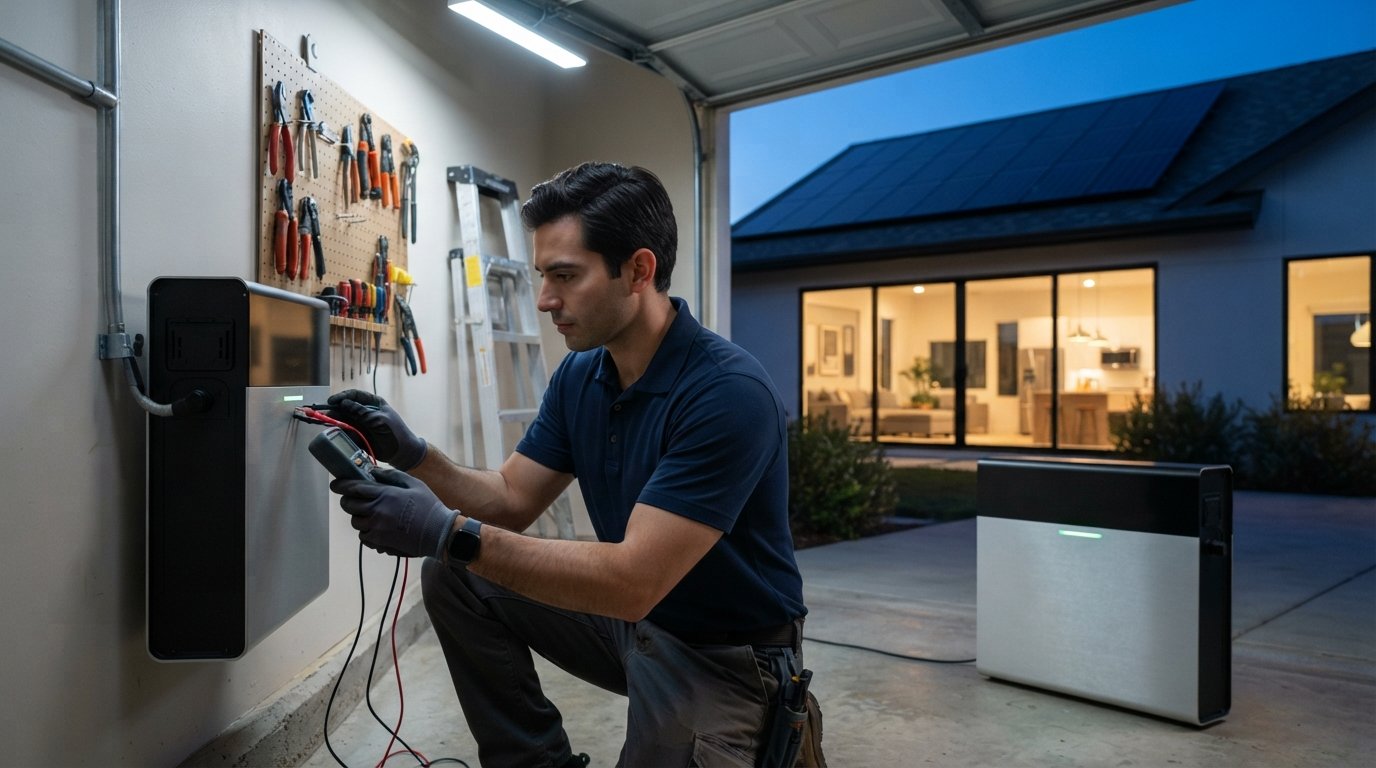
Best Tesla Powerwall Alternatives for 2026 Home Energy Storage
Discover the best Tesla Powerwall alternatives for 2026, from modular Enphase to whole-home Generac. Compare costs and features to find your ideal battery.

By Alexia Mabel
Learn more about Solar Panel Installation and Repair for guides, costs, and what to expect.
Compare Solar Panel Installation and Repair Pros Near You

Enter your ZIP code to compare top-rated local professionals and request free quotes.
When your solar array produces more electricity than your home can use during the day, that surplus goes back to the grid, often at a wholesale rate that is far lower than what you pay to pull power at night. A home battery lets you keep that excess energy for yourself, shift your consumption to off-peak hours, and maintain power during outages. Tesla's Powerwall is the most recognizable name in this space, but it is not the only option, and it may not be the best fit for every home. In fact, a growing number of homeowners are finding that Tesla Powerwall alternatives offer better pricing, more flexible capacity, or features that align more closely with their specific energy goals. This guide compares the leading competitors, explains what to look for, and helps you decide which battery system deserves a spot on your wall.
Why Look Beyond the Powerwall?
The Tesla Powerwall 3 is a powerful AC-coupled battery with a built-in solar inverter, and it has earned a strong reputation for reliability and sleek design. However, several factors can make other systems a smarter choice. First, availability: Tesla prioritizes installations through its own certified partners, and wait times can stretch for months in some regions. Second, pricing: the Powerwall's upfront cost, which typically lands between $12,000 and $16,000 installed, does not always include the necessary gateway or sub-panel upgrades, and those extras can add $2,000 or more. Third, capacity flexibility: the Powerwall 3 offers 13.5 kilowatt-hours (kWh) of usable capacity, but if you need less storage for a small home or a backup-only setup, you end up paying for capacity you will never use.
Beyond those practical concerns, there is also the question of features. Some homeowners want a battery that integrates seamlessly with an existing solar inverter, while others need a system that can operate independently of the grid without special equipment. And for those who already have a non-Tesla solar array, a Powerwall may require additional hardware to function properly, which adds cost and complexity. This is why exploring Tesla Powerwall alternatives is not just about finding a cheaper option; it is about finding the right tool for your specific energy profile.
Top Tesla Powerwall Alternatives in 2026
The home battery market has matured significantly, and several brands now offer products that rival or exceed the Powerwall in key areas. Based on performance, cost, and market adoption, these are the most compelling alternatives to consider.
1. Enphase IQ Battery 5P
Enphase is a giant in the solar microinverter space, and its IQ Battery series leverages that expertise to create a highly modular and reliable storage solution. The IQ Battery 5P is a 5 kilowatt-hour (kWh) unit that can be stacked to create systems of 10, 15, or 20 kWh. This is a major advantage if your storage needs are modest today but could grow later. Each battery module includes its own microinverter, which means the system is AC-coupled and works with virtually any solar array, regardless of the inverter brand. The IQ Battery also has a robust temperature management system, allowing it to operate in a wider range of climates without derating.
For homeowners who already have Enphase microinverters, the integration is seamless, and the monitoring software is considered some of the best in the industry. However, the per-kWh cost is often higher than the Powerwall, and a 10 kWh system can cost close to $15,000 installed. The modular design also means you will have multiple boxes on your wall, which some homeowners find less aesthetically pleasing than a single, sleek unit.
2. LG Chem RESU Prime
LG Chem has been a major player in residential storage for years, and the RESU Prime series continues that tradition with high energy density and a compact footprint. The RESU Prime is available in 9.8 kWh and 16 kWh versions, and it uses a lithium-ion NMC chemistry that offers excellent cycle life. Unlike the Powerwall, which requires a separate gateway for load control, the RESU Prime can be paired with a wide range of hybrid inverters from brands like SolarEdge, SMA, and Fronius. This makes it a popular choice for homeowners who are designing a custom system and want to choose each component individually.
The main drawback of the RESU Prime is that it is a DC-coupled battery, which means it typically needs a hybrid inverter to convert the solar DC power to AC for home use and then back to DC for charging the battery. This adds a layer of complexity and cost, and it can reduce overall system efficiency if the inverter is not properly sized. Additionally, LG Chem does not offer the same level of all-in-one monitoring and app integration as Tesla or Enphase, so you may need to rely on your inverter manufacturer's software.
3. Sonnen eco
Sonnen is a German company that has built a strong following for its premium, software-driven batteries. The Sonnen eco is a scalable system that starts at 5 kWh and can be expanded in 2.5 kWh increments up to 15 kWh. It uses a lithium iron phosphate (LFP) chemistry, which is inherently safer and has a longer lifespan than NMC chemistries. The Sonnen eco also comes with a proprietary energy management system that uses machine learning to optimize when to charge and discharge based on your usage patterns and electricity rates. It is one of the few systems that can participate in grid services programs in some states, which can earn you bill credits.
The trade-off is price. Sonnen is one of the most expensive options on the market, with a 10 kWh system often costing $20,000 or more installed. That premium buys you a beautifully designed unit, a 10-year warranty that covers the entire system, and access to Sonnen's community energy features. But for most homeowners, the cost per kWh is difficult to justify unless you place a high value on the software and longevity.
4. Generac PWRcell
Generac, known primarily for backup generators, has made a serious push into home storage with the PWRcell. This system is designed to be a true whole-home backup solution, capable of powering large loads like air conditioners, well pumps, and electric vehicle chargers. The PWRcell is modular, with each cabinet holding up to 6 kWh of capacity, and you can stack multiple cabinets to create a system of 6 to 18 kWh or more. It is AC-coupled and includes an integrated transfer switch that automatically disconnects you from the grid during an outage, so you never have to worry about backfeeding.
Generac's strength is its integration with its own line of automatic transfer switches and generators, making it a natural choice for homeowners who already have a Generac generator. The PWRcell also has a slightly lower installed cost per kWh compared to the Powerwall in many markets. However, the system is bulkier and more industrial-looking than the Powerwall, and the monitoring app is less polished. It is also not as widely available from solar installers, so you may need to work with an electrical contractor who specializes in Generac products.
5. FranklinWH aPower
FranklinWH is a newer player that has quickly gained attention for its large-capacity, whole-home backup capabilities. The aPower battery offers a substantial 13.6 kWh of usable capacity, and it can be paired with the company's aGate smart energy management system. The aGate allows you to control up to 64 circuits in your home, giving you granular control over which loads are powered during an outage. This is a level of flexibility that few other systems offer, and it can be a lifesaver if you have a well pump, a medical device, or a home office that must stay online.
The aPower uses LFP chemistry, and it has a continuous power output of 5 kW per unit, which can be doubled by adding a second battery. The system is also designed to work with or without solar, making it a viable option for homeowners who just want backup power today and plan to add solar later. The main downside is that FranklinWH is a relatively young company, so its track record for reliability and customer support is still being established. The installed cost is also on the higher end, often exceeding $18,000 for a single battery plus gateway.
Key Features to Compare When Shopping
When you start comparing Tesla Powerwall alternatives, you will quickly notice that specifications can be confusing. To make an informed decision, focus on these five critical areas. First, usable capacity: this is the amount of energy you can actually draw from the battery, measured in kWh. A 10 kWh battery will power a typical home for about 8 to 10 hours, depending on your consumption. Second, continuous power output: this is the maximum amount of power the battery can deliver at once, measured in kilowatts (kW). If you plan to run an air conditioner or an electric car charger during an outage, you need a battery with a high continuous rating. Third, round-trip efficiency: this is the percentage of energy that comes out of the battery versus what went in. Most modern batteries are around 90% efficient, but a 5% difference can add up to significant savings over a decade. Fourth, warranty and cycle life: look for a warranty that guarantees a certain number of cycles or years of operation, and check the degradation rate. A good battery should retain at least 70% of its capacity after 10 years. Fifth, scalability: can you add more battery modules later if your needs change? Some systems are fixed, while others allow you to stack additional units.
- Usable capacity: 5 to 20 kWh is typical for residential systems.
- Continuous power: 4 to 7 kW per unit is common, but some can deliver more.
- Round-trip efficiency: Look for 90% or higher to maximize savings.
- Warranty: 10 years or 10,000 cycles is the industry standard.
- Scalability: Modular systems let you start small and expand later.
Beyond these specs, you should also consider the physical footprint and installation requirements. Some batteries are wall-mounted, while others are floor-standing. Wall-mounted units like the Powerwall and Enphase IQ are space-saving, but they require a solid wall with proper structural support. Floor-standing units like the Generac PWRcell can be placed in a garage or utility room, but they take up more floor space. Also, check whether the battery is AC-coupled or DC-coupled. AC-coupled batteries are easier to retrofit into an existing solar system, while DC-coupled batteries are more efficient when installed alongside a new solar array.
How to Choose the Right Battery for Your Home
The best way to choose among Tesla Powerwall alternatives is to start with your primary goal. If you want to maximize your solar self-consumption and have a modest energy budget, a smaller, modular system like the Enphase IQ Battery or the Sonnen eco may be ideal. If you are preparing for frequent outages and need to power heavy appliances, then a larger, whole-home system like the Generac PWRcell or the FranklinWH aPower is worth the investment. And if you already have a solar inverter that you love, you should look for a battery that is compatible with that inverter, rather than forcing a proprietary system.
Another important factor is the cost of electricity in your area. If your utility charges time-of-use rates, meaning electricity is more expensive during peak hours, a battery can help you arbitrage those rates by charging during off-peak times and discharging during peak times. In states like California and Massachusetts, this can shave hundreds of dollars off your annual electric bill. On the other hand, if you have net metering, which gives you full retail credit for the excess solar you export, a battery may not generate enough savings to justify its cost. In that case, a backup-only system with a smaller capacity might make more sense.
Finally, do not overlook the importance of the installer. A battery is only as good as the person who wires it. Look for an experienced, certified installer who has worked with the specific brand you are considering. Ask for references and check online reviews. A good installer will also help you navigate local permitting and interconnection requirements, which can be a significant hurdle in some municipalities.
Installation and Cost Considerations
The installed cost of a home battery can vary widely based on the system size, the complexity of the installation, and your location. On average, you can expect to pay between $1,000 and $1,500 per kWh of usable capacity, including all hardware, labor, and permits. That means a 10 kWh system will likely cost between $10,000 and $15,000. However, there are ways to reduce this cost. The federal solar investment tax credit (ITC) currently offers a 30% credit for battery systems that are charged by solar, and many states offer additional rebates or incentives. For example, California's Self-Generation Incentive Program (SGIP) provides rebates for battery installations, with higher amounts for low-income households.
It is also worth noting that some utilities offer demand response programs that pay you to reduce your electricity usage during peak events. If your battery is eligible, it can automatically discharge during these events, earning you bill credits. This is a feature that Sonnen and some other smart batteries support, but it is not universal. Be sure to ask your installer about any local programs that could offset your upfront investment.
Making the Final Decision
Choosing a home battery is a significant investment, but it is one that can pay off in energy savings, peace of mind, and increased property value. The key is to match the system to your specific needs, not just to the most popular brand. Tesla Powerwall alternatives like the Enphase IQ Battery, Generac PWRcell, and FranklinWH aPower offer distinct advantages in terms of modularity, scalability, and integration with existing solar systems. By focusing on capacity, power output, efficiency, and warranty, you can confidently select a battery that will serve your home for years to come.
To get started, use online tools to estimate your energy consumption and backup needs, and then reach out to multiple certified installers for quotes. Compare the total installed cost, the equipment warranty, and the installer's reputation. A well-designed system from a reputable installer is more valuable than any brand name. With the right research and a clear understanding of your goals, you can find the perfect home energy storage solution without defaulting to the Powerwall.
If you are ready to explore your options, NewSolarQuotes can help you connect with pre-screened solar and storage installers in your area. Our network of certified professionals can provide personalized recommendations and competitive quotes for the best Tesla Powerwall alternatives on the market. Start with a free quote request today and take the next step toward energy independence.