
Commercial Solar and BEMS Integration: Cut Demand Charges
Commercial solar systems building energy management integration cuts demand charges by 10-30 percent. Call (833)-212-3715 for expert guidance.

By Wendy Keller
Learn more about Solar Panel Installation and Repair for guides, costs, and what to expect.
Compare Solar Panel Installation and Repair Pros Near You

Enter your ZIP code to compare top-rated local professionals and request free quotes.
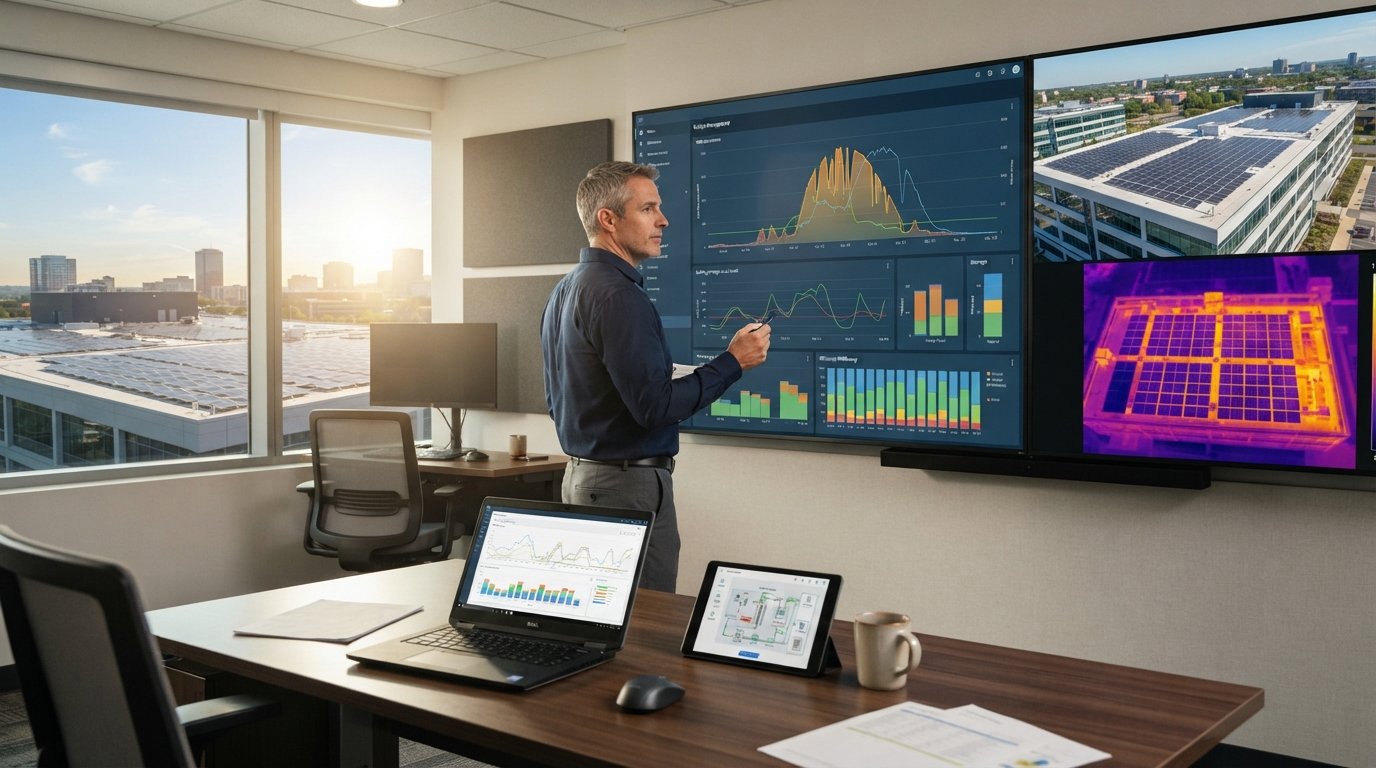
Electricity bills for commercial buildings often hide a costly secret: demand charges. These fees, based on your highest 15-minute peak of energy use, can account for 30 to 50 percent of a monthly bill. Solar panels alone reduce energy consumption, but they do not automatically shave peaks unless you pair them with intelligent building controls. That is where commercial solar systems building energy management integration (BEMS) becomes a game changer. By linking solar production data with your building's automation system, you can orchestrate HVAC, lighting, and heavy machinery to avoid demand spikes while maximizing self-consumed solar power. This guide explains how the integration works, the protocols involved, and the questions to ask before you sign an installation contract.
Why Solar Alone Is Not Enough for Demand Charge Reduction
Solar photovoltaic (PV) systems generate electricity during the day, but their output fluctuates with clouds and sun angle. Without coordination, a building's HVAC system might ramp up at the exact moment a cloud passes over, forcing the utility to supply the missing power and setting a new demand peak. Conversely, on sunny afternoons, excess solar production might be exported to the grid at low net-metering rates while the building still pays demand charges based on a morning peak. The solution is to make the building's loads follow solar production, not the other way around. That requires real-time communication between the solar inverters and the building energy management system (BEMS).
Building energy management systems are already common in commercial facilities. They control HVAC, lighting, and plug loads based on schedules, occupancy, and setpoints. When you integrate solar production data into the BEMS, the system can prioritize solar self-consumption and pre-cool or pre-heat spaces before a forecasted peak. In effect, the BEMS becomes the brain that uses solar as a variable energy source to trim demand charges. Without this integration, you are leaving significant savings on the table. According to the U.S. Department of Energy, demand charges can represent up to 50 percent of a commercial electricity bill, so even a modest reduction translates to thousands of dollars annually.
How Solar Inverters Communicate with BEMS: Modbus, BACnet, and APIs
The key to integration lies in the communication protocols supported by your solar inverters and your BEMS. Most commercial inverters offer at least one of three standard interfaces: Modbus, BACnet, or a RESTful API. Understanding these options will help you ask the right questions during the procurement process.
Modbus is a serial communication protocol widely used in industrial settings. Many string inverters and central inverters provide Modbus TCP or Modbus RTU ports that expose real-time data such as AC power output, DC voltage, temperature, and fault codes. A BEMS can poll these registers at regular intervals (e.g., every 5 seconds) to know exactly how much solar power is available. Modbus is reliable and inexpensive, but it requires a physical connection (RS-485) or a network gateway.
BACnet is the standard protocol for building automation and is natively supported by most BEMS. Some inverter manufacturers offer BACnet/IP gateways or built-in BACnet interfaces. This allows the BEMS to treat the solar system as just another device on the network, reading points like "PV Power Output" and writing setpoints if the inverter supports curtailment. BACnet integration is often simpler for facility managers because it uses the same network and tools as the rest of the building controls.
APIs (Application Programming Interfaces) are becoming more common with cloud-connected inverters. The inverter sends data to a manufacturer's cloud platform, and the BEMS can retrieve that data via a REST API. This approach avoids additional wiring, but it introduces latency (typically 1 to 5 minutes) and depends on internet connectivity. For demand charge management, sub-minute data is preferable, so APIs are better suited for forecasting and reporting than for real-time peak shaving. Some advanced inverters also support local APIs for direct integration.
When evaluating commercial solar panels for efficiency, check whether the inverter (often bundled with the panels) supports the protocol your BEMS uses. A high-efficiency panel is worthless for demand charge management if its inverter cannot talk to your automation system. Request the inverter's communication manual and verify that it exposes the data points you need: real-time AC power, energy production, and curtailment capability.
Using Solar Forecasting to Schedule HVAC and Heavy Loads
Beyond real-time data, the most sophisticated integration uses solar forecasting to plan the day's operations. Weather forecasts and satellite imagery can predict solar irradiance for the next 24 to 48 hours with reasonable accuracy. Your BEMS can ingest this forecast and automatically adjust HVAC schedules, battery charging, and industrial process loads.
For example, consider a big-box retail store with a 200 kW solar array. On a sunny day, the forecast predicts peak production between 11 a.m. and 3 p.m. The BEMS can pre-cool the store from 9 a.m. to 11 a.m. using grid power (when demand charges are lower) and then reduce HVAC output during the solar peak. This not only avoids a demand spike but also uses the solar energy directly for cooling. On a cloudy day, the BEMS might delay pre-cooling and instead rely on the solar forecast to decide when to start the HVAC system. Machine learning algorithms can refine these schedules over time based on actual building thermal behavior.
Another strategy involves shifting heavy loads like water heating, EV charging, or manufacturing equipment to coincide with solar production. The BEMS can send start signals to these loads when solar output exceeds a threshold. This is especially valuable for facilities with time-of-use rates, where solar generation during peak pricing periods offsets expensive grid power. The integration of solar forecasting and load scheduling is a core function of advanced BEMS platforms, and it delivers measurable savings without sacrificing comfort or productivity.
Demand Charge Reduction Strategies with Solar Plus BEMS
Demand charges are calculated based on the highest average power draw over a short interval (often 15 minutes) during the billing period. To reduce them, you need to predict and prevent peaks before they occur. Here are proven strategies that combine solar production with BEMS control:
- Peak shaving with solar and battery storage: If the building's load approaches a set threshold, the BEMS can discharge a battery or curtail non-essential loads. Solar production reduces the net draw from the grid, effectively lowering the peak. Without storage, the BEMS can still stagger HVAC compressors and turn off discretionary loads.
- Solar-aware load prioritization: The BEMS assigns priority levels to equipment. When solar production is high, it enables lower-priority loads (e.g., decorative fountains, EV chargers). When solar drops, it sheds those loads first. This prevents a sudden spike when a cloud passes and all equipment restarts simultaneously.
- Pre-cooling and pre-heating: Use the solar forecast to cool or heat the building before the solar peak, then coast through the peak with minimal HVAC. This shifts energy consumption to times when solar is abundant or grid prices are low.
- Dynamic demand response: Some utilities offer demand response programs that pay you to reduce load during grid emergencies. A BEMS integrated with solar can automatically respond by curtailing loads and relying on solar, earning additional revenue.
To implement these strategies, your BEMS must receive real-time solar production data and have control over the relevant loads. The integration also needs a fallback plan: if the solar inverter goes offline, the BEMS should revert to a safe schedule that avoids peaks. Regular testing and commissioning ensure that the system responds correctly under different scenarios. Facilities that have implemented solar plus BEMS integration report demand charge reductions of 10 to 30 percent, with payback periods often under three years.
Questions to Ask Installers About BEMS Compatibility Before Signing
Before you commit to a commercial solar installation, ask the installer detailed questions about BEMS integration. Many solar contractors focus on generation and may not have expertise in building automation. The following questions will separate the true integration specialists from the panel-only installers.
- Which communication protocols do the proposed inverters support? You need Modbus, BACnet, or a local API. If the installer cannot answer, look elsewhere.
- Can you provide a sample integration with my BEMS vendor? Ask for a reference project where the same BEMS platform was integrated with solar. This proves they have done it before.
- What data points will be exposed to the BEMS? You need at least real-time AC power, energy production, and curtailment control. Confirm that the inverter can be commanded to reduce output if needed.
- How will the system handle communication failures? A robust design includes heartbeat monitoring and fail-safe defaults. If the BEMS loses connection, the solar system should continue to operate safely, but load control should revert to a conservative schedule.
- Who is responsible for programming the BEMS? Solar installers typically do not program BEMS. You may need a separate controls contractor. Clarify the scope and cost upfront to avoid gaps.
- What cybersecurity measures are in place? Connecting solar inverters to your building network introduces risk. Ask about network segmentation, encryption, and access controls.
- Can you help with utility interconnection and net metering? Some utilities require specific settings for solar systems that interact with demand response programs. The installer should handle the paperwork.
If you are planning a move to a new facility while evaluating solar, resources like Moving.Homes relocation guides can help you plan the logistics of transferring operations. However, for the solar and BEMS integration itself, insist on a detailed commissioning plan that includes functional testing of all control sequences. A well-integrated system will pay dividends for decades, while a poorly integrated one may sit idle or cause operational headaches.
Real-World Example: Warehouse with 500 kW Solar and BEMS
Consider a distribution warehouse in Texas with a 500 kW rooftop solar array and a legacy BEMS controlling 20 rooftop units (RTUs). Before integration, the warehouse saw demand charges of $18,000 per month. The solar array reduced energy consumption by 30 percent, but demand charges remained high because the RTUs started simultaneously at 6 a.m., before solar production began. The facility manager worked with an integrator to connect the solar inverters via Modbus TCP to the BEMS. The BEMS was reprogrammed to stagger RTU starts over 30 minutes and to pre-cool the warehouse from 4 a.m. to 6 a.m. using grid power (off-peak). During the day, the BEMS monitors solar output and adjusts RTU setpoints upward by 2 degrees Fahrenheit when solar production exceeds 300 kW, reducing compressor load. After six months, demand charges dropped to $12,500 per month, a 30 percent reduction, while energy consumption fell by an additional 5 percent due to optimized scheduling. The integration cost $15,000 and paid back in under four months.
This example illustrates that the biggest savings often come from operational changes, not just hardware. The solar panels were already installed; the BEMS integration unlocked their full value. It also highlights the importance of commissioning: the initial programming had a bug that caused RTUs to restart after a cloud event, creating a new peak. The integrator fixed it by adding a 10-minute delay before restarting any RTU.
Key Takeaways for Facility Managers
Integrating commercial solar with your building energy management system is one of the highest-ROI investments you can make in your facility. It transforms solar from a passive energy source into an active tool for demand charge reduction. To succeed, focus on three pillars: communication (choose inverters with open protocols), control (give the BEMS authority to modulate loads), and commissioning (test every sequence under real conditions). Involve your BEMS vendor early, and do not accept a solar proposal that ignores integration. The savings from demand charge reduction often exceed the savings from energy production alone, and they continue for the life of the system.
As you evaluate quotes, remember that the cheapest solar installation may not be the most cost-effective. Ask potential installers about their experience with BEMS integration and request references. A slightly higher upfront cost for a fully integrated system will pay for itself many times over. With the right approach, your commercial solar system and BEMS will work together to cut costs, improve resilience, and support your sustainability goals.