
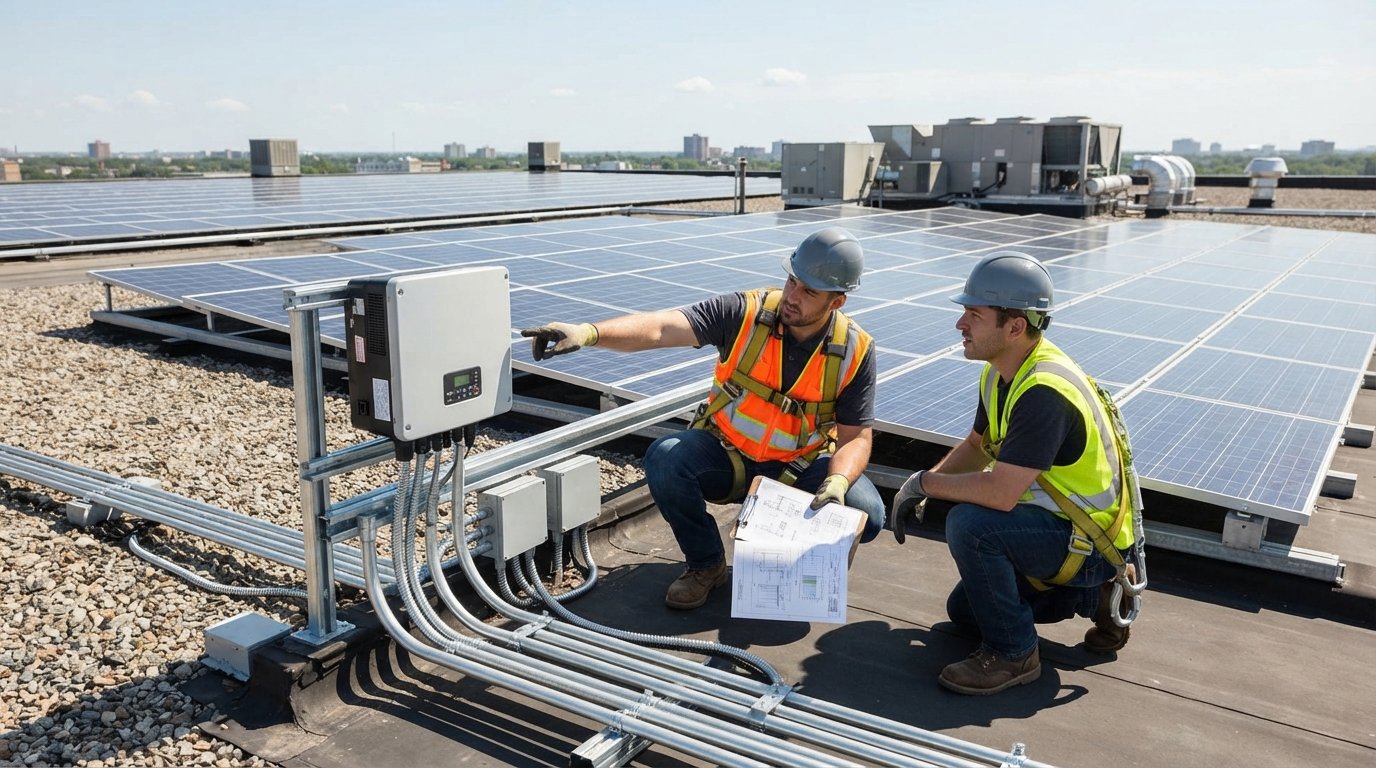
Commercial Solar Expansion Planning: Upgrades Done Right
Plan commercial solar expansion with confidence: assess inverter headroom, roof capacity, warranties, and interconnection rules. Call (833)-212-3715 for expert guidance.
By Scott Thompson
Learn more about Solar Panel Installation and Repair for guides, costs, and what to expect.
Compare Solar Panel Installation and Repair Pros Near You

Enter your ZIP code to compare top-rated local professionals and request free quotes.
Your business has outgrown its solar array. Maybe you added a second shift, installed EV chargers, or brought on new refrigeration equipment. The original system that once covered most of your load now falls short, and you are considering an expansion. Before you call an installer, understand this: expanding a commercial solar system is not simply adding more panels. It requires careful planning around inverter capacity, structural limits, electrical service upgrades, warranty preservation, and utility interconnection rules. A well-designed expansion can deliver decades of additional savings, while a poorly planned one can void warranties, trigger costly change orders, or leave you with a system that underperforms. This guide walks you through the critical planning steps for commercial solar system expansion planning upgrades so you can add capacity with confidence.
Why Expansion Planning Matters More Than the Panels Themselves
Commercial solar systems are engineered as integrated systems, not collections of independent parts. The inverter, wiring, racking, and utility interconnection were all sized for a specific DC and AC capacity. When you add panels without accounting for these interdependencies, you risk overloading the inverter, exceeding voltage limits, or violating your interconnection agreement. In many cases, the cheapest way to expand is not to add panels at all but to upgrade the inverter or rebalance the existing array. Planning ahead avoids these pitfalls and often reduces the total cost per kilowatt added.
Another reason planning is critical: incentives. Federal tax credits, state rebates, and utility programs often have capacity caps or require separate applications for expansions. If you phase your expansion incorrectly, you might lose eligibility for a grant or face a recapture of previously claimed credits. A solid expansion plan sequences the work so that each phase captures available incentives while maintaining compliance. For a detailed breakdown of current system costs and savings, see our guide on commercial solar system costs and savings in 2026.
Assessing Inverter Headroom and AC/DC Ratio
The inverter is the heart of your solar system, and its capacity often determines how much you can expand without major equipment replacement. Most commercial inverters are rated for a maximum DC input, and they operate most efficiently when the array's DC capacity is slightly higher than the inverter's AC rating, typically a DC/AC ratio of 1.1 to 1.3. If your existing inverter is already near its DC limit, adding panels will require a second inverter or a larger replacement.
Start by reviewing your inverter's specification sheet. Look for the maximum DC input power and the maximum DC input voltage. Then calculate the existing array's DC capacity. If you have headroom, you may be able to add panels without replacing the inverter. However, even with headroom, you must consider AC output clipping. Adding panels beyond the inverter's AC rating means some production will be clipped during peak sun hours. In many cases, slight clipping is acceptable and economically beneficial, but you should model the output to confirm.
If your inverter is undersized or at its limit, consider upgrading to a larger model or adding a second inverter in a parallel configuration. Keep in mind that inverters have a typical lifespan of 10 to 15 years, so if yours is approaching retirement, replacing it with a larger unit as part of the expansion can be more cost-effective than adding a separate inverter. A qualified solar designer can run a simulation to determine the optimal DC/AC ratio for your expansion goals.
Roof Structural and Electrical Service Capacity Checks
Before adding panels, you must verify that your roof can support the additional weight and that your electrical service can handle the extra power. Commercial roofs are often designed with a live load margin, but older buildings or roofs with existing equipment may be near their limit. A structural engineer should review the roof framing and calculate the additional load from the new panels, racking, and ballast. This is especially important for flat roofs where ballasted racking adds significant weight.
On the electrical side, check the capacity of your main service panel and any subpanels. The solar system's output must be connected to a breaker that does not exceed the panel's busbar rating minus the main breaker rating. If your service panel is already fully loaded, you may need a service upgrade, which can be a major expense. Alternatively, you can use a line-side tap or a separate meter to avoid upgrading the panel, but this depends on local codes and utility rules.
Here is a checklist of the key structural and electrical items to review before expanding:
- Roof framing and decking condition: confirm the roof can support additional live and dead loads, especially if the existing roof is nearing replacement age.
- Main service panel busbar rating and available breaker space: verify that the new solar breaker can be added without exceeding the 120 percent rule.
- Existing wiring and conduit capacity: ensure that conductors and conduit can handle the additional current or plan for new runs.
- Grounding and bonding: confirm that the existing grounding electrode system can accommodate the expanded array.
- Available space for additional inverters, disconnects, and combiners: plan for clearances and ventilation.
Addressing these items early prevents costly surprises during installation. If you are also planning a move or relocation, resources like Moving.Homes offer practical checklists that can help you coordinate facility changes alongside your energy upgrades.
Phasing Expansions Without Voiding Existing Warranties
Most commercial solar installations come with warranties covering panels, inverters, racking, and workmanship. These warranties often have conditions that require the system to be installed and maintained according to the manufacturer's specifications. Adding panels or modifying the system without approval can void coverage. To protect your investment, follow a phased approach that keeps the original system intact and adds new equipment as a clearly separate expansion.
One common strategy is to add a new inverter and a new array section that is electrically independent of the existing system. This keeps the original system's warranty intact and simplifies troubleshooting. If you must modify the existing array, such as reconfiguring strings to accommodate a new inverter, get written approval from the original installer and the equipment manufacturers. Some manufacturers offer extended warranties for expansions performed by certified installers, so choose an installer who is familiar with the original equipment.
Another consideration is the workmanship warranty. If the original installer is still in business, they may be the best choice for the expansion because they can maintain continuity. If not, hire a certified installer who can document the existing system and provide a new workmanship warranty for the expansion only. Always keep detailed records of the expansion, including as-built drawings and equipment serial numbers, to support future warranty claims.
Interconnection Rules for Expanding an Existing Commercial Array
Expanding a commercial solar system almost always triggers a new interconnection application with your utility. Most utilities require a new application whenever the system's capacity increases, even if the increase is small. The application process can take weeks or months, so plan ahead. You will need to provide updated single-line diagrams, equipment specifications, and proof of compliance with local codes.
Some utilities have simplified procedures for small expansions under a certain size (e.g., less than 10 kW or 20 kW). Others require a full study if the expansion pushes the system above a threshold, such as 1 MW. In areas with high solar penetration, the utility may impose limits on exports or require you to add storage to manage backfeed. Check your utility's interconnection manual and talk to their distributed generation team early in the planning process.
Net metering rules can also change with an expansion. If your original system was grandfathered under older, more favorable net metering rates, adding capacity might move you to a new tariff with lower compensation. In some states, you can expand up to a certain percentage (e.g., 10 percent) without losing grandfathered status. Verify these rules before you commit to a design. A solar professional can help you navigate the paperwork and avoid delays.
Financing and Incentives for Expansions
Financing a commercial solar expansion is similar to financing the original system, but there are a few nuances. The federal investment tax credit (ITC) is available for expansions, but the credit is based on the cost of the new equipment only. If you are adding panels to an existing system, you can claim the ITC on the incremental cost. However, the ITC begins to step down after 2026, so timing matters. Consult a tax advisor to confirm current rates.
State and local incentives may also apply. Some rebate programs have separate caps for expansions, and some utilities offer performance-based incentives for added capacity. If you are in a state with a renewable portfolio standard, you may be able to generate additional renewable energy credits (RECs) from the expansion. Be sure to factor in any changes to your property tax or insurance premiums; some jurisdictions offer property tax abatements for solar, but expansions may require a new application.
When comparing financing options, consider the payback period of the expansion separately from the original system. The expansion may have a different cost per watt due to economies of scale or new equipment. A cash purchase typically offers the best return, but if capital is tight, a solar loan or a power purchase agreement (PPA) can work. For businesses with a long time horizon, owning the expanded system maximizes savings.
Step-by-Step Expansion Planning Process
To keep your expansion on track, follow a structured planning process. This sequence helps you avoid costly mistakes and ensures that all stakeholders are aligned.
- Review your energy consumption data for the past 12 to 24 months and project future load growth. Identify the drivers, such as new equipment, EV charging, or extended hours.
- Audit the existing solar system: inverter capacity, DC/AC ratio, roof condition, electrical service, and warranty terms. Document everything.
- Engage a certified solar installer and a structural engineer to assess feasibility. Get a written report on structural and electrical capacity.
- Contact your utility to understand interconnection requirements and any capacity limits. Submit a preliminary application if required.
- Design the expansion with a clear phasing plan that protects warranties and maximizes incentives. Model the financial performance.
- Secure financing and approvals, then schedule installation during a low-production period to minimize downtime.
After installation, update your monitoring system to track the expanded array's performance separately. This helps you verify savings and identify any issues early. Keep all documentation, including permits, interconnection agreements, and warranty certificates, in a safe place.
Common Pitfalls to Avoid
Many businesses rush into expansion without considering the hidden costs. One common pitfall is ignoring the inverter's DC/AC ratio. Adding panels to an already maxed-out inverter leads to clipping and wasted production. Another is failing to check the roof's structural capacity, which can result in costly reinforcements or even roof failure. Electrical service upgrades can also blow the budget if not anticipated.
Warranty voidance is another risk. If you modify the existing system without manufacturer approval, you could lose coverage on the entire array, not just the new panels. Interconnection delays can also derail your timeline; utilities are often backlogged, so start the process early. Finally, don't overlook the impact on your net metering agreement. Moving to a less favorable tariff can reduce the payback of the expansion significantly. By addressing these pitfalls in the planning stage, you can avoid surprises and maximize the return on your investment.
Expanding a commercial solar system is a strategic investment that can lower operating costs and enhance sustainability. With careful planning around inverter capacity, structural limits, warranties, and interconnection rules, you can add capacity smoothly and cost-effectively. Start by assessing your current system, engage qualified professionals, and follow a phased approach. The effort you put into planning will pay off in reliable performance and long-term savings.
Learn more about Solar Panel Installation and Repair for guides, costs, and what to expect.
Compare Solar Panel Installation and Repair Pros Near You
Enter your ZIP code to compare top-rated local professionals and request free quotes.