
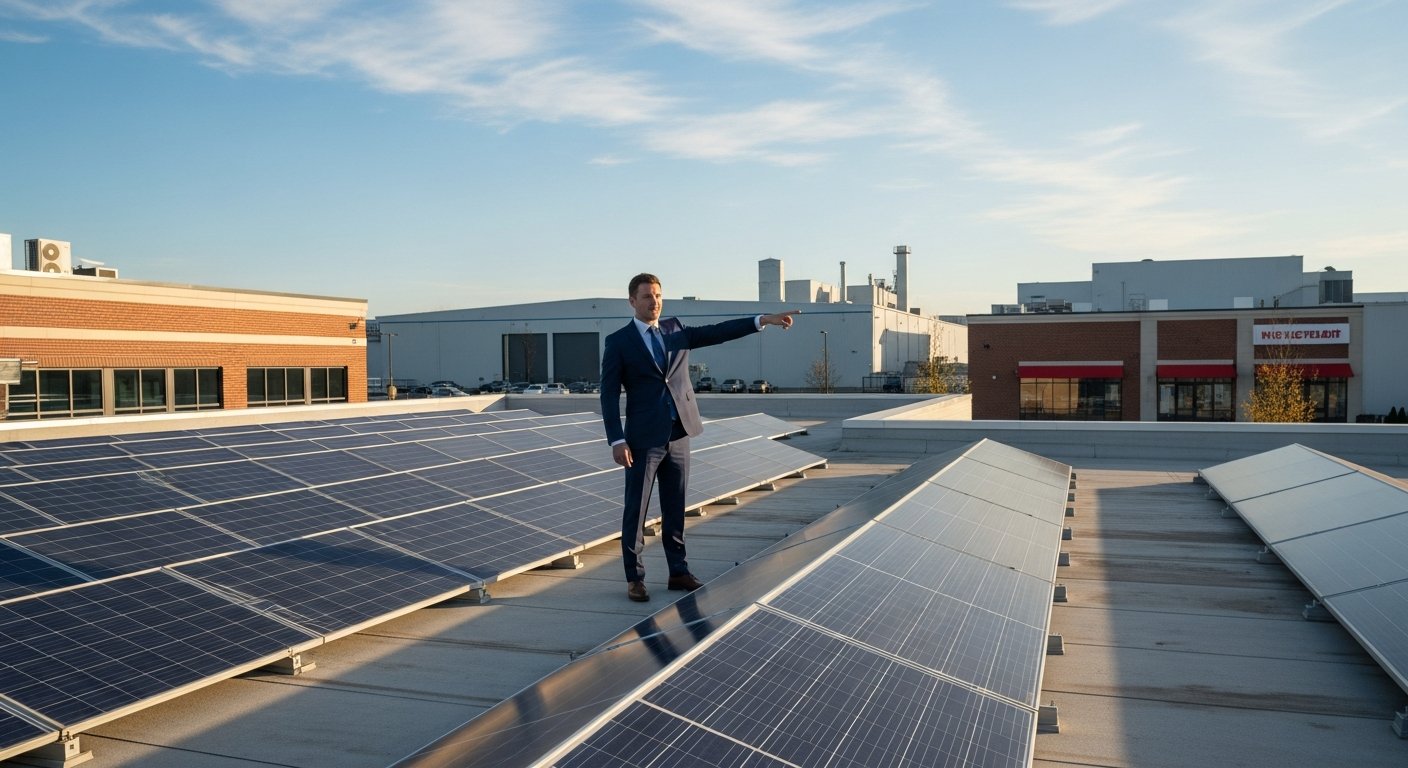
Commercial Solar Panels: A Guide to Business Energy Savings
Commercial solar panels can cut your business electricity bills by up to 75% while providing energy independence and federal tax credits.
By Scott Thompson
Learn more about Solar Panel Installation and Repair for guides, costs, and what to expect.
Compare Solar Panel Installation and Repair Pros Near You
Enter your ZIP code to compare top-rated local professionals and request free quotes.
For many business owners, the monthly electricity bill is a significant and often unpredictable expense. From manufacturing plants to retail storefronts, the cost of keeping the lights on, machines running, and climate control active can eat into profit margins year after year. Commercial solar panels offer a proven way to convert that ongoing operational cost into a predictable, long-term investment. By generating your own clean electricity, you can reduce your dependence on volatile utility rates, take advantage of generous federal tax incentives, and demonstrate a commitment to sustainability that resonates with customers and employees alike. The technology has matured, installation costs have fallen dramatically over the past decade, and financing options now make it possible for businesses of all sizes to go solar with little or no upfront capital.
Why Businesses Are Switching to Commercial Solar Panels
The decision to install commercial solar panels is rarely driven by a single factor. Instead, it is a combination of economic, operational, and strategic benefits that make solar energy an increasingly attractive choice for organizations across industries.
Cost reduction remains the primary motivator. Commercial electricity rates are often higher than residential rates, and businesses face demand charges that can add thousands of dollars to monthly bills. Solar panels generate power during peak sunlight hours, which typically coincides with a business's highest energy usage. This alignment allows companies to offset a large portion of their consumption, directly reducing the amount they owe to the utility. Over the 25- to 30-year lifespan of a commercial solar system, the cumulative savings can reach hundreds of thousands of dollars.
Beyond immediate savings, businesses also benefit from energy price stability. Utility rates have historically risen by 2% to 5% per year. By locking in a fixed or predictable energy cost through a solar power purchase agreement (PPA) or a system ownership model, businesses insulate themselves from future rate hikes. This predictability is valuable for budgeting and financial planning, especially for companies with tight margins.
Another key driver is the growing expectation from stakeholders that businesses operate sustainably. Corporate sustainability reports and environmental, social, and governance (ESG) goals often include targets for reducing carbon emissions. Installing commercial solar panels is one of the most visible and impactful steps a company can take. It reduces scope 2 greenhouse gas emissions directly and signals to customers, investors, and regulators that the organization is serious about its environmental commitments.
How Commercial Solar Panels Work
At a fundamental level, commercial solar systems operate the same way as residential systems, but they are scaled up to meet the higher energy demands of a business. Photovoltaic (PV) panels convert sunlight into direct current (DC) electricity. An inverter then converts that DC power into alternating current (AC) electricity, which is what your business uses to run equipment, lighting, and HVAC systems.
The key differences lie in the scale and design. Commercial systems are typically installed on large rooftop spaces, carports, or ground-mounted arrays. They often require more complex engineering to handle the structural load, electrical capacity, and interconnection requirements of a commercial facility. Additionally, commercial systems can incorporate advanced technologies like bifacial panels (which capture light on both sides) or trackers that follow the sun to maximize energy production.
Most commercial installations are also connected to the utility grid, allowing for net metering. When your system generates more electricity than your business uses, the excess is sent back to the grid, and you receive credits on your bill. These credits can be used to offset the power you consume at night or on cloudy days. Net metering policies vary by state and utility, but they are a critical component of the financial case for commercial solar.
The Financial Case for Commercial Solar
Understanding the return on investment (ROI) for commercial solar panels is essential before making a decision. The financial picture involves several key variables: system cost, available incentives, electricity rates, and the amount of sunlight your location receives.
The upfront cost of a commercial solar system can range from $100,000 to over $1 million, depending on the size and complexity. However, the effective cost is significantly reduced by the federal Investment Tax Credit (ITC), which currently allows businesses to deduct 30% of the system cost from their federal taxes. Additional state and local incentives can further lower the net price. For example, some states offer cash rebates, property tax exemptions, or sales tax exemptions for solar equipment.
Beyond the ITC, businesses can also accelerate depreciation of the solar asset using the Modified Accelerated Cost Recovery System (MACRS). This allows you to write off a large portion of the system's value in the first few years, creating substantial tax savings. When combined with the ITC, the effective after-tax cost of a commercial solar system can be reduced by 40% to 50% or more.
To help you evaluate the financial benefits, consider these key metrics:
- Payback period: The time it takes for cumulative savings to equal the net system cost. For commercial systems, payback periods typically range from 5 to 10 years.
- Internal rate of return (IRR): A measure of the project's profitability. Many commercial solar installations achieve IRRs of 8% to 15%, which is competitive with other capital investments.
- Cash flow from day one: With solar loans or PPAs, monthly payments can be lower than the utility bills they replace, meaning your business saves money immediately without a large upfront investment.
Financing options are plentiful. Businesses can purchase the system outright with cash, take out a commercial solar loan, enter into a solar lease, or sign a PPA. Each option has different implications for ownership, tax benefits, and cash flow. For organizations that cannot use the tax credits (e.g., non-profits or government entities), third-party ownership models like PPAs allow a developer to own the system and sell the power to you at a reduced rate.
Choosing the Right Commercial Solar System
Selecting the right equipment and design for your facility is crucial to maximizing energy production and savings. Not all commercial solar panels are created equal, and the best choice depends on your specific site conditions and energy goals.
The first decision is panel type. Monocrystalline panels are the most efficient and space-efficient, making them ideal for rooftops with limited area. Polycrystalline panels are slightly less efficient but lower in cost, suitable for ground-mounted systems where space is abundant. Thin-film panels are lightweight and flexible, often used on flat roofs where structural load is a concern.
Inverter technology is another important consideration. String inverters are the most common and cost-effective for commercial systems. Microinverters and power optimizers offer module-level monitoring and can improve performance if part of the array is shaded. For larger installations, central inverters or even string inverters with DC optimizers are typical.
The orientation and tilt of your panels will also affect output. Ideally, panels in the Northern Hemisphere should face south, at a tilt angle equal to your latitude. However, east- and west-facing arrays can still produce well and may better match the load profile of a business that operates in the morning and afternoon. Your installer will use site-specific modeling to design a system that optimizes production given your roof geometry and shading.
Battery storage is an optional but increasingly popular addition. Commercial batteries allow you to store excess solar power for use during peak demand periods or after the sun goes down. This can reduce or eliminate demand charges and provide backup power during grid outages. While batteries add to the upfront cost, falling prices and available incentives are making them more viable for commercial applications.
The Installation Process for Commercial Solar
Installing commercial solar panels is a multi-phase project that typically takes several months from initial consultation to grid connection. Understanding the steps can help you plan and set realistic expectations.
The process begins with a site assessment. Your installer will evaluate your roof condition, structural integrity, electrical panel capacity, and shading from nearby buildings or trees. They will also review your utility bills to understand your energy usage patterns. This data is used to size the system correctly, ensuring it meets your needs without overproducing.
Next comes system design and engineering. Your installer will create a detailed plan that includes panel layout, wiring diagrams, and electrical specifications. For larger systems, this may involve structural engineering reports and permit applications. Your local building department and utility company must approve the plan before installation can begin.
Installation itself typically takes one to three weeks, depending on system size and complexity. The crew will mount the racking system, install the panels, run conduit and wiring, and connect the inverter and electrical panel. For rooftop installations, careful attention to waterproofing and sealing is critical to avoid leaks. After installation, the system is inspected by the local building authority and your utility company. Once it passes inspection, the utility will install a net meter, and your system can begin generating power.
Throughout this process, your installer should provide clear communication and project milestones. Many companies now offer online portals where you can track the progress of your installation in real time.
State and Federal Incentives for Commercial Solar
The financial viability of commercial solar panels depends heavily on the incentives available at the federal, state, and local levels. As of 2025, the federal Investment Tax Credit (ITC) is at 30% for commercial systems placed in service before 2033. After that, the credit decreases to 26% in 2033 and 22% in 2034, before stepping down to a permanent 10% for commercial projects. Businesses should act quickly to lock in the higher credit.
In addition to the ITC, commercial solar systems can benefit from accelerated depreciation under MACRS. The Modified Accelerated Cost Recovery System allows you to depreciate 85% of the system's cost over six years (after accounting for the ITC). This depreciation deduction creates significant tax savings, especially for profitable businesses. Combined, the ITC and MACRS can reduce the effective cost of a commercial solar system by 40% to 60%.
State-level incentives vary widely, but many offer additional support. For example, New York, California, Massachusetts, and New Jersey have strong solar renewable energy certificate (SREC) markets, allowing you to sell the environmental attributes of your solar generation for extra income. Other states provide cash rebates per watt of installed capacity, property tax exemptions, or sales tax exemptions on solar equipment. It is essential to check with your state energy office or a qualified installer to identify all applicable incentives in your area.
Utility-specific programs also matter. Some utilities offer performance-based incentives that pay you for every kilowatt-hour your system produces, while others have demand response programs where you can earn payments for reducing your grid consumption during peak events.
How to Get Started with Commercial Solar
Beginning your commercial solar journey does not require an in-house energy expert. The first step is to gather your electricity bills and determine your annual consumption and peak demand. This information will help you and potential installers size a system that delivers maximum value.
Next, research local installers who specialize in commercial systems. Look for companies with a track record of successful commercial installations, proper licensing, and insurance. Ask for references and case studies from projects similar to yours in scope and industry. A reputable installer will conduct a thorough site visit and provide a detailed proposal, including estimated energy production, costs, savings, and payback period.
NewSolarQuotes simplifies this process by connecting you with up to four certified commercial solar installers in your area. Our platform is designed to save you time and ensure you receive competitive, transparent quotes from vetted professionals. We do not charge any fees for this service, and there is no obligation to proceed. Simply provide some basic information about your business and energy usage, and we will match you with installers who can meet your needs.
Once you receive proposals, compare them carefully. Pay attention to the equipment specifications, warranties, production guarantees, and financing options offered. A lower price does not always mean better value. Consider the installers reputation, customer support, and the quality of the components they propose. Your solar system will operate for decades, so choosing the right partner is critical.
Commercial solar panels represent a smart investment for businesses ready to take control of their energy future. The combination of falling hardware costs, generous incentives, and rising utility rates creates a compelling case for action. With the right financing and installation partner, your business can start saving money from the moment the system is switched on. To explore your options and get free, no-obligation quotes from trusted installers, visit NewSolarQuotes.com today and take the first step toward energy independence.
Learn more about Solar Panel Installation and Repair for guides, costs, and what to expect.
Compare Solar Panel Installation and Repair Pros Near You
Enter your ZIP code to compare top-rated local professionals and request free quotes.