
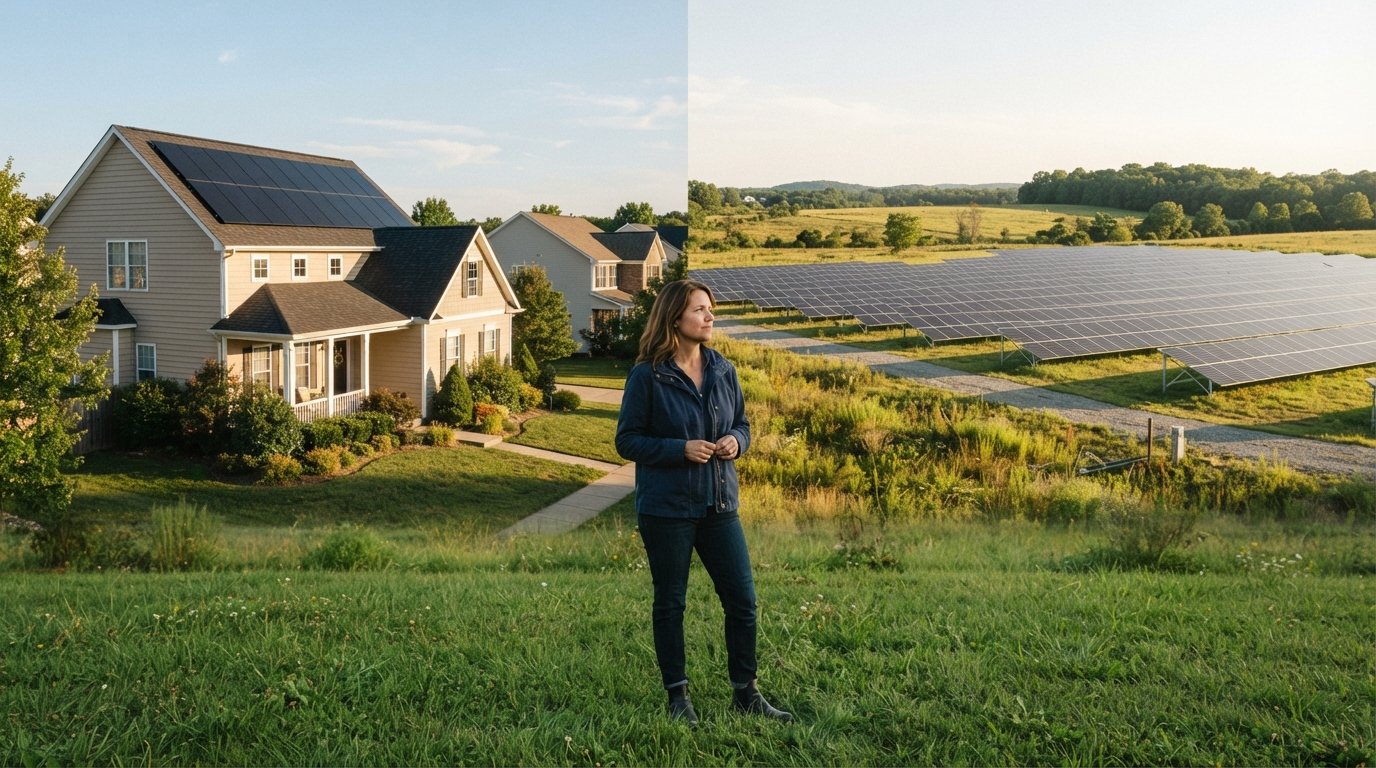
Community Solar Subscription vs Rooftop Ownership
Compare community solar subscription versus rooftop ownership, including $0 upfront options, long-term savings, contract traps, and which model fits your home.

By Benjamin Kalif
Learn more about Solar Panel Installation and Repair for guides, costs, and what to expect.
Compare Solar Panel Installation and Repair Pros Near You
Enter your ZIP code to compare top-rated local professionals and request free quotes.
Choosing how to go solar used to mean one thing: panels on your roof. Today, millions of Americans have a second option that requires no roof, no installation crew, and often no upfront cash. The community solar subscription versus rooftop ownership debate has become one of the most common questions homeowners ask before they commit to clean energy, and the answer depends on your roof, your budget, your credit, and how long you plan to stay in your home. This guide breaks down how each model works, what each one costs, who wins in which situation, and the fine print that catches some subscribers off guard.
How Rooftop Ownership Works
With rooftop ownership, you buy a solar panel system and it gets installed on your property. You own the equipment outright, either by paying cash or through a solar loan. The system generates electricity during daylight hours, your home uses that power first, and any excess flows back to the grid. Depending on your utility and state, you may earn credits for that exported power through net metering or a similar program.
The financial logic is simple: you replace a monthly utility bill with a smaller (or zero) electric bill, plus a loan payment if you financed the system. Once the loan is paid off, your electricity is essentially free for the remaining 15 to 20 years of the panels' useful life. You also qualify for the federal residential clean energy credit, which covers a percentage of your total system cost, and many states and utilities layer on rebates and property tax exemptions.
Ownership also comes with responsibilities. You are the one calling the installer if an inverter fails, monitoring production, and handling any roof work the panels require. The upside is control: you decide the equipment, you capture the full value of the incentives, and you keep every kilowatt-hour the system produces for decades. If you want to see how ownership numbers look on a real home, our guide on how rooftop solar panels cut bills walks through the math.
How Community Solar Subscriptions Work
A community solar subscription flips the model. Instead of putting panels on your roof, you subscribe to a share of a large solar farm built somewhere else in your utility territory, often on farmland, brownfields, or commercial rooftops. The farm generates electricity, and your utility credits your account for your portion of that production.
You then pay the solar developer for those credits, typically at a discount. If the farm produces $100 worth of electricity credits in a month, you might pay $90 for them. That 10 percent savings is the core selling point. Nothing gets installed on your property, so renters, condo owners, and homeowners with shaded or aging roofs can participate.
The trade-off is that you do not own anything. When the subscription term ends, your savings end. You also do not qualify for the federal tax credit, because you are not buying a system: the developer claims those incentives and passes a portion of the value to you as a discount. Cancellation terms vary widely, and some contracts include exit fees that make it expensive to leave early.
Cost and Savings: What Each Option Really Delivers
Rooftop ownership typically produces the largest lifetime savings because you capture 100 percent of the energy value plus every available incentive. A typical residential system might cost between $18,000 and $30,000 before incentives, and the federal credit plus state programs can shave thousands off that figure. Over 25 years, well-sited systems often save homeowners tens of thousands of dollars compared to continuing to buy power from the utility, though results vary by location, usage, and rate increases.
Community solar savings are smaller but far more predictable in the short term. Most subscriptions advertise 5 to 15 percent off the credited electricity, which for an average household might mean $50 to $150 per year in savings. That is real money, but it is not the wealth-building, bill-eliminating outcome that ownership can deliver. The table below summarizes the practical differences:
- Upfront cost: Rooftop ownership requires thousands in cash or a loan; community solar usually requires $0 down.
- Lifetime savings: Ownership is typically much higher; subscriptions deliver modest ongoing discounts.
- Tax credit access: Owners claim the federal credit directly; subscribers cannot.
- Property impact: Owned systems can raise home value; subscriptions do not affect your property.
- Flexibility: Subscriptions are easier to start but often harder to cancel; ownership is a long-term commitment but you control the asset.
If your goal is maximum financial return and you have a suitable roof, ownership almost always wins on pure economics. If your goal is to support clean energy with zero upfront cost and no installation hassle, a subscription can make sense. Homeowners who want to compare real quotes for their specific address can request free, no-obligation estimates through FreeSolarPowerQuotes to see what ownership would actually cost them.
Who Should Choose Rooftop Ownership
Ownership fits homeowners who plan to stay in their house for at least seven to ten years, have a roof in good condition with decent sun exposure, and can use the federal tax credit. It also suits anyone who wants to charge an electric vehicle at home, add battery storage later, or simply stop writing a check to the utility every month.
There is one more factor worth weighing: home value. Studies have consistently found that owned solar systems sell homes faster and at a premium in many markets, because buyers inherit a house with lower operating costs. That premium is not guaranteed, and appraisers do not always capture it perfectly, but it is a genuine advantage that subscriptions cannot match.
Before committing, get quotes from at least three installers, verify their licensing and insurance, and ask how they handle roof penetrations and workmanship warranties. A good installer will walk you through production estimates, degradation rates, and what happens if your usage changes.
Who Should Choose Community Solar
Community solar shines for people who cannot go the rooftop route. That includes renters, condo owners, people in apartments, and homeowners whose roofs are shaded, too old, or structurally unsuitable. It also appeals to anyone who wants to support renewable energy but cannot afford a five-figure system or does not want to take on debt.
If you fall into one of these groups, a subscription can deliver real, if modest, savings with almost no effort. The key is reading the contract carefully. Watch for these details before you sign:
- What is the discount rate, and is it fixed for the whole term or does it change?
- How long is the term, and what are the cancellation fees if you move or change your mind?
- What happens if the solar farm underproduces, do you still owe the same payment?
- Can you transfer the subscription to another address or another person?
Some states have strong consumer protections for community solar, and others are still catching up. Check your state's utility commission website or ask the developer directly for a plain-language summary of your obligations. If a salesperson pressures you to sign on the spot, that is a red flag.
The Fine Print That Trips People Up
Both models have traps. On the rooftop side, the biggest mistakes are buying from a high-pressure door-to-door salesperson, financing through a lender with hidden dealer fees, or installing panels on a roof that needs replacement within a few years. If your roof is near the end of its life, replace it first, because removing and reinstalling panels later is expensive.
On the community solar side, the most common complaints involve cancellation fees, savings that are smaller than advertised, and confusion about how credits appear on utility bills. Some subscribers expect their entire bill to shrink, but the credit only offsets the supply portion of the bill in many programs. The delivery and fixed charges remain.
One more consideration: portability. If you sell your home and move outside the solar farm's service territory, you may not be able to take the subscription with you. Rooftop panels, by contrast, stay with the house and transfer to the new owner, which is part of why they can command a price premium.
A Simple Framework for Deciding
Start by answering four questions. Do you own your home and plan to stay put for several years? Is your roof sunny, in good shape, and large enough? Can you use the federal tax credit and handle a loan or cash purchase? Do you want the lowest possible long-term cost, or the lowest possible hassle and upfront cost?
If you answered yes to the first three and want maximum savings, rooftop ownership is likely your better path. If you rent, have a problematic roof, or simply want to start with zero dollars down and no installation, a community solar subscription is a reasonable entry point. Neither choice is permanent: you can subscribe now and buy a system later when your situation changes.
Whichever route you take, get the numbers in writing before you commit. Compare at least two or three options, ask about fees and exit terms, and verify current incentives with your state energy office, because programs change every year. Clean energy works best when you understand exactly what you are signing up for.
For homeowners ready to explore ownership, the next step is simple: gather a few quotes, review production estimates side by side, and see whether the numbers beat your utility's rates. Then decide whether the long-term payoff of ownership or the low-commitment convenience of a subscription fits your life right now.