
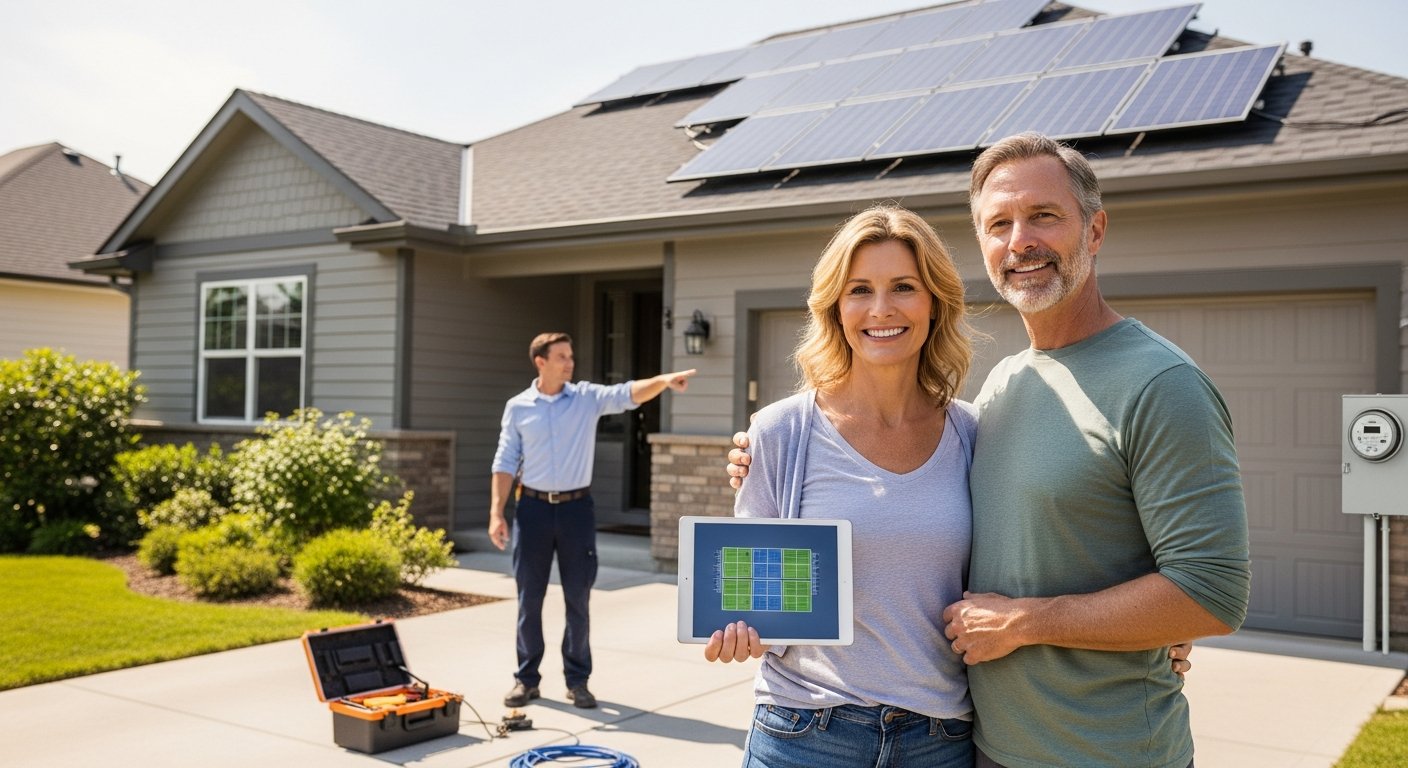
Home Solar Cost in 2026: Full Pricing Breakdown
Discover what really drives home solar cost in 2026, including hidden fees, financing options, and state incentives. Get accurate quotes and save.
By Scott Thompson
Learn more about Solar Panel Installation and Repair for guides, costs, and what to expect.
Compare Solar Panel Installation and Repair Pros Near You
Enter your ZIP code to compare top-rated local professionals and request free quotes.
If you have been putting off solar panels because you assume they are too expensive, you are not alone. The sticker shock of a full installation is the number one reason homeowners hesitate. But the home solar cost story has changed dramatically in the last few years. Equipment prices have fallen, financing has become more flexible, and federal tax credits still reduce your net investment by 30 percent. The real question is not whether you can afford solar, it is whether you can afford to keep paying your utility company instead.
In this guide, you will learn exactly what affects the price of a residential solar system, how to estimate your own home solar cost, and how to compare quotes with confidence. We will also walk through the hidden costs that many homeowners miss, plus the financing options that can bring your upfront payment down to zero. By the end, you will know how to get the best value for your budget and your home.
What Drives the Home Solar Cost in 2026?
Solar pricing is not a single number. It depends on your location, your roof, your energy usage, and the equipment you choose. The national average for a residential system is around $2.80 per watt before incentives, which means a typical 6 kilowatt (kW) system costs roughly $16,800 before the federal tax credit. After the 30 percent credit, that same system lands near $11,760. However, these are national averages. Your actual quote could be higher or lower depending on several key factors.
Here are the main drivers of your home solar cost:
- System size: Larger systems cost more upfront but produce more electricity, so your payback period often stays similar.
- Equipment quality: Premium panels and microinverters cost more but offer better efficiency and longer warranties.
- Roof complexity: A steep roof, multiple stories, or unusual angles increase labor time and safety equipment costs.
- Local labor rates: Solar installers in high-wage areas charge more per hour, which raises the total price.
- Permitting and inspection fees: Some cities charge hundreds of dollars for permits, and others require engineering stamps.
- Battery storage: Adding a battery can add $10,000 or more, but it provides backup power and maximizes your savings with time-of-use rates.
Your energy consumption is the starting point for any solar quote. A home that uses 800 kWh per month will need a smaller system than one using 1,500 kWh. Your installer will analyze your past utility bills to size the system correctly. If you plan to buy an electric vehicle or switch to a heat pump, you should tell your installer now, because those additions will increase your future electricity needs and may justify a larger system.
Average Home Solar Cost by System Size
To give you a clearer picture, here are typical price ranges for common system sizes in the United States. These figures assume a standard roof with no major complications and use the national average of $2.80 per watt before incentives.
- 4 kW system: $11,200 before credit, $7,840 after
- 6 kW system: $16,800 before credit, $11,760 after
- 8 kW system: $22,400 before credit, $15,680 after
- 10 kW system: $28,000 before credit, $19,600 after
These numbers are useful for a rough budget, but your final quote will depend on your specific situation. For example, a home in California with high electricity rates might choose a larger system to offset more usage, while a home in a state with low rates might install a smaller system to cover just the baseline load. The key is to size your system based on your needs, not just the price per watt.
You should also know that the federal Investment Tax Credit (ITC) applies to the full installed cost, including labor, permits, and equipment. This credit is a dollar-for-dollar reduction of your federal income tax, not a deduction. If you owe less tax than the credit amount, you can carry the remaining balance forward to future tax years. That flexibility makes solar more accessible for households with moderate tax liability.
Hidden Costs and Fees You Should Expect
Many homeowners compare quotes based only on the equipment price and forget to ask about additional fees. These hidden costs can add up quickly, so it is important to ask each installer for a detailed line-item quote. Some common fees include:
- Permit fees: Usually $150 to $500, depending on your city or county.
- Interconnection fees: Your utility may charge a fee to connect your system to the grid, typically $50 to $200.
- Structural upgrades: If your roof needs reinforcement or a new layer of shingles, that adds $1,000 to $3,000.
- Electrical panel upgrades: Older homes often need a 200-amp panel, which can cost $1,500 to $3,000.
- Tree trimming or removal: If trees shade your roof, you may need to clear them, which can cost several hundred dollars.
- Monitoring subscription: Some installers charge a monthly fee for system monitoring, though many now include it free for the first year.
Do not let these fees scare you. Many are one-time costs that are factored into your overall return on investment. For example, if you need a panel upgrade, that added expense will be offset by your long-term energy savings. The important thing is to get a complete estimate so you can compare apples to apples.
When you receive quotes, ask each installer to provide a breakdown of equipment, labor, permits, and any additional line items. A reputable company will be transparent about all costs. If one quote is dramatically lower than others, ask why. It may be using cheaper equipment or skipping important steps like a proper site assessment.
Financing Options to Reduce Your Upfront Payment
One of the biggest misconceptions is that you need to pay for solar in cash. In reality, most homeowners finance their systems through a solar loan, a lease, or a power purchase agreement (PPA). Each option has its own advantages and trade-offs.
Solar Loans
Solar loans let you own the system while spreading payments over 10, 15, or 20 years. Many lenders offer $0 down loans, meaning you can start saving from day one. Your monthly loan payment is usually less than your previous electric bill, so you see positive cash flow immediately. The interest rates vary, but most solar loans range from 4 to 8 percent APR. Ownership also qualifies you for the federal tax credit, which you can use to pay down the principal early.
Leases and PPAs
With a lease or PPA, you do not own the system. Instead, you pay a fixed monthly amount or a per-kWh rate for the electricity it produces. The installer handles maintenance and repairs, which can be appealing if you want a hands-off experience. However, you do not receive the tax credit, and you may have a harder time selling your home with a leased system. Some buyers are willing to take over the lease, but others prefer a home with owned solar.
Cash Purchase
Paying cash gives you the best long-term return because you avoid interest and finance fees. You also have the freedom to choose any installer, and you can claim the tax credit in the first year. The downside is the large upfront cost, which is not feasible for every household. If you have cash reserves, this is often the most profitable route, with typical payback periods of 6 to 10 years.
How to Get an Accurate Quote for Your Home
The most reliable way to know your home solar cost is to request multiple quotes from certified installers. You can use NewSolarQuotes to get competitive quotes from vetted professionals in your area. This service is free and does not obligate you to make a purchase. You will receive detailed proposals that include system size, equipment brand, estimated production, and total cost.
Before you request quotes, gather your electricity bills from the last 12 months. This gives installers the data they need to size your system accurately. Also, note any planned changes to your energy usage, such as adding an EV charger or a swim spa. The more information you provide, the more accurate your quotes will be.
When you compare quotes, do not focus only on the price per watt. Look at the total cost, the equipment warranty, the workmanship warranty, and the company's reputation. A slightly higher quote may be worth it if it includes better panels, a longer warranty, or a more experienced installation crew.
State Incentives and Rebates That Lower Your Cost
In addition to the federal tax credit, many states, utilities, and local governments offer incentives that directly reduce your home solar cost. These can include cash rebates, performance-based incentives, and property tax exemptions. For example, some states offer a one-time rebate of $1,000 or more for installing solar, while others allow you to exclude the added home value from property taxes.
Net metering is another powerful incentive. With net metering, your utility credits you for the excess electricity your panels produce, often at the retail rate. This dramatically improves the economics of solar because you can effectively use the grid as a battery. Some states have moved to net billing or avoided-cost rates, which are less generous, but solar can still be a smart investment depending on your utility rates.
To find incentives in your state, check the Database of State Incentives for Renewables and Efficiency (DSIRE) or ask your installer. Your installer should be familiar with local programs and will help you apply for any rebates you qualify for. Be sure to ask about time-sensitive incentives that may expire soon.
Is Solar Worth It for Your Home?
Solar is not a one-size-fits-all solution. In some areas, the combination of high electricity rates, strong sun exposure, and generous incentives makes solar an excellent financial move. In other regions, the payback period may be longer, but you still benefit from energy independence and a lower carbon footprint. The best way to decide is to calculate your break-even point.
To estimate your payback period, divide your net system cost (after incentives) by your annual electricity savings. For example, if your net cost is $12,000 and you save $1,500 per year, your payback period is about 8 years. Since solar panels last 25 to 30 years, you could enjoy 17 to 22 years of free electricity after you break even. That is a strong return on investment.
Additionally, solar panels increase your home's resale value. Studies have shown that homes with solar sell for a premium, often around $15,000 more than comparable homes without solar. This makes solar an attractive upgrade if you plan to sell in the future. The key is to ensure the system is owned, not leased, because owned systems are more attractive to buyers.
Final Thoughts on Home Solar Cost
Understanding home solar cost is the first step toward making an informed decision. The price has never been more affordable, and the available incentives can significantly reduce your net investment. Whether you choose to buy, finance, or lease, the most important thing is to get multiple quotes and compare them carefully. Use a trusted source like NewSolarQuotes to connect with certified installers who can provide accurate, competitive bids.
Take the time to review your energy usage, your roof's suitability, and your financial goals. Solar is a long-term investment, but for many homeowners, the savings, the increased property value, and the peace of mind are well worth it. Start by requesting quotes today and see what the numbers look like for your home. You might be surprised at how accessible solar has become.
Learn more about Solar Panel Installation and Repair for guides, costs, and what to expect.
Compare Solar Panel Installation and Repair Pros Near You
Enter your ZIP code to compare top-rated local professionals and request free quotes.