
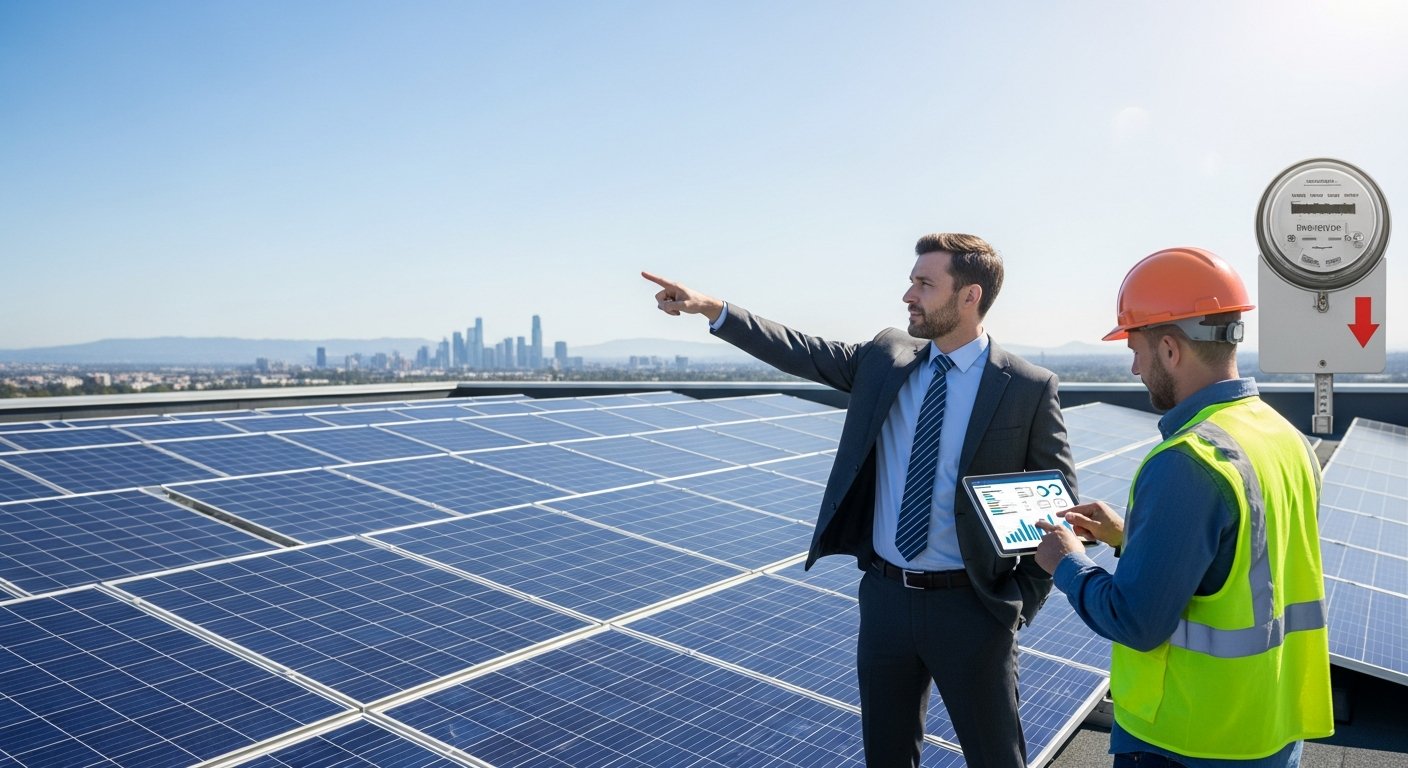
How Commercial Solar Installation Saves Your Business Money
Commercial solar installation can cut your business's energy bills by up to 30% and provide a strong return on investment.
By Scott Thompson
Learn more about Solar Panel Installation and Repair for guides, costs, and what to expect.
Compare Solar Panel Installation and Repair Pros Near You
Enter your ZIP code to compare top-rated local professionals and request free quotes.
Rising electricity costs are squeezing profit margins for businesses of all sizes. Every dollar spent on utility bills is a dollar that could go toward expansion, hiring, or improving operations. Commercial solar installation offers a proven way to take control of those costs, turning a fixed overhead into a predictable, long-term investment. By generating your own power, you insulate your business from rate hikes and create a new asset that appreciates over time. This guide walks you through the financial, technical, and practical aspects of going solar, so you can make an informed decision that strengthens your bottom line.
Why Commercial Solar Installation Makes Financial Sense
Switching to solar is not just an environmental statement; it is a strategic financial move. The upfront cost of a commercial solar system is offset by decades of reduced electricity bills, often with payback periods of five to seven years. After that, the electricity your system generates is essentially free, aside from minimal maintenance. The federal Investment Tax Credit (ITC) allows you to deduct 30% of the installation cost from your federal taxes, significantly lowering the net investment. Many states also offer additional incentives, such as renewable energy certificates (RECs) or property tax exemptions for solar equipment.
Depreciation further sweetens the deal. Under the Modified Accelerated Cost Recovery System (MACRS), commercial solar systems can be depreciated over five years, accelerating tax savings. Combined with the ITC, these incentives can reduce the effective cost of a system by 50% or more. For businesses that pay taxes, this creates a powerful cash flow advantage. Additionally, solar systems increase property value and can make your facility more attractive to eco-conscious tenants or customers.
Key Components of a Commercial Solar System
Understanding the hardware is essential for evaluating quotes and ensuring quality. A commercial solar installation typically includes several core components, each playing a critical role in system performance and longevity.
Solar panels are the most visible part. Commercial panels are often more robust and efficient than residential models, with higher wattage ratings. Monocrystalline panels are popular for their efficiency, while polycrystalline panels offer lower cost per watt. Bifacial panels, which capture sunlight on both sides, are gaining traction for ground-mounted or flat-roof systems where reflected light is available.
Inverters convert the direct current (DC) electricity generated by panels into alternating current (AC) used by your facility. String inverters are cost-effective for uniform roof layouts, while microinverters or power optimizers provide per-panel monitoring and are ideal for roofs with shading or varying orientations. For large installations, central inverters or multi-string configurations are common.
Mounting systems secure panels to the roof or ground. Ballasted mounts are popular for flat roofs to avoid penetrations, while pitched roofs use rail-based attachments. Ground-mounted systems require land but allow optimal tilt and orientation. Monitoring software tracks energy production in real time, alerting you to underperformance. Battery storage is an optional add-on that stores excess energy for use during outages or peak demand periods, enhancing energy independence.
The Commercial Solar Installation Process
Installing a commercial solar system involves several distinct stages. Following a structured process ensures a smooth transition and maximizes long-term returns.
- Site Assessment and Energy Audit , A qualified installer evaluates your roof condition, shading, structural integrity, and electrical infrastructure. They also analyze your historical energy usage to size the system appropriately.
- System Design and Engineering , Based on the assessment, engineers create a custom layout, select equipment, and model expected production. Permitting documents are prepared for local building and electrical departments.
- Permitting and Approvals , The installer submits plans to your city or county and utility company. This step can take several weeks, depending on local regulations. Interconnection agreements with the utility are also secured.
- Installation , Crews mount racking, install panels, run wiring, and set up inverters and monitoring. For a typical commercial system, installation takes one to three weeks, depending on size and complexity.
- Inspection and Commissioning , Local inspectors verify the system meets code, and the utility conducts a final review. Once approved, the system is turned on and begins producing power.
- Ongoing Monitoring and Maintenance , After commissioning, continuous monitoring ensures optimal performance. Routine cleaning and annual inspections keep the system running efficiently for 25 years or more.
Each step is managed by your installer, allowing you to focus on core business operations. Reputable companies handle all paperwork and coordinate with utilities, simplifying the experience for you.
Financing Options for Commercial Solar
The cost of a commercial solar installation can range from tens of thousands to several million dollars, depending on size and complexity. Fortunately, multiple financing paths make solar accessible for businesses with varying capital situations.
Before exploring options, consider the following key factors: your tax appetite, cash flow, and long-term ownership goals. Each option has trade-offs between upfront cost, monthly payments, and total savings over the system's life.
- Cash Purchase , Paying upfront gives you full ownership and the highest long-term savings. You capture all incentives and depreciation benefits. Best for businesses with strong cash reserves and a desire to maximize ROI.
- Solar Loans , Many lenders offer loans specifically for solar installations. You own the system and can use the tax incentives to accelerate repayment. Monthly payments are often lower than your previous utility bills, creating positive cash flow from day one.
- Solar Lease , You pay a fixed monthly fee to use the system, while the leasing company owns it and claims the tax credits. Leases offer zero upfront cost but lower long-term savings compared to ownership.
- Power Purchase Agreement (PPA) , Under a PPA, a third party installs and owns the system, and you buy the electricity it generates at a reduced rate per kilowatt-hour (kWh). This eliminates upfront costs and maintenance responsibilities, but you do not benefit from incentives.
Choosing the right financing depends on your specific tax situation and financial goals. Many businesses find that a loan or cash purchase provides the best balance of savings and control. Consulting with a financial advisor or your installer can help you model the numbers for your unique scenario.
Choosing the Right Commercial Solar Installer
The quality of your installer directly affects system performance, reliability, and savings. A poorly installed system can underperform, require costly repairs, or violate warranty terms. When evaluating potential partners, consider the following criteria.
First, verify that the company holds relevant licenses and certifications. Look for North American Board of Certified Energy Practitioners (NABCEP) certification, which demonstrates advanced technical knowledge. Also check that they carry general liability and workers' compensation insurance. Ask for commercial installation references and call them to discuss their experience. Inquire about the installer's warranty offerings. Typical equipment warranties cover panels for 25 years and inverters for 10 to 15 years. Workmanship warranties should cover installation defects for at least five years, ideally ten.
Request multiple detailed proposals that include equipment specifications, estimated annual production, system price, financing options, and projected savings. Compare not just the price per watt but also the quality of components and the installer's reputation. Avoid companies that pressure you into signing same-day contracts or demand large deposits before design work is complete. A trustworthy installer will take the time to educate you and answer all your questions.
Finally, consider whether the installer offers ongoing monitoring and maintenance services. Some companies provide remote monitoring and annual checkups as part of their standard package, while others charge separately. Having a single point of contact for maintenance helps ensure your system continues performing at peak efficiency.
Making the switch to commercial solar is a major decision, but the long-term benefits are clear. Lower operating costs, predictable energy expenses, and attractive tax incentives create a compelling business case. By understanding the process, components, financing, and installer selection, you are well equipped to move forward with confidence.
NewSolarQuotes can help you compare quotes from certified commercial solar installers in your area. Start your journey today by requesting free, no-obligation proposals tailored to your facility's needs and goals.