
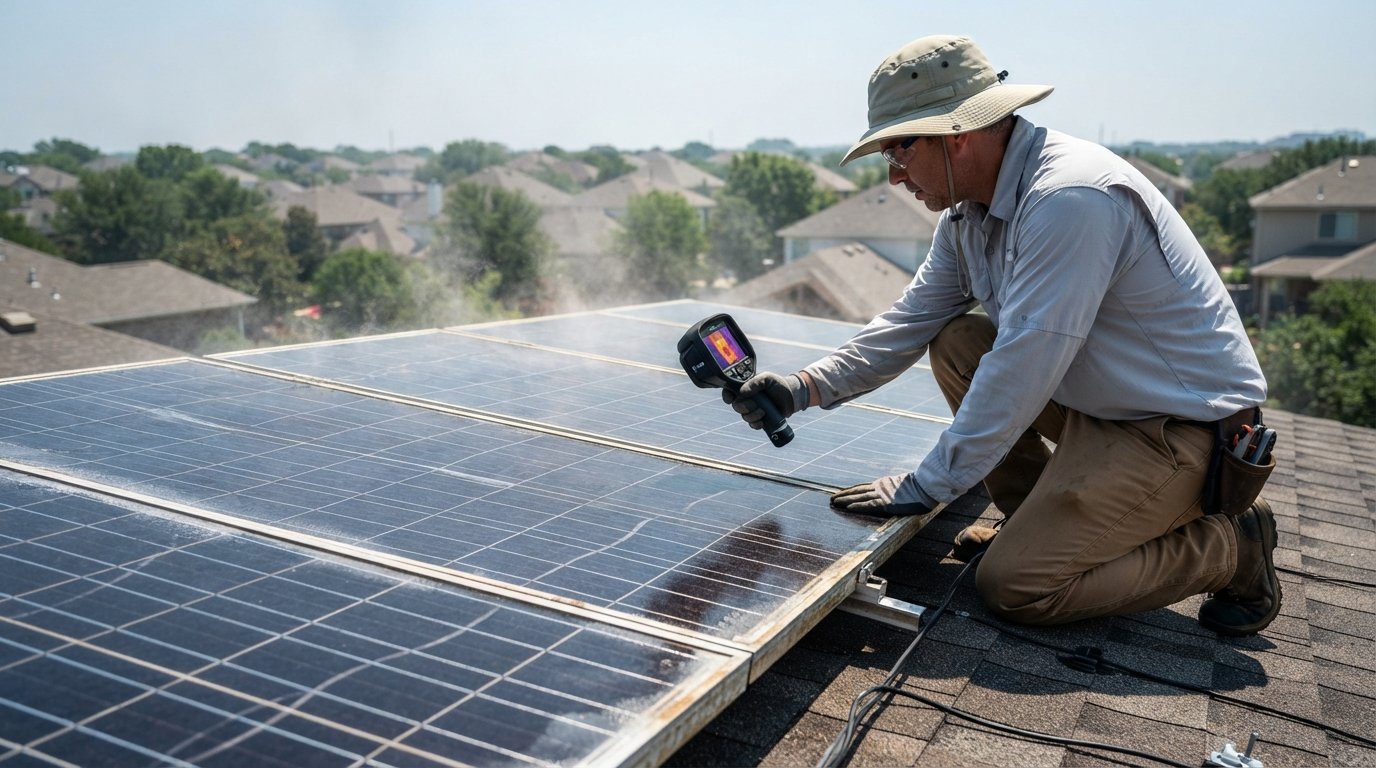
How Solar Panels Perform in Extreme Heat and Humidity
Heat and humidity shift solar output and durability. Learn how panels perform and protect your investment. Call (833)-212-3715 for expert guidance.

By Caleb Hayes
Learn more about Solar Panel Installation and Repair for guides, costs, and what to expect.
Compare Solar Panel Installation and Repair Pros Near You

Enter your ZIP code to compare top-rated local professionals and request free quotes.
Solar panels are built to thrive in sunlight, but extreme heat and humidity test their limits in ways that many homeowners do not anticipate. If you live in a region where summer temperatures routinely climb past 95 F and the air feels like a warm sponge, you need to understand how those conditions affect power output, long-term durability, and the real return on your investment. The good news is that modern solar technology handles heat and moisture far better than early systems did, but performance does shift, and smart buyers plan for it.
This guide breaks down how solar panels perform in extreme heat and humidity, from the physics of temperature coefficients to the practical maintenance habits that protect your system in humid climates. You will see real output examples, learn why hot-climate panel selection differs from cold-climate buying, and discover the mounting and ventilation strategies that keep heat losses in check. By the end, you will know exactly what to expect and how to maximize production even when the weather works against you.
How Heat Affects Solar Panel Output: The Temperature Coefficient Explained
Solar panels are rated under standard test conditions: 25 C (77 F) cell temperature, 1,000 watts per square meter of sunlight, and an air mass of 1.5. In the real world, a panel sitting on a roof in Houston or Phoenix can easily reach 140 F to 160 F on a summer afternoon. That heat matters because photovoltaic cells become slightly less efficient as they warm up. The metric that captures this is the temperature coefficient of power, usually expressed as a negative percentage per degree Celsius.
Most residential panels today have a temperature coefficient between -0.30% and -0.45% per degree C. A premium panel at -0.30% loses about 0.30% of its rated power for every degree Celsius above 25 C. A budget panel at -0.45% loses more. The difference sounds small, but it compounds quickly in hot climates. If your panel reaches 65 C (about 149 F) on a hot roof, that is 40 C above the standard test condition. At -0.35% per degree C, you lose roughly 14% of rated output. At -0.45%, you lose 18%. Over a 6 kW system, that is a difference of about 240 watts during peak heat, which adds up over a 25-year lifespan.
Here is a concrete example. Suppose you install two systems in Phoenix: System A uses panels with a -0.30% coefficient, and System B uses panels with a -0.45% coefficient. Both are 6 kW arrays. On a 105 F day with rooftop cell temperatures around 65 C, System A produces about 5.16 kW at peak, while System B produces about 4.92 kW. That 240-watt gap may not sound dramatic on any single day, but across hundreds of hot afternoons each year, it translates into meaningful lost production and lower savings. For homeowners comparing quotes, the temperature coefficient is one of the most overlooked specs, and it deserves a place alongside wattage and warranty terms.
It is also worth noting that heat losses are not linear throughout the day. Early morning and late afternoon production often happens at cooler cell temperatures, so the system may perform close to its rated output during those windows. The biggest losses occur during the middle of the day when irradiance is strongest and cell temperatures peak. This is why some installers recommend slightly oversized arrays or higher-efficiency panels in hot climates: the extra capacity compensates for heat-driven losses during the hours when production matters most.
Humidity, Corrosion, and Connector Degradation Risks
Humidity introduces a different set of challenges. Water vapor itself does not directly reduce panel output the way heat does, but sustained moisture accelerates wear on the components that hold a system together. The most vulnerable areas are the junction box, the connectors (often called MC4 connectors), the frame edges, and the mounting hardware. In humid regions, condensation can form inside junction boxes when temperatures swing between day and night. Over time, that moisture can corrode solder joints and create resistance that reduces performance or causes intermittent faults.
Connector degradation is a particular concern. MC4 connectors are designed to be watertight, but they rely on proper crimping and mating. In humid climates, a poorly seated connector can allow moisture intrusion, leading to corrosion of the metal contacts. That corrosion raises resistance, which not only reduces power but can also generate heat at the connection point. In extreme cases, this is one of the pathways that can lead to electrical arcing or fire risk. If you want to understand the fire-safety side of heat and moisture, our guide on whether solar panels can catch fire in extreme heat explains the mechanisms and prevention steps in detail.
Salt air in coastal humid regions adds another layer of risk. Salt spray deposits on panels and hardware can accelerate corrosion of aluminum frames and steel mounting brackets. Even inland humidity can cause galvanic corrosion where dissimilar metals meet, such as stainless steel bolts threaded into aluminum rails. The best defense is to specify corrosion-resistant hardware (stainless steel or anodized aluminum), ensure connectors are properly crimped and sealed, and schedule periodic inspections that look for discoloration, loose connections, or water intrusion. In humid climates, a professional inspection every two to three years is a wise investment.
Humidity also affects soiling and cleaning. In humid areas, dust and pollen can combine with moisture to form a stubborn film on the glass. That film reduces light transmission and can create hotspots if it accumulates unevenly. Regular cleaning, especially after pollen season or in regions with frequent dew, helps maintain output and prevents long-term staining. Do not underestimate the value of a simple rinse and squeegee: in humid climates, clean panels can outperform dirty ones by 5% to 10% during the summer months.
Mounting Clearance and Ventilation That Reduce Heat Losses
How a system is mounted has a direct impact on cell temperature. Panels mounted flush against a roof surface trap heat, while panels raised on standoffs allow air to circulate behind them and carry heat away. The difference can be significant: a well-ventilated array may run 10 C to 15 C cooler than a flush-mounted array on the same roof. That translates to 3% to 5% more output during peak heat, which is meaningful over the life of the system.
Several mounting strategies help in hot climates. First, use mounting hardware that provides at least 4 to 6 inches of clearance between the panel backsheet and the roof surface. Second, avoid dense clustering of panels that blocks cross-ventilation. Third, consider a ground-mount or a shade structure if roof space allows, since ground-mounted systems can be tilted for better airflow and are easier to inspect. Fourth, if you have a flat roof, use tilted racking rather than flush mounting to promote convection. Finally, ensure the roof itself is light-colored or reflective if possible, since a cooler roof surface reduces the ambient heat load on the array.
Ventilation also matters for the inverter and wiring. Inverters mounted in direct sun or in a closed garage can derate (reduce output) when they get too hot. In humid climates, mounting inverters in a shaded, ventilated location protects them from both heat and moisture. Similarly, conduit and wiring should be routed to avoid standing water and to allow drainage. These details may seem minor, but they are the difference between a system that performs reliably for 25 years and one that suffers premature failures.
Why Hot-Climate Panel Selection Differs from Cold-Climate Buying
In cold climates, buyers often prioritize snow-shedding ability, low-light performance, and robust framing. In hot and humid climates, the priorities shift. The temperature coefficient becomes a headline spec rather than an afterthought. You also want to look closely at the panel's warranty terms for thermal cycling and humidity exposure. Some manufacturers offer enhanced warranties for coastal or high-humidity installations, and those are worth seeking out.
Hot-climate buyers should also pay attention to the panel's bill of materials. Backsheets made from quality polymers resist yellowing and cracking better in high heat. Junction boxes with robust sealing and strain relief reduce moisture intrusion risk. Frame anodization quality matters for corrosion resistance. And the connector brand and crimping quality are not glamorous but are critical. If you are comparing quotes, ask installers which panel models they recommend for hot, humid conditions and why. A good installer will explain the trade-offs between cost, efficiency, and durability rather than pushing the cheapest option.
Another consideration is system sizing. Because heat reduces output, some homeowners in hot climates choose to size their array slightly larger than their annual consumption would suggest in a moderate climate. This oversizing compensates for heat losses and ensures that production meets expectations during the hottest months. Your installer can model this using site-specific temperature data, which is far more accurate than rules of thumb.
Finally, consider the role of monitoring. A system with module-level monitoring (per-panel optimizers or microinverters) makes it easier to spot heat-related underperformance or moisture-related faults early. In humid climates, early detection of a failing connector or a soiled panel can prevent bigger problems. Monitoring is not a substitute for inspections, but it is a valuable early-warning tool.
Maintenance Habits That Protect Systems in Humid Regions
Maintenance in humid climates is less about reacting to failures and more about preventing them. A simple annual or biannual routine can add years to your system's life and keep output near its peak. Here are the habits that matter most:
- Inspect connectors and junction boxes annually. Look for discoloration, loose fittings, or signs of water intrusion. A qualified technician can check torque and sealing without disassembling the system.
- Clean panels after pollen season and before summer peak. A soft brush or rinse removes film that traps moisture and reduces output. Avoid abrasive tools that can scratch the glass.
- Trim vegetation and remove debris. Shading not only reduces output but also creates cool, damp pockets where moisture lingers. Keep gutters and drainage paths clear.
- Check mounting hardware for corrosion. Look for rust streaks or white powdery deposits on aluminum. Replace any compromised hardware promptly.
- Review monitoring data monthly. A sudden drop in one panel's output can indicate a failing connector, soiling, or shading. Address anomalies early.
These habits are straightforward, but they require consistency. Homeowners who treat solar like a set-and-forget appliance often discover problems only when a system underperforms for months. In humid regions, where small moisture issues can escalate into corrosion and electrical faults, proactive maintenance is the cheapest insurance you can buy. If you are not comfortable inspecting connectors or climbing on the roof, hire a professional. The cost of an inspection is small compared to the cost of replacing a junction box or an inverter.
It is also smart to document your maintenance. Keep a log of inspections, cleanings, and any repairs. If you ever sell your home, that log becomes a selling point: it shows the system has been cared for and is likely to perform well for the next owner. In hot and humid markets, a well-documented solar system can add tangible value to a home sale.
What This Means for Your Solar Investment
Extreme heat and humidity do affect solar performance, but they do not make solar a bad investment in hot climates. In fact, many of the sunniest states also have high heat and humidity, and solar remains one of the best financial decisions homeowners there can make. The key is to plan for the conditions rather than ignore them. Choose panels with a favorable temperature coefficient, insist on quality connectors and corrosion-resistant hardware, ensure proper mounting clearance, and commit to a simple maintenance routine.
If you are early in your research, it helps to understand the full picture of costs and incentives before you commit. Platforms like SolarEnergy.ai offer comprehensive guides and tools that can help you estimate savings and compare options. And when you are ready to get quotes, work with installers who understand your local climate and can explain how their recommended equipment will perform in July, not just in a laboratory. The right system, installed with hot and humid conditions in mind, will deliver reliable savings for decades.
Finally, do not let heat and humidity scare you away from solar. Modern panels are tested to withstand far harsher conditions than most homeowners will ever see. With the right specifications and a little care, your system will keep producing clean energy even on the most sweltering, sticky afternoons. The sun is still your best ally, and a well-designed solar array turns that sunlight into savings no matter how hot or humid it gets.