
How to Compare Solar Installer Workmanship and Reviews
Use verified reviews and warranty checks to compare solar installer workmanship and reviews. Call (833)-212-3715 for help finding vetted local installers.
By Scott Thompson
Learn more about Solar Panel Installation and Repair for guides, costs, and what to expect.
Compare Solar Panel Installation and Repair Pros Near You

Enter your ZIP code to compare top-rated local professionals and request free quotes.
A solar panel system is a 25-year investment, and the crew that bolts it to your roof matters as much as the panels themselves. Yet most homeowners spend weeks comparing equipment specs and financing terms, then pick an installer based on a single number at the bottom of a quote. That approach invites leaks, roof damage, and warranty disputes that can cost thousands to fix. Learning how to compare solar installer workmanship and reviews is the difference between a system that quietly pays for itself and one that becomes a constant source of frustration.
This guide gives you a practical, step-by-step method for evaluating installer quality beyond price. You will learn how to separate genuine customer feedback from paid marketing, what a workmanship warranty should actually cover, which licensing and insurance checks matter, and how to request quotes from pre-vetted installers so you start with a stronger pool of candidates.
Why Workmanship Deserves Equal Billing With Equipment
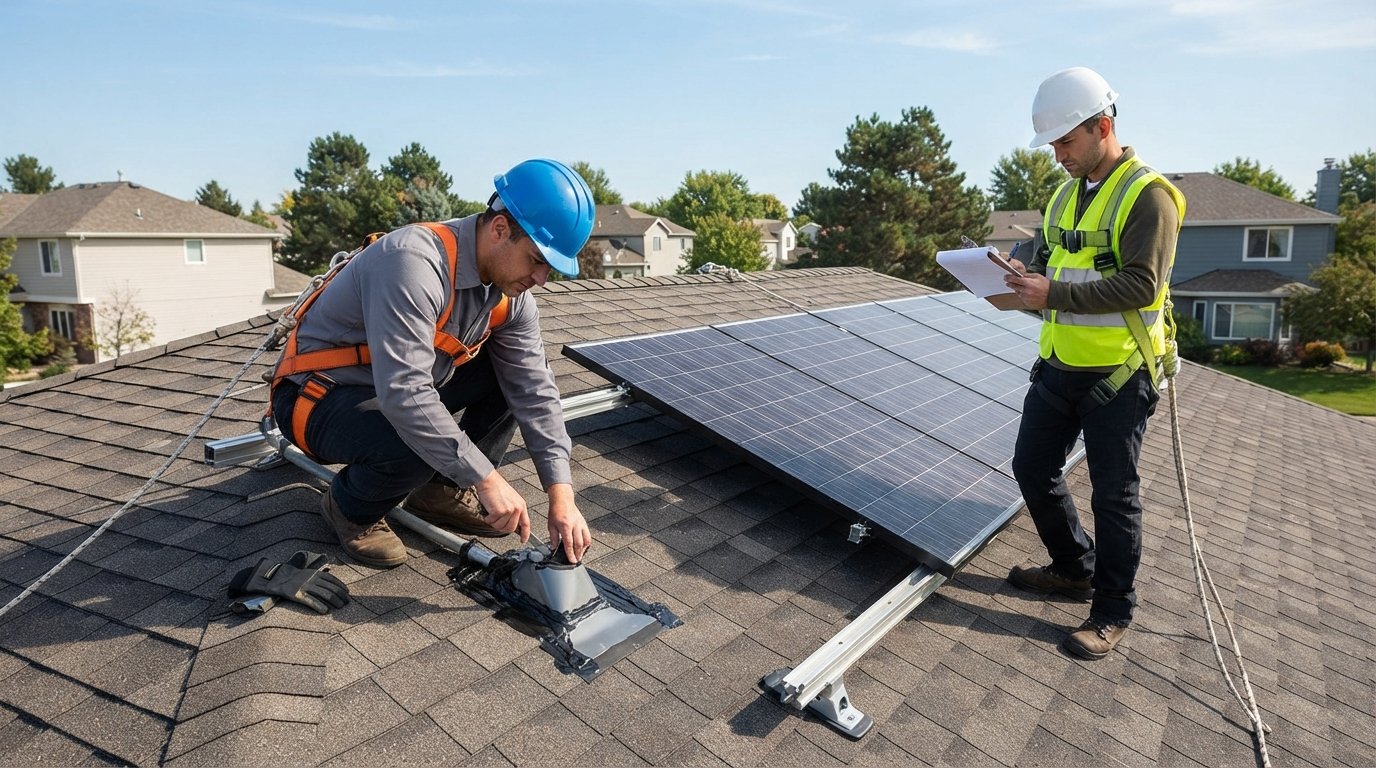
Solar panels from tier-one manufacturers rarely fail. The weak link is almost always the installation: a poorly sealed penetration, a rushed flashing job, or a wiring mistake that voids a manufacturer warranty. According to industry data, a significant share of residential solar service calls trace back to workmanship issues rather than product defects. That means the cheapest bid often carries the highest hidden cost.
Equipment warranties typically run 10 to 25 years, but they only cover manufacturing defects. If water gets behind a panel because the mount was installed incorrectly, the panel maker will not pay. The installer's workmanship warranty is your only protection, and its value depends entirely on the company's longevity and reputation. That is why comparing workmanship and reviews together is essential: reviews tell you how a company behaves under pressure, and the warranty tells you what happens after the crew leaves.
Separating Verified Reviews From Marketing Testimonials
Every installer website has a testimonials page, and every testimonial is glowing. That is not evidence. Marketing testimonials are curated, often edited, and sometimes written by the sales team. Verified reviews live on independent platforms where the reviewer's identity and project are confirmed, and where negative feedback cannot be quietly deleted.
Start by checking multiple independent sources rather than a single rating. Google Business Profiles, BBB listings, Angi, and SolarReviews each have different verification standards. Look for reviews that mention specific crew behavior, timeline accuracy, and post-installation service. A review that says "great company, highly recommend" tells you nothing. A review that says "crew arrived on time, cleaned up daily, and returned within 48 hours when the inverter threw an error" tells you how the company operates.
Here is a practical screening framework for review quality:
- Verified purchase badges: Platforms like SolarReviews and Google often mark reviews tied to a real project. Prioritize those over unverified submissions.
- Recency and volume: A company with 200 reviews over five years is more reliable evidence than one with 15 reviews posted in a single month.
- Response patterns: Read how the owner replies to negative reviews. A professional, solution-oriented response signals accountability; defensiveness or blame signals the opposite.
- Complaint themes: One angry review is noise. Three reviews mentioning the same issue (permitting delays, roof leaks, no-shows for service calls) is a pattern.
Finally, cross-check the review count against the company's claimed installation volume. If an installer says it has completed 2,000 projects but has only 40 reviews, ask where the rest of the feedback lives. Many satisfied customers never leave reviews, but a large gap between claims and evidence is worth questioning during your quote consultation.
What a Workmanship Warranty Should Cover
The workmanship warranty is the single most important contract term most homeowners overlook. A 25-year equipment warranty paired with a 1-year workmanship warranty is a red flag: it means the installer is not standing behind the labor for the life of the system. Reputable installers in the U.S. market typically offer 10 to 25 years of workmanship coverage, and the best ones match the equipment warranty term.
Read the warranty language carefully and confirm it covers the following:
- Roof penetrations and flashing: Leaks are the most common workmanship failure, so the warranty must explicitly cover water intrusion at mount points.
- Racking and mounting integrity: Coverage should include structural attachment failures and corrosion issues.
- Electrical connections and conduit: Loose connections, improper grounding, and conduit damage should be included.
- Labor costs, not just materials: A warranty that covers replacement parts but not the labor to install them is nearly worthless.
- Transferability: If you sell the home, the warranty should transfer to the new owner. Transferable warranties protect resale value.
Also ask who performs warranty service. Some installers subcontract service to third parties, which can mean weeks of waiting. Others handle it in-house. Get the answer in writing, and confirm the company has been in business long enough to make a 25-year promise credible. A company founded three years ago cannot demonstrate a 25-year track record, so weigh its warranty against its balance sheet and local reputation.
Licensing, Insurance, and Local Experience Checks
Workmanship quality starts with accountability, and accountability starts with paperwork. Before you compare quotes, verify three things for every installer: licensing, insurance, and local experience. Skipping these checks is how homeowners end up with unpermitted systems that fail inspection or, worse, roof damage with no recourse.
Licensing requirements vary by state. Some states require a specific solar contractor license, while others require a general electrical or roofing license. Check your state's contractor licensing board database and confirm the license is active and in good standing. In Texas, for example, electrical work must be performed or supervised by a licensed electrician, and many municipalities require separate permits. Ask for the license number and verify it yourself rather than trusting a logo on a brochure.
Insurance is equally critical. Request a certificate of insurance showing general liability coverage (typically at least $1 million) and workers' compensation. If a crew member is injured on your roof and the installer lacks workers' comp, you could face liability. Call the insurance carrier to confirm the policy is current; certificates can be altered or expired.
Local experience matters because solar installation is regulated at the municipal level. An installer who has completed dozens of projects in your county knows the permitting office, the inspection quirks, and the utility interconnection process. Ask how many systems the company has installed in your city or county in the past 12 months. A crew that works your area weekly will likely deliver cleaner workmanship and faster timelines than one driving in from three counties away.
For a deeper look at how to structure your quote comparison around pricing and savings, see our guide on how to compare solar installation offers for savings. Workmanship and pricing should be evaluated side by side, not in isolation.
Reading the Quote for Workmanship Signals
Most solar quotes are sales documents, but they contain clues about workmanship standards. A detailed quote specifies the racking manufacturer, flashing method, conduit routing, and monitoring hardware. A vague quote lists panel wattage and a total price. The level of detail is a proxy for how the installer approaches the job.
Compare quotes on these specific line items: racking brand and warranty, flashing and sealant method, conduit placement (roof-mounted versus attic-run), main panel upgrade scope, and the permit and inspection responsibility. Ask each installer to explain how they handle roof penetrations and whether they use flashed mounts or sealant-only attachments. Sealant-only is a workmanship risk that may not fail for years, by which time the warranty may have expired.
Also compare crew composition. Does the company use in-house crews or subcontractors? Subcontracting is not automatically bad, but it introduces variability. If crews rotate, workmanship consistency suffers. Ask how long the average crew member has been with the company and whether the same crew handles service calls. Companies with low turnover tend to produce more consistent work.
How to Request Quotes From Pre-Vetted Installers
The fastest way to improve your comparison pool is to start with installers who have already been screened. Requesting quotes through a vetted network saves you from cold-calling every company in town and gives you a baseline of licensed, insured, and reviewed installers. NewSolarQuotes connects homeowners with certified installers through a free quote request system, matching you with local professionals who meet licensing and insurance standards.
When you submit a request, be specific about your goals: system size, roof type, financing preference, and timeline. Installers who know your parameters upfront provide more accurate quotes, which makes workmanship comparisons fairer. Expect two to four quotes, and schedule each consultation with the same set of questions so you can compare answers directly.
If you are also planning broader home improvement or renovation work alongside your solar project, resources like ContractorHomeQuotes can help you plan and estimate costs for related projects, so your solar installation fits into a coherent home upgrade plan rather than becoming an isolated expense.
A Step-by-Step Comparison Framework
With reviews, warranties, and licensing information in hand, you need a consistent way to score each installer. Use a simple weighted framework so emotion does not drive the decision. The following sequence works well for most homeowners:
- Screen for minimum standards: Eliminate any installer without active licensing, current insurance, and at least 10 years of verifiable workmanship warranty coverage.
- Score verified reviews: Rate each installer on review volume, recency, verified status, and complaint patterns. Give more weight to reviews that mention installation quality and service response.
- Evaluate workmanship warranty terms: Compare coverage length, what is included, labor coverage, and transferability. Ask for the warranty document, not a verbal promise.
- Check local experience: Confirm project volume in your county and ask for references from similar roofs and system sizes.
- Compare quote detail: Score each quote on specificity of racking, flashing, conduit, and permitting scope. Vague quotes lose points.
- Interview the crew: Ask who will be on your roof, whether they are employees or subcontractors, and how service calls are handled.
After scoring, review the top two installers side by side. A small price premium for a longer workmanship warranty, in-house crews, and strong verified reviews is usually money well spent. The goal is not the lowest quote; it is the lowest total cost of ownership over 25 years.
Red Flags That Should End the Conversation
Some warning signs are disqualifying regardless of price. A high-pressure sales pitch with same-day discounts is a classic red flag; reputable installers give you time to review documents. Refusal to provide a written workmanship warranty, or a warranty shorter than five years, signals that the company does not stand behind its labor. A quote that omits the racking brand and flashing method suggests the installer is hiding low-grade materials or rushed techniques.
Also be wary of companies that cannot name their licensed electrician or that subcontract all installation work without disclosing it. Check whether the company has changed names recently or has a pattern of unresolved BBB complaints. Finally, if the salesperson discourages you from getting multiple quotes or claims their pricing is only valid today, walk away. Legitimate installers compete on quality and transparency, not urgency.
Comparing solar installer workmanship and reviews takes a few extra hours, but it protects a purchase that will sit on your roof for decades. Start with a vetted pool of installers, verify the paperwork, read the reviews like an investigator, and score every quote against the same criteria. Your future self, dry and leak-free, will thank you.