
Monocrystalline vs Polycrystalline Solar Panels: Performance Guide
Compare monocrystalline vs polycrystalline solar panels performance, including efficiency, heat tolerance, and cost, to pick the right panels for your roof.

By Benjamin Kalif
Learn more about Solar Panel Installation and Repair for guides, costs, and what to expect.
Compare Solar Panel Installation and Repair Pros Near You

Enter your ZIP code to compare top-rated local professionals and request free quotes.
Choosing between monocrystalline and polycrystalline solar panels often comes down to a single question: which technology delivers better performance for your home or business? Both types convert sunlight into electricity using silicon, yet they differ in manufacturing, efficiency, and real-world output. Understanding those differences helps you avoid overpaying for capacity you cannot use or settling for panels that underperform on a shaded or space-limited roof.
At NewSolarQuotes, an independent educational resource for U.S. homeowners and businesses, we break down the technical and practical factors that shape solar performance. The goal is simple: give you the knowledge to compare quotes with confidence and choose a system that maximizes savings over its 25-year lifespan.
How Monocrystalline and Polycrystalline Panels Differ at the Cell Level
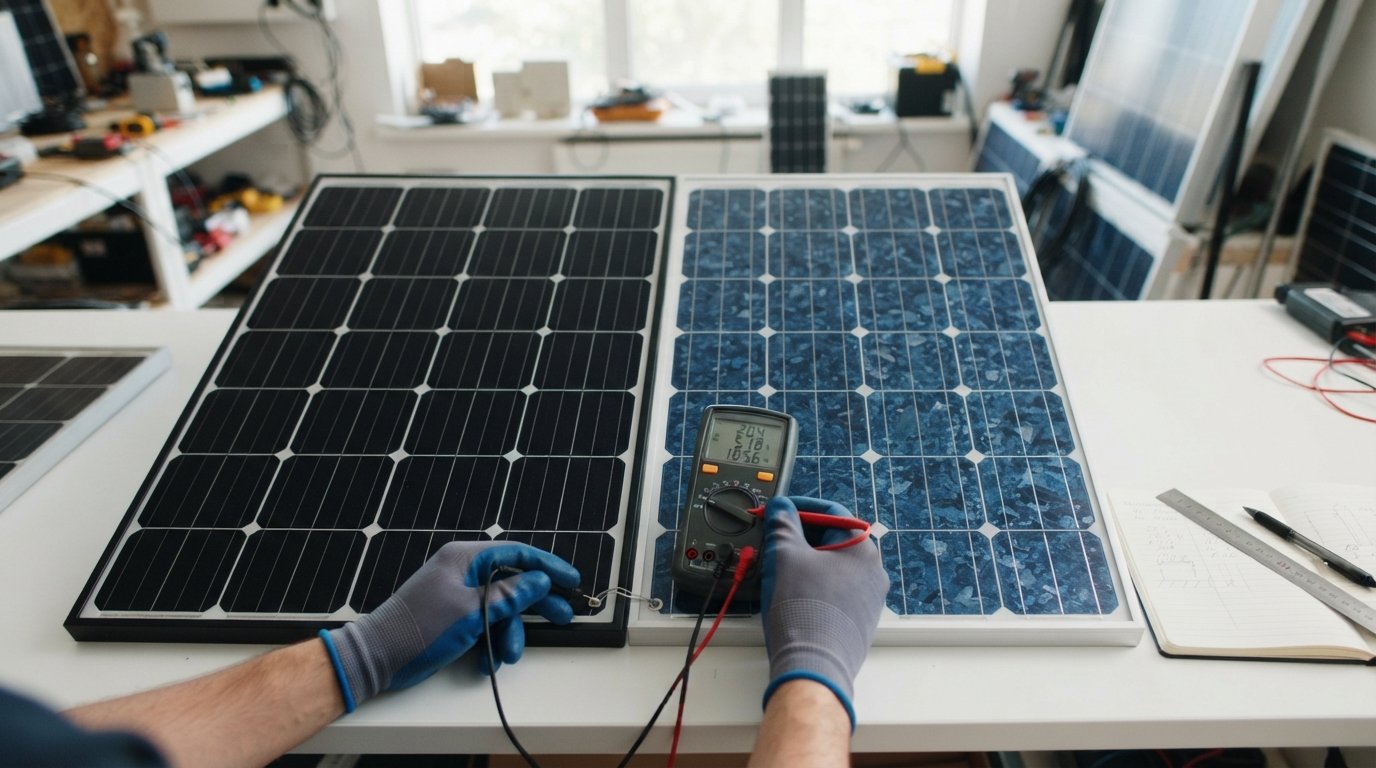
Monocrystalline panels are made from single-crystal silicon, grown using the Czochralski process. This produces a highly ordered lattice structure that allows electrons to flow with less resistance. The result is a darker, uniform appearance and slightly higher efficiency per square foot. Because the manufacturing process is more energy-intensive, monocrystalline panels typically cost more per watt.
Polycrystalline panels are made by melting silicon fragments and pouring them into a mold. As the silicon cools, it forms multiple crystals, creating the characteristic blue, speckled look. The grain boundaries between crystals reduce electron mobility slightly, which lowers efficiency compared with monocrystalline. However, polycrystalline manufacturing wastes less silicon and requires less energy, which is why these panels historically cost less.
Both technologies use the same photovoltaic effect, and both degrade at similar rates over time, typically 0.5 to 0.8 percent per year. The performance gap is not about durability but about how much power each panel produces from a given area of roof or ground space.
Efficiency and Power Output: Which Wins in Real Conditions
Efficiency ratings tell you how much of the sun's energy a panel converts into usable electricity. Monocrystalline panels generally range from 17 to 22 percent efficiency, with premium models exceeding 23 percent. Polycrystalline panels typically range from 15 to 17 percent. On a square-foot basis, monocrystalline delivers more watts, which matters most when roof space is limited.
Power output per panel also favors monocrystalline. A standard residential monocrystalline panel might produce 400 to 450 watts, while a comparable polycrystalline panel often produces 300 to 350 watts. If your roof can fit only 20 panels, monocrystalline could give you a 2 to 3 kW advantage, enough to cover a larger share of your annual electricity use.
Temperature coefficients are another performance factor. Both types lose efficiency as temperatures rise, but monocrystalline panels often have a slightly better temperature coefficient (around -0.34 percent per degree Celsius versus -0.39 percent for poly). In hot climates such as Arizona or Texas, that difference can add up over a summer. However, the gap is small enough that system design and ventilation often matter more than cell type.
Performance in Shade, Heat, and Low-Light Conditions
Shading affects both technologies similarly because shading losses depend on the panel's bypass diodes and the inverter's architecture, not on whether the silicon is single-crystal or multi-crystal. A shaded monocrystalline panel can still drag down the performance of an entire string unless you use module-level power electronics or microinverters. Polycrystalline panels do not offer a shading advantage; they simply may be paired with different system designs depending on the installer.
Heat performance is often misunderstood. Polycrystalline panels historically had a reputation for performing better in high heat, but modern monocrystalline panels have closed that gap. Independent tests show that the temperature coefficient difference translates to roughly 1 to 2 percent less output for polycrystalline at 45 degrees Celsius (113 degrees Fahrenheit). That is noticeable but rarely a deal-breaker, especially when you factor in monocrystalline's higher baseline efficiency.
Low-light performance, such as on cloudy days or during early morning and late afternoon, is slightly better with monocrystalline because of its higher purity and lower internal resistance. The difference is marginal, typically a few percentage points, but it can matter for homeowners who rely on solar for a high proportion of their daily energy needs.
Cost, Space, and Payback: The Practical Trade-Off
Monocrystalline panels cost more per watt, but they also produce more power per square foot. The key question is whether your roof has enough space to accommodate polycrystalline panels and still meet your energy goals. If you have a large, unshaded roof, polycrystalline can deliver a lower upfront cost and a comparable payback period. If your roof is small, shaded, or complex, monocrystalline often wins because it lets you install more capacity in the same footprint.
Installation costs also include labor, mounting hardware, wiring, and inverters, which are largely the same regardless of panel type. That means the panel cost difference is only part of the total system price. A 6 kW polycrystalline system might save you $1,000 to $2,000 upfront compared with a monocrystalline system of the same capacity, but the monocrystalline system may produce more electricity over 25 years, improving your return on investment.
Financing options can change the calculus. If you choose a solar loan or lease, the monthly payment may be similar for both technologies, but the higher-output monocrystalline system could offset more of your electricity bill. If you pay cash, the lower upfront cost of polycrystalline may appeal if your budget is tight and your roof has ample space.
To compare quotes accurately, you need to look beyond the panel type and evaluate the full system design, including inverter type, mounting, and warranty. Our guide on best polycrystalline solar panels explains how to identify quality modules and avoid low-cost options that sacrifice performance.
Degradation, Warranty, and Long-Term Reliability
Both monocrystalline and polycrystalline panels are extremely reliable. Most manufacturers offer a 25-year performance warranty guaranteeing at least 80 to 85 percent of original output. Degradation rates are similar: monocrystalline panels average 0.5 percent per year, while polycrystalline averages 0.6 to 0.8 percent per year. Over 25 years, that difference amounts to a few percentage points of total energy production.
Warranty terms are often more about the manufacturer than the cell technology. Tier-1 manufacturers of both types provide robust warranties, and some polycrystalline panels from reputable brands outperform lower-tier monocrystalline panels in real-world tests. The lesson: do not choose a panel solely on cell type. Look at the brand's track record, the warranty terms, and third-party testing results.
Physical durability is also comparable. Both types use tempered glass, anodized aluminum frames, and weatherproof junction boxes. Hail, wind, and snow loads are addressed through product certification, not cell structure. A well-installed system of either type should last 30 years or more with minimal maintenance.
Which Panel Type Fits Your Project Best
The right choice depends on your priorities and site conditions. If you value maximum power per square foot, monocrystalline is the clear winner. If you have plenty of roof space and want to minimize upfront costs, polycrystalline remains a solid option. For many homeowners, the decision comes down to a simple comparison of quotes and projected savings.
- Choose monocrystalline if: your roof is small or shaded, you want the highest efficiency, or you plan to add battery storage and need maximum production per panel.
- Choose polycrystalline if: you have a large, unshaded roof, your budget is tight, or you want the lowest cost per watt and do not mind using more panels.
- Consider hybrid or premium options if: you want the latest technology, such as half-cut cells or bifacial designs, which are often monocrystalline but can also be found in polycrystalline formats.
Before you decide, request multiple quotes from certified installers. A good installer will model your roof's sun exposure, calculate your annual energy use, and recommend a system that balances cost and performance. They can also explain how net metering and local incentives affect your payback period, which may shift the advantage from one panel type to the other.
Real-World Performance Data and What It Means for You
Field studies show that monocrystalline panels typically produce 5 to 10 percent more energy per square foot than polycrystalline panels under identical conditions. That advantage shrinks when you compare entire systems because polycrystalline systems often use more panels to reach the same capacity. The key metric is levelized cost of electricity (LCOE), which accounts for upfront cost, energy production, and lifespan.
In most U.S. markets, the LCOE difference between monocrystalline and polycrystalline is small, often less than 1 cent per kilowatt-hour. That means the financial case for either technology is strong, provided the system is sized correctly and installed by a qualified professional. The bigger variables are your local electricity rates, available incentives, and how much sun your roof receives.
If you are still weighing your options, FreeSolarPowerQuotes offers free, no-obligation quotes from vetted installers across the United States. Comparing multiple quotes side by side is the best way to see how panel type affects your specific project.
Ultimately, monocrystalline vs polycrystalline solar panels performance is a story of trade-offs: higher efficiency and power density versus lower upfront cost and proven reliability. Both technologies can deliver decades of clean energy and significant savings. The right choice is the one that matches your roof, your budget, and your energy goals, and that decision is easier when you have transparent quotes and expert guidance.