
Smart Home Energy Management Systems Integrating Solar for Savings
Smart home energy management systems integrating solar for savings can cut peak-rate bills by hundreds yearly. Call 8332123715 for expert guidance.

By Alexia Mabel
Learn more about Solar Panel Installation and Repair for guides, costs, and what to expect.
Compare Solar Panel Installation and Repair Pros Near You

Enter your ZIP code to compare top-rated local professionals and request free quotes.
Your rooftop solar panels are generating cheap, clean electricity every sunny afternoon, yet your utility bill still spikes when the sun goes down. That frustrating gap between production and consumption is exactly what smart home energy management systems integrating solar for savings are built to close. Instead of guessing when to run the dishwasher or hoping the battery charges before peak rates kick in, an intelligent controller watches weather forecasts, utility price signals, and your household habits in real time, then shifts energy where it saves the most money.
For homeowners across the United States, the math has never been more compelling. Federal incentives, rising utility rates, and falling battery prices have turned home energy management from a niche hobby into a mainstream financial strategy. The key is understanding how these systems work, what they cost, and how to pair them with solar so every kilowatt-hour you generate actually reduces your bill instead of being exported for pennies.
What a Smart Home Energy Management System Actually Does
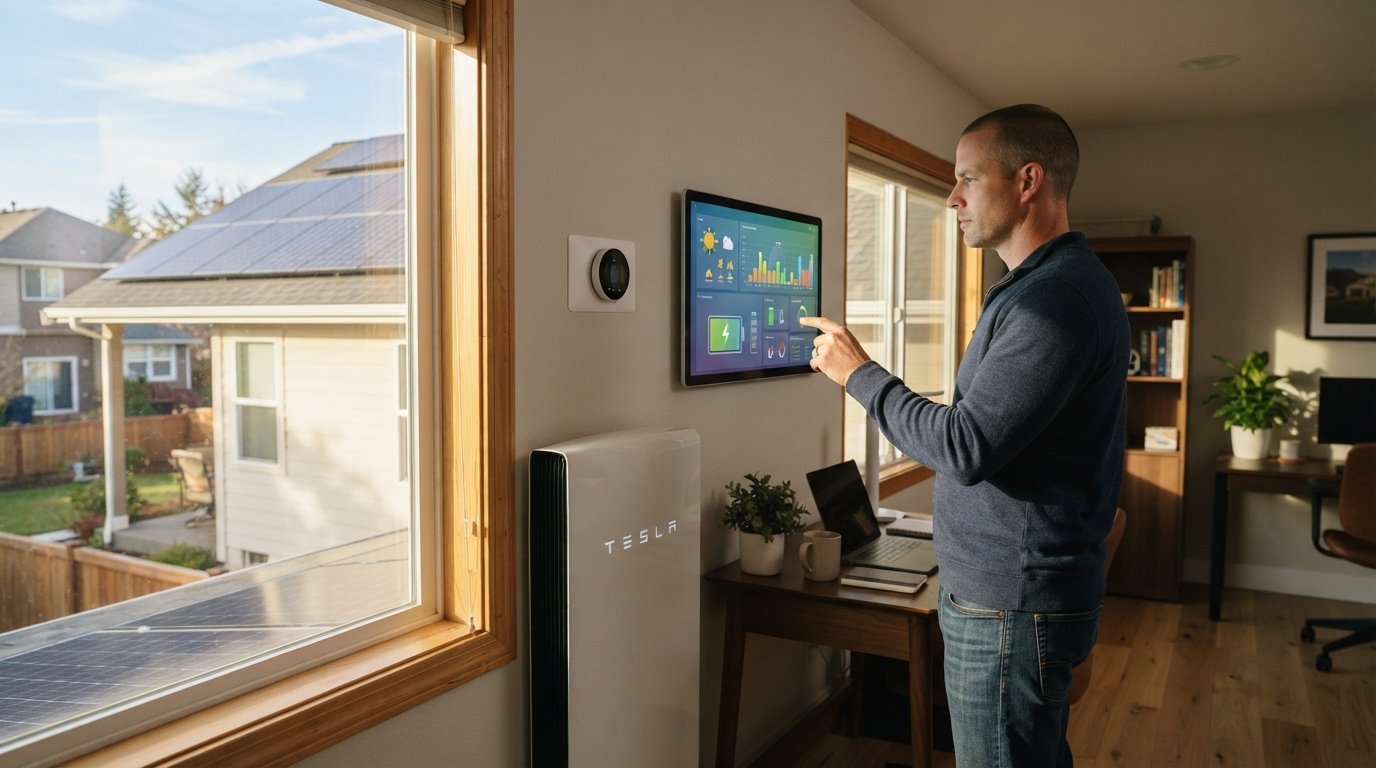
A smart home energy management system, often shortened to HEMS, is the brain that coordinates solar production, battery storage, and the appliances inside your home. It connects to your solar inverter, your battery, your smart thermostat, your electric vehicle charger, and even individual smart plugs through a single app or dashboard. From there, it makes decisions that a human would struggle to optimize manually, such as charging the battery from solar at noon and discharging it during the 6 p.m. to 9 p.m. peak window when electricity costs three times as much.
The best systems go beyond simple scheduling. They learn your routines, monitor weather forecasts to predict tomorrow's solar output, and respond to utility demand-response events that pay you to reduce consumption. Some models even integrate with time-of-use rates automatically, so you never have to reprogram anything when your utility changes its pricing structure.
Here is what a typical HEMS monitors and controls:
- Solar inverter output and real-time production data
- Battery state of charge and discharge scheduling
- Smart thermostats, water heaters, and EV chargers
- Utility time-of-use rates and demand-response signals
- Whole-home energy monitoring at the circuit level
That combination turns a passive solar array into an active financial asset. Without management, solar panels simply push power to the grid whenever the sun shines, and you get credited at whatever rate your utility offers. With management, you keep that power for yourself, store it, and use it when it is worth the most.
Why Pairing Solar With Energy Management Boosts Savings
Solar alone reduces your bill, but it does not eliminate it unless you also control when you use power. Most utilities have moved to time-of-use rates, meaning electricity costs more during peak hours and less overnight. If your solar system exports power at noon for a credit of 4 cents per kWh, then you buy it back at 7 p.m. for 30 cents, you are losing money on every cycle.
A smart energy management system integrating solar reverses that equation. It stores your midday production in a battery, then discharges it during peak pricing. Depending on your utility and battery size, this strategy can cut your evening electricity costs by 60 to 90 percent. Over a year, that often translates to hundreds or even thousands of dollars in additional savings beyond what solar alone delivers.
There is also the resilience factor. When the grid goes down, a managed solar-plus-battery system can island your home and keep critical loads running. Without smart controls, many inverters shut off entirely during outages for safety reasons, leaving you with panels that produce nothing when you need them most.
If you are still mapping out your system design, our guide on the solar installation planning system walks through how to size panels, batteries, and controls for maximum return.
Key Components of a Solar-Integrated HEMS
Understanding the hardware helps you evaluate quotes and avoid paying for features you do not need. A complete system typically includes four layers: production, storage, control, and monitoring. Each layer plays a distinct role, and skipping one usually undermines the savings you were promised.
The production layer is your solar array and inverter. The storage layer is your battery, whether it is a Tesla Powerwall, Enphase IQ Battery, or another lithium-based unit. The control layer is the HEMS hub itself, which may be built into the inverter or exist as a separate device. The monitoring layer includes sensors, smart plugs, and the software dashboard you interact with daily.
When these components come from different manufacturers, compatibility becomes the biggest risk. A battery that cannot communicate with your inverter will not discharge on schedule. A smart thermostat that ignores utility price signals will not shift load when it matters. That is why many installers now recommend staying within a single ecosystem, such as Enphase, SolarEdge, or Tesla, unless you are working with a HEMS platform like Span or Emporia that specializes in cross-brand integration.
How Much Can You Realistically Save?
Savings vary widely based on your location, utility rates, system size, and how aggressively you automate. That said, patterns emerge from thousands of installations across the country. Homes with time-of-use rates and a properly sized battery typically see the highest returns, while homes with flat-rate pricing benefit more from load shifting and demand reduction.
Consider a typical scenario: a 8 kW solar system in a moderate-climate state produces roughly 11,000 kWh per year. Without management, the homeowner might save $1,200 annually. With a 10 kWh battery and smart controls that shift 70 percent of evening consumption to stored solar, that same homeowner could save an additional $600 to $900 per year, bringing total savings above $2,000. Add demand-response payments and EV charging optimization, and the number climbs further.
It helps to think in terms of three savings buckets:
- Production savings: solar power you use directly instead of buying from the grid.
- Arbitrage savings: storing cheap solar and using it during expensive peak hours.
- Incentive savings: utility payments for reducing demand or exporting during grid stress events.
Most homeowners focus only on the first bucket and miss the other two entirely. A smart HEMS captures all three, which is why the payback period on the control hardware is often under four years.
Choosing the Right System for Your Home
Not every home needs the same level of automation. A small apartment with a few panels and no battery has different needs than a 3,000 square foot house with an EV, a pool pump, and two air conditioners. The right approach depends on your utility's rate structure, your budget, and how much complexity you are willing to manage.
Start by identifying your utility's pricing model. If you are on a flat rate with full net metering, your savings from HEMS will be modest. If you are on time-of-use rates, demand charges, or reduced export credits, the case for smart management is much stronger. Next, decide whether you want a battery. Without storage, a HEMS can still shift loads like EV charging and water heating, but it cannot arbitrage peak rates as effectively.
Finally, evaluate the software. A HEMS is only as good as its app, its update history, and its customer support. Look for platforms that integrate with major inverter and battery brands, offer clear savings reporting, and allow manual overrides when you want control. For deeper research on equipment and incentives, resources like SolarEnergy.ai provide independent comparisons and calculators that can help you sanity-check installer quotes.
When you request quotes through NewSolarQuotes, ask each installer specifically how their proposed HEMS handles time-of-use optimization, battery dispatch, and demand response. The answers will quickly separate installers who understand energy management from those who simply bolt panels to roofs.
Installation Steps and What to Expect
Adding a smart energy management system to an existing solar array is usually less disruptive than the original solar installation. In many cases, it involves mounting a control hub near your electrical panel, connecting current transformers around your main service lines, and linking the hub to your inverter and battery over Wi-Fi or a wired connection. A qualified electrician can complete the work in a few hours.
For new solar installations, it is far easier to design the HEMS in from the start. The installer can select an inverter with built-in management features, size the battery for your evening load, and configure the system before commissioning. This approach avoids the compatibility headaches that come with retrofitting mismatched equipment later.
Expect the following timeline for a typical project:
- Energy audit and rate analysis: 1 to 2 weeks.
- System design and equipment selection: 2 to 4 weeks.
- Permitting and utility approval: 4 to 8 weeks.
- Installation and commissioning: 1 to 3 days.
- Optimization and monitoring setup: 1 to 2 weeks after activation.
After commissioning, give the system at least a full billing cycle to learn your patterns. Most HEMS platforms improve their recommendations over the first 30 to 60 days as they gather data on your consumption and solar production.
Common Mistakes That Reduce Savings
The biggest mistake homeowners make is treating solar and energy management as separate purchases. They buy panels from one company, a battery from another, and a smart thermostat from a third, then wonder why nothing talks to anything else. Integration is where the savings live, and fragmented systems rarely deliver the full benefit.
Another common error is oversizing the battery relative to actual evening load. A battery that never fully discharges is wasted capital. Conversely, undersizing the battery means you still buy expensive peak power. A proper load analysis during the design phase prevents both problems.
Finally, many homeowners set their HEMS to "set it and forget it" mode and never review the data. Utility rates change, seasons shift, and household habits evolve. Spending ten minutes a month reviewing your dashboard and adjusting schedules can recover hundreds of dollars annually that would otherwise slip away.
The Bottom Line on Smart Solar Savings
Smart home energy management systems integrating solar for savings turn a good investment into a great one. They close the gap between what your panels produce and what your home actually needs, capturing value that would otherwise flow to your utility. Whether you are planning a new installation or upgrading an existing array, the combination of solar, storage, and intelligent control is quickly becoming the standard for homeowners who want predictable bills and real energy independence.
Start with a clear understanding of your utility's rate structure, choose equipment that communicates seamlessly, and work with installers who can explain exactly how their system will optimize your savings. Do that, and your solar investment will pay you back faster than you expected.