
Solar Panel Degradation Rate: What Owners Should Expect
Solar panel degradation rate what owners should expect: modern panels lose 0.25 to 0.8 percent yearly, and knowing the numbers protects your 25-year savings.

By Alex Carter
Find Local Pros Near You

Enter your ZIP code to compare top-rated local professionals and request free quotes.
Every solar panel starts its life producing peak power, but that output does not stay flat forever. Understanding the solar panel degradation rate and what owners should expect over the coming decades is one of the most practical pieces of knowledge you can have before signing an installation contract. Degradation determines how much electricity your system will generate in year 10, year 20, and year 25, which directly affects your long-term savings, your payback period, and the resale value of your home. The good news is that modern panels degrade slowly and predictably, and manufacturers back that performance with written warranties. The better news is that once you know the numbers, you can compare quotes with confidence and spot inflated production claims before they cost you money.
What Solar Panel Degradation Actually Means
Solar panel degradation is the gradual decline in a panel's power output over time. It happens for several physical reasons, and none of them can be eliminated entirely. The photovoltaic cells slowly lose efficiency as they are exposed to ultraviolet light, temperature swings, and moisture. Encapsulant materials yellow slightly, solder joints develop micro-cracks, and tiny amounts of moisture can creep past frame seals. Each of these changes shaves a fraction of a percent off the panel's ability to convert sunlight into electricity.
Manufacturers measure this decline and express it as an annual degradation rate. If a 400-watt panel degrades at 0.5 percent per year, it should produce roughly 398 watts after year one, about 380 watts after year ten, and around 360 watts after year twenty. Those small percentages compound quietly, which is why the difference between a 0.25 percent panel and a 0.7 percent panel becomes significant across a 25-year horizon.
It helps to separate two distinct phases. The first is called light-induced degradation, or LID, a rapid initial drop that occurs in the first few hours or days of sun exposure. Most panels lose between 1 and 3 percent of output during this phase, and reputable manufacturers account for it in their warranty baseline. The second phase is the slow, steady annual decline that continues for the rest of the system's life. When you read a spec sheet quoting a degradation rate, you are usually looking at that second, long-term figure.
Typical Degradation Rates by Panel Technology
Not all panels age at the same speed. The cell technology inside the panel is the single biggest factor, followed by manufacturing quality and the climate where the system is installed. Here is how the major categories compare based on current industry data.
- Monocrystalline silicon panels: typically 0.25 to 0.5 percent per year, the best performance available for residential systems.
- Polycrystalline silicon panels: typically 0.5 to 0.8 percent per year, slightly faster decline and increasingly rare in new installations.
- Thin-film panels (cadmium telluride and similar): typically 0.5 to 1.0 percent per year, though some manufacturers now publish rates closer to 0.4 percent.
- Older or budget-tier panels: 0.7 to 1.0 percent per year, often with weaker warranty terms to match.
Tier-one manufacturers such as those producing premium monocrystalline modules now routinely guarantee no more than 0.25 to 0.4 percent annual degradation after the first year. That may sound like marketing hair-splitting, but the math matters. A 10-kilowatt system degrading at 0.25 percent per year will still produce roughly 94 percent of its original output at year 25. The same system degrading at 0.75 percent per year will be down to about 83 percent, a difference of more than a thousand kilowatt-hours annually in many markets.
Technology is also improving. Newer cell architectures, better glass coatings, and more robust backsheets are pushing real-world degradation rates lower than the warranties require. Independent field studies of systems installed in the last decade often find measured degradation running below the guaranteed ceiling, which means most owners end up with more production than the contract promises.
Choosing the right panel for your roof, budget, and climate is easier when you can compare specifications side by side. A structured comparison helps you weigh degradation rate against price, efficiency, and warranty length instead of fixating on a single number.
If you are still early in the research phase, a good starting point is to find the best solar panel selection tool for your home, which walks you through the tradeoffs in plain language before you request quotes.
The Real-World Numbers: What 25 Years Looks Like
Warranty language can feel abstract, so it helps to translate degradation into actual production and dollars. Consider a typical 8-kilowatt residential system in a sunny state producing about 12,000 kilowatt-hours in its first year at an average electricity rate of 15 cents per kilowatt-hour.
At a 0.5 percent annual degradation rate, that system produces roughly 11,400 kilowatt-hours in year 10 and about 10,600 kilowatt-hours in year 25. At 15 cents per kilowatt-hour, the year-25 output is still worth around 1,590 dollars annually, and the cumulative 25-year savings land in the neighborhood of 42,000 dollars before accounting for utility rate increases, which historically push that figure higher.
Now run the same system at a 0.8 percent degradation rate. Year-25 production drops to about 9,900 kilowatt-hours, worth roughly 1,485 dollars that year. The 25-year difference between the two scenarios is several thousand dollars, money that quietly disappears if you choose panels on price alone without checking the degradation spec.
Three variables push real-world results above or below these estimates:
- Climate and heat: High ambient temperatures accelerate cell wear, so systems in Arizona, Texas, and Florida tend to degrade slightly faster than the warranty floor unless they use premium heat-tolerant modules.
- Installation quality: Poor mounting, inadequate ventilation, and sloppy wiring create hot spots and stress that speed up degradation.
- Maintenance: Dirty panels, shaded cells, and ignored inverter faults all reduce output in ways that look like degradation but are actually reversible.
The takeaway is not that degradation is a dealbreaker. It is that the difference between a well-chosen system and a cheap one compounds every single year, and the gap is large enough to justify a few extra hours of comparison shopping.
How Warranties Protect You (and Where They Fall Short)
Solar warranties come in two layers, and understanding both is essential to knowing what you are actually guaranteed. The product warranty covers defects in materials and workmanship, typically running 12 to 25 years and promising a replacement panel if the hardware fails. The performance warranty, sometimes called the power warranty or output warranty, guarantees a minimum percentage of original output over time.
A standard 25-year performance warranty looks something like this: no more than 2 percent degradation in year one, then no more than 0.5 percent per year after that, ending with at least 84.8 percent of nameplate output at year 25. Premium warranties tighten those numbers, sometimes guaranteeing 92 percent or more at year 25 with annual degradation capped at 0.25 percent.
Warranties are valuable, but they have limits every owner should understand:
- Most performance warranties pay out based on factory test conditions, not your actual roof conditions, so a shaded or dirty system may underperform without qualifying for a claim.
- Filing a claim usually requires documented production data, which means you need monitoring equipment and a habit of checking it.
- Labor to remove and reinstall a failed panel is often excluded, and that cost can rival the panel price itself.
- If the manufacturer goes out of business, the warranty may be worthless unless it is backed by an insurance provider or a third-party guarantor.
This is why the financial strength of the manufacturer matters as much as the warranty language. Tier-one brands with decades of balance sheets behind them are far more likely to honor a claim in year 18 than a startup that appeared three years ago. When you compare quotes, ask who makes the panels, how long the company has operated, and whether the performance warranty is transferable to a new homeowner. Transferability adds real resale value, because the next buyer inherits a documented production guarantee.
Homeowners who want a neutral starting point for comparing installers and understanding incentive programs can explore educational resources and request no-obligation quotes through FreeSolarPowerQuotes, which connects consumers with vetted providers across the United States.
What Accelerates Degradation and How to Slow It Down
Manufacturers test panels in controlled chambers, but your roof is not a laboratory. Several real-world factors can push degradation faster than the warranty rate, and most of them are within your control to manage or at least monitor.
Heat is the biggest silent accelerant. Panel efficiency drops as cell temperature rises, and prolonged exposure to extreme heat stresses the encapsulant and solder joints. Roofs with poor airflow beneath the array, dark shingles, and tight mounting clearances all run hotter. Properly elevated racking and adequate spacing make a measurable difference over 25 years.
Shading and soiling are the second major factor, though their effects are often reversible. A single shaded cell can drag down an entire string, and if the bypass diodes cannot compensate, the affected cells run hot and degrade faster. Dust, pollen, bird droppings, and leaf litter reduce output immediately; regular cleaning restores it, but neglecting buildup for years can cause permanent hot-spot damage. Systems in dusty regions or under trees need a maintenance schedule, not just a one-time installation.
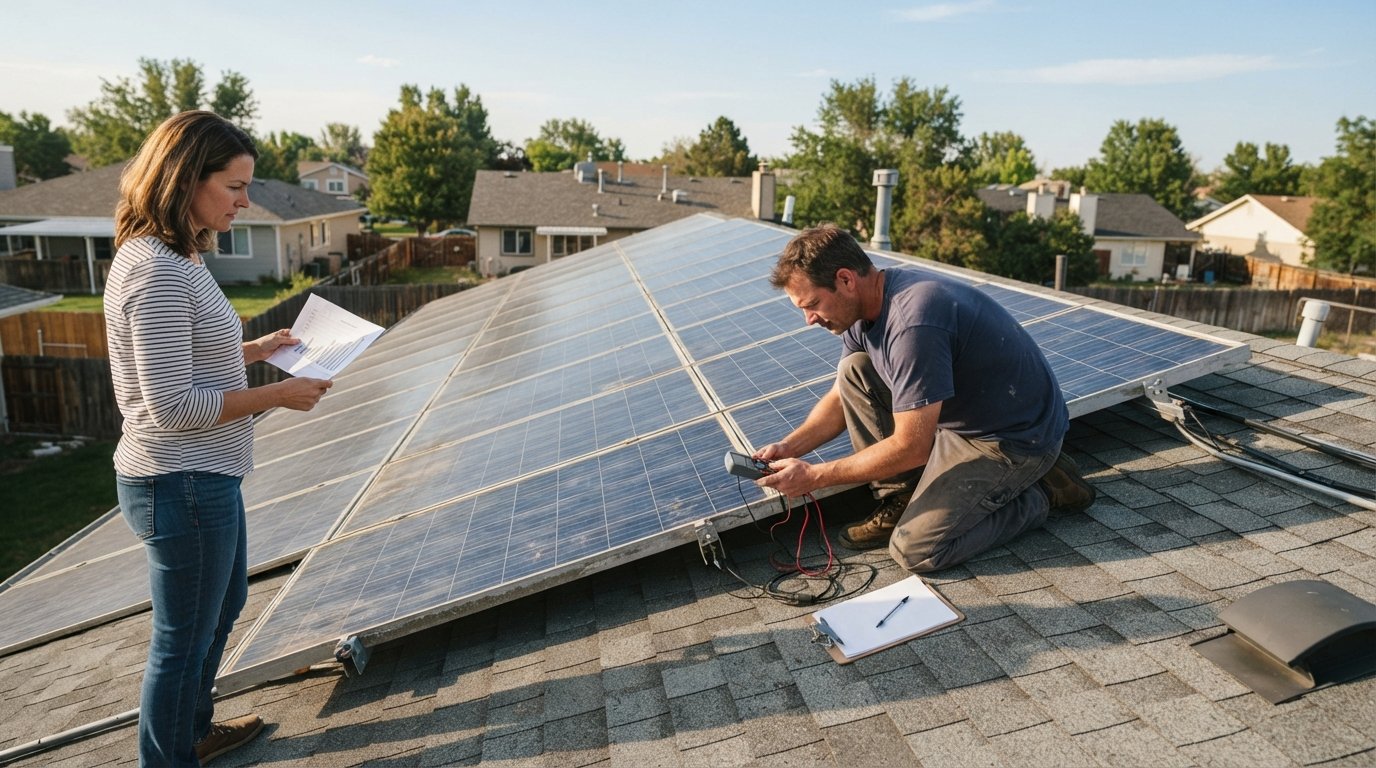
Finally, installation quality quietly determines how close your system stays to its warranty curve. Loose connections, mismatched components, and undersized wiring create resistance and heat. Inverters that fail and go unreplaced for months mean lost production that never comes back. A thorough commissioning report, proper torque on all connections, and a monitoring platform that alerts you to underperformance are the practical defenses against premature degradation.
A simple annual routine covers most of the risk: check your monitoring dashboard monthly, schedule a professional inspection every two to three years, clean panels when output drops noticeably, and keep documentation of every service visit. These habits cost little and protect a 25-year investment.
Comparing Quotes with Degradation in Mind
When you request quotes, degradation rate should sit alongside price, efficiency, and warranty length as a core comparison criterion, not an afterthought buried in a spec sheet. A quote that is 2,000 dollars cheaper but uses panels degrading at 0.7 percent per year instead of 0.3 percent may actually cost you more over the system's life.
A practical way to evaluate any quote is to ask for the year-25 production estimate in kilowatt-hours, not just the year-one number. Reputable installers can model this using tools like PVWatts or their own design software. If an installer cannot or will not provide it, that is a warning sign. Then compare the year-25 figure across quotes and multiply it by your current utility rate to see the lifetime value difference in dollars.
It also helps to ask three specific questions before signing: What is the guaranteed degradation rate after year one? Is the performance warranty transferable if I sell my home? Who backs the warranty if the manufacturer exits the market? The answers separate serious installers from order-takers, and they give you written documentation to hold everyone accountable for the next quarter century.
Solar panels are one of the few home investments that pay you back every month, and degradation is simply the slow tax on that return. Modern modules lose only a fraction of a percent of output each year, and strong warranties guarantee most of that performance in writing. Choose panels with a low published degradation rate, install them well, keep them clean and monitored, and your system will still be producing the vast majority of its original power when your mortgage is long paid off. The owners who get the most from solar are not the ones who chase the lowest sticker price; they are the ones who understand the numbers behind the panels and plan for the full 25 years.