
Solar Panel Maintenance Costs and Service Plans: 2026 Guide
Solar panel maintenance costs and service plans explained, with real 2026 pricing and repair tips. Call 8332123715 for expert guidance.

By Andy Pearson
Learn more about Solar Panel Cleaning for guides, costs, and what to expect.
Compare Solar Panel Cleaning Pros Near You

Enter your ZIP code to compare top-rated local professionals and request free quotes.
Your solar panels sit on the roof, silently turning sunlight into savings, and most days you probably forget they are even there. That is the beauty of solar: no moving parts, no fuel deliveries, no daily chores. But forgetting about them entirely can cost you money. Dust, pollen, bird droppings, and seasonal debris slowly chip away at production, and a single failed inverter can wipe out weeks of savings before you notice. Understanding what solar panel maintenance costs and service plans actually look like in 2026 helps you protect the investment you already made and avoid surprise repair bills down the road.
The good news is that solar is still one of the lowest-maintenance energy systems you can put on a home. The less good news is that "low maintenance" is not the same as "no maintenance." Panels need occasional cleaning, inverters need monitoring, and racking and wiring deserve a professional look every few years. How much you pay depends on where you live, how big your system is, and whether you choose to handle tasks yourself or bundle everything into a service plan.
What Solar Panel Maintenance Actually Involves
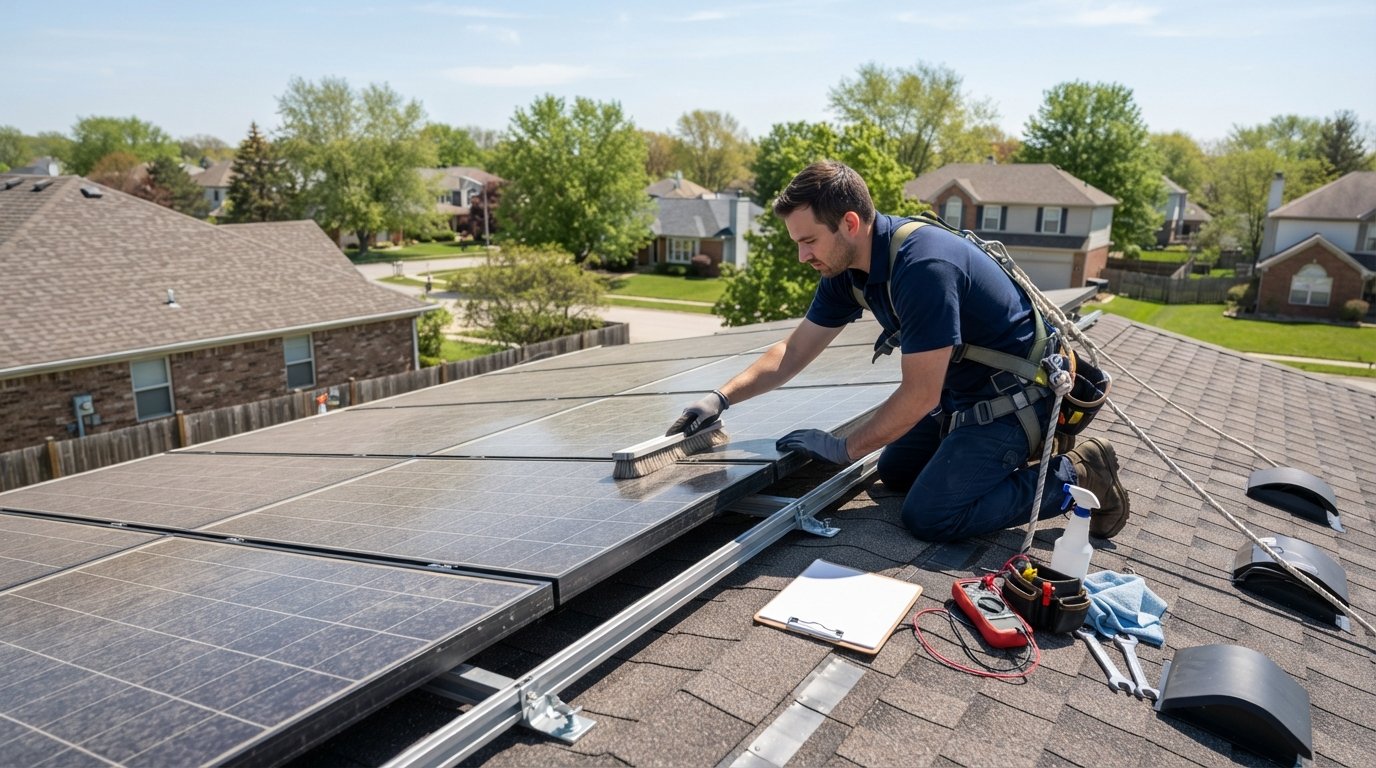
Maintenance for a residential solar array falls into a few clear buckets: cleaning, inspection, electrical checks, and component replacement. Cleaning removes dust, pollen, and bird droppings that block sunlight. Inspection catches loose racking, cracked glass, rodent damage, and water intrusion before they become expensive. Electrical checks verify that inverters, optimizers, and wiring are performing as expected. Component replacement covers the parts that simply wear out, most commonly the inverter around year 10 to 15.
How often each task is needed depends heavily on your environment. A home in dusty Arizona or West Texas may need cleaning two to four times per year, while a home in a rainy climate with regular downpours might only need it once. Homes under heavy tree cover deal with more leaf litter and bird activity, while homes near farmland may see more agricultural dust. Snowy regions add a winter wrinkle: you generally should not climb up to clear snow yourself, both for safety and because panels are built to shed snow on their own once the sun hits them.
Most homeowners never think about maintenance until production drops or a red light appears on the inverter. By then, the problem has usually been developing for weeks. A modest amount of proactive care keeps a system running near its rated output for 25 years or more, which is the whole point of going solar in the first place.
Typical Solar Panel Maintenance Costs in 2026
Costs vary by region, system size, roof pitch, and the going labor rate in your market, so treat any number you see as a range rather than a fixed price. That said, the industry has settled into fairly predictable bands for the most common services. Here is a realistic snapshot of what homeowners are paying this year.
- Professional cleaning: $150 to $400 for a typical residential array, with higher prices for steep roofs, tile roofs, or systems over 30 panels.
- Full system inspection: $150 to $300, often bundled with cleaning.
- Inverter repair or replacement: $500 to $2,500 depending on brand and whether it is a string inverter or microinverters.
- Panel replacement: $200 to $600 per panel installed, mostly driven by labor and whether matching panels are still available.
- Wiring or racking repairs: $200 to $1,000 depending on the scope and roof access.
Annualized, most homeowners spend somewhere between $0 and $300 per year on maintenance, with the average landing closer to $100 to $150 when you spread occasional repairs across the life of the system. Systems under warranty often cost nothing out of pocket for covered components, though labor may still apply depending on the warranty terms. That is why reading the fine print on your panel and inverter warranties matters as much as the sticker price.
If you are still in the shopping phase and want to compare equipment and system designs before committing, a good starting point is to use a solar panel selection tool for your home so you understand what you are maintaining before you buy it.
DIY Maintenance vs Professional Service: Where to Draw the Line
Some maintenance tasks are genuinely safe and sensible for homeowners to handle. Others are not, and the difference usually comes down to height, electricity, and warranty risk. Panels produce DC electricity whenever light hits them, so even a "shut off" system can carry live voltage at the panel level. That is a serious hazard for anyone without proper training and equipment.
Safe DIY tasks generally include visual inspections from the ground, keeping trees trimmed back, and rinsing panels with a garden hose from a safe position during cool morning hours. You should never use a pressure washer on panels, walk on them, or use abrasive soaps, all of which can void warranties or cause micro-cracks.
Professional service makes sense for anything involving roof access, electrical work, or warranty-sensitive components. Most manufacturers require installation and some repairs to be performed by certified professionals to keep the warranty valid. If your inverter is throwing error codes, if production has dropped more than 10 percent without an obvious cause, or if you see any signs of arcing, burning, or water intrusion, call a pro.
If you want to connect with vetted local installers and service providers who specialize in solar rather than general handyman work, FreeSolarPowerQuotes is a useful resource for comparing options and getting no-obligation quotes before you commit to a maintenance contract.
Solar Service Plans: What They Include and What They Cost
Service plans, sometimes called maintenance agreements or performance plans, bundle routine care into a predictable monthly or annual fee. They are most popular with homeowners who want one phone number to call when something goes wrong, and with older systems that are past their initial warranty period.
Most plans fall into three tiers. Basic plans cover annual inspection and cleaning, usually $100 to $200 per year. Mid-tier plans add monitoring, remote diagnostics, and priority scheduling, typically $200 to $400 per year. Premium plans include full monitoring, guaranteed response times, inverter coverage, and sometimes a production guarantee, running $400 to $800 or more per year. Some installers include the first one to three years of service free with a new installation, which is worth asking about during the quote process.
Whether a plan is worth it depends on your situation. If your system is new and under full warranty, a basic plan is often enough. If your system is 10 years old and the inverter is nearing end of life, a mid-tier or premium plan can pay for itself the first time something fails. If you are highly hands-on and your system is simple, you may be fine with pay-as-you-go service.
How to Evaluate a Maintenance Contract Before You Sign
Not all service plans are created equal, and the differences matter most when you actually need help. Before signing anything, read the contract with a few specific questions in mind. What exactly is covered, and what is excluded? How fast will they respond to a production outage? Do they use their own technicians or subcontract? Is the plan transferable if you sell the home? Are there cancellation fees?
A few red flags to watch for: plans that exclude inverter coverage but still charge premium prices, plans with vague response time language like "as soon as possible," and contracts that lock you in for multiple years with no exit. On the flip side, a strong plan will spell out response times in hours or days, list covered components by name, and offer a clear path to cancel.
It also helps to ask whether the company monitors your system remotely. Remote monitoring catches underperformance early, often before you would notice on your utility bill, and it is one of the most valuable features a service plan can offer. If two plans cost roughly the same, choose the one with monitoring and clear response commitments every time.
Warranties, Insurance, and Why Maintenance Records Matter
Your solar panels likely carry a 25-year performance warranty, and your inverter probably has a 10 to 12-year warranty that can sometimes be extended. Those warranties are powerful protections, but they come with conditions. Most require that the system be installed and serviced according to manufacturer guidelines, and some require proof of regular maintenance if you file a claim.
That is where keeping records pays off. Save receipts, service reports, and monitoring screenshots. If a panel fails at year 12 and the manufacturer asks whether the system was maintained, you want a clean paper trail. Homeowners insurance also comes into play: most policies cover solar panels as part of the dwelling, but damage from neglect, pests, or improper installation may be excluded. Documented maintenance strengthens your position if you ever file a claim.
For homeowners in hail-prone states like Texas, Colorado, and Oklahoma, an annual inspection after storm season is especially valuable. Catching cracked glass or compromised seals early can be the difference between a warranty claim and an out-of-pocket replacement.
When to Repair, When to Replace, and When to Do Nothing
Not every dip in production requires a service call. Seasonal variation, cloud cover, and soiling can all cause temporary drops that resolve on their own. But some signals clearly justify professional attention.
- Call a pro immediately: inverter error codes, burning smells, visible arcing, water intrusion, or a complete production stop.
- Schedule service soon: production down more than 10 percent for several weeks, visible cracks in panel glass, or loose racking.
- Handle it yourself: light dust, pollen, or leaves that rinse off easily, plus routine tree trimming.
- Wait and monitor: small day-to-day fluctuations tied to weather, which are completely normal.
Repair versus replace usually comes down to age and cost. A $400 inverter repair on a 12-year-old unit that is likely to fail again may not make sense compared to a $1,500 replacement with a fresh warranty. A single cracked panel under warranty should always be claimed rather than replaced out of pocket. An experienced installer can walk you through the math for your specific system.
Keeping Long-Term Costs Low
The cheapest maintenance is the maintenance you never have to do because you designed and installed the system well in the first place. Choosing quality equipment, working with a certified installer, and keeping trees trimmed back all reduce lifetime costs. So does registering your warranties promptly and setting up monitoring from day one.
It also helps to think about maintenance costs as part of your overall solar investment, not as an afterthought. A system that costs $200 more per year to maintain but produces 15 percent more energy may still be the better financial choice. Run the numbers over 25 years, not just the first year.
If you are comparing installers and want transparent pricing that accounts for long-term service, ask each one what their maintenance program looks like after year one. The answers will tell you a lot about how they treat customers after the sale.
Solar panel maintenance costs and service plans do not have to be complicated. Budget a modest amount each year, keep records, choose a plan that matches your system's age and your comfort level with DIY tasks, and you will keep your array producing at or near its peak for decades. That is the whole promise of solar, and a little care is all it takes to keep it.