
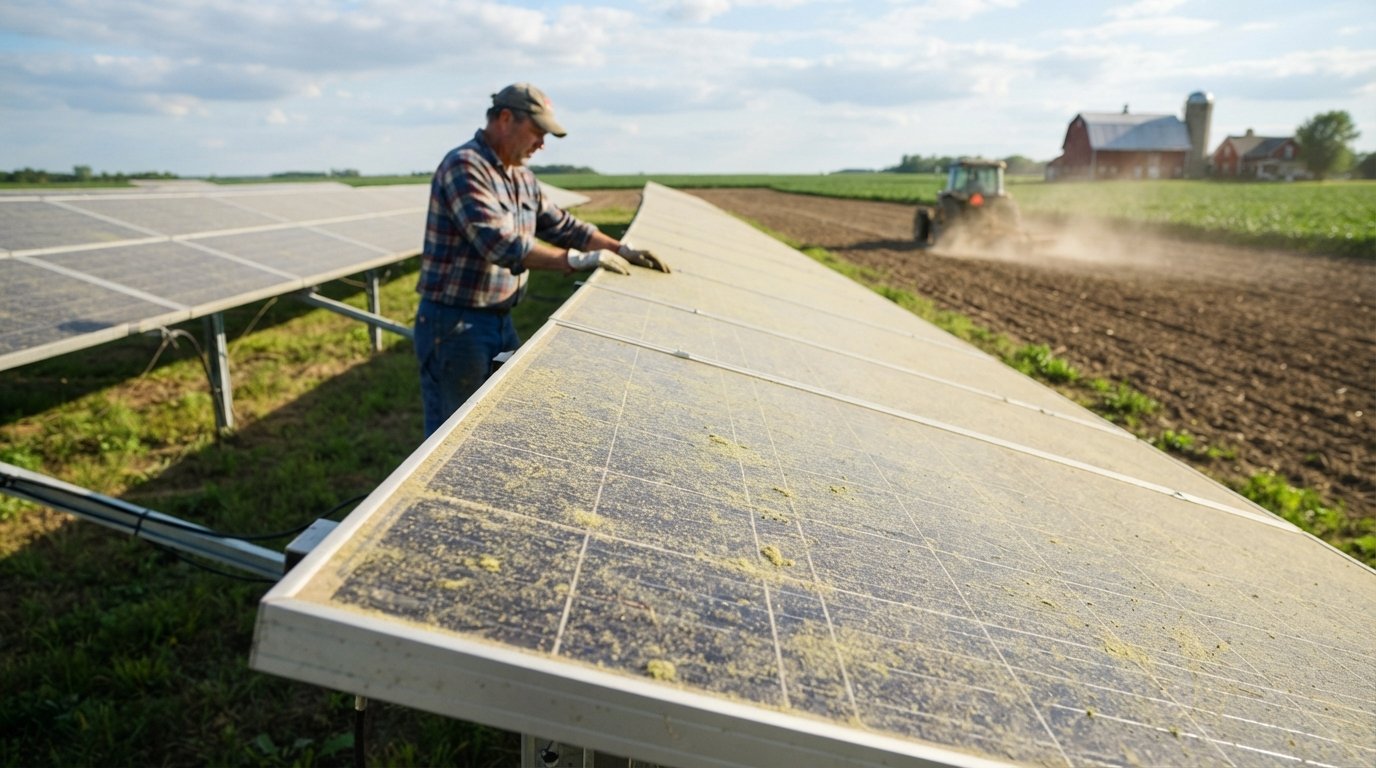
Solar Panel Soiling Losses: Dust, Pollen, and Farming Impact
Quantify solar panel soiling losses from dust, pollen, and farming. Call (833)-212-3715 to connect with pros who can help you recover lost energy.

By Andy Pearson
Learn more about Solar Panel Cleaning for guides, costs, and what to expect.
Compare Solar Panel Cleaning Pros Near You

Enter your ZIP code to compare top-rated local professionals and request free quotes.
Your solar panels are quietly losing money every day they sit dirty. In dusty, agricultural, or high-pollen regions, soiling losses can silently erode 5%, 10%, or even 25% of your system's output before you notice anything on the inverter display. For farmers and rural homeowners, the combination of airborne dust, seasonal pollen, and agricultural activity creates a perfect storm of performance degradation. This article breaks down exactly how much energy you are losing, how to measure it, and when cleaning actually pays for itself. If you are still selecting equipment, our solar panel selection tool guide can help you choose models that resist soiling better.
Understanding Soiling Losses and Why They Matter
Soiling is the accumulation of dust, dirt, pollen, bird droppings, and other particulate matter on the surface of solar panels. This layer blocks sunlight from reaching the photovoltaic cells, directly reducing electricity generation. Unlike a permanent defect, soiling is reversible through cleaning, but the cost and effort of cleaning must be weighed against the energy recovered. In agricultural settings, soiling rates can be significantly higher than in urban or suburban environments due to exposed soil, farming operations, and increased pollen from crops.
The financial impact is straightforward: if your system generates 10,000 kWh per year and soiling causes a 10% loss, you are losing 1,000 kWh annually. At an average U.S. electricity rate of $0.15 per kWh, that is $150 per year. For larger systems or higher soiling rates, the loss can reach hundreds or thousands of dollars. Understanding your specific soiling profile is the first step toward recovering that value.
Typical Soiling Loss Percentages by Region and Season
Soiling losses vary dramatically across the United States. According to research from the National Renewable Energy Laboratory (NREL), annual average soiling losses range from less than 1% in clean, rainy climates to over 20% in dusty, arid regions. The following list summarizes typical ranges by region, but keep in mind that local conditions, panel tilt, and farming activity can push losses higher.
- Southwest and arid regions (Arizona, Nevada, New Mexico): 10% to 25% annual loss without regular cleaning, peaking in dry, windy months.
- Agricultural heartlands (Midwest, Central Valley): 5% to 15% annual loss, with spikes during planting and harvest when dust and pollen are airborne.
- Southeast and humid areas: 3% to 8% annual loss, often mitigated by frequent rainfall but with pollen events causing temporary spikes.
- Northeast and rainy climates: 1% to 5% annual loss, with rain self-cleaning panels for much of the year.
Seasonally, soiling tends to peak in late spring and early summer due to pollen, and in dry summer months when dust accumulates. In farming areas, fall harvest can also resuspend soil particles. Winter snow can temporarily cover panels, but snow typically slides off and does not contribute to long-term soiling in the same way. The key takeaway: if you live in a dusty or agricultural region, assume your losses are at the higher end of these ranges until you measure them.
How to Estimate Your Own Soiling Rate from Monitoring Data
You do not need laboratory equipment to estimate soiling losses. Most modern solar systems include monitoring software that tracks daily energy production. By comparing actual production to expected production on clear days, you can infer the soiling rate. Here is a simple method:
- Identify a clean reference period. Right after a heavy rain or a manual cleaning, record the system's output on a clear, sunny day. This represents your clean baseline.
- Track daily output over time. Log production on subsequent clear days. As soiling accumulates, output will gradually decline relative to the baseline.
- Calculate the loss percentage. Subtract the current output from the baseline output, divide by the baseline, and multiply by 100. For example, if baseline is 50 kWh and current is 45 kWh, the loss is 10%.
- Repeat seasonally. Soiling rates change with weather and farming cycles, so repeat this process each season to build a profile.
For a more precise approach, some monitoring platforms offer soiling loss estimates based on irradiance sensors or satellite data. If your system does not have these features, the manual method above is sufficient for most homeowners. Keep a simple log in a spreadsheet or notebook to track trends. Over time, you will see how quickly your panels get dirty and when cleaning delivers the highest return.
Cleaning Frequency Thresholds: When Does Cleaning Pay Back?
Cleaning solar panels costs money, either in DIY supplies and time or in professional services. The decision to clean should be based on economic payback: clean only when the value of recovered energy exceeds the cost of cleaning. As a general rule, cleaning is worthwhile when soiling losses exceed 5% and the cost per cleaning is less than the value of lost energy over the period between cleanings.
For example, suppose a professional cleaning costs $150 and your system loses 8% of its output due to soiling. If your system generates 8,000 kWh per year and electricity is $0.15 per kWh, an 8% loss equals 640 kWh, or $96 per year. If soiling accumulates over six months, the loss is $48, which is less than the cleaning cost. In this case, cleaning once per year might be more economical. However, in high-soiling areas where losses reach 15% or more, cleaning twice per year could be justified. The table below provides a rough guide, but you should plug in your own numbers.
- Loss below 5%: Usually not worth cleaning unless cleaning is very cheap or free (e.g., after rain).
- Loss 5% to 10%: Consider cleaning if you can do it safely yourself or if professional cleaning is competitively priced.
- Loss above 10%: Cleaning is likely cost-effective, especially in agricultural areas where losses can climb quickly.
Remember that cleaning frequency also depends on your tolerance for risk. Climbing on roofs to clean panels can be dangerous, so professional cleaning is often recommended. NewSolarQuotes can connect you with certified solar professionals who offer panel cleaning services, ensuring the job is done safely and effectively.
Rain, Tilt Angle, and Pollen Events That Self-Clean Panels
Not all soiling requires intervention. Rain can naturally wash away accumulated dust, but its effectiveness depends on intensity and frequency. Light drizzle may actually make things worse by creating muddy streaks, while heavy rain can clean panels effectively. Panel tilt also plays a role: steeper angles shed water and debris more readily, while flat-mounted panels accumulate soiling faster.
Pollen events are a special case. During spring, trees and crops release massive amounts of pollen that coat panels in a fine yellow film. This film can be sticky and resistant to light rain. A single heavy rainstorm may be needed to clear it. In farming areas, pollen from crops like corn and soybeans can be particularly problematic. Monitoring your system during pollen season is crucial; you may see a sudden drop in production that persists until a significant rain or manual cleaning occurs. If you notice a sharp decline that does not recover after a light rain, pollen is a likely culprit.
Monitoring Alerts That Reveal Hidden Soiling Losses
Many solar monitoring systems offer alerts for underperformance. These alerts can be configured to notify you when production falls below a certain threshold relative to expected output. Such alerts are invaluable for catching soiling losses early, before they compound. For instance, if your system normally produces 40 kWh on a clear day and suddenly drops to 35 kWh, an alert can prompt you to investigate. Without monitoring, you might not notice until the loss is severe.
Some advanced systems use machine learning to distinguish between soiling and other issues like inverter faults or shading. If you are in the market for a new system, consider inverters with built-in soiling detection. And if you already have a system, check whether your monitoring app allows you to set custom alerts. Regular review of your production data, coupled with alerts, ensures you stay ahead of soiling losses. For homeowners looking to upgrade or install a new system, our home remodeling and solar installation professionals can help integrate monitoring solutions that fit your needs.
Strategies to Minimize Soiling Losses in Agricultural Settings
Farmers and rural homeowners face unique challenges. Dust from tilling, harvesting, and livestock can settle on panels quickly. Pollen from crops adds another layer. To mitigate these losses, consider the following strategies:
- Optimize panel tilt: Steeper tilt angles (30 degrees or more) allow better self-cleaning by rain.
- Establish vegetation barriers: Planting windbreaks or grass buffers can reduce dust transport onto panels.
- Schedule cleaning around farming activities: Clean panels after major dust-generating events like harvest.
- Use anti-soiling coatings: Some panels come with hydrophobic coatings that repel dust and make cleaning easier.
These measures can reduce soiling rates and extend the time between cleanings, saving both energy and money. Additionally, when planning a new solar installation, consult with installers about local soiling conditions. They can recommend panel types and tilt angles that perform better in dusty environments.
When to Call a Professional
While DIY cleaning is possible, safety and effectiveness are concerns. Roof-mounted systems require ladder work and risk of falls. Moreover, improper cleaning techniques can scratch panels or void warranties. Professional solar cleaners have the tools and training to clean safely and efficiently. If your soiling losses are significant or your roof is steep, hiring a pro is wise. NewSolarQuotes can help you find certified solar professionals in your area who offer cleaning and maintenance services. By addressing soiling proactively, you protect your investment and maximize your energy savings.
In summary, solar panel soiling losses from dust, pollen, and farming activities are real and measurable. By understanding your regional soiling patterns, monitoring production, and cleaning strategically, you can recover lost energy and improve your system's return on investment. Stay vigilant, especially if you live in an agricultural area, and do not let dirt steal your solar savings.
Learn more about Solar Panel Cleaning for guides, costs, and what to expect.
Compare Solar Panel Cleaning Pros Near You
Enter your ZIP code to compare top-rated local professionals and request free quotes.