
Solar Panel Soiling Losses: When Cleaning Pays Off
Understand solar panel soiling losses and when cleaning pays off. Call 8332123715 to connect with certified solar pros and maximize your savings.

By Alexia Mabel
Learn more about Solar Panel Cleaning for guides, costs, and what to expect.
Compare Solar Panel Cleaning Pros Near You

Enter your ZIP code to compare top-rated local professionals and request free quotes.
Dust, pollen, bird droppings, and agricultural spray settle on solar panels every day, quietly eroding the energy output you paid for. A system that produced 10 kilowatts in March might drop to 8.5 kilowatts by August, not because the hardware failed, but because a film of grime is blocking sunlight. The question every homeowner eventually faces is simple: does cleaning the array actually recover enough production to justify the cost, or is it money poured into a bucket with a slow leak? The answer depends on where you live, how your system is tilted, what surrounds your property, and how your utility compensates you for exported power. Understanding solar panel soiling losses when cleaning actually pays off requires looking at the math, not just the dirt.
This guide walks through the real economics of panel cleaning, the conditions that make it worthwhile, the conditions that make it a waste, and the practical steps to decide for your own roof. Whether you own a 6-kilowatt residential array in Arizona or manage a 500-kilowatt commercial rooftop in North Carolina, the same variables apply. The goal is to help you spend money only when the return is measurable and real.
What Solar Panel Soiling Actually Costs You
Soiling loss is the percentage of potential energy production lost because something is covering the glass. In most U.S. residential installations, average soiling losses run between 2 and 7 percent annually, but that average hides enormous variation. A rooftop in Portland, Oregon, washed by regular rain, might lose less than 2 percent. A ground-mount in west Texas, where dust storms roll through in spring, can lose 15 percent or more during dry months. Agricultural areas with nearby fields, industrial zones with smokestack emissions, and regions with heavy pollen seasons all push losses higher.
The financial impact scales directly with your system size and your local electricity rate. A 10-kilowatt system in a sunny state producing 15,000 kilowatt-hours per year at an average retail rate of 15 cents per kilowatt-hour generates roughly $2,250 in annual value. A 5 percent soiling loss quietly removes about $112 from that total. A 12 percent loss during a dry season removes far more. Over a 25-year system life, even modest soiling compounds into thousands of dollars of foregone savings.
Beyond direct production loss, heavy soiling can create secondary problems. Persistent bird droppings create hot spots that stress individual cells. Dust that bonds with morning dew forms a cement-like layer that rain cannot rinse away. Pollen combined with dust can stain glass if left for months. These issues can shorten panel life and reduce performance even after cleaning. The cost of soiling, then, is not just lost kilowatt-hours today; it is potential long-term degradation if the problem is ignored.
The Variables That Determine Whether Cleaning Pays Off
Not every dirty panel deserves a cleaning crew. The decision hinges on a handful of measurable factors that together determine your break-even point. The first is your local soiling rate, which varies dramatically by geography and season. The second is your electricity rate or net metering compensation, because higher rates mean each lost kilowatt-hour costs more. The third is the cost of cleaning itself, which ranges from free (if you do it yourself with a hose) to several hundred dollars for a professional crew on a steep or multi-story roof. The fourth is your system's tilt and mounting, since steeper arrays shed dirt more effectively than flat ones.
Rainfall patterns matter enormously. In regions with frequent, heavy rain, panels often self-clean well enough that professional cleaning never makes financial sense. In arid regions with months of dry weather, the calculus flips. A system in Phoenix might need cleaning two or three times per year to stay near peak, while a system in Seattle might go years without a wash and still perform within a few percent of optimal.
Here are the key factors to weigh when deciding whether to schedule a cleaning:
- Local soiling rate: Areas with dust, pollen, agriculture, or industry see losses of 10 to 20 percent or more during dry seasons.
- Electricity rate or net metering credit: Higher rates mean each lost kilowatt-hour costs more, making cleaning more valuable.
- Cleaning cost: DIY costs are minimal; professional cleaning runs $150 to $500 depending on system size and roof complexity.
- Tilt angle: Panels tilted 15 degrees or more shed dirt better than flat-mounted arrays.
- Rainfall frequency: Regular heavy rain reduces the need for manual cleaning.
After you have these numbers, a simple break-even calculation tells you whether cleaning makes sense. Multiply your system's annual production by the soiling loss percentage to find lost kilowatt-hours. Multiply that by your electricity rate to find lost dollars. If the cost of cleaning is less than the value of recovered energy over the period the panels stay clean, cleaning pays off. If it is more, you are better off waiting for rain or accepting the loss.
When Cleaning Clearly Pays Off
There are situations where the math is not close, and cleaning is an obvious win. The first is high soiling combined with high electricity rates. A homeowner in California paying 30 cents per kilowatt-hour with a 15 percent soiling loss on a 8-kilowatt system is losing roughly $540 per year to dirt. A $300 professional cleaning that restores full output for six months recovers $270, which is a clear positive return. In states with lower rates, the same soiling loss is worth less, but cleaning may still pay if the cost is low.
The second clear case is commercial or agricultural installations where production directly offsets high demand charges or time-of-use rates. A farm with a 100-kilowatt array powering irrigation pumps during peak summer rates can lose thousands of dollars to soiling in a single dry month. Professional cleaning crews that service commercial rooftops often pay for themselves in a single billing cycle under these conditions.
The third case is any system with visible, heavy contamination such as bird droppings, construction dust, or wildfire ash. These are not uniform films; they are concentrated blockages that create hot spots and disproportionate losses. Even a small number of soiled panels can drag down string performance if they are wired in series. In these situations, cleaning is less about average soiling rates and more about preventing localized damage and production drops.
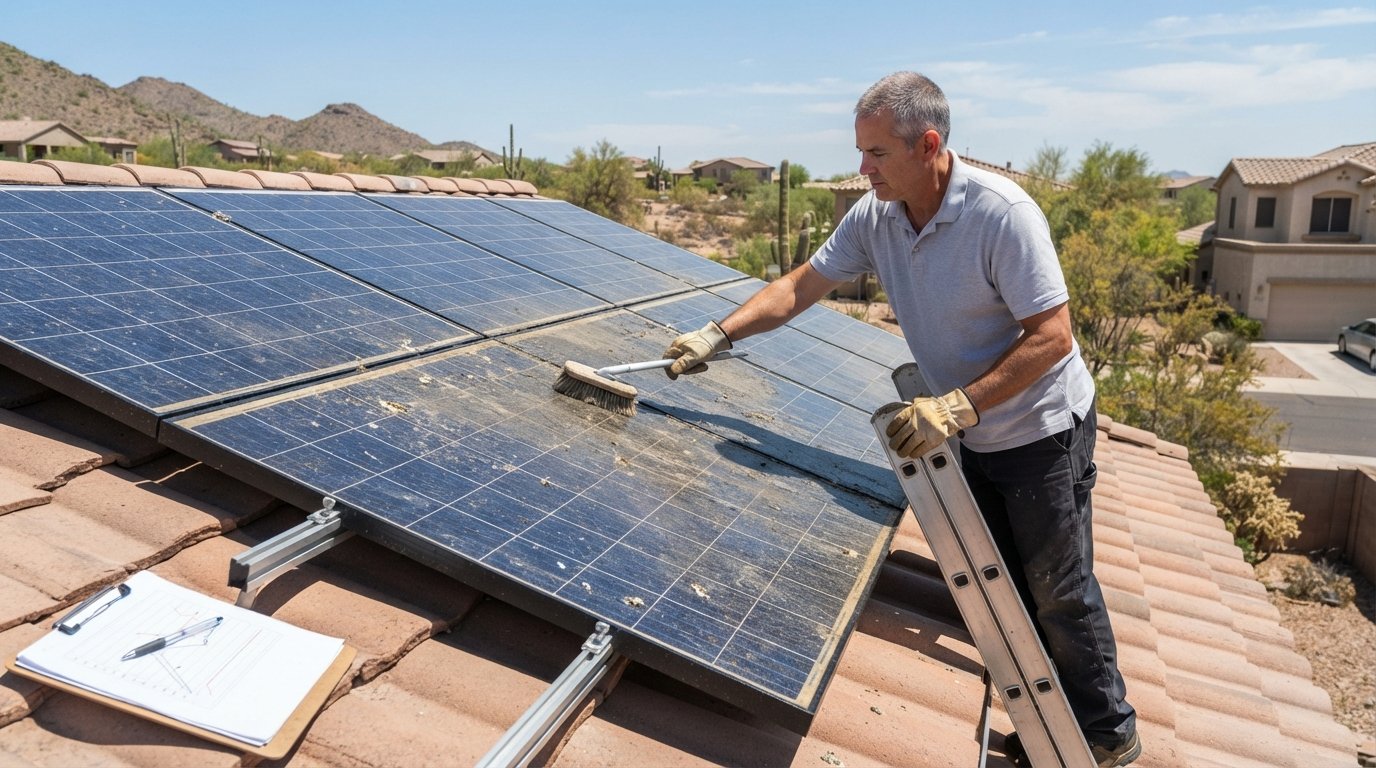
Finally, cleaning pays off when you can do it yourself safely and cheaply. A ground-mount array or a single-story roof with easy access can be cleaned with a garden hose, a soft brush, and a few hours of time. The only cost is water and effort, which makes the break-even threshold very low. If your system qualifies for solar panel financing and you are already focused on maximizing returns, DIY cleaning is one of the highest-return maintenance tasks available.
When Cleaning Does Not Pay Off
Just as important as knowing when to clean is knowing when to skip it. In many U.S. climates, rain does the job well enough that professional cleaning never recovers its cost. If you live in an area with regular rainfall spread throughout the year, your panels may never accumulate enough soiling to justify a service call. Studies across multiple climates consistently show that in temperate, rainy regions, soiling losses stay under 3 percent, and the cost of cleaning exceeds the value of recovered energy.
Steeply tilted arrays also tend to self-clean. Panels mounted at 30 degrees or more allow rain to sheet off quickly, carrying dust and pollen with it. If your roof pitch is steep and your region gets regular rain, your soiling losses may be negligible. In these cases, spending money on cleaning is effectively donating to your installer with no measurable return.
Another situation where cleaning does not pay is when the cleaning method itself risks damage. High-pressure washers can force water past seals, crack glass, or void warranties. Abrasive brushes can scratch anti-reflective coatings. If the only available cleaning option is aggressive or unqualified, the risk of damage outweighs the benefit of removed dirt. In these cases, waiting for rain or accepting modest losses is the wiser financial choice.
Finally, cleaning does not pay if your system is already underperforming for other reasons. If inverters are failing, wiring is faulty, or shading is severe, soiling is not your primary problem. Cleaning a system with underlying issues produces disappointing results and can mask more serious faults. Diagnose performance problems first, then address soiling if it remains a factor.
How to Measure Your Own Soiling Loss
You do not need a laboratory to estimate your soiling losses. Most monitoring systems, whether from SolarEdge, Enphase, or another provider, report daily and monthly production. By comparing clear-day production in a clean month to clear-day production in a dusty month, you can estimate the soiling effect. If your system produced 50 kilowatt-hours on a sunny day in April and only 44 kilowatt-hours on a similarly sunny day in August, the difference is likely due to a combination of soiling, heat, and panel degradation, with soiling often the largest variable.
A more direct method is to clean a small section of one panel and compare its output to an adjacent dirty panel using a clamp meter or the system's per-panel monitoring. If the clean section produces meaningfully more, you have your answer. This approach is especially useful for commercial systems where per-panel data is available and the stakes are higher.
For homeowners who want a simpler rule of thumb, consider these thresholds:
- If you live in a dry, dusty region and have not cleaned in six months, schedule a cleaning or do it yourself.
- If you live in a rainy region and your panels look visibly dirty, monitor production for a month before deciding.
- If you see bird droppings or concentrated debris, clean those areas promptly regardless of overall soiling.
- If your production has dropped more than 10 percent from the same month last year and weather is similar, investigate soiling as a likely cause.
These thresholds are not precise engineering standards, but they provide a practical framework for most homeowners. The key is to make the decision based on data from your own system, not on generic advice. Every roof is different, and the only soiling rate that matters is yours.
Professional Cleaning vs. DIY: Which Makes Financial Sense
The cost difference between professional cleaning and DIY is significant, and so is the risk difference. Professional crews bring specialized equipment, know how to avoid damage, and often carry insurance. They also charge accordingly. A typical residential cleaning runs $150 to $300 for a standard system, while larger or more complex arrays can cost $500 or more. For commercial systems, pricing is usually quoted per panel or per kilowatt.
DIY cleaning costs almost nothing beyond water and a few supplies, but it carries risks. Climbing on a roof is dangerous, especially on steep pitches or two-story homes. Using the wrong tools or technique can scratch glass or void warranties. If you are not comfortable on a roof or your system is difficult to access, professional cleaning may be the safer and ultimately cheaper option once you factor in potential damage.
For many homeowners, the best approach is a hybrid: DIY cleaning for ground-mount or easily accessible arrays, and professional cleaning for steep, high, or complex roofs. This keeps costs low where possible and ensures safety and quality where it matters. The financial decision should weigh the cost of cleaning against the value of recovered energy, but it should also weigh the risk of injury or damage, which can easily exceed the cost of a professional service.
If you are comparing quotes for cleaning or considering a broader solar service provider, platforms like SolarEnergy.ai offer resources and tools that can help you understand system performance and maintenance options. The goal is to make an informed decision, not just a cheap one.
Seasonal Timing and Long-Term Strategy
When you clean matters almost as much as whether you clean. In most U.S. regions, the highest soiling accumulation happens during dry seasons: late spring and summer in the Southwest, summer and early fall in agricultural areas, and pollen season in the Southeast. Cleaning just before your highest-production months ensures you capture the full benefit of restored output when electricity value is highest.
In regions with time-of-use rates, cleaning before the peak-rate season can be especially valuable. If your utility charges more for afternoon power in summer, restoring production in June pays more than restoring it in October. Similarly, if you are on a net metering plan that credits exported power at retail rates, every recovered kilowatt-hour is worth the full retail rate, making cleaning more valuable than in areas with lower export compensation.
A long-term strategy should include regular monitoring, seasonal cleaning where justified, and periodic professional inspections. Panels that are cleaned appropriately last longer and perform closer to their rated output. Panels that are ignored may degrade faster and cost more in lost production over their lifetime. The goal is not to clean obsessively, but to clean intelligently, based on local conditions and measurable returns.
Ultimately, the question of solar panel soiling losses when cleaning actually pays off is answered by your own numbers. In dusty, high-rate, high-soiling environments, cleaning is a clear financial win. In rainy, low-rate, low-soiling environments, it is often a waste. Most homeowners fall somewhere in between, which means a simple calculation and a bit of observation can guide the decision. Clean when the math says clean, skip it when the math says skip, and let your system deliver the returns you expected when you installed it.