
Solar Panel Tilt Angle Optimizer for Maximum Production
A solar panel tilt angle optimizer for maximum production can add 10 to 25 percent more output. Learn how to calculate the ideal angle for your location.

By Andy Pearson
Learn more about Solar Panel Installation and Repair for guides, costs, and what to expect.
Compare Solar Panel Installation and Repair Pros Near You

Enter your ZIP code to compare top-rated local professionals and request free quotes.
A solar panel's tilt angle is one of the few variables a homeowner can actually control after installation, and it quietly determines whether a system hits its projected output or falls short year after year. Panels mounted at the wrong angle can lose 10 to 25 percent of their potential production depending on latitude, season, and roof orientation. A solar panel tilt angle optimizer for maximum production solves that problem by calculating the ideal angle for your exact location, then adjusting it as the sun's path shifts through the year. This guide explains how tilt works, how to calculate it, when adjustable mounting pays off, and how to put the numbers to work on a real roof.
Why Tilt Angle Matters More Than Most Homeowners Realize
Sunlight strikes a solar panel at an angle. When that angle is perpendicular to the panel surface, the panel captures the most irradiance per square meter. When sunlight arrives at a steep angle, part of the beam reflects away and production drops. Tilt is simply the tool that keeps the panel face aligned with the sun's average position over the day and across the seasons.
Latitude is the starting point. A common rule of thumb says the optimal fixed tilt is roughly equal to your latitude. A home in Phoenix at 33 degrees north would tilt panels near 33 degrees, while a home in Boston at 42 degrees north would tilt closer to 42 degrees. That rule gets you within a few percentage points of ideal, but it ignores two important factors: seasonal variation and roof pitch. In summer the sun rides high, so a flatter angle captures more energy. In winter the sun sits low, so a steeper angle performs better. A fixed tilt is always a compromise between those extremes.
Roof pitch adds another layer. Most residential roofs slope between 15 and 45 degrees, and many installers mount panels flush with the roof surface to save on racking costs and preserve aesthetics. That means the roof itself often dictates the tilt, not the sun. If your roof faces south at a 30 degree pitch in a 35 degree latitude city, you are already close to optimal. If your roof faces east or west, tilt adjustments matter less than orientation, and a tilt optimizer should account for both.
How a Tilt Angle Optimizer Calculates the Best Angle
A solar panel tilt angle optimizer for maximum production is not a single formula. It is a set of calculations that weigh latitude, season, panel orientation, local weather patterns, and sometimes shading. The most accurate tools use solar position algorithms that track the sun's declination and hour angle throughout the year, then simulate production at each candidate tilt angle.
Here is the basic process a good optimizer follows:
- Enter your latitude and longitude, or let the tool pull them from your address.
- Input the panel's azimuth, meaning the compass direction it faces (180 degrees is true south in the northern hemisphere).
- Set the time period you want to optimize for: annual production, winter production, or summer production.
- Run a simulation across tilt angles from 0 to 60 degrees in small increments.
- Compare the modeled output at each angle and identify the tilt that produces the highest total kilowatt-hours.
The result often surprises people. For a south-facing array in the continental United States, the annual optimal tilt usually falls between 25 and 35 degrees. Winter-optimized tilt runs 10 to 15 degrees steeper. Summer-optimized tilt runs 10 to 15 degrees flatter. If your utility uses time-of-use rates with high evening prices, a west-facing tilt may beat a south-facing one even though annual production is slightly lower, because the panels generate more during peak pricing hours.
Shading and soiling also affect the math. A panel tilted too flat collects dust, pollen, and bird droppings that block light. A panel tilted steeply sheds debris and snow more easily. In snowy regions, a 45 degree tilt can outperform a 30 degree tilt in winter simply because snow slides off instead of sitting on the glass for days.
Fixed Tilt vs Adjustable Tilt vs Tracking Systems
Once you know the ideal angle, the next question is whether to lock the panels in place or make the tilt adjustable. Each approach has trade-offs in cost, complexity, and production.
- Fixed tilt: Panels are bolted at one angle permanently. Lowest cost, lowest maintenance, and the standard choice for most residential roofs.
- Adjustable tilt: Rack hardware lets you manually change the angle two to four times per year. Adds 5 to 15 percent annual production in many locations, with moderate hardware cost.
- Single-axis tracking: Motors rotate panels east to west following the sun. Adds 15 to 25 percent production but requires ground mounting and moving parts.
- Dual-axis tracking: Motors adjust both tilt and azimuth. Highest production gains, highest cost, and rarely justified for residential systems.
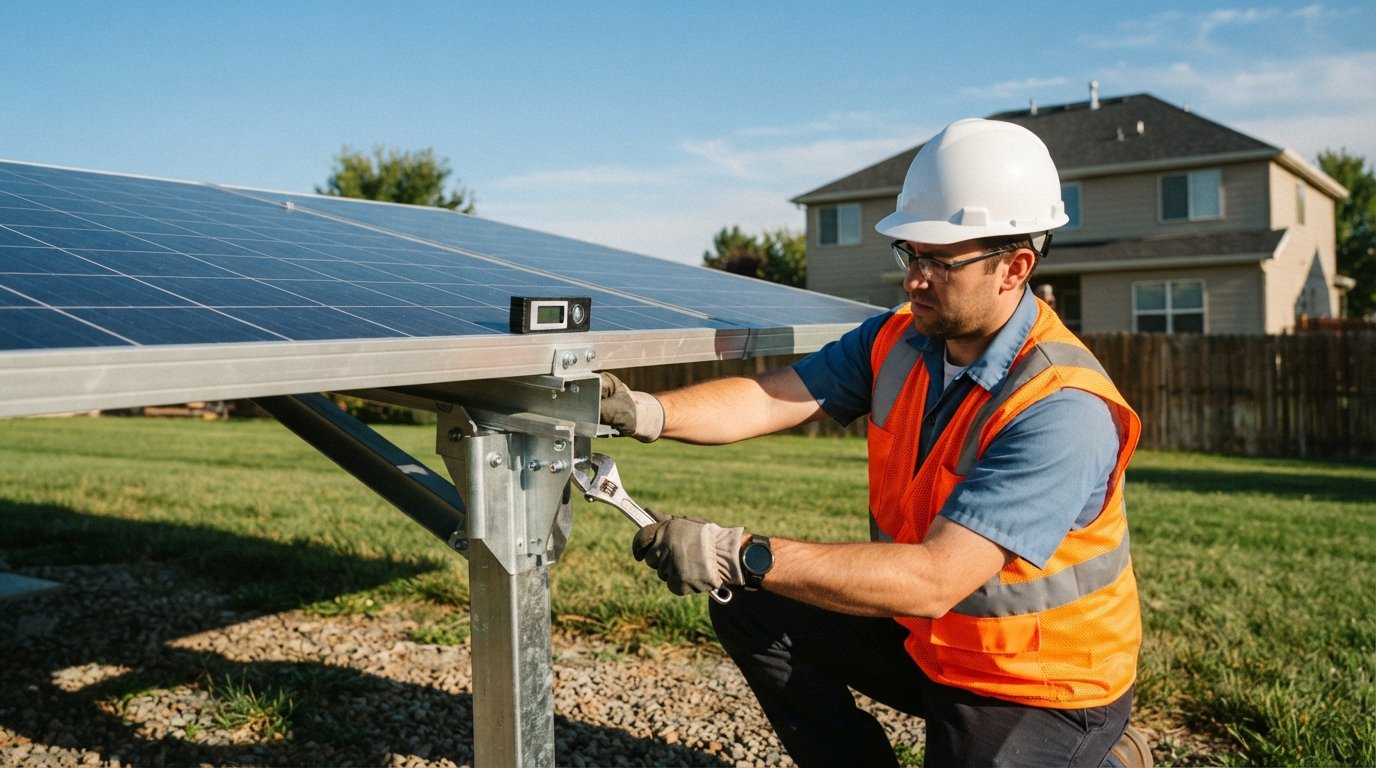
For rooftop systems, fixed tilt is almost always the practical choice because adjustable racks add wind loading concerns and roof penetration complexity. For ground-mounted arrays, adjustable tilt becomes much more attractive because you can walk up to the rack and change the angle with a wrench or a hand crank. A solar panel tilt angle optimizer for maximum production is most valuable in that ground-mount scenario, where the production gain from seasonal adjustment actually shows up on your bill.
Tracking systems deserve a caution. They generate more energy, but they also add motors, controllers, and bearings that can fail. For most homeowners, the maintenance risk and upfront cost outweigh the production gain unless the array is large and the property has plenty of open land.
Seasonal Tilt Adjustments That Actually Pay Off
If you have an adjustable ground mount, you do not need to chase the perfect angle every week. A simple four-setting schedule captures most of the available gain. The exact numbers depend on your latitude, but the pattern holds across the United States.
Set the tilt to latitude minus 15 degrees for summer, latitude for spring and fall, and latitude plus 15 degrees for winter. In a 35 degree latitude location, that means 20 degrees in summer, 35 degrees in spring and fall, and 50 degrees in winter. The winter angle is steeper because the sun is lower in the sky and the panel needs to face it more directly.
Is the effort worth it? For a 10 kilowatt ground-mounted array in a location with good sun, seasonal adjustment can add 400 to 800 kilowatt-hours per year compared to a fixed tilt at the annual optimum. At a retail electricity rate of 15 cents per kilowatt-hour, that is 60 to 120 dollars per year. Over a 25 year system life, the gain reaches 1,500 to 3,000 dollars, which is real money but not life-changing. The decision comes down to whether you enjoy the maintenance or prefer a hands-off system.
One more consideration: manual adjustment requires safe access to the array. If the ground mount sits on a steep slope or behind landscaping, changing the tilt four times a year may become a chore you skip. In that case, a fixed tilt at the annual optimum is the better choice, and a tilt optimizer still helps by identifying that exact angle.
How Tilt Interacts With Orientation, Shading, and Local Climate
Tilt does not operate in isolation. Azimuth, shading, and weather all change how much a given tilt angle helps or hurts. A solar panel tilt angle optimizer for maximum production should account for all of them, and so should you when reviewing installer proposals.
Azimuth is the compass direction the panel faces. In the northern hemisphere, true south is ideal for fixed tilt. Panels facing southeast or southwest lose a few percent of annual production but may gain during morning or afternoon peak rate windows. Panels facing east or west lose more, and tilt adjustments become less effective because the sun's path across those orientations is already oblique. If your roof faces east or west, focus on panel quality and inverter choice rather than tilt micro-optimization.
Shading is the silent killer of solar production. A single tree branch shading one panel can cut the output of an entire string in a traditional system. Tilt cannot fix shading, but it can sometimes reduce it. Raising the tilt angle can lift panels above a low obstruction, while lowering it can tuck them under an overhang. A good optimizer includes a shading model, and a good installer will walk the roof with a shade analysis tool before finalizing the design.
Local climate matters too. Coastal areas with frequent fog or marine layer benefit from steeper tilt in summer to catch the sun as it burns through. Desert regions with intense midday sun may perform well at flatter tilt because the sun is high for most of the day. Snowy regions favor steeper tilt for shedding. A tilt optimizer that uses only latitude will miss these nuances, so look for tools that incorporate local weather data.
Tools and Calculators You Can Use Today
Several free and low-cost tools can calculate optimal tilt for your location. The National Renewable Energy Laboratory offers the PVWatts calculator, which models production at user-defined tilt and azimuth. The Global Solar Atlas provides irradiance data by location. Many manufacturers, including panel and inverter brands, offer their own string sizing and tilt tools. If you are comparing installer proposals, a professional design tool such as Aurora Solar or OpenSolar will include tilt optimization as part of the layout process.
For a quick estimate without software, use the latitude rule and adjust for season. Then verify with a calculator before committing to a racking design. The difference between a guess and a modeled angle can be several percentage points of annual production, which compounds over decades. When you request quotes from local installers, ask each one what tilt they plan to use and why. A credible installer will explain the reasoning, not just default to flush mounting. If you want to compare how different installers approach system design and production estimates, our guide on choosing a solar installer walks through the questions that separate thorough designers from quick-quote operations.
For broader research on solar technology, incentives, and savings modeling, SolarEnergy.ai offers guides, calculators, and industry insights that complement the tilt-specific work described here. Combining a tilt optimizer with a reputable quote comparison process gives you the best shot at a system that performs as promised.
Putting Tilt Optimization Into Your Solar Plan
Tilt angle is not glamorous, but it is one of the few levers that directly affects how many kilowatt-hours your system produces each year. A solar panel tilt angle optimizer for maximum production turns that lever from guesswork into a calculated decision. Start with your latitude, factor in azimuth and shading, decide whether fixed or adjustable mounting fits your site, and verify the final angle with a modeling tool before installation.
If you are still in the research phase, gather quotes from multiple certified installers and compare their tilt assumptions alongside equipment, pricing, and warranties. A system designed around the right angle will outperform a system designed around convenience, and the difference shows up on every utility bill for the next 25 years. Take the time to get the angle right, and the rest of your solar investment has a much better chance of meeting its projections.