
Solar Plus EV Charging for Business Fleets: 2026 Guide
Pair solar plus EV charging for business fleets to cut fuel costs, avoid demand charges, and stabilize your operating budget with onsite clean power.
By Scott Thompson
Learn more about Solar Panel Installation and Repair for guides, costs, and what to expect.
Compare Solar Panel Installation and Repair Pros Near You

Enter your ZIP code to compare top-rated local professionals and request free quotes.
Business fleets are electrifying faster than most operators expected. Delivery vans, service trucks, and executive sedans are returning to base with batteries to refill, and the electricity to refill them is becoming a line item that finance teams scrutinize. Pairing onsite solar with EV charging turns that line item into a controlled, predictable operating cost. It also shields fleet managers from peak demand charges, utility rate spikes, and the public relations risk of charging corporate vehicles on a coal-heavy grid.
The logic is straightforward: solar panels generate power during the same daytime hours your vehicles sit idle at the depot. Instead of exporting that power to the grid for a modest credit, you route it into the batteries of your vans and trucks. The result is lower fuel costs, a smaller carbon footprint, and a stronger sustainability story for customers and investors. But the engineering and financing details are where most fleet solar projects either succeed or stall. This guide walks through the planning, technology, and financial frameworks that make solar plus EV charging for business fleets work in the real world.
Why Pair Solar With EV Charging Instead of Grid Power Alone
Charging a fleet from the grid is simple, but it exposes you to the same volatility that makes diesel and gasoline budgets painful. Utilities are raising demand charges, adding time-of-use rates, and in some regions restricting new high-power interconnections. Solar mitigates all three pressures. When your panels produce power behind the meter, you consume that electricity before it ever hits the utility's rate schedule. That reduces both energy charges and the peak demand component that utilities use to calculate monthly bills.
There is also a resilience argument. A solar array paired with battery storage can keep critical vehicles charged during outages, which matters for emergency services, healthcare logistics, and any fleet that cannot afford downtime. And because solar production peaks in the middle of the day, it aligns well with depot-based fleets that charge between routes or overnight using stored energy. For fleets operating in states with strong net metering or solar renewable energy credits, the economics improve further.
Finally, consider the brand and compliance angle. Many corporate sustainability reports now include Scope 1 and Scope 2 emissions. Charging EVs from a solar array directly reduces Scope 2 emissions and gives your sustainability team verifiable data. That data supports ESG disclosures, helps win contracts with environmentally conscious clients, and can qualify your business for local clean energy incentives. If you are still mapping out the broader energy picture, a solid resource on solar for businesses energy planning can help you connect the dots between generation, storage, and fleet operations.
Designing the Solar Array Around Your Fleet's Duty Cycle
Fleet electrification is not a one-size-fits-all exercise. A last-mile delivery fleet that runs 80 miles per day has very different charging needs than a sales fleet that accumulates 200 miles daily or a utility fleet with power take-off equipment. Before sizing a solar array, you need to understand your duty cycle: how many vehicles, how many miles per day, what payloads, and when they return to base.
Start by calculating daily kilowatt-hour demand. A typical electric cargo van consumes roughly 0.4 to 0.6 kWh per mile. If you operate 20 vans averaging 60 miles per day, that is roughly 600 to 720 kWh of daily charging demand. Add depot overhead, and you can see why a solar array sized only for office loads will fall short. The goal is to offset as much of that charging load as possible with onsite generation, then use grid power or battery storage to cover the remainder.
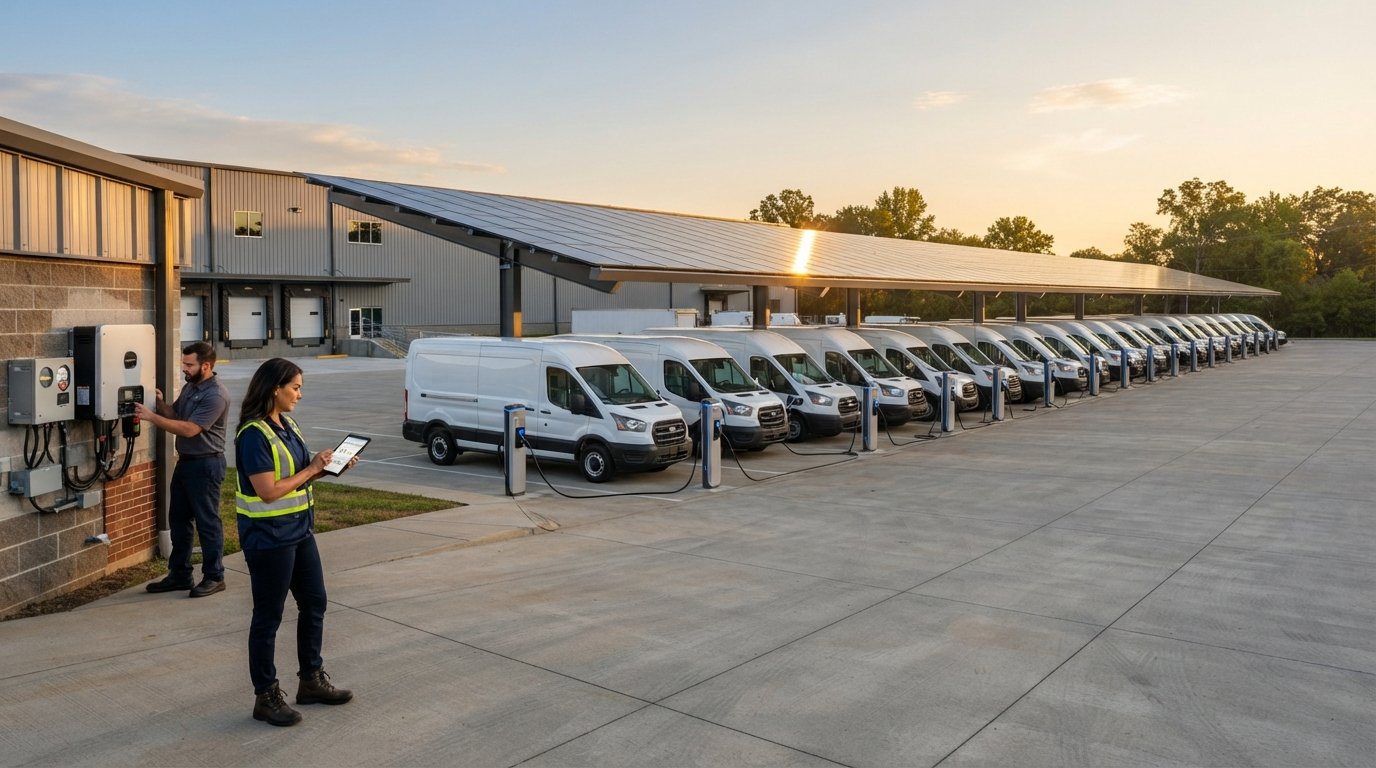
Solar design also depends on available roof and land area. A typical commercial rooftop can host 15 to 25 watts per square foot, while ground-mounted arrays need roughly 4 to 5 acres per megawatt. If your depot has limited space, you may need a combination of rooftop solar, carport solar over parking areas, and a power purchase agreement that sources offsite renewable energy. Carports are particularly attractive for fleets because they shade vehicles while generating power, and they can be financed separately from the building.
When you model the system, pay attention to these variables:
- Daily fleet energy demand in kWh, including seasonal variations
- Solar production profile by hour and season for your location
- Charging schedule: will vehicles charge during solar hours or overnight
- Battery storage capacity needed to shift solar production to evening charging
- Utility rate structure, including demand charges and time-of-use windows
Once you have those numbers, you can right-size the solar array and charger mix. Oversizing solar without storage can lead to exported power that earns low credits. Undersizing means you still pay high demand charges. The sweet spot is usually a solar array that covers 60 to 90 percent of annual charging energy, paired with a battery or smart charging system that manages the rest.
Charging Infrastructure That Scales With Your Fleet
Charging hardware is where fleet managers often underestimate complexity. A single Level 2 charger can replenish a van overnight, but a fleet of 30 vehicles needs a coordinated system of chargers, load management, and electrical infrastructure. The good news is that solar integration does not require exotic equipment. Most commercial EV chargers accept input from solar inverters or hybrid inverters that manage both solar and grid power.
There are three main charging tiers to consider. Level 1 charging uses a standard 120-volt outlet and adds only 3 to 5 miles of range per hour, which is rarely practical for commercial fleets beyond a few vehicles. Level 2 charging uses 240 volts and adds 10 to 60 miles of range per hour, making it the workhorse for depot charging. DC fast charging can add 100 to 200 miles in 30 minutes, but it carries high demand charges and is usually reserved for route support or public-facing charging.
For most business fleets, a mix of Level 2 chargers for overnight and opportunity charging, plus a small number of DC fast chargers for urgent needs, strikes the best balance. The critical enabler is load management software. This software communicates with the chargers and the building's electrical panel to ensure you never exceed your service capacity. It can also prioritize charging based on solar production, vehicle state of charge, and departure time. That means your fleet charges on the cheapest, cleanest electrons available without manual intervention.
When planning infrastructure, think in phases. Phase one might install 10 Level 2 chargers and a 100 kW solar array. Phase two adds 20 more chargers and a 250 kW array as more vehicles electrify. Phased deployment reduces upfront capital and lets you learn from real operating data. It also keeps you eligible for incentive programs that reward incremental clean energy investments.
Financing Models That Make Fleet Solar Affordable
Cash purchase is the simplest way to own a solar plus EV charging system, and it delivers the highest long-term savings. But many fleets prefer to preserve capital for core operations. Fortunately, several financing structures exist that can make the transition cash-flow positive from day one.
Power purchase agreements (PPAs) allow a third party to own the solar array and sell you the electricity at a fixed rate below utility prices. You pay nothing upfront, and your operating budget benefits immediately. Solar leases work similarly but typically involve fixed monthly payments. For EV charging infrastructure, some vendors offer charging-as-a-service models where you pay per kilowatt-hour dispensed, avoiding equipment ownership entirely.
Commercial property assessed clean energy (C-PACE) financing is another powerful tool. It lets you finance solar and charging infrastructure through a property tax assessment, with payments spread over 20 years. Because the assessment transfers with the property if you sell, it removes the fear of stranded costs. Many states also offer grants and rebates for fleet electrification, especially for school buses, transit fleets, and vehicles operating in disadvantaged communities.
Federal incentives matter too. The federal investment tax credit (ITC) covers a significant percentage of solar and battery storage costs, and additional credits exist for EV charging infrastructure in certain locations. State and utility programs can stack on top. A reputable solar provider can help you identify every available incentive, which is why many businesses start by requesting competing quotes from vetted installers. Platforms like FreeSolarPowerQuotes connect businesses with local solar professionals who understand commercial fleet requirements, helping you compare designs and financing options without obligation.
Operational Best Practices for Solar-Powered Fleets
Once the system is installed, operations determine whether you capture the full value. Smart charging is the single most impactful practice. By scheduling charging during solar production hours or off-peak windows, you reduce demand charges and maximize self-consumption. Many fleet telematics platforms now integrate with charging management systems, so you can automate this based on vehicle routes and state of charge.
Preventive maintenance also matters. Solar panels need occasional cleaning in dusty or snowy environments, and inverters should be monitored for performance drift. EV chargers require periodic inspection of connectors and cables. A service agreement with your installer can cover both, ensuring your system operates at peak efficiency for decades.
Data is your friend. Track solar production, charging consumption, and utility bills in a single dashboard. Over time, you will see patterns that reveal further savings, such as shifting more charging to solar hours or adding storage to capture excess production. These insights also support grant reporting and sustainability disclosures, turning operational data into a strategic asset.
Finally, communicate with your drivers. A brief training session on charging etiquette, plug-in procedures, and mobile app usage prevents small issues from becoming costly downtime. When drivers understand that solar power is keeping their vehicles fueled, they become partners in the system's success.
Solar plus EV charging for business fleets is no longer a niche experiment. It is a mature strategy that reduces operating costs, stabilizes energy budgets, and demonstrates environmental leadership. By designing around your duty cycle, phasing infrastructure, and leveraging smart financing, you can build a fleet energy system that pays dividends for years.
Learn more about Solar Panel Installation and Repair for guides, costs, and what to expect.
Compare Solar Panel Installation and Repair Pros Near You
Enter your ZIP code to compare top-rated local professionals and request free quotes.