
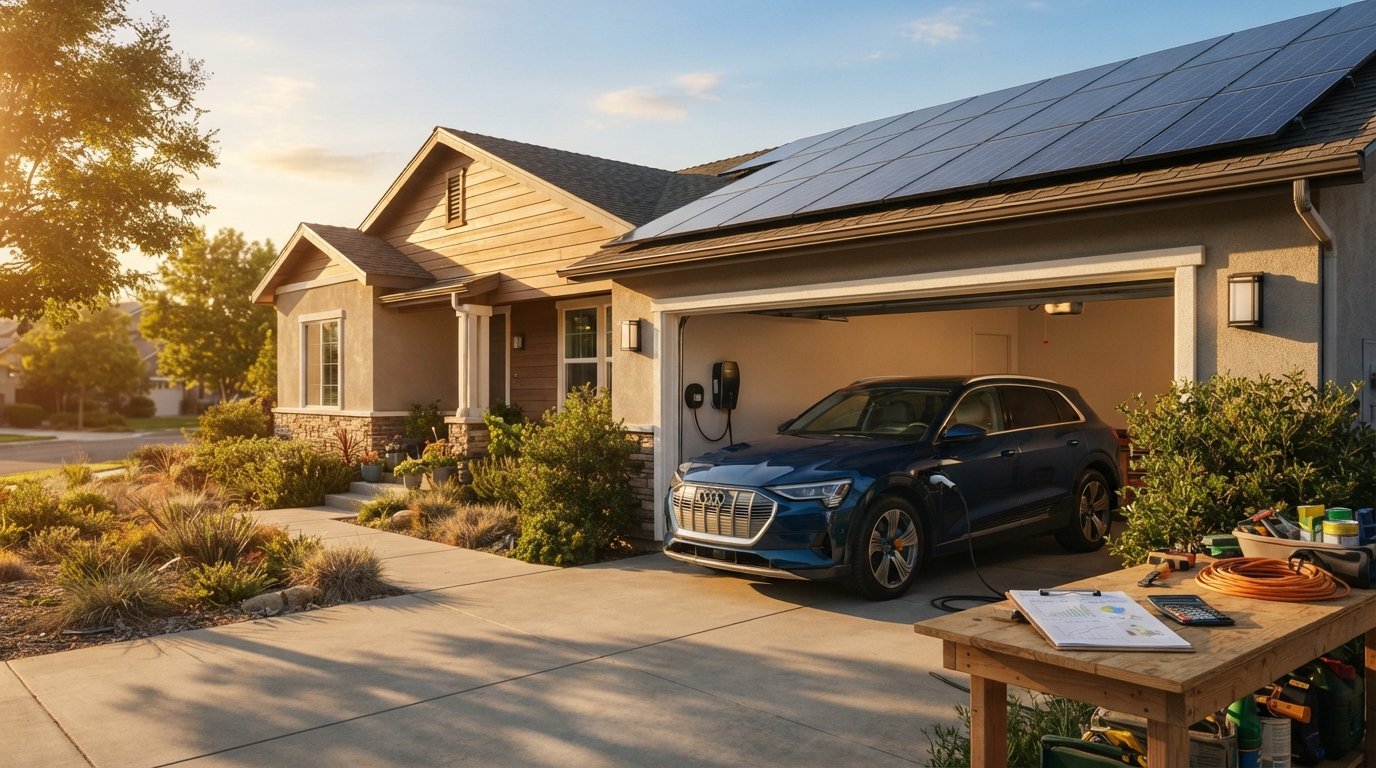
Solar Plus EV Charging System Sizing Guide for Homes
This solar plus EV charging system sizing guide shows how to match panel output to your daily driving so you charge on sunshine, not peak grid rates.
By Scott Thompson
Learn more about Solar Panel Installation and Repair for guides, costs, and what to expect.
Compare Solar Panel Installation and Repair Pros Near You

Enter your ZIP code to compare top-rated local professionals and request free quotes.
Pairing solar panels with an electric vehicle charger is one of the smartest energy moves a homeowner can make in 2026, but the math behind a properly sized system trips up even experienced buyers. Size it too small and your car drains grid power at night; size it too large and you overspend on equipment you never use. This solar plus EV charging system sizing guide walks through the exact variables that matter, from daily driving miles to panel wattage, so you can plan a system that fuels your car with sunshine instead of utility rates.
Why Sizing Solar and EV Charging Together Matters
Most homeowners treat solar and EV charging as two separate purchases. They buy a solar array sized for household loads, then add a Level 2 charger a year later and wonder why their electric bill crept back up. The two systems share the same energy budget, so they should be designed on the same spreadsheet. When you size them together, you capture the full value of every kilowatt-hour your roof produces, and you avoid the awkward scenario where your charger pulls more power than your panels can replace.
The stakes go beyond monthly bills. Utilities across the country are shifting toward time-of-use rates and demand charges, which punish households that charge cars during peak evening hours. A correctly sized solar plus storage plus EV setup can shift charging to midday or overnight windows when energy is cheapest or free. If your home is smaller than average, the principles in our solar for small homes system sizing guide apply here too, since limited roof space forces the same tradeoffs between panel count and load coverage.
There is also a hardware angle. EV chargers draw 32 to 48 amps continuously, which is a serious load for any electrical panel. Planning solar and charging infrastructure at the same time lets your installer account for panel upgrades, conduit runs, and inverter capacity in a single permit and a single site visit. That coordination typically saves hundreds of dollars compared to retrofitting later.
The Core Sizing Variables You Cannot Ignore
Every accurate sizing calculation starts with four numbers: how far you drive, how efficient your EV is, how much sun your location receives, and how much of your home load you want solar to cover. Get these wrong and the rest of the design collapses. Get them right and the system practically sizes itself.
Start with annual miles driven. The average U.S. driver covers about 13,500 miles per year, but EV owners often drive more because charging at home is cheap. Divide your annual miles by your vehicle's efficiency in miles per kWh. A Tesla Model 3 averaging 4 miles per kWh needs roughly 3,375 kWh per year; a Ford F-150 Lightning at 2.2 miles per kWh needs over 6,100 kWh for the same distance. That gap alone can double your required array size.
Next, factor in production ratio, which is the number of kilowatt-hours a solar array generates per installed kilowatt of capacity in your region. This varies dramatically by geography:
- Arizona and New Mexico: 1,600 to 1,800 kWh per kW annually
- Texas and Florida: 1,400 to 1,600 kWh per kW annually
- Colorado and North Carolina: 1,300 to 1,500 kWh per kW annually
- New England and the Midwest: 1,100 to 1,300 kWh per kW annually
A homeowner in Boston needs meaningfully more panels than a homeowner in Phoenix to cover the same EV. Once you know your production ratio, divide your total annual kWh need (home plus EV) by that number to get your target system size in kilowatts. A household using 10,000 kWh for the home and 4,000 kWh for the car in a region producing 1,400 kWh per kW needs about a 10 kW system.
Calculating Your EV Charging Load Step by Step
Precision here pays off. Follow this sequence to convert driving habits into a solar sizing number you can hand to an installer.
- Record your daily commute and typical weekend driving, then multiply by 365 for annual miles.
- Look up your EV's efficiency rating in miles per kWh (the EPA fuel economy site lists every model).
- Divide annual miles by efficiency to get annual charging kWh.
- Add 10 to 15 percent for charging losses, which occur as AC power converts to DC in the battery.
- Add this total to your home's annual electricity usage from past utility bills.
The result is your true annual energy demand, and it is usually 25 to 40 percent higher than the home-only figure. That is the number your solar array must offset if you want to drive on sunshine rather than grid power. Skipping the charging-loss buffer is one of the most common reasons homeowners come up short, especially with older EVs that have higher conversion losses.
If you drive irregularly or plan to add a second EV, build in headroom. A system sized for one car today may be undersized in three years, and expanding an array later costs more per watt than installing the extra panels upfront.
Charger Selection and How It Shapes System Size
Your charger choice affects both your electrical infrastructure and the timing of when solar energy gets used. Level 1 charging (a standard 120-volt outlet) adds only 3 to 5 miles of range per hour and rarely justifies a solar upgrade on its own. Level 2 chargers at 240 volts deliver 25 to 40 miles of range per hour and are the standard for homes that want to maximize solar self-consumption.
Within Level 2, amperage matters. A 32-amp charger draws about 7.7 kW, a 40-amp unit draws 9.6 kW, and a 48-amp unit draws 11.5 kW. If your solar array produces 8 kW at peak sun and your charger pulls 11.5 kW, you are importing grid power even on a clear day. Matching charger output to array output, or slightly below it, keeps more of your charging solar-powered.
Smart chargers add a layer of optimization. Many models let you schedule charging for peak production hours or integrate with solar inverter data to charge only when excess production is available. This functionality effectively reduces the array size you need because it eliminates waste. For homeowners exploring broader renewable options beyond solar, platforms like SolarEnergy.ai provide additional industry insights and tools that complement your planning.
Battery Storage: When You Need It and How Much
Solar alone only charges your EV when the sun is shining. If you work from home or can schedule charging midday, that may be enough, and you can skip storage entirely. If you charge overnight, a home battery becomes the bridge between daytime production and evening charging, but it changes your sizing math significantly.
To size a battery for EV charging, multiply your daily charging kWh by the number of days of autonomy you want. Most homeowners target one day of EV charging plus critical home loads, which for a typical commuter means 10 to 15 kWh of usable battery capacity after accounting for depth-of-discharge limits. A 13.5 kWh Tesla Powerwall, for example, delivers about 13.5 kWh of usable energy, enough for one full overnight charge cycle for many drivers.
Battery storage also unlocks rate arbitrage. If your utility charges 35 cents per kWh during peak hours and 12 cents overnight, a battery that shifts solar production to peak times can pay for itself faster than the panels alone. Factor this into your sizing by calculating how much of your EV load you can realistically shift versus how much you must store.
Real-World Sizing Examples by Region
Abstract math becomes clearer with concrete scenarios. Consider a Texas homeowner driving 15,000 miles per year in an EV rated at 3.5 miles per kWh. Annual charging demand is about 4,285 kWh plus 12 percent losses, or roughly 4,800 kWh. Home usage is 11,000 kWh, bringing the total to 15,800 kWh. At a Texas production ratio of 1,500 kWh per kW, the target array is 10.5 kW, which typically requires 26 to 28 panels at 400 watts each.
Now move that same household to Massachusetts. Production drops to 1,200 kWh per kW, so the array must grow to about 13.2 kW, or roughly 33 panels. The homeowner faces a choice: add panels, reduce driving, or accept partial grid charging in winter. Many choose a hybrid approach, sizing to 90 percent offset and relying on net metering credits to cover the gap.
In Arizona, the opposite happens. With production near 1,700 kWh per kW, the same household needs only a 9.3 kW system, about 23 panels. Lower array cost and higher production mean the payback period shortens considerably, often to six or seven years when EV fuel savings are included.
These examples assume unobstructed south-facing roofs. Shade, roof pitch, and azimuth can cut production by 10 to 25 percent, so always apply a shading factor before finalizing panel count. A professional site assessment through a service like NewSolarQuotes' installer network captures these variables accurately.
Incentives, Net Metering, and Financial Sizing
Financial incentives effectively reduce the system size you need to justify. The federal Investment Tax Credit covers 30 percent of solar and battery installation costs, and several states add rebates or property tax exemptions on top. When you run your payback calculation, apply these credits to the net cost, not the gross, or you will overstate your breakeven time.
Net metering policy shapes sizing strategy just as much as hardware. Under full retail net metering, oversized arrays bank credits that offset winter EV charging, so sizing to 100 percent or slightly above annual usage makes sense. Under avoided-cost or buy-all, sell-all structures, exported power earns far less, so sizing to maximize self-consumption (often 70 to 80 percent of annual usage) delivers better returns. Check your utility's current policy before committing to a size.
Demand charges deserve special attention for EV owners. Some utilities bill based on your highest 15-minute usage window, and a 48-amp charger can spike that number. A battery or a lower-amperage charger can shave the peak and reduce demand charges by $20 to $50 per month, which changes the economics of your entire system.
Common Sizing Mistakes and How to Avoid Them
The most frequent error is sizing solar for today's usage and ignoring the EV that arrives next year. If you know a car purchase is coming, size for it now. The second mistake is forgetting charging losses, which quietly add 10 to 15 percent to your demand. Third, many homeowners overlook winter production dips; a system that covers 100 percent of annual usage may only cover 60 percent in December, forcing grid purchases when rates are highest.
Finally, do not assume your electrical panel can handle a 48-amp charger without an upgrade. Many older homes have 100-amp service that cannot support both the charger and existing appliances. A panel upgrade adds $1,500 to $3,000, and discovering this after installation starts derails timelines and budgets. Mention your EV plans during the initial solar consultation so the installer can address service capacity in the same project.
When you request quotes, ask each installer to show the sizing calculation, not just a proposed system size. A transparent breakdown of annual kWh, production ratio, and offset percentage tells you whether the design actually meets your driving needs. The best solar plus EV charging system sizing guide is the one your installer walks you through line by line, and a reputable provider will welcome those questions.
Sizing solar with EV charging is ultimately an exercise in matching supply to a moving target. Driving habits change, rates change, and vehicles change. Build in modest headroom, prioritize self-consumption over maximum export, and revisit your numbers every few years. Do that, and your roof will keep your car running on sunlight for the next two decades.
Learn more about Solar Panel Installation and Repair for guides, costs, and what to expect.
Compare Solar Panel Installation and Repair Pros Near You
Enter your ZIP code to compare top-rated local professionals and request free quotes.