
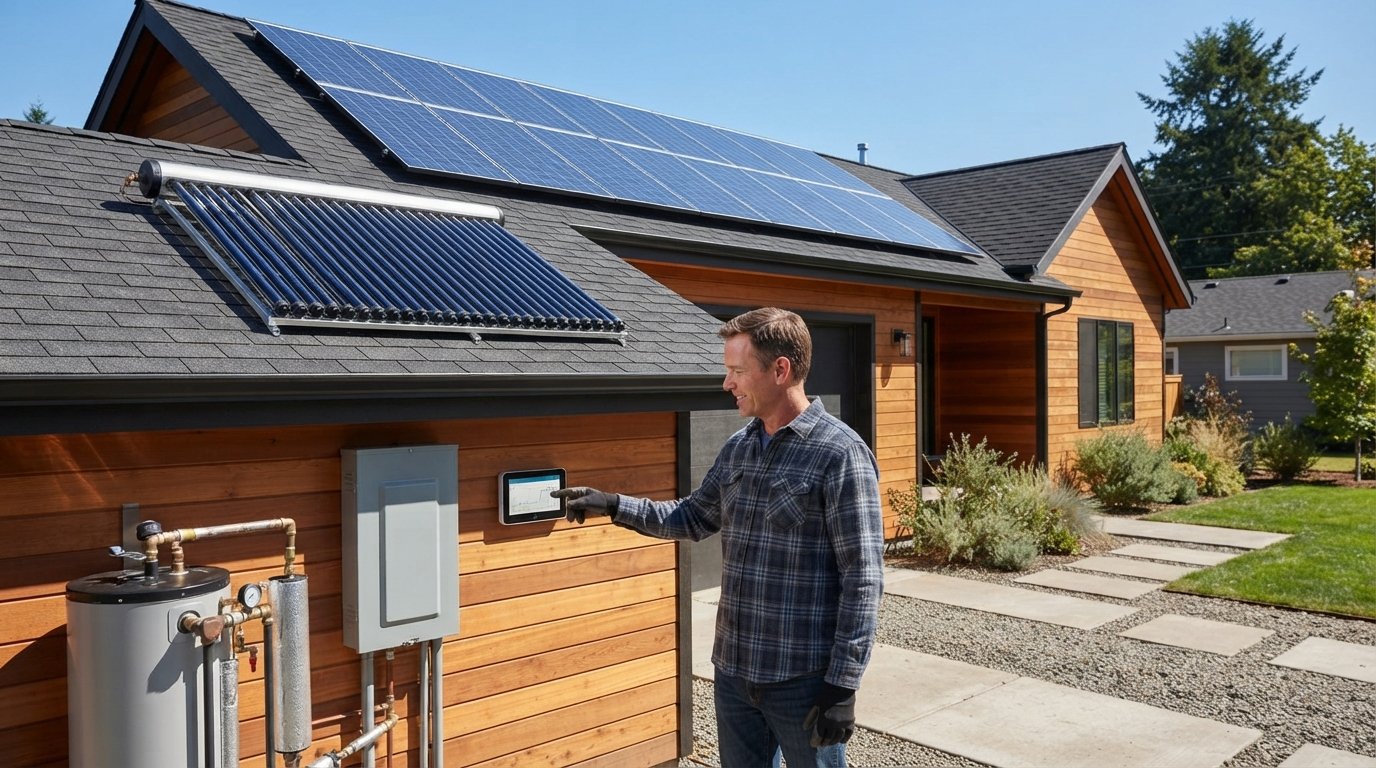
Solar Thermal vs Photovoltaic Efficiency: 2026 Guide
Solar thermal vs photovoltaic efficiency comparison reveals why PV panels are the smarter investment for most homes, despite thermal's higher heat-capture rate.

By Andy Pearson
Learn more about Solar Panel Installation and Repair for guides, costs, and what to expect.
Compare Solar Panel Installation and Repair Pros Near You

Enter your ZIP code to compare top-rated local professionals and request free quotes.
When homeowners begin exploring solar energy, a fundamental question often arises: should they install photovoltaic (PV) panels that generate electricity, or a solar thermal system that heats water directly? The answer hinges on a complex and often misunderstood metric: efficiency. A solar thermal vs photovoltaic efficiency comparison is not just about which panel converts more sunlight; it is about which technology delivers the greatest value for your specific energy needs, climate, and budget. While photovoltaic panels have become the dominant choice for residential solar, solar thermal systems still hold a distinct advantage in certain applications. This guide unpacks the technical differences, real-world performance, and financial implications to help you make an informed decision.
Understanding the core distinction is the first step. Photovoltaic (PV) systems use semiconductor cells to convert sunlight directly into electricity. Solar thermal systems use sunlight to heat a fluid (usually water or an antifreeze mixture) that can then be used for domestic hot water, space heating, or even industrial processes. While both harness the sun, their efficiency is measured in entirely different ways, and their optimal use cases are almost opposite. A solar thermal collector may boast a higher efficiency percentage for converting sunlight into heat, but that heat cannot run your television, charge your electric vehicle, or offset your lighting load. Conversely, a PV panel's electricity can do all that, but its conversion efficiency is typically lower. This trade-off is the heart of the solar thermal vs photovoltaic efficiency comparison.
To further complicate the comparison, the definition of "efficiency" itself shifts. For PV panels, efficiency is the percentage of sunlight that becomes usable electricity. For solar thermal, it is the percentage of sunlight that becomes usable heat. These are fundamentally different energy forms with different values. In this article, we will break down the numbers, the real-world performance factors, and the financial return of each technology, enabling you to choose the system that truly fits your home and your energy goals.
Defining Efficiency in Solar Thermal vs Photovoltaic Systems
At the most basic level, the efficiency of a solar technology is the ratio of useful energy output (electricity or heat) to the solar energy input. However, the way this ratio is calculated and reported differs dramatically between PV and thermal systems, which is why a direct numerical comparison can be misleading.
Photovoltaic efficiency is measured under standard test conditions (STC) at a cell temperature of 25 degrees Celsius (77 degrees Fahrenheit) and with a solar irradiance of 1,000 watts per square meter. Under these laboratory conditions, modern monocrystalline silicon panels typically achieve efficiencies between 18% and 22%. Premium panels from manufacturers like SunPower or REC can push this to 22.8%, while budget panels may fall closer to 16%. These percentages represent the fraction of sunlight that is converted into direct current (DC) electricity. In real-world conditions, however, this number drops due to heat, dust, shading, and inverter losses, resulting in an actual system efficiency of around 15% to 18%.
Solar thermal efficiency is typically expressed as a range, often between 40% and 70%, but this number is not directly comparable to PV efficiency for two critical reasons. First, the output is heat, not electricity. Second, thermal collectors do not have a single, fixed efficiency; their performance is highly dependent on the temperature difference between the collector and the surrounding air. A solar thermal collector operating at a low temperature (for a swimming pool, for example) can achieve efficiencies of 70% or more. However, when the same collector is used to produce high-temperature water (for domestic use or space heating), the efficiency drops significantly, often to the 40% to 50% range, because higher operating temperatures increase heat loss to the environment.
Therefore, when you see a claim that "solar thermal is twice as efficient as PV," it is usually referring to the thermal collector's ability to capture sunlight as heat, not to its ability to produce a usable form of energy like electricity. A more apples-to-apples comparison would consider the final energy service provided. For example, a solar thermal system might use 60% of the sun's energy to heat water, but that heated water is not a substitute for electricity. Conversely, a PV system might convert 20% of sunlight into electricity, but that electricity can be used for anything, including heating water with an electric heat pump.
Real-World Performance: Beyond the Lab Ratings
Laboratory efficiency ratings are useful for comparing the peak capability of different technologies, but they do not tell the whole story. Real-world performance is influenced by a host of factors that can significantly alter the solar thermal vs photovoltaic efficiency comparison.
Climate and Weather Patterns
Photovoltaic panels perform best in cool, sunny conditions. They are actually more efficient at lower temperatures, which is why a 20% efficient panel might produce more electricity on a crisp 50-degree day than on a scorching 95-degree day, even with the same amount of sunlight. They also generate electricity even on cloudy days, albeit at a reduced rate, because they can capture diffuse sunlight. This makes them a reliable option in a variety of climates, from the rainy Pacific Northwest to the desert Southwest.
Solar thermal systems, in contrast, are more sensitive to both temperature and cloud cover. They rely on direct sunlight to heat a fluid, and their performance drops sharply on overcast days. They also suffer from higher heat losses in cold, windy conditions, which reduces their efficiency when you need hot water the most. For example, a solar thermal system in Minneapolis would produce less hot water in January than a similar system in Phoenix, not only because of fewer sun hours but also because the colder ambient temperature increases thermal losses from the collector.
System Type and Application
The intended application of a solar thermal system dramatically affects its real-world efficiency. A system designed to preheat water for a boiler or pool (low temperature) will have a higher solar fraction (the percentage of your hot water needs met by the sun) than a system trying to produce very hot water for domestic use (high temperature). This is why flat-plate collectors, which are less efficient at high temperatures, are often used for pool heating, while evacuated tube collectors, which have better insulation and can achieve higher temperatures, are preferred for domestic hot water in colder climates.
Photovoltaic systems, on the other hand, have a consistent efficiency for electricity generation regardless of the end-use application. Whether you are powering lights, charging a car, or running a heat pump, the PV panel's efficiency remains the same. The only variable is the amount of sunlight it receives. This simplicity is a major advantage for PV, as it allows homeowners to offset a wide range of energy consumption with a single system.
Space and Installation Constraints
Efficiency also translates into space requirements. A higher-efficiency technology needs less roof area to produce the same amount of energy. If you have a small or shaded roof, this can be a deciding factor.
- Photovoltaic panels typically require 100 to 150 square feet of roof space for a 5 kW system that generates about 6,500 kWh per year (depending on location).
- Solar thermal systems for a family of four usually require 40 to 80 square feet of collector area to provide 60% to 70% of your domestic hot water needs.
- Hybrid systems, which combine PV with a heat pump water heater, can achieve hot water efficiency that rivals thermal systems while also providing electricity.
When you compare the space needed to replace a significant portion of your electricity bill (which includes heating, cooling, and appliances) with the space needed to just heat water, PV panels are often the more practical and versatile choice, especially for larger homes.
Financial Analysis: Return on Investment and Incentives
The financial case for each technology is arguably more important than the raw efficiency numbers. A solar thermal system might be more efficient at converting sunlight to heat, but if it costs more to install and saves less money on your utility bills, it may not be the best investment.
Photovoltaic systems have seen dramatic cost reductions over the past decade. The average cost of a residential solar PV system in the United States is now around $2.50 to $3.00 per watt, meaning a typical 6 kW system costs between $15,000 and $18,000 before incentives. After the 30% federal solar tax credit, the net cost drops to roughly $10,500 to $12,600. This system will generate about 8,000 to 10,000 kWh per year, offsetting a significant portion of an average home's electricity consumption. With net metering or battery storage, you can also sell excess electricity back to the grid or use it at night, further improving the financial return. The payback period for PV systems is typically 7 to 12 years, after which you enjoy free electricity for the remaining 20 to 25 years of the system's life.
Solar thermal systems, on the other hand, have a higher upfront cost relative to the amount of energy they save. A complete solar water heating system for a single-family home typically costs between $5,000 and $8,000 before incentives. After the 30% federal tax credit (which also applies to solar water heating), the net cost is $3,500 to $5,600. However, the average household spends only about $400 to $600 per year on water heating. Even if a solar thermal system covers 70% of that load, it only saves $280 to $420 per year. This results in a payback period of 10 to 15 years, which is often longer than the system's warranty period (usually 10 years for collectors, 15 for tanks).
The financial comparison becomes even more one-sided when you consider that PV systems can also be used to heat water. By installing a heat pump water heater (which is two to three times more efficient than a standard electric water heater) and powering it with your PV array, you can achieve the same hot water savings as a thermal system while also covering all your other electricity needs. This is why many solar experts now recommend a PV-plus-heat-pump-water-heater combination over a traditional solar thermal system.
Making the Right Choice for Your Home
Given the complexities of the solar thermal vs photovoltaic efficiency comparison, how do you decide which technology is right for you? The answer depends on your specific goals, your home's characteristics, and your local utility rates.
When Solar Thermal Makes Sense
Solar thermal is still a viable option in a few specific scenarios. If you have a very high hot water demand, such as a large family, a swimming pool, or a commercial application like a laundromat or car wash, a thermal system can be highly cost-effective. In these cases, the higher efficiency of converting sunlight to heat can lead to significant fuel savings. Additionally, if you are building a new home or doing a major renovation, incorporating a solar thermal system into the design can be more seamless and less costly than retrofitting an existing home.
Another niche where solar thermal excels is space heating, particularly in colder climates. Solar thermal systems can be designed to provide a substantial portion of your home's heating load through radiant floor heating or forced-air systems that use a hydronic coil. In these cases, the thermal system's ability to generate high-temperature water (140 to 180 degrees Fahrenheit) is a distinct advantage over PV, which would require a heat pump to achieve the same heating effect. However, these systems are more complex and expensive to install, and they require careful engineering to avoid overheating in the summer.
When Photovoltaics Is the Clear Winner
For the vast majority of homeowners, photovoltaics is the more practical and profitable choice. PV systems are more versatile because they generate electricity, which can be used for everything, including water heating. They also offer better long-term financial returns due to falling equipment costs and the ability to take advantage of net metering or time-of-use rates. Furthermore, PV technology is improving at a faster pace than thermal, with new panel designs and battery storage solutions constantly being developed.
If your primary goal is to reduce your overall carbon footprint and electricity bills, a PV system is the way to go. It allows you to generate clean energy that offsets the largest source of household emissions (electricity use), and it can be expanded over time. You can always add a heat pump water heater later to further reduce your reliance on fossil fuels for hot water, and that heat pump will be powered by your own solar electricity.
To help you make a more informed choice, consider the following checklist:
- Assess your energy needs: Calculate your current electricity usage and water heating load. If water heating is a small fraction of your total energy use, PV is likely the better investment.
- Evaluate your roof: Check the available south-facing roof area and any shading from trees or chimneys. If you have limited unshaded space, a high-efficiency PV panel may be necessary to meet your electricity needs.
- Review your local incentives: Look into your state and utility company incentives for both solar PV and solar thermal. Some utilities offer rebates specifically for solar water heaters, while others may have net metering policies that make PV more attractive.
- Consider your long-term plans: If you plan to stay in your home for more than 10 years, PV is more likely to pay off. If you are planning to move soon, a solar thermal system might have a shorter payback period, but it can also complicate a home sale.
In our guide on 100 Watt Flex Solar Panel: Off-Grid Efficiency Explained, we delve into how small-format PV panels can provide supplementary power for RVs, boats, and tiny homes, which is another area where PV's flexibility shines.
The Verdict: Efficiency Is Not the Only Metric
In the solar thermal vs photovoltaic efficiency comparison, it is tempting to declare a winner based solely on the efficiency percentage. However, doing so would ignore the most important factor: the value of the energy produced. Electricity is a high-grade form of energy that can be used to power virtually anything, while heat is a lower-grade form that is useful only for heating water or spaces. Therefore, a PV system that converts 20% of sunlight into electricity is often more valuable to a homeowner than a thermal system that converts 60% of sunlight into hot water.
The decision ultimately comes down to your energy goals. If you want to maximize your environmental impact by reducing your use of fossil fuels for both electricity and water heating, a PV system combined with a heat pump water heater is the most effective and flexible solution. If you have a specialized application that requires a large volume of hot water or space heating, and you have already maximized your electricity efficiency, then a solar thermal system can be a worthwhile addition.
Before making any final decision, it is crucial to obtain multiple quotes from certified installers. A reputable installer will conduct a site assessment and provide you with a detailed cost and savings analysis for both technologies. They can also help you navigate the available incentives and choose the system that best fits your budget and energy objectives. For unbiased, educational resources and to connect with vetted solar professionals, you can explore FreeSolarPowerQuotes, which offers free, no-obligation quotes from third-party providers across the United States.
In summary, while solar thermal systems can claim higher efficiency in converting sunlight to heat, photovoltaic systems offer superior efficiency in converting sunlight to a more versatile and valuable form of energy: electricity. For most modern homes, PV is the more pragmatic and financially sound investment, especially when paired with energy-efficient electric appliances like heat pump water heaters. By understanding the true nature of efficiency and how it impacts your daily life, you can make a choice that will serve you well for decades to come.