
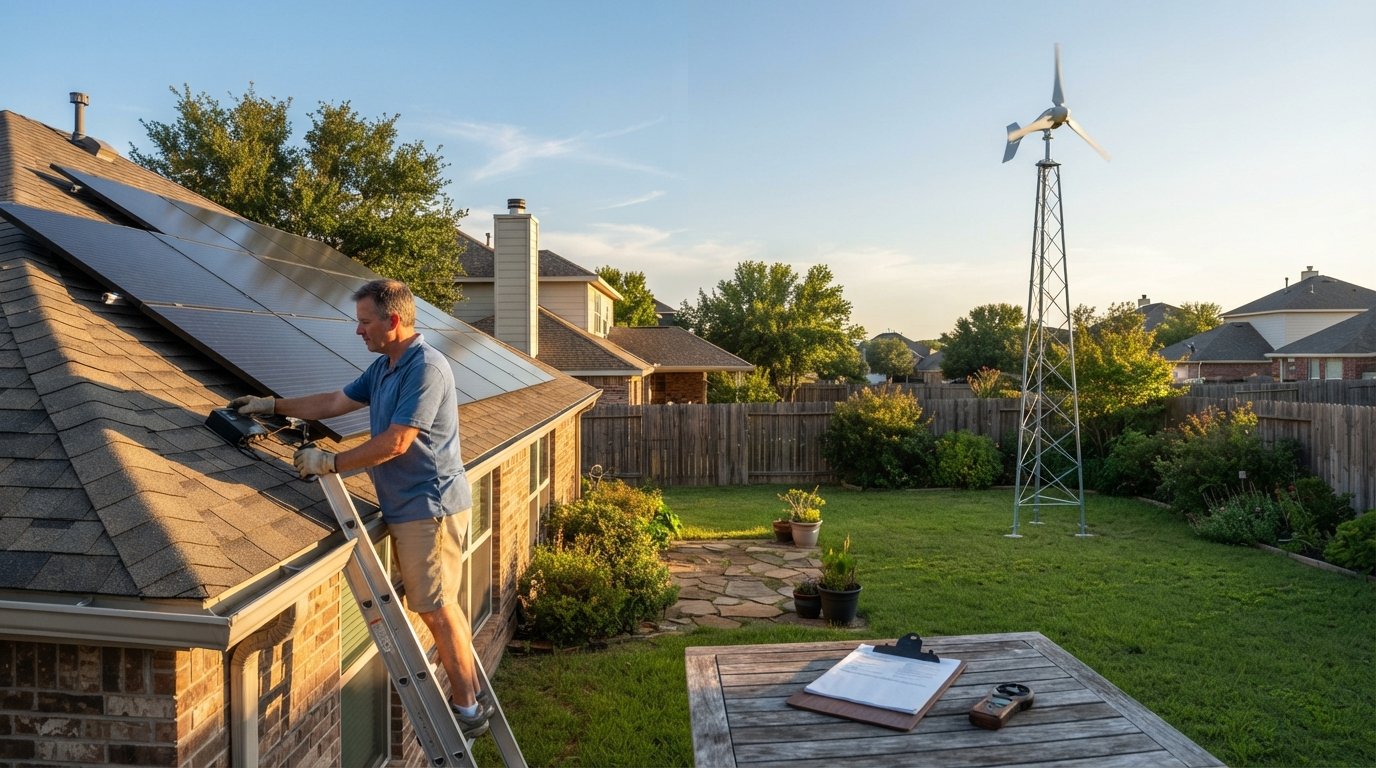
Solar vs Wind for Home Comparison 2026: Which Wins?
Compare solar vs wind for home comparison 2026 with real costs, output, and payback, so you can pick the system that actually fits your property.

By Alexia Mabel
Learn more about Solar Panel Installation and Repair for guides, costs, and what to expect.
Compare Solar Panel Installation and Repair Pros Near You

Enter your ZIP code to compare top-rated local professionals and request free quotes.
Choosing between solar panels and a small wind turbine for your home in 2026 means weighing your roof, your yard, your local weather, and your utility's rules. Both technologies turn free natural resources into electricity, but they behave very differently on a residential property. Solar thrives on open roofs and steady sunshine, while wind depends on tower height, average wind speed, and local zoning. The right answer is rarely the same for two neighbors, let alone two states. This guide breaks down the solar vs wind for home comparison 2026 with real numbers, practical constraints, and a framework you can apply to your own property before you spend a dollar.
How Solar and Wind Actually Work at Home Scale
Residential solar uses photovoltaic (PV) panels to convert sunlight directly into direct current (DC) electricity. An inverter then converts that DC power into the alternating current (AC) your home appliances use. Modern panels run at 20 to 23 percent efficiency, and a typical 8 kW system needs roughly 400 to 600 square feet of unshaded roof. Output peaks at midday, and net metering or battery storage determines how much of that midday production you actually capture for evening use.
Small wind turbines work on a completely different principle. They rely on kinetic energy in moving air, and power output scales with the cube of wind speed. That means a site with 12 mph average wind can produce roughly 70 percent more energy than a site with 10 mph average wind, all else equal. Turbines also need clean, unobstructed airflow, so a rooftop mount is usually a bad idea in residential settings. Most effective home turbines sit on towers 60 to 100 feet tall, which immediately introduces permitting, setback, and neighbor-relations issues.
The practical takeaway is that solar is a modular, low-mechanical-risk technology that scales easily on suburban roofs, while wind is a site-specific technology that rewards rural acreage and punishes poor siting. If you live in a subdivision with mature trees, solar will almost always be the more realistic option. If you own several acres with consistent prevailing winds, a small turbine deserves serious consideration.
Cost Comparison: Upfront Price and Long-Term Value
For a typical 8 kW residential solar system in 2026, installed costs range from about $16,000 to $24,000 before incentives, depending on region, roof complexity, and equipment tier. The federal Residential Clean Energy Credit covers 30 percent of the installed cost, bringing the net figure to roughly $11,200 to $16,800. Many homeowners pair that with state rebates, utility programs, or sales tax exemptions, and you can run your own numbers quickly with a solar installation estimate tool before requesting quotes.
Small wind is harder to price because the market is thinner and installation labor is more specialized. A 5 kW turbine with a proper tower, foundation, wiring, and permitting often lands between $25,000 and $45,000 installed. The same 30 percent federal credit applies, but state and utility incentives for wind are far less common than for solar. Maintenance costs also diverge: solar has no moving parts and typically needs only occasional cleaning and inverter service, while turbines require annual inspections, lubrication, and eventual bearing or blade replacement.
Here is how the two options stack up on the major cost dimensions homeowners care about:
- Upfront cost: Solar ranges from $2.00 to $3.00 per watt installed; small wind typically runs $5.00 to $9.00 per watt.
- Incentives: The 30 percent federal credit applies to both, but solar qualifies for more state, utility, and local programs.
- Maintenance: Solar averages $100 to $300 per year; wind averages $300 to $800 per year plus major component risk.
- Lifespan: Panels carry 25 to 30 year performance warranties; turbines often need significant service within 10 to 15 years.
- Financing: Solar has mature loan, lease, and PPA markets; wind financing is limited and usually cash-only.
When you translate those numbers into cost per kilowatt-hour over the system's life, solar usually lands between 5 and 9 cents per kWh in good sun states. Wind can beat that in excellent wind resources, but only if the turbine actually produces near its rated capacity, which many residential installations fail to do because of poor siting or unrealistic manufacturer claims.
Energy Production: Which Resource Fits Your Property?
Solar production depends primarily on your location's peak sun hours, roof orientation, tilt, and shading. Most U.S. homes see 4 to 6 peak sun hours per day on average, with the Southwest at the high end and the Pacific Northwest and Northeast at the low end. A south-facing roof with no shade is ideal; east and west orientations lose roughly 10 to 20 percent of potential output, and heavy shading can eliminate a site entirely.
Wind production depends on average wind speed at hub height, not at ground level. The U.S. Department of Energy maps show that most populated areas have Class 1 or Class 2 winds, which are marginal for small turbines. Class 3 and above (roughly 13 mph average at 30 meters) is where small wind starts to make economic sense, and those sites are concentrated in the Great Plains, mountain passes, coastal ridges, and parts of the Midwest. If your property sits in a suburban subdivision with buildings and trees, expect turbulence that degrades turbine performance and accelerates wear.
A useful rule of thumb: if your average wind speed at 30 to 40 feet is below 10 mph, a small turbine will likely produce less than a third of its rated output, making solar the better investment. If you have consistent 12 mph or higher winds and open terrain, wind can complement or even outperform solar on a per-dollar basis, especially during winter when solar production dips.
Space, Zoning, and Practical Installation Constraints
Solar needs contiguous, unshaded area. A typical home uses 300 to 600 square feet of roof, though ground mounts work well on rural properties with available land. Permitting is usually straightforward because most jurisdictions have adopted streamlined solar permitting, and roof structural checks are routine. The main constraints are roof age (replace an old roof first to avoid removal and reinstallation costs), HOA rules, and utility interconnection timelines.
Wind faces a much steeper approval path. Tower height triggers setback requirements, often one times the tower height from property lines, and many HOAs ban turbines outright. Structural engineering is more involved because towers must withstand extreme wind loads, and neighbors may object to visual and noise impacts. Noise from small turbines is often overstated in marketing materials, but low-frequency and vibration issues do occur, especially with roof-mounted units.
Before committing to either technology, walk through this checklist:
- Measure your available unshaded roof area or open land, and note compass orientation.
- Check your utility's interconnection rules and net metering or net billing policy for 2026.
- Look up local wind resource maps and your state's incentive database.
- Review HOA covenants and municipal zoning for height and setback limits.
- Get at least three itemized quotes from certified installers for the technology you are considering.
Homeowners who follow this sequence almost always discover that one technology is clearly viable and the other is not, which saves months of research and avoids expensive mistakes.
Incentives, Financing, and Payback in 2026
The federal Residential Clean Energy Credit remains at 30 percent for both solar and small wind through 2032, with a gradual step-down afterward. That parity is one of the few places where the two technologies compete on equal footing. Beyond the federal credit, however, solar enjoys a much deeper incentive stack: state tax credits, utility rebates, sales tax exemptions, property tax abatements, and SREC markets in some states. Wind incentives exist but are typically limited to rural energy programs and a handful of state-specific grants.
Financing also favors solar. Solar loans, leases, and power purchase agreements are widely available with competitive rates, and some lenders offer $0-down options. Wind systems are usually financed through home equity lines or cash because lenders view them as higher-risk assets with less predictable production. That financing gap alone can push wind's effective payback beyond 15 years in mediocre wind resources, while solar commonly pays back in 7 to 12 years depending on state rates and incentives.
For homeowners who want a clear, side-by-side view of their own numbers, requesting free, no-obligation quotes from certified installers is the fastest way to compare real pricing. A reputable platform like FreeSolarPowerQuotes can connect you with vetted local professionals who will assess your property and provide itemized proposals, which beats guessing from national averages every time.
Hybrid and Off-Grid Scenarios: When to Combine Both
Solar plus wind hybrids make sense in a narrow set of cases: rural properties with strong wind resources, off-grid cabins where winter solar production is weak, and locations where wind blows hardest at night and in winter when solar output is lowest. In these scenarios, the two resources complement each other seasonally and daily, and a shared battery bank can smooth out the combined production curve.
However, hybrids also double the maintenance surface, complicate permitting, and increase upfront cost. For most grid-connected homeowners, a solar-plus-battery system delivers better reliability and simpler operations than a solar-plus-wind configuration. The exception is a truly off-grid property in a cloudy, windy region, where wind may be the only way to keep batteries charged through winter.
If you are considering off-grid, model your worst-case month, not your annual average. A system that works beautifully in July can fail in January if you size it on yearly production data. Wind's winter advantage is real, but only where the resource is strong enough to justify the added complexity.
Environmental Impact and Property Value
Both technologies reduce carbon emissions compared to grid electricity, though the lifecycle footprint differs. Solar panels produce most of their embodied carbon during manufacturing and pay that back within one to two years of operation. Small wind turbines have a similar payback period but require more material per kilowatt of capacity, and their blades and generators are harder to recycle at end of life.
From a property value perspective, solar consistently ranks as a positive feature in real estate listings, with studies showing premiums of roughly 3 to 5 percent in many markets. Wind is more polarizing: some buyers value the energy independence, while others see maintenance liability and visual impact. Appraisers also have more comparable sales data for solar, which makes valuation easier and more predictable.
If resale value matters to you, solar is usually the safer bet. If energy independence on a rural property is the priority, wind may earn its place, but be prepared to document production data carefully so a future buyer can see the actual return.
Making the Decision: A Practical Framework
Start with your resource. If your roof is unshaded and your average wind speed is below 10 mph, solar wins by default. If your roof is shaded but you have open land and 12 mph average winds, wind deserves a closer look. If both resources are marginal, focus on efficiency upgrades and consider a smaller solar array rather than forcing a technology that does not fit.
Next, check your utility rules. Net metering, net billing, and time-of-use rates change the math dramatically, and some utilities now charge fixed fees for distributed generation customers. Understanding those rules before you buy prevents unpleasant surprises in year one.
Finally, get real quotes. National averages are useful for orientation, but every property is different, and installer pricing varies widely even within the same city. The solar vs wind for home comparison 2026 ultimately comes down to your specific site, your utility, and your budget, and the only way to know for sure is to put real numbers on paper from qualified installers. Do that, and the decision usually becomes obvious.
Learn more about Solar Panel Installation and Repair for guides, costs, and what to expect.
Compare Solar Panel Installation and Repair Pros Near You
Enter your ZIP code to compare top-rated local professionals and request free quotes.