What Is a Solar Inverter and How Does It Work?
Learn what a solar inverter is and how it works to convert sunlight into usable power, and discover how choosing the right one maximizes your savings.

By Alex Carter
Learn more about Solar Panel Installation and Repair for guides, costs, and what to expect.
Compare Solar Panel Installation and Repair Pros Near You
Enter your ZIP code to compare top-rated local professionals and request free quotes.
When most people picture a solar energy system, they think of the dark blue panels mounted on a rooftop. But the real brain of the operation is a device usually tucked away in a garage or on the side of a house: the solar inverter. If you have ever asked, "what is a solar inverter and how does it work," you are not alone. This single piece of equipment plays a critical role in whether your system performs well, saves you money, and lasts for decades. In this guide, we will break down the functions, types, and selection criteria for solar inverters, so you can make an informed decision for your home or business. We will also connect you with the resources you need to compare costs and find certified installers.
The Core Role of a Solar Inverter
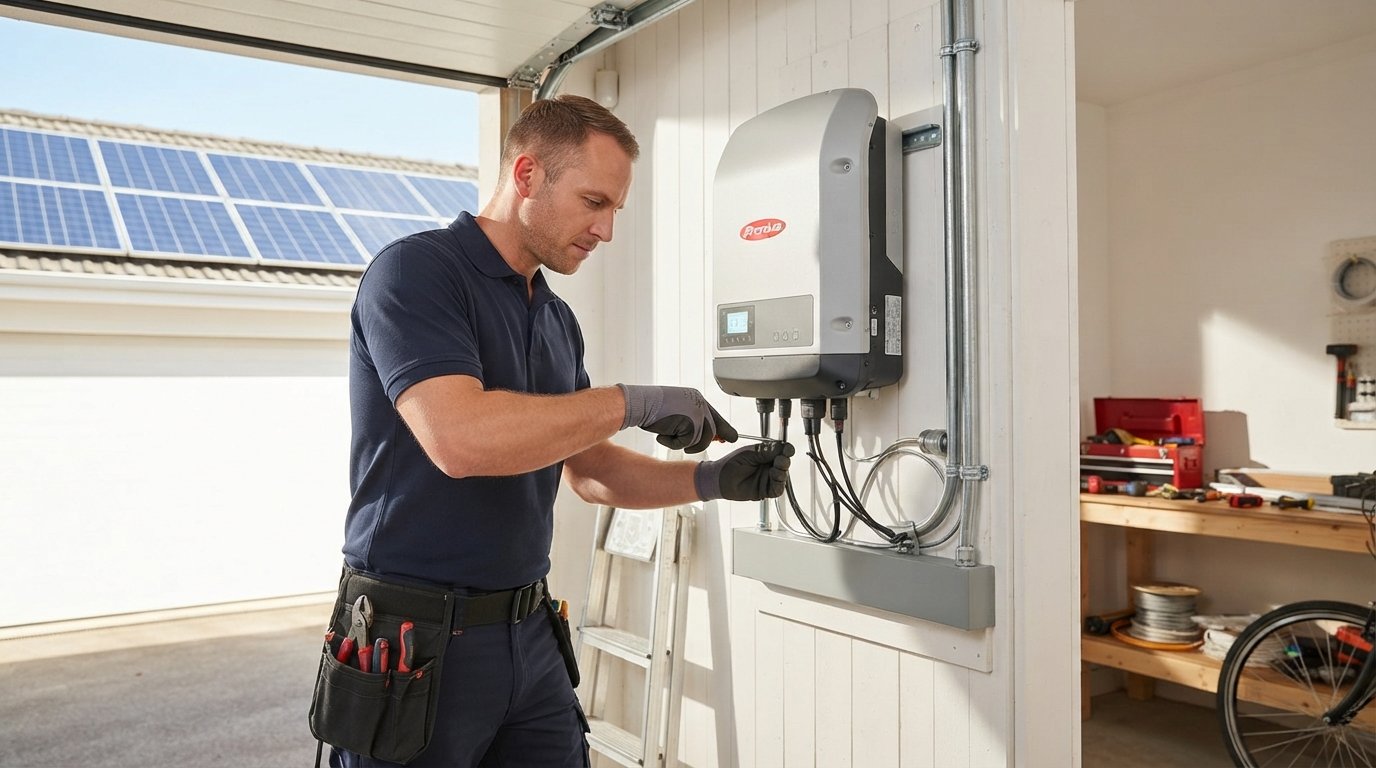
Solar panels generate electricity in the form of direct current (DC). However, the appliances, lighting, and electronics in your home operate on alternating current (AC). The solar inverter is the converter that changes DC electricity into usable AC electricity. Without this conversion, the power from your panels would be incompatible with your home's electrical system and the utility grid.
But the inverter does more than simple conversion. Modern inverters also monitor system performance, track energy production, and communicate with you or your installer if a problem arises. They act as the safety mechanism that shuts down the system during grid outages or electrical faults. In essence, the inverter is the gateway between your solar array and your daily energy consumption.
The importance of choosing the right inverter cannot be overstated. A high-quality inverter maximizes energy harvest, which directly influences the payback period of your investment. A poorly matched inverter can cause energy losses, reduce panel lifespan, and create safety hazards. Therefore, understanding inverter technology is a vital step in any solar project.
How a Solar Inverter Works in Practice
To truly grasp "what is a solar inverter and how does it work," you need to understand the electronic process inside the box. The inverter uses a set of switches, transformers, and control circuits to convert DC to AC. The process involves rapidly toggling the DC input to create a square wave, then filtering and shaping it into a smooth sine wave that matches the grid's frequency and voltage.
This conversion happens in real time, dozens or even hundreds of times per second. The inverter continuously tracks the maximum power point (MPPT) of your panels, adjusting the electrical load to ensure the panels operate at their most efficient voltage and current. This optimization is essential because panel output fluctuates with sunlight intensity, temperature, and shading.
In addition to conversion and optimization, the inverter manages grid synchronization. It constantly monitors the utility grid's voltage and frequency. If the grid goes down, the inverter must immediately disconnect your solar system to prevent feeding electricity back into the lines, which could endanger utility workers. This feature, known as anti-islanding, is a standard safety requirement.
Key Functions at a Glance
- DC to AC conversion for home and grid compatibility
- Maximum power point tracking (MPPT) for optimal panel output
- Grid synchronization and anti-islanding protection
- Performance monitoring and fault reporting
These functions work together to ensure that your solar system is both safe and efficient. Without a reliable inverter, even the best solar panels would produce unusable or hazardous power.
Types of Solar Inverters
There is no one-size-fits-all inverter solution. The best type for your property depends on factors like roof orientation, shading, panel layout, budget, and whether you plan to add battery storage later. Let us explore the three main categories.
String Inverters
String inverters are the most traditional option. In this configuration, all solar panels are connected in series, forming a "string" that feeds DC power to a single central inverter. The inverter converts the combined DC power to AC for your home.
String inverters are generally the most affordable option per watt. They are also easier to access for maintenance because they are installed at ground level or on a wall, not on the roof. However, they have a notable drawback: if one panel in the string underperforms (due to shade, dirt, or damage), the entire string's output drops to the level of the weakest panel. This limitation makes string inverters less ideal for roofs with partial shading or panels facing different directions.
Microinverters
Microinverters are small devices attached to each individual solar panel. Each panel operates independently, converting its own DC output to AC. This design eliminates the single point of failure of string systems and allows each panel to produce its maximum possible power, even if a neighboring panel is shaded or dirty.
Microinverters also enable panel-level monitoring, so you can see the performance of each panel from your computer or smartphone. This granular data helps identify issues early. The main trade-offs are higher upfront cost and the fact that the electronics sit on the roof, exposed to heat and weather, which can affect their lifespan. Nonetheless, many homeowners prefer microinverters for their reliability and performance in complex roof layouts.
Power Optimizers
Power optimizers are a hybrid approach. They are attached to each panel, like microinverters, but they do not convert DC to AC at the panel. Instead, they condition the DC power and send it to a central string inverter. This setup offers panel-level optimization and monitoring, but centralizes the inversion process.
Power optimizers provide many benefits of microinverters, including shade mitigation and individual panel tracking, while potentially being slightly less expensive. They also allow for longer string runs, which can be advantageous for large rooftops. The trade-off is that you still have a single central inverter that can fail, and the system becomes more complex with two types of electronics.
Choosing the Right Inverter for Your Home
Selecting an inverter involves balancing performance, cost, and your specific site conditions. Start by examining your roof's exposure and shading. If your roof is simple, with panels facing one direction and minimal shade, a string inverter may be a cost-effective choice. If you have panels on multiple roof planes, trees casting shadows, or expect future obstructions, microinverters or power optimizers are likely worth the extra investment.
Another critical factor is your future plans for battery storage. Some inverters are designed to work seamlessly with batteries, while others require additional equipment. If you are considering a solar battery for backup power or self-consumption, look for an inverter that is AC-coupled or DC-coupled with that battery system. This compatibility can save you money and headaches later.
Finally, consider the warranty and the reputation of the manufacturer. Inverters typically have warranties of 10 to 25 years, depending on the type. String inverters often need replacement after 10 to 15 years, while microinverters and optimizers can last 20 to 25 years. Factor in the cost of potential replacements when comparing quotes.
To make the best decision, you should obtain multiple quotes from certified installers. Each installer will recommend a specific inverter brand and model based on their experience. Comparing these recommendations, along with the system design and price, will help you select the best overall package for your home.
Monitoring and Efficiency: The Inverter's Hidden Value
Inverter efficiency is a measure of how much DC power is successfully converted to AC power. High-quality inverters often reach efficiencies of 96% to 98%. This means only a small fraction of energy is lost as heat during conversion. While a few percentage points may seem minor, over the 25-year life of your solar system, that difference can translate into hundreds of dollars in energy savings.
Monitoring capabilities are equally important. Modern inverters come with built-in Wi-Fi or Ethernet connectivity, allowing you to view your system's production in real time through a mobile app or web portal. This data helps you verify that your system is working as expected and alerts you to any underperformance. For example, if a tree grows and starts shading a panel, the monitoring software will show a drop in output for that specific panel (if you have microinverters or optimizers) or for the whole string.
Regular monitoring also helps you spot inverter faults early. Most inverters display error codes that indicate the nature of the problem. Many issues, such as grid voltage fluctuations or temporary faults, can be resolved with a simple reset. However, persistent problems may require professional service. Understanding your inverter's error codes can save you time and money on unnecessary service calls.
Inverter Sizing and Placement
Inverter sizing is not a simple one-to-one match with panel capacity. In fact, many systems are designed with an inverter that has a lower DC input rating than the total panel capacity. This practice, known as DC-to-AC ratio, is intentional. Because panels rarely produce their maximum rated output due to temperature, weather, and soiling, a slightly undersized inverter can still handle the typical output without clipping excessive power. This oversizing can improve system efficiency and reduce costs.
However, if the inverter is too small, it may clip power during peak production times, losing some energy. The optimal ratio depends on your location and climate. In cooler regions with high insolation, a ratio closer to 1.0 may be better, while in hot climates, a ratio of 1.2 to 1.3 is common. A professional installer will calculate the ideal ratio for your specific site.
Placement of the inverter is also crucial. String inverters are usually installed indoors, in a garage, basement, or utility room, where they are protected from weather extremes. They need ventilation to dissipate heat. Microinverters and optimizers, on the other hand, are mounted on the roof under the panels. They are designed to withstand outdoor conditions, but extreme heat can still affect their performance. Ensure that your installer follows the manufacturer's recommendations for clearances and ventilation.
Common Inverter Issues and Maintenance
Like all electronic devices, inverters can fail or experience issues. The most common problems include:
- Ground faults, often caused by damaged wiring or moisture ingress
- Grid voltage or frequency issues, which can cause the inverter to trip offline
- Overheating, especially in poorly ventilated installations
- Communication failures, preventing monitoring updates
Many of these issues are easy to diagnose and fix. For example, a simple breaker trip may be resolved by resetting it. However, you should never open the inverter case yourself, as internal components can hold dangerous voltages even when the unit is off. Always contact a qualified electrician or your solar installer for repairs.
Maintenance is minimal. You should keep the inverter area clean and free of debris, ensure vents are not blocked, and periodically check the monitoring app for any alerts. Dust buildup on the inverter's heatsink can cause overheating, so occasional cleaning with a dry cloth is beneficial. For roof-mounted electronics, you may need professional cleaning during regular panel maintenance.
If your inverter fails within the warranty period, the manufacturer will typically provide a replacement. However, labor costs for removal and reinstallation may not be covered. This is why choosing a reputable brand with a strong service network is important.
Financial and Environmental Impact of Inverter Choice
The inverter you choose directly affects the financial return of your solar investment. A more efficient inverter maximizes your energy harvest, reducing your grid electricity purchases. Over 25 years, even a 1% efficiency difference can amount to significant savings, especially in areas with high electricity rates.
Inverter reliability also impacts your system's uptime. A string inverter that fails for a week means your entire system is offline, costing you lost production. Microinverter systems, by contrast, only lose production from the affected panel. This resilience can be valuable in regions with frequent storms or grid disturbances.
From an environmental perspective, every kilowatt-hour of solar energy that you use instead of grid electricity reduces your carbon footprint. Maximizing your system's efficiency, through proper inverter selection and monitoring, ensures you are getting the most environmental benefit from your panels.
For more detailed guidance on solar system design and performance, you can explore our solar guide for beginners: how does it work to understand the broader context of your solar installation.
Getting a Solar Quote: What to Ask About the Inverter
When you request quotes from solar installers, you should treat the inverter as a critical component, not just a footnote. Ask each installer the following questions:
- What inverter brand and model are you proposing, and why?
- What is the inverter's efficiency rating and warranty period?
- How does the system handle shading on my roof?
- Is the inverter compatible with future battery storage?
- What monitoring capabilities are included?
Getting clear answers to these questions will help you compare proposals on an apples-to-apples basis. It will also reveal which installers are truly knowledgeable and which are just pushing a standard package.
To streamline your search, you can use a service like FreeSolarPowerQuotes, which connects you with multiple qualified solar providers in your area. This allows you to compare quotes and inverter options without spending hours on the phone.
The Future of Solar Inverter Technology
The solar industry is rapidly evolving, and inverters are becoming smarter and more integrated. Many modern inverters now include features such as rapid shutdown, which is a safety requirement in many jurisdictions. Others are being designed to support vehicle-to-grid (V2G) charging, where an electric vehicle can discharge power back to your home during outages.
Hybrid inverters, which combine solar inversion with battery management, are also gaining popularity. These units simplify installations and reduce the need for separate battery inverters. As battery prices continue to fall, more homeowners will likely choose hybrid systems to gain energy independence.
Artificial intelligence and machine learning are also making their way into inverter technology. Some advanced inverters can learn your household's energy consumption patterns and optimize when to store or use solar power, further increasing your savings. These developments promise to make solar systems even more efficient and user-friendly in the coming years.
In summary, the solar inverter is an indispensable component of any photovoltaic system. It converts DC to AC, optimizes panel output, ensures safety, and provides essential monitoring data. By understanding the different types, functions, and selection criteria, you can make an informed choice that maximizes your solar investment.
Whether you are a homeowner looking to reduce your electricity bills or a business aiming to lower operational costs, the right inverter will play a central role in your success. Take the time to research, ask the right questions, and compare quotes from reputable installers. With the right setup, your solar system will provide clean, affordable energy for decades to come.