
Bifacial Solar Panels for Homes: Worth the Investment?
Are bifacial solar panels for homes worth it? It depends on your mount. Call (833)-212-3715 for a free quote and expert guidance.

By Alexia Mabel
Learn more about Solar Panel Installation and Repair for guides, costs, and what to expect.
Compare Solar Panel Installation and Repair Pros Near You

Enter your ZIP code to compare top-rated local professionals and request free quotes.
When you picture a home solar installation, you probably imagine sleek black panels soaking up direct sunlight. That is a monofacial panel, the standard for decades. Bifacial solar panels look similar from the front, but they have a transparent backsheet or dual glass construction that lets them capture light on both sides. The promise is compelling: more energy from the same footprint. But for a typical homeowner with a shingled roof, the reality is more nuanced. The question of whether bifacial solar panels for homes are worth it hinges on where and how you mount them, the reflectivity of the surface below, and the price premium you pay at checkout. This guide breaks down the physics, the economics, and the practical installation scenarios so you can decide if the extra production justifies the added cost.
How Bifacial Panels Capture Reflected Light
Standard monofacial panels absorb sunlight only on the front face. Any light that bounces off the ground or a nearby surface is wasted. Bifacial panels change that equation. They use a transparent back layer that allows photons to strike the rear side of the solar cells, generating additional electricity. This rear-side gain is not a magic multiplier. It depends on how much light reaches the back of the panel and at what angle. In a laboratory, bifacial modules can produce up to 30 percent more energy than monofacial equivalents. In the real world, residential gains are far lower, typically between 5 and 15 percent depending on installation conditions.
The key mechanism is albedo, the measure of how much sunlight a surface reflects. A dark asphalt shingle roof has an albedo around 0.1, meaning it reflects only 10 percent of incoming light. A white membrane roof can reflect 80 percent or more. Ground-mounted systems on grass or gravel see modest reflection, while installations over snow or light-colored concrete perform better. For a roof-mounted system, the back of the panel often sits just inches above the shingles, so very little reflected light reaches the rear side. That is why many experts argue that bifacial solar panels for homes are only worth it when the mounting configuration allows meaningful rear-side exposure.
Roof Mount Versus Ground Mount and Pergola Suitability
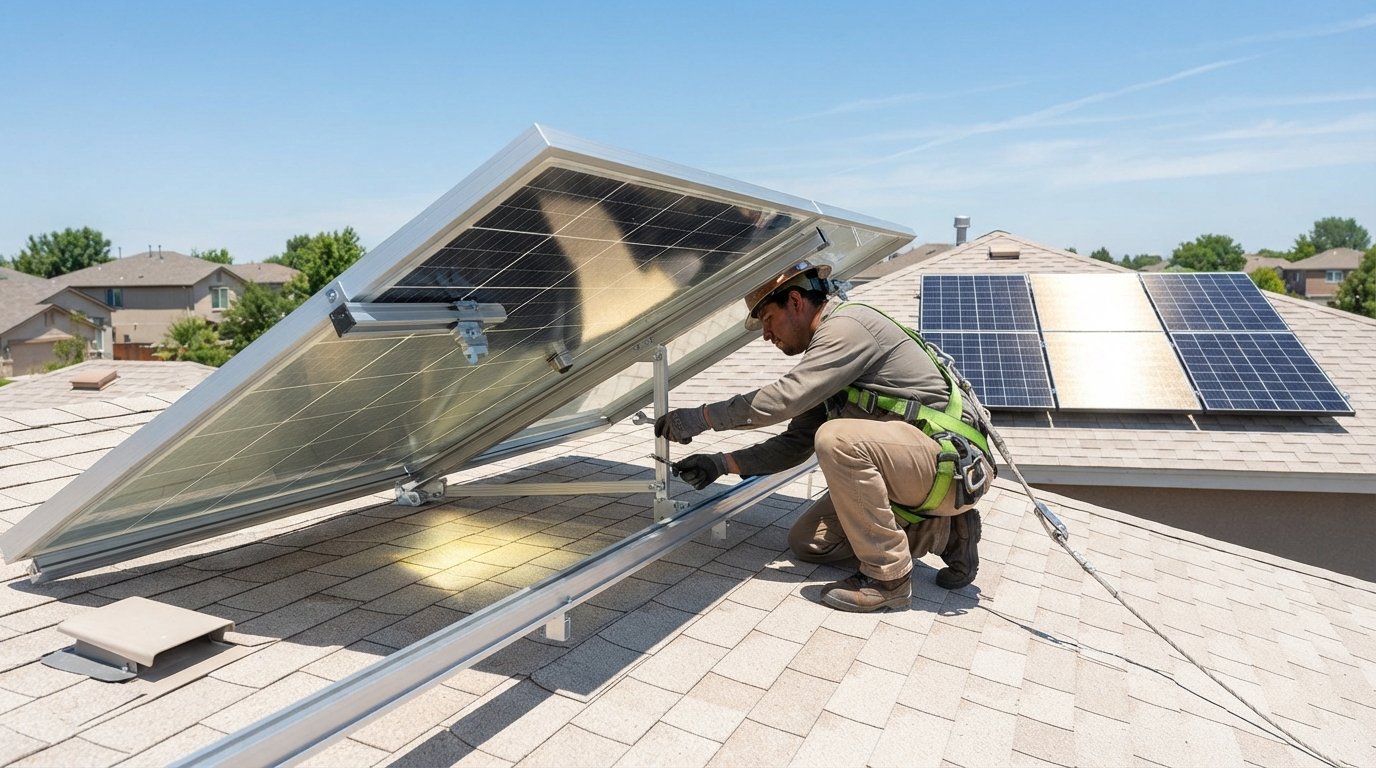
Where you install bifacial panels matters more than the panel technology itself. On a standard pitched roof, panels are mounted flush or close to the surface. The rear side is shaded by the roof deck and the panel above it. Any reflected light that does reach the back is minimal. In this scenario, a bifacial panel behaves almost identically to a monofacial panel, but you pay a higher price. For most homeowners with asphalt shingle roofs, bifacial solar panels for homes are not worth the premium because the rear-side gain is negligible.
Ground-mounted systems are a different story. When panels are elevated on racks with clearance below, light can reflect off the ground and strike the backside. The higher the elevation and the more reflective the ground, the greater the gain. A ground mount over a light-colored gravel pad or a reflective membrane can deliver double-digit production increases. Pergolas and patio covers also present an opportunity. If you install bifacial panels as a roof for a pergola, the space below allows reflected light from the patio surface to reach the rear side. In these open structures, bifacial panels can make sense, especially if you want a modern look with dual glass construction.
To evaluate your own installation, consider these factors that determine rear-side yield:
- Albedo of the surface below: White roofing, snow, or light concrete reflect more light than dark shingles or grass.
- Tilt angle: Steeper tilts can allow more reflected light to reach the back, but the effect varies by latitude and season.
- Clearance height: A minimum of 1 to 2 feet between the panel and the mounting surface is often needed for meaningful rear-side exposure.
- Shading of the rear side: Nearby walls, HVAC units, or the roof itself can block reflected light.
If your installation cannot satisfy these conditions, the added cost of bifacial panels is unlikely to pay back. For roof-mounted systems on standard shingles, monofacial panels remain the practical choice. But if you are planning a ground mount or a pergola, bifacial solar panels for homes might be worth it, provided you calculate the expected gain accurately.
Albedo, Tilt, and Clearance: The Physics of Rear-Side Gain
Understanding the physics helps you avoid overpaying for unused potential. Albedo is the starting point. A surface with high albedo reflects more sunlight, which can then hit the back of the panel. Snow is an excellent reflector, but relying on snow cover is not a year-round strategy. Light-colored gravel, white paint, or reflective roofing membranes can improve albedo intentionally. Some homeowners install bifacial panels over a light-colored ground mount and even add reflective sheeting to boost performance. However, these upgrades add cost and maintenance, so you must factor them into the payback calculation.
Tilt angle also plays a role. Panels tilted at a steeper angle relative to the ground may capture more reflected light on the rear side, especially when the sun is low. But tilt is usually optimized for front-side production, so you should not sacrifice front-side yield for rear-side gains. Clearance is perhaps the most critical factor. A panel mounted 6 inches above a dark roof will see almost no rear-side benefit. A panel mounted 3 feet above a reflective surface will see much more. For ground mounts, standard racking often provides 2 to 4 feet of clearance, which is adequate. For pergolas, the open structure naturally provides clearance, but the ground below might be a wood deck with low albedo. You can improve albedo by using a light-colored patio surface or adding a reflective rug or coating.
Before committing to bifacial panels, ask your installer to model the rear-side gain for your specific site. Tools like PVSyst can simulate albedo, tilt, and clearance. If the modeled gain is below 5 percent, the premium is hard to justify. If the gain is 10 percent or more, the economics improve. Keep in mind that these gains are estimates, and real-world performance depends on soiling, snow, and seasonal variations. For a deeper dive into financing options that can affect your overall return, see our guide on how to sell your home with financed solar panels.
Cost Premium Versus Added Production for Typical Homes
Bifacial panels typically cost 10 to 20 percent more than comparable monofacial panels. For a 6 kW residential system, that premium can range from $1,000 to $2,500 depending on the brand and installer. The added production must be high enough to recover that upfront cost within the system's lifetime. Let us run a simple example. Suppose a 6 kW monofacial system produces 9,000 kWh per year. A bifacial system with a 10 percent gain would produce 9,900 kWh per year, an extra 900 kWh. At an electricity rate of $0.15 per kWh, that is $135 in annual savings. Over 25 years, that is $3,375, which may or may not exceed the premium after accounting for the time value of money. If the gain is only 5 percent, the annual savings drop to $67.50, and the payback stretches beyond 20 years.
For roof-mounted systems where the gain is often 2 to 5 percent, the math rarely works in favor of bifacial panels. The premium is simply too high for the marginal production increase. For ground mounts with high albedo and good clearance, a 10 to 15 percent gain can make the investment worthwhile, especially if you plan to stay in the home long enough to realize the savings. It is also important to consider inverter clipping and system design. If your inverter is already sized to clip at peak production, the extra rear-side output may be wasted. A qualified installer can help you right-size the system.
Incentives can shift the calculus. The federal solar tax credit (currently 30 percent through 2032) applies to the total system cost, including the bifacial premium. That effectively reduces the net cost of the upgrade by 30 percent. State and local incentives may add more. However, you should always verify current incentives with a tax professional, as rules can change. To compare quotes from certified installers and see how bifacial pricing stacks up in your area, you can request free quotes through FreeSolarPowerQuotes, a service that connects homeowners with vetted solar professionals.
When Monofacial Panels Remain the Smarter Buy
For the majority of homeowners, monofacial panels are still the better choice. If you have a standard pitched roof with asphalt shingles, the rear-side gain from bifacial panels will be minimal. You would be paying a premium for a feature you cannot use. Monofacial panels are also slightly lighter and less prone to certain types of degradation, although dual-glass bifacial panels are generally more durable. The weight difference matters for older roofs, and the cost savings can be redirected to other system components like a higher-efficiency inverter or additional panels.
Monofacial panels also simplify maintenance. Bifacial panels with dual glass are heavier and may require stronger racking. While dual-glass construction can improve fire resistance and longevity, it also adds cost. If your roof has limited space, you might be tempted by the higher power density of bifacial panels, but the gain is only realized if the rear side is exposed. In most residential roof mounts, it is not. Therefore, bifacial solar panels for homes are not worth it for typical roof installations. They are a niche product best suited for ground mounts, pergolas, and commercial flat roofs with high albedo and clearance.
That said, if you are building a new home or planning a ground-mounted array, bifacial panels can be a smart upgrade. They offer a hedge against future increases in electricity prices and can increase the overall energy yield of your property. The key is to run the numbers for your specific site and not rely on marketing claims. A reputable installer can provide a production estimate that accounts for albedo and clearance. If the modeled gain is strong, bifacial panels may be worth it. If not, stick with monofacial and invest the savings elsewhere.
Ultimately, the decision comes down to your installation type and your willingness to optimize for rear-side gain. Bifacial solar panels are an exciting technology with real benefits in the right application. For homeowners with standard roofs, they are rarely worth the extra cost. For those with ground mounts or pergolas, they can deliver meaningful additional production. Evaluate your site, get multiple quotes, and choose the configuration that maximizes your return on investment.
Learn more about Solar Panel Installation and Repair for guides, costs, and what to expect.
Compare Solar Panel Installation and Repair Pros Near You
Enter your ZIP code to compare top-rated local professionals and request free quotes.