
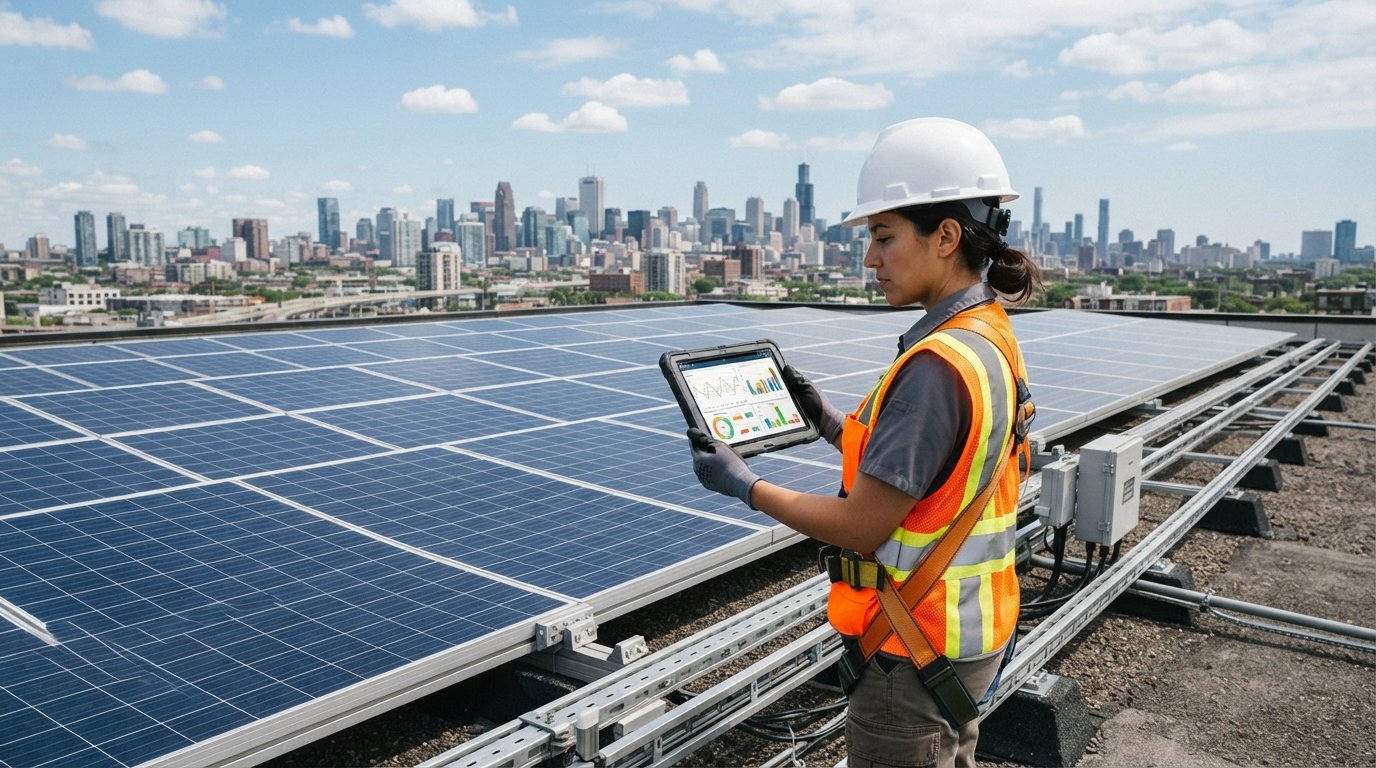
Commercial Solar System Monitoring Performance Tracking
Master commercial solar system monitoring performance tracking to protect your ROI. Call (833)-212-3715 for expert guidance on optimizing your solar investment.

By Julia Walsh
Find Local Pros Near You
Enter your ZIP code to compare top-rated local professionals and request free quotes.
Your commercial solar array is a long-term financial asset, and like any asset, it demands vigilant oversight to protect its value. Once the panels are installed and the system is energized, the real work of maximizing your return on investment begins. Without a robust commercial solar system monitoring performance tracking strategy, you are essentially flying blind, leaving thousands of dollars in potential savings and lost production on the table. This guide will walk you through the essential metrics, the tools available, and the processes you need to ensure your solar investment performs exactly as promised.
The Core Metrics That Drive Solar ROI
To effectively track performance, you must first understand what to measure. While a simple glance at a production app might show you a current power output in kilowatts, that number alone is meaningless without context. The foundation of any serious monitoring effort is the relationship between actual energy generated and the system's rated capacity over time. This is where the specific yield, often expressed as kWh per kW, becomes your most critical benchmark.
Kilowatt-hours (kWh) per kilowatt (kW) tells you how many hours of full-sun equivalent your system produced for each kilowatt of installed capacity. For example, a 100 kW system that generates 400 kWh in a day has a specific yield of 4 kWh per kW. This metric normalizes performance across different system sizes and geographic locations, allowing you to compare your site against regional averages or your own historical data. If your specific yield begins to trend downward while weather conditions remain stable, it is a clear red flag that something is amiss.
Beyond specific yield, a comprehensive monitoring platform should track several other key performance indicators (KPIs). These include the performance ratio (the ratio of actual to theoretical energy output), system availability (the percentage of time the system is capable of producing power), and the inverter efficiency. Monitoring these metrics collectively provides a holistic view of system health. For instance, a drop in performance ratio coupled with high availability points to soiling or degradation, while low availability suggests inverter faults or grid outages.
Establishing Baselines and Automated Alerts
You cannot manage what you do not measure, and you cannot detect a problem without a baseline. The first step in any commercial solar system monitoring performance tracking plan is to establish a clear, data-driven baseline during the system's first year of operation. This baseline should account for expected seasonal variations, typical weather patterns, and known shading events. Once this baseline is set, you can configure your monitoring platform to send automated alerts when performance deviates from the expected norm by a certain threshold, typically 5% to 10%.
These alerts are the early warning system for your solar investment. A sudden drop in production could indicate a tripped breaker, a failed inverter, or a communication error. A gradual decline over weeks or months often points to soiling (dirt, pollen, or bird droppings), module degradation, or string-level issues like a faulty optimizer. By catching these issues early, you can schedule maintenance before a minor problem becomes a major expense. For instance, cleaning a heavily soiled array can recover 5% to 15% of lost production, a quick win that directly improves your bottom line.
When setting up alerts, it is crucial to avoid alert fatigue. Configure thresholds that are meaningful for your specific site and business operations. A 2% deviation might be normal noise, but a 10% drop warrants immediate investigation. Many platforms allow for tiered alerts, sending a notification for minor deviations and escalating to a phone call or work order for critical failures. This ensures your facilities team or O&M provider responds appropriately without being overwhelmed by false alarms.
Fleet-Level Dashboards for Multi-Site Businesses
For businesses with solar installations across multiple locations, from retail chains to manufacturing facilities, managing performance site-by-site is inefficient and prone to oversight. A fleet-level monitoring dashboard aggregates data from all your sites into a single, unified view, allowing you to compare performance, identify underperforming locations, and prioritize maintenance resources effectively.
These dashboards typically display key metrics for each site, such as current power output, daily energy yield, and performance ratio, often using color-coded status indicators (green for good, yellow for warning, red for fault). This visual management style enables rapid triage. If one store in a chain is consistently underperforming compared to its peers, you can drill down into its data to diagnose the issue, whether it is local shading, a maintenance problem, or a configuration error. Fleet-level monitoring also supports financial reporting, allowing you to track the ROI of each site and the portfolio as a whole.
When evaluating monitoring platforms for a multi-site commercial solar portfolio, look for features like customizable dashboards, role-based access controls, and robust reporting capabilities. The ability to export data to CSV or integrate with business intelligence tools is also valuable for long-term analysis. If you are in the process of selecting an installer or EPC contractor for a multi-site project, it is wise to ask about their monitoring capabilities upfront. For guidance on vetting potential partners, see our article on how to find the best commercial solar company.
Leveraging Monitoring Data for Warranty Claims
One of the most overlooked benefits of rigorous commercial solar system monitoring performance tracking is the evidentiary trail it creates for warranty claims. Solar panels and inverters come with long-term warranties, often 25 years for panels and 10 to 12 years for inverters. However, manufacturers and installers will require proof of underperformance before honoring a claim. Your monitoring data is that proof.
If you suspect a module is failing prematurely or an inverter is not performing to specification, a detailed history of production data can substantiate your claim. For example, if the performance ratio of a specific string of panels has steadily declined over two years while others remain stable, the data clearly points to a defect. Without this data, your claim may be denied due to a lack of evidence. Therefore, it is essential to ensure your monitoring system logs data at regular intervals (at least every 15 minutes) and that you retain this data for the life of the system.
When filing a warranty claim, you should present a clear narrative supported by data: the baseline performance, the observed deviation, the steps taken to rule out other causes (like soiling or shading), and the conclusion that a component has failed. This professional approach increases the likelihood of a swift resolution. It also holds installers accountable for the quality of their work. If you are planning a move to a new facility and need to relocate your solar assets or evaluate a new property's energy potential, resources like Moving.Homes offer practical guidance for managing the logistical side of relocation, ensuring your energy strategy remains intact.
Choosing the Right Monitoring Platform
The market offers a range of monitoring solutions, from basic manufacturer-provided portals to advanced third-party platforms. The right choice depends on your portfolio size, budget, and internal capabilities. For a single commercial site, the inverter manufacturer's monitoring app may suffice, but it often lacks the depth and flexibility needed for serious performance tracking. For multi-site portfolios, a dedicated third-party platform is usually necessary.
When selecting a platform, consider the following factors:
- Data granularity: Can it provide string-level or module-level data, or is it limited to total system output?
- Alerting capabilities: Are alerts customizable, and can they be routed to multiple recipients?
- Reporting and analytics: Does it offer automated reports, trend analysis, and the ability to export data?
- Integration: Can it integrate with your existing CMMS (Computerized Maintenance Management System) or accounting software?
- Cybersecurity: How is data secured and transmitted? Ensure the platform meets your IT department's standards.
It is also important to consider the total cost of ownership, including hardware (sensors, data loggers), software subscriptions, and installation. Some platforms require additional hardware, while others rely on existing inverter communications. Always request a demo and a trial period to evaluate the platform's usability and accuracy before committing. Remember, the goal is to make data actionable, not just to collect it.
Integrating Monitoring into Your O&M Strategy
Commercial solar system monitoring performance tracking is not a set-and-forget task; it must be integrated into a broader operations and maintenance (O&M) strategy. This means assigning responsibility for reviewing alerts, scheduling preventative maintenance based on data trends, and conducting regular performance reviews. A common pitfall is installing a monitoring system but never acting on the data it provides.
Establish a routine: daily review of critical alerts, weekly review of performance dashboards, and monthly or quarterly deep-dive analysis. Use the data to plan cleaning schedules, inverter maintenance, and vegetation management. For example, if historical data shows a consistent dip in production during pollen season, you can proactively schedule cleaning just before that period. This data-driven approach to O&M maximizes uptime and energy yield, directly enhancing your ROI.
Finally, ensure that your monitoring data is archived and accessible. If you change monitoring providers or sell the property, the historical performance data is a valuable asset that demonstrates the system's health and supports future warranty claims. By treating your monitoring data as a strategic asset, you protect your investment and ensure that your commercial solar system delivers the financial and environmental returns you expect.