
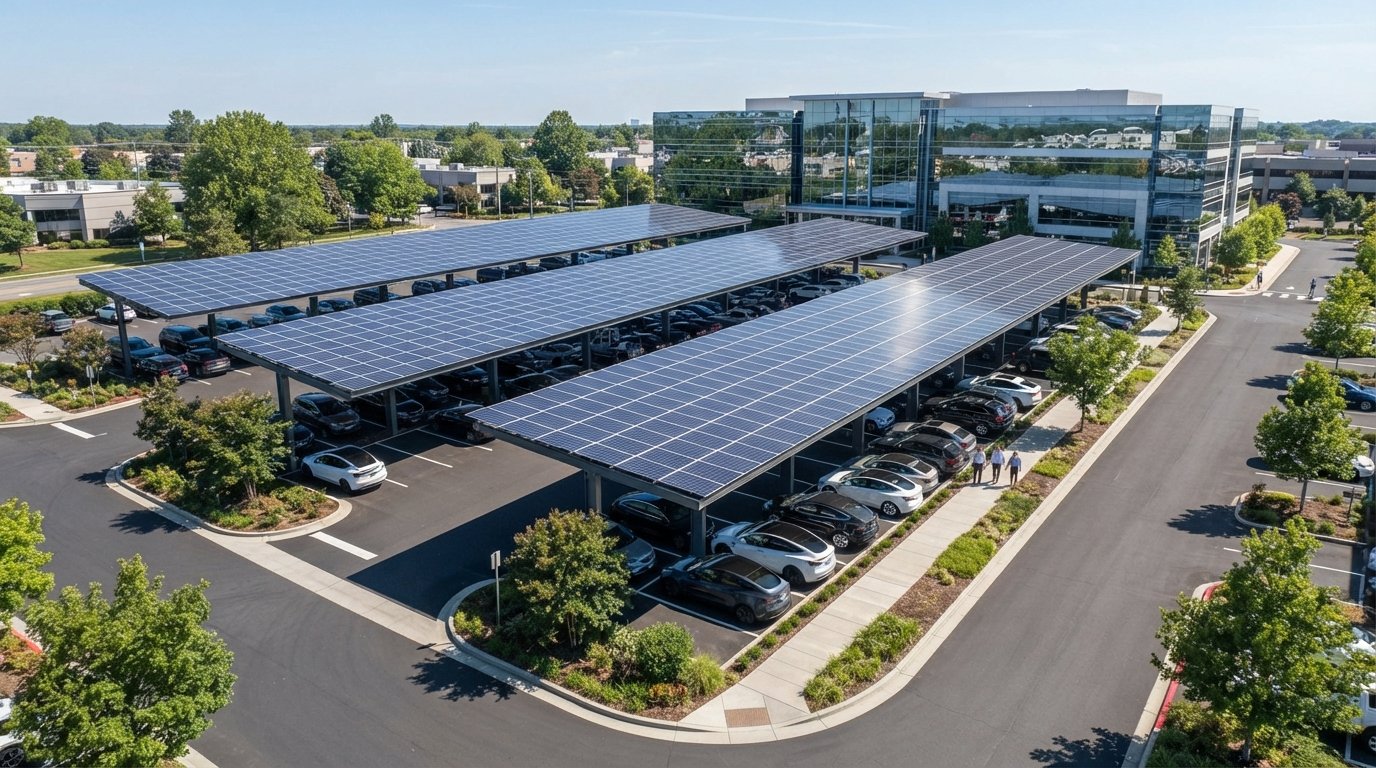
Solar Carport Cost and Design for Business Parking Lots
Solar carport cost and design for business parking lots can turn idle asphalt into revenue. Call 8332123715 for a free quote from certified installers.

By Alex Carter
Learn more about Solar Panel Installation and Repair for guides, costs, and what to expect.
Compare Solar Panel Installation and Repair Pros Near You

Enter your ZIP code to compare top-rated local professionals and request free quotes.
Business parking lots are among the most underused assets on commercial properties. They occupy thousands of square feet, sit idle for hours at a time, and generate zero revenue. A solar carport changes that equation entirely. By mounting photovoltaic panels on elevated steel or timber structures, property owners can convert asphalt into a power plant that offsets operating costs, supports sustainability goals, and even generates new income streams. For U.S. businesses facing rising utility rates and growing pressure from tenants, investors, and regulators to decarbonize, solar carports are no longer a niche experiment. They are a maturing infrastructure play with predictable economics and a growing track record.
Understanding solar carport cost and design for business parking lots requires more than a simple price-per-watt calculation. It involves structural engineering, local building codes, utility interconnection rules, tax incentive stacking, and long-term maintenance planning. The decisions made during feasibility and design determine whether a project delivers a 12 percent return or becomes a capital sink. This guide walks through the numbers, the design variables, and the practical steps that separate successful commercial solar carports from costly missteps.
Why Solar Carports Make Sense for Commercial Parking Lots
The core value proposition of a solar carport is dual-use land. Unlike ground-mount solar farms that consume open acreage, carports sit above existing parking spaces without reducing vehicle capacity. For businesses in dense urban or suburban markets where land is expensive, that efficiency is decisive. A typical carport canopy covers two to four parking spaces and can support 5 to 15 kilowatts of solar capacity depending on panel efficiency and structural spacing.
Beyond energy generation, carports provide tangible benefits that facility managers appreciate. Shaded parking reduces surface temperatures by 20 to 40 degrees Fahrenheit, which protects vehicle interiors and extends asphalt lifespan. In regions with heavy snow or hail, canopies shield cars from damage. For retail centers, office parks, hospitals, and universities, covered parking is a premium amenity that can justify higher lease rates or attract tenants with sustainability mandates.
The financial case strengthens when you factor in federal incentives. The Investment Tax Credit (ITC) currently covers 30 percent of project costs for commercial solar installations, and carports qualify because they are considered part of the solar energy system. Accelerated depreciation under MACRS allows businesses to recover most of the remaining cost in the first five years. State and utility rebates, renewable energy certificates, and net metering policies can push the effective payback period below seven years in favorable markets. If you are still evaluating whether your property is a good fit for solar, our guide on solar carport and canopy structures for parking areas covers the structural and site considerations in more detail.
It is also worth noting that carports can be paired with electric vehicle (EV) charging stations. As EV adoption accelerates, businesses that offer covered, solar-powered charging gain a competitive edge. The same conduit and structural supports that carry solar wiring can often accommodate Level 2 or DC fast chargers, reducing the incremental cost of adding EV infrastructure later.
Solar Carport Cost Breakdown for Business Parking Lots
Solar carport cost and design for business parking lots vary widely based on geography, structural requirements, panel selection, and the complexity of electrical integration. As a general benchmark, commercial solar carports in the United States cost between $2.50 and $4.50 per watt installed before incentives. That translates to roughly $250,000 to $450,000 for a 100-kilowatt system, or $1.25 million to $2.25 million for a 500-kilowatt installation.
These figures are higher than rooftop solar, which typically ranges from $1.80 to $3.00 per watt, because carports require additional steel, foundations, engineering, and labor. The premium is usually 20 to 40 percent over an equivalent rooftop array. However, carports often enable larger system sizes than rooftops can support, and they avoid roof warranty complications that plague many commercial installations.
To understand where the money goes, consider the major cost categories for a typical 250-kilowatt carport project:
- Structural steel and canopy materials: $0.80 to $1.40 per watt, including columns, beams, purlins, and corrosion protection.
- Solar modules and inverters: $0.60 to $0.95 per watt, depending on panel efficiency and inverter type (string vs. microinverter).
- Foundation and civil work: $0.25 to $0.50 per watt, covering concrete footings, grading, and drainage modifications.
- Electrical and interconnection: $0.30 to $0.60 per watt, including wiring, combiner boxes, switchgear, and utility coordination.
- Engineering, permitting, and labor: $0.40 to $0.80 per watt, reflecting prevailing wages, inspections, and project management.
Soft costs, including financing, insurance during construction, and legal fees, can add another 10 to 15 percent. It is also important to budget for ongoing operations and maintenance, which typically runs $8 to $15 per kilowatt annually. That covers periodic cleaning, inverter servicing, structural inspections, and monitoring system subscriptions.
Incentives dramatically change the net cost picture. A 30 percent ITC on a $1 million project reduces the tax basis by $300,000. MACRS depreciation on the remaining $700,000 can yield another $200,000 to $250,000 in tax savings over five years, depending on the business tax rate. State-level programs in California, New York, Massachusetts, and Illinois can add $0.10 to $0.50 per watt in rebates or performance-based incentives. The result is that a project with a gross cost of $3.00 per watt can often be installed for an effective net cost of $1.50 to $2.00 per watt.
Financing options further shape the economics. Cash purchases deliver the highest lifetime returns but require upfront capital. Power Purchase Agreements (PPAs) and leases allow businesses to host carports with zero upfront cost, purchasing the electricity at a fixed rate below utility rates. Property Assessed Clean Energy (PACE) financing and commercial solar loans are also common. The right choice depends on the business tax appetite, balance sheet capacity, and long-term real estate plans.
Design Considerations That Drive Performance and Cost
Design decisions made early in the project lifecycle have an outsized impact on both installed cost and long-term energy yield. One of the first choices is canopy height and clearance. Standard carports range from 9 to 12 feet at the low end, but solar carports often require 12 to 14 feet to accommodate panel tilt and maintenance access without obstructing vehicles. Higher canopies increase steel costs but may be necessary for fire code compliance or to allow larger vehicles such as delivery trucks or emergency vehicles.
Panel tilt and orientation also matter. Fixed-tilt systems at 5 to 15 degrees are common for carports because they balance energy production with wind loading and aesthetics. Steeper tilts increase energy yield in northern latitudes but require more steel and spacing, raising costs. Single-axis trackers can boost production by 15 to 25 percent but add mechanical complexity and maintenance requirements that many commercial owners prefer to avoid.
Structural engineering is non-negotiable. Carports must withstand wind, snow, and seismic loads specific to the site. In hurricane-prone regions like Florida and Texas, wind uplift requirements can drive foundation sizes and steel gauges significantly higher. Snow loads in the Northeast and Midwest require reinforced purlins and sometimes active snow-shedding designs. A licensed structural engineer should always be involved, and their fees should be baked into the project budget from the start.
Electrical design is equally critical. The inverter strategy, whether string inverters, microinverters, or DC optimizers, affects both cost and resilience. String inverters are cheaper per watt but can suffer from shading losses if canopies are partially obstructed by trees or adjacent buildings. Microinverters and optimizers mitigate shading but cost 15 to 30 percent more. Battery storage is increasingly part of the conversation, especially for businesses that want resilience during grid outages or want to maximize demand charge savings. Adding batteries can increase project cost by 30 to 50 percent but may be justified by utility rate structures or critical load requirements.
Finally, design should account for future expansion. Conduit runs, switchgear capacity, and structural connections can be oversized modestly during initial construction to accommodate additional canopies or EV chargers later. The incremental cost of future-proofing is small compared to the expense of retrofitting.
Navigating Permits, Interconnection, and Incentives
Commercial solar carports involve a web of approvals that can delay or derail projects if not managed proactively. Local building departments review structural plans, electrical diagrams, and site plans. Fire departments may require clearances for emergency vehicle access and signage. Some jurisdictions have specific carport codes that dictate minimum heights, column spacing, and fire ratings. In historic districts or planned communities, aesthetic review boards may impose design conditions.
Utility interconnection is often the longest lead item. Depending on the size of the system and the local grid capacity, utilities may require studies, upgrades, or new metering equipment. In some cases, utilities impose fees for interconnection or require liability insurance beyond standard commercial policies. Early engagement with the utility is essential, ideally before finalizing the system design.
Incentive paperwork adds another layer. The federal ITC requires documentation of placed-in-service date, cost basis, and tax liability. State programs often have separate applications, inspections, and reporting requirements. Some utilities offer rebates that are reserved on a first-come, first-served basis, so timing matters. Working with an experienced solar developer or a platform like SolarEnergy.ai that provides comprehensive solar information, cost analysis, and industry insights can help businesses avoid missed deadlines and compliance pitfalls.
It is also wise to consult a tax advisor early. The ITC can be claimed against tax liability, but businesses with low tax liability may need to consider tax equity financing or pass-through structures. Depreciation schedules, bonus depreciation eligibility, and state tax treatment vary. Getting these details right can be worth hundreds of thousands of dollars on a large project.
Evaluating ROI and Long-Term Value
The return on investment for a commercial solar carport depends on electricity rates, system size, incentives, and financing structure. In states with high utility rates such as California, Massachusetts, and Connecticut, payback periods of five to seven years are common for cash purchases. In lower-rate states like Texas or Florida, payback may stretch to eight to ten years, but the 25-to-30-year lifespan of the system still delivers strong lifetime returns.
Beyond direct energy savings, carports can increase property value. Commercial appraisers are increasingly recognizing solar assets as income-producing improvements. A carport that reduces operating expenses by $20,000 per year can add $200,000 to $300,000 to property value at a 7 to 10 percent capitalization rate. For businesses planning to sell or refinance, that uplift can be significant.
There is also the brand and stakeholder value. Many corporations have public sustainability commitments, and on-site solar generation provides verifiable renewable energy credits that can be applied toward those goals. Retailers, universities, and municipalities often find that visible solar carports generate positive press and community goodwill. In competitive leasing markets, covered parking with solar-powered EV charging can be a differentiator that commands premium rents.
Risk management matters too. Solar carports have no moving parts in fixed-tilt configurations, which means low maintenance and high reliability. Panels typically carry 25-year performance warranties, and inverters carry 10-to-12-year warranties. With proper installation and routine inspections, systems routinely exceed 90 percent of their original output after 20 years. That predictability makes carports attractive to conservative investors and lenders.
Practical Steps to Move from Concept to Construction
Businesses that want to pursue a solar carport should follow a structured process to avoid costly surprises. The sequence below reflects best practices from successful commercial installations across the United States.
- Conduct a feasibility study: Assess parking lot orientation, shading, soil conditions, utility rate structure, and local incentives. This step typically costs $5,000 to $15,000 but can prevent six-figure mistakes.
- Request multiple quotes: Solicit proposals from at least three experienced commercial solar installers. Compare not just price but also equipment quality, warranties, and track record. Our free quote request system connects you with certified professionals in your area.
- Secure financing: Decide between cash, loan, lease, or PPA based on tax appetite and cash flow needs. Lock in terms before construction begins.
- Finalize design and permits: Work with your chosen installer and a structural engineer to produce stamped drawings, then submit for building and electrical permits.
- Coordinate utility interconnection: Submit interconnection applications early and respond promptly to utility requests for additional studies or documentation.
- Construct and commission: Manage construction to minimize disruption to parking operations. Schedule commissioning tests and utility witness tests as required.
- Monitor and maintain: Set up performance monitoring and establish a maintenance schedule for cleaning, inverter checks, and structural inspections.
Each step builds on the previous one, and skipping ahead often leads to rework. For example, ordering equipment before permits are approved can result in costly change orders if the building department requires design modifications. Similarly, signing a PPA before confirming utility interconnection capacity can leave the business locked into a contract it cannot fulfill.
Working with a trusted partner simplifies the process. NewSolarQuotes connects businesses with vetted solar specialists who understand commercial carport design, financing, and incentive stacking. The platform also provides educational resources, cost calculators, and state-specific guidance to help decision-makers evaluate their options with confidence.
Solar carports represent a rare opportunity to turn an underused asset into a productive one. The technology is proven, the incentives are strong, and the economics work across a wide range of U.S. markets. Businesses that move early can lock in favorable utility rates, capture tax benefits, and position themselves as leaders in the transition to clean energy. The key is to approach the project with the same rigor applied to any major capital investment: clear feasibility analysis, competitive procurement, disciplined engineering, and long-term performance management.