
Ground Mount Solar vs Rooftop for Rural Homes: Which Wins?
Weigh ground mount vs rooftop solar for rural homes. Call (833)-212-3715 for expert guidance on optimizing production and savings.

By Alex Carter
Learn more about Solar Panel Installation and Repair for guides, costs, and what to expect.
Compare Solar Panel Installation and Repair Pros Near You

Enter your ZIP code to compare top-rated local professionals and request free quotes.
Rural homeowners face a decision that their suburban counterparts often do not: whether to mount solar panels on the roof or on the open ground. With acreage, outbuildings, and often unobstructed sun, the choice is not automatic. Ground mount solar versus rooftop for rural homes involves tradeoffs in cost, production, maintenance, and land use that can significantly affect your long-term savings. This guide breaks down the key differences so you can choose the system that fits your property, your budget, and your energy goals.
Cost, Permitting, and Excavation: The Hidden Differences
At first glance, rooftop solar looks cheaper because the mounting structure is already there: your roof. Ground mounts require additional hardware, including steel or aluminum racking, concrete footings or ground screws, and often trenching for wiring. These components add to the upfront cost, typically 10 to 20 percent more than a comparable rooftop system. However, that premium can be offset by lower labor costs if your roof is steep or complex, and by easier access that speeds installation.
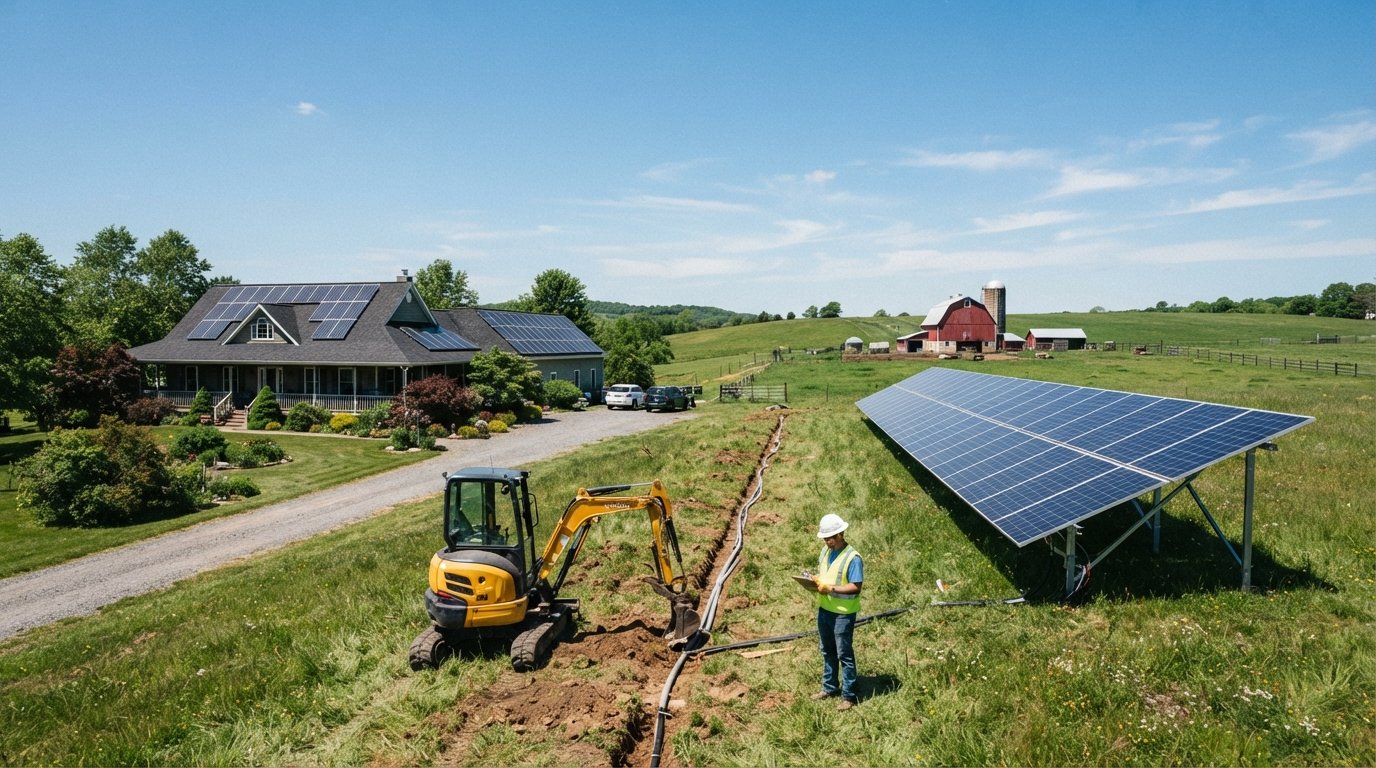
Permitting also differs. Rooftop systems usually fall under standard residential solar permits, but ground mounts may trigger additional zoning reviews, especially in rural areas with setback requirements or height restrictions. Some jurisdictions treat ground-mounted arrays as accessory structures, requiring a separate building permit. Excavation is another factor: you will need to dig trenches for conduit from the array to your home, which adds cost and requires careful planning to avoid underground utilities. In rocky terrain, excavation can be challenging and expensive.
To manage these variables, start by checking local zoning ordinances and talking to your permitting office early. A professional installer can help you navigate the process and may have experience with similar projects in your area. For those considering a ground mount on uneven terrain, our guide on ground mounted solar array design for sloped yards explains how to adapt racking and footings for hillside properties.
Production Gains: Why Tilt and Orientation Matter
One of the strongest arguments for ground mounts in rural settings is energy production. Rooftop systems are constrained by the roof's pitch and orientation, which may not be optimal for solar gain. Ground mounts can be tilted at the ideal angle for your latitude, maximizing exposure to the sun throughout the year. In many cases, this can boost annual production by 10 to 15 percent compared to a roof-mounted system of the same size.
Ground mounts also allow for better air circulation, which keeps panels cooler and improves efficiency. Heat reduces panel output, so the cooling effect of open mounting can add a few percentage points to production. Additionally, ground mounts can be designed with adjustable tilt to capture more sun in winter when the sun is lower in the sky, further increasing yield.
For rural homeowners with shade issues, ground mounts offer flexibility. You can position the array in the sunniest part of your property, away from trees or buildings that might shade the roof. This is especially valuable in wooded areas where roof shading is unavoidable. The ability to optimize tilt and orientation, combined with reduced shading, often makes ground mounts the higher-production choice.
Land Use and Setback Requirements: What to Check
Rural properties often have plenty of land, but that does not mean you can place a ground mount anywhere. Setback requirements vary by municipality and can affect where you can install the array. Common setbacks include distances from property lines, roads, and other structures. Some areas also have height restrictions that limit how tall the array can be. Before committing to a ground mount, review your local zoning code and consult with your installer to ensure compliance.
Land use also involves considering the opportunity cost of the space. A typical residential ground mount might occupy 200 to 400 square feet, depending on system size. If you have unused acreage, this is rarely an issue. But if you have plans for a garden, outbuilding, or future expansion, you will need to site the array accordingly. Keep in mind that ground mounts can be dual-purpose: some homeowners use the space beneath the panels for grazing small livestock or storing equipment, though this requires careful planning.
Another factor is future land use. If you might sell the property, a ground mount could be seen as an asset or a liability, depending on the buyer. Some buyers prefer the clean look of a rooftop system, while others value the production benefits of a ground mount. In rural areas, where land is abundant, ground mounts are generally well-accepted.
Snow, Shading, and Vegetation Management
Rural homes often face harsher environmental conditions than urban ones. Snow accumulation is a major consideration: rooftop panels can shed snow naturally as the roof warms, but ground-mounted panels are closer to the ground and may be partially shaded by snowbanks. However, ground mounts can be tilted steeper to encourage snow sliding, and their lower height makes them easier to clear manually if needed. In heavy snow regions, ground mounts with adjustable tilt can be set to a steep angle in winter to maximize snow shedding.
Shading from trees is another rural challenge. While ground mounts allow you to avoid roof shading, you must also consider future tree growth. A tree that is small now could shade your array in a few years. Regular pruning or removal may be necessary to maintain production. Vegetation management around ground mounts is an ongoing task: you will need to keep grass and weeds trimmed to prevent shading and to reduce fire risk. Some homeowners use gravel or landscape fabric around the array to simplify maintenance.
Wildlife is another factor. Ground mounts can attract animals that may chew wiring or nest under panels. Proper conduit and screening can mitigate these issues. Overall, ground mounts require more active management of the surrounding environment, but the payoff is a system that can be optimized for production.
Wiring Runs and Inverter Placement: Planning for Efficiency
The distance between your array and your home's electrical panel is a critical design consideration for ground mounts. Longer wiring runs mean more voltage drop, which can reduce system efficiency. To minimize losses, installers often use higher-voltage DC wiring or place the inverter closer to the array. Some ground mount systems use microinverters or DC optimizers at each panel to convert power to AC early, reducing losses over long runs.
Inverter placement is another decision point. String inverters are typically mounted near the main service panel, but for ground mounts, you might consider a location closer to the array to shorten DC runs. However, the inverter must be accessible for maintenance and protected from the elements. In rural areas, equipment theft and wildlife can be concerns, so secure mounting and fencing may be advisable.
Proper planning of wiring and inverter placement is essential to maximize the production benefits of a ground mount. Work with your installer to calculate voltage drop and choose the optimal equipment for your site. A well-designed system will ensure that the extra production from optimal tilt is not lost to wiring inefficiencies.
Maintenance and Accessibility: The Long-Term View
Ground mounts are generally easier to maintain than rooftop systems. Panels are at a comfortable height for cleaning, inspection, and repair. You can walk around the array, check connections, and clear debris without climbing a ladder. This accessibility can reduce maintenance costs over the life of the system and make it more likely that small issues are caught early.
Rooftop systems, by contrast, require specialized labor for many maintenance tasks, and some homeowners are uncomfortable with heights. While solar panels are durable and require infrequent maintenance, occasional cleaning or troubleshooting is easier with a ground mount. In rural areas, where service providers may be farther away, the ability to perform simple checks yourself can be a significant advantage.
However, ground mounts are more exposed to vandalism and theft. In remote areas, this risk may be low, but it is worth considering. Fencing or security cameras can add cost but provide peace of mind. Overall, the accessibility of ground mounts is a strong point in their favor for rural homeowners who value self-reliance.
Making the Decision: A Framework for Rural Homeowners
To choose between ground mount and rooftop solar for your rural home, consider these key factors:
- Roof condition and orientation: If your roof is old, steep, or poorly oriented, a ground mount may be the better choice.
- Available land and setbacks: Ensure you have a suitable location that meets local zoning requirements.
- Budget: Ground mounts have higher upfront costs but may offer better production and lower maintenance.
- Snow and shading: Ground mounts can be tilted for snow shedding and positioned to avoid shade.
- Future plans: Consider how long you plan to stay and whether the system adds value to your property.
For many rural homeowners, the production gains and easier maintenance of a ground mount outweigh the extra cost. However, if your roof is in good shape and well-oriented, a rooftop system may be more cost-effective. To explore financing options and get free quotes from certified installers, visit FreeSolarPowerQuotes for educational resources and no-obligation estimates.
Whichever you choose, the goal is to maximize your energy independence and savings. With careful planning and professional guidance, you can design a solar system that fits your rural property perfectly.
Learn more about Solar Panel Installation and Repair for guides, costs, and what to expect.
Compare Solar Panel Installation and Repair Pros Near You
Enter your ZIP code to compare top-rated local professionals and request free quotes.