You open your monthly electricity bill and feel a familiar frustration. Rates have gone up again, and you wonder if there is a way to stop this cycle. Many homeowners in the United States are asking the same question and discovering that solar energy offers a practical answer. A solar lifetime savings example can show you exactly how much money you could keep in your pocket over the next 25 or 30 years. Instead of paying the utility company month after month, you can generate your own power and reduce your dependence on the grid. This article walks through a realistic scenario so you can see what solar might mean for your home.
Understanding solar lifetime savings example
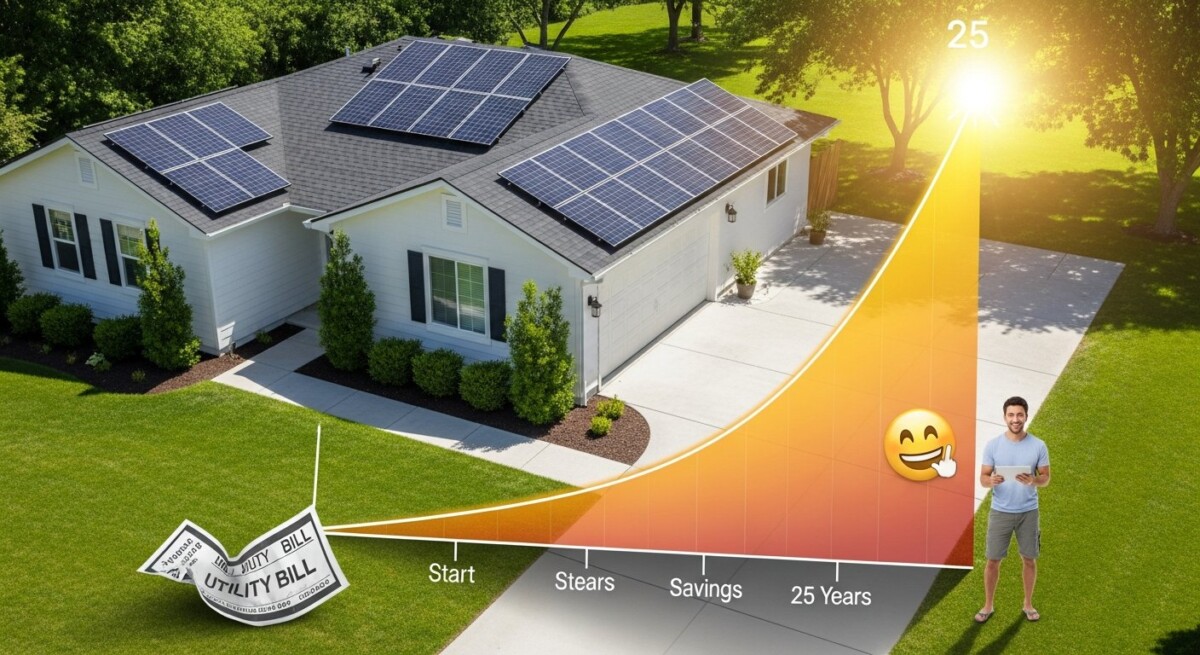
A solar lifetime savings example is a calculation that estimates the total money you will not pay to your utility company over the lifespan of your solar panel system. Most residential solar panels come with a performance warranty of 25 years, and many continue producing electricity well beyond that. The concept is simple: you invest in a solar installation now, and over time the system pays for itself through lower or eliminated electricity bills.
Here is how it works. Solar panels convert sunlight into direct current electricity. An inverter changes that power into alternating current that your home can use. When your panels produce more electricity than you need, the excess flows back to the grid, and many utility companies offer net metering credits that reduce your future bills. Over the life of the system, these savings add up significantly. More homeowners are considering solar because it turns a fixed upfront cost into decades of predictable energy expenses.
Why Solar Energy Is Becoming More Popular
Rising electricity prices are the number one reason homeowners switch to solar. According to the U.S. Energy Information Administration, residential electricity rates have increased steadily over the past decade, and that trend shows no sign of reversing. Solar energy locks in a large portion of your electricity cost, protecting you from future rate hikes. The financial predictability is a major draw for families on a budget.
Environmental concerns also play a role. Solar power produces no carbon emissions during operation, which helps reduce your household’s carbon footprint. But for many, the strongest motivator is the long-term savings. A well-designed system can save tens of thousands of dollars over its lifetime. That kind of return on investment makes solar an attractive option for homeowners who plan to stay in their homes for several years.
If you are considering solar power for your home, comparing installation quotes can help you understand your options. Request a free solar quote or call to learn more.
Common Questions Homeowners Have About Solar
Many homeowners hesitate because they worry about the upfront installation cost. The good news is that federal and state incentives, including the Investment Tax Credit, can reduce the price by 30 percent or more. You may also qualify for local rebates or performance-based incentives that lower your initial investment further.
Another common concern is roof suitability. Solar panels work best on roofs that face south or west and receive direct sunlight for most of the day. However, installers can assess your specific roof orientation, shading, and structural condition during a free evaluation. System performance is also a frequent question. Modern solar panels are highly efficient and durable, and most come with a 25-year performance warranty that guarantees a certain level of electricity production.
- How much does a solar system cost after incentives?
- Will solar panels work on my roof?
- How long will the system last?
- What happens during a power outage?
- Do I need to clean the panels regularly?
- Can I add batteries later?
How Solar Panel Installation Works
The installation process is straightforward when you work with a professional installer. It typically begins with a home energy assessment to review your electricity usage and roof condition. From there, the installer designs a system tailored to your home’s layout and your energy goals.
After you approve the design, the installer handles permits and approvals with your local government and utility company. The physical installation usually takes one to three days, depending on the system size and roof complexity. Once the panels are mounted and connected, the utility company performs a final inspection and activates your system. You start saving from day one.
- Home energy assessment
- System design and proposal
- Permits and approvals
- Panel installation
- System activation and net metering setup
Speaking with experienced installers can help you determine the best solar solution for your home. Compare solar quotes here or call to explore available options.
Signs Your Home May Be Ideal for Solar
Not every home is a perfect candidate, but many are. The most important factor is strong sunlight exposure. If your roof receives direct sunlight for most of the day, especially between 9 a.m. and 3 p.m., your system will produce more electricity. High electricity bills also signal a good opportunity because the savings will be larger.
Suitable roof space is another indicator. A typical residential system needs about 300 to 500 square feet of unobstructed roof area. If you plan to stay in your home for at least five to ten years, the long-term savings will more than cover the upfront cost. Energy independence is also appealing to homeowners who want to reduce their reliance on the grid.
- Strong sunlight exposure with minimal shading
- High monthly electricity bills
- Suitable roof space facing south or west
- Long-term home ownership plans
- Access to net metering or local incentives
- Desire for energy independence
What Affects Solar Installation Costs
The size of your solar system is the biggest cost driver. A larger system that covers 100 percent of your electricity usage will cost more upfront but generate higher lifetime savings. Equipment quality also matters. High-efficiency panels and premium inverters often cost more but can produce more power and last longer.
Installation complexity can increase the price if your roof is steep, has multiple angles, or requires electrical panel upgrades. Local incentives and utility policies vary by state and can significantly reduce your net cost. A professional installer will factor all of these variables into a detailed quote that shows your estimated savings.
The cost of solar installation varies depending on your home and energy needs. Request personalized solar quotes or call to see what options are available.
Tips for Choosing a Reliable Solar Installer
Choosing the right installer is just as important as choosing the right equipment. Look for a company with several years of experience and a strong track record in your area. Check that they hold proper licenses and certifications, such as NABCEP (North American Board of Certified Energy Practitioners) certification.
Warranties are another critical factor. A reliable installer will offer a workmanship warranty of at least 10 years and will support the manufacturer’s equipment warranties. Reading online reviews and asking for references can give you confidence in your choice. Always compare multiple quotes to see the range of prices and system designs available.
- Review installer experience and certifications
- Check equipment and workmanship warranties
- Read customer reviews and ask for references
- Compare multiple quotes to find the best value
- Ask about financing options and incentives
Long-Term Benefits of Installing Solar Panels
The most obvious long-term benefit is lower electricity bills. After your system pays for itself, which typically happens within 6 to 10 years, the electricity it produces is essentially free. Over a 25-year period, the savings can total $20,000 to $50,000 or more, depending on your location and energy usage.
Solar panels also increase your home’s resale value. Studies show that homes with solar systems sell for a premium compared to similar homes without solar. Beyond the financial benefits, you gain energy independence and reduce your environmental impact. Every kilowatt-hour of solar electricity you use means less fossil fuel burned at a power plant. That is a win for your wallet and the planet.
Frequently Asked Questions
What is a realistic solar lifetime savings example?
A realistic example assumes your system costs $20,000 after the federal tax credit and saves you $1,200 per year on electricity. Over 25 years, that equals $30,000 in gross savings, minus maintenance costs of about $1,000. Your net lifetime savings would be approximately $29,000.
How long does it take for solar panels to pay for themselves?
The payback period typically ranges from 6 to 10 years. This depends on your electricity rates, system cost, available incentives, and how much sun your roof receives. After the payback period, the electricity your panels produce is essentially free.
Do solar panels work on cloudy days?
Yes, solar panels still generate electricity on cloudy days, though at a reduced rate. Modern panels are designed to capture diffuse sunlight. Your system will produce less power than on a sunny day, but you will still offset some of your electricity usage.
Can I install solar panels myself to save money?
DIY solar installation is possible but not recommended for most homeowners. Professional installers ensure the system is correctly sized, safely wired, and compliant with local codes. Improper installation can void warranties, create safety hazards, and reduce performance.
What happens if I move after installing solar?
If you own your solar system, it can increase your home’s resale value. Many buyers view solar as a desirable feature because it offers lower electricity bills. You can also include the remaining cost of the system in the home sale price.
Are there government incentives for solar in 2025?
Yes, the federal Investment Tax Credit (ITC) allows you to deduct 30 percent of your solar installation cost from your federal taxes. Many states and local utilities also offer rebates, tax credits, or performance-based incentives. These incentives can significantly reduce your upfront cost.
Do I need a battery with my solar system?
No, a battery is optional. If you have net metering, you can send excess power to the grid and draw from it at night. A battery provides backup power during outages and can increase your energy independence, but it adds to the system cost.
How much maintenance do solar panels need?
Solar panels require very little maintenance. Rain usually keeps them clean enough. You may need to have them professionally cleaned once a year in dusty areas. The inverter and monitoring system should be checked periodically to ensure everything is working.
Solar energy is a long-term investment in your home and your financial future. By understanding a solar lifetime savings example, you can see how much money you stand to save over the years. The best way to move forward is to explore your options with a trusted professional. Compare solar installation quotes from certified installers to find the system that fits your home and budget. Take the first step today and see what solar can do for you.