
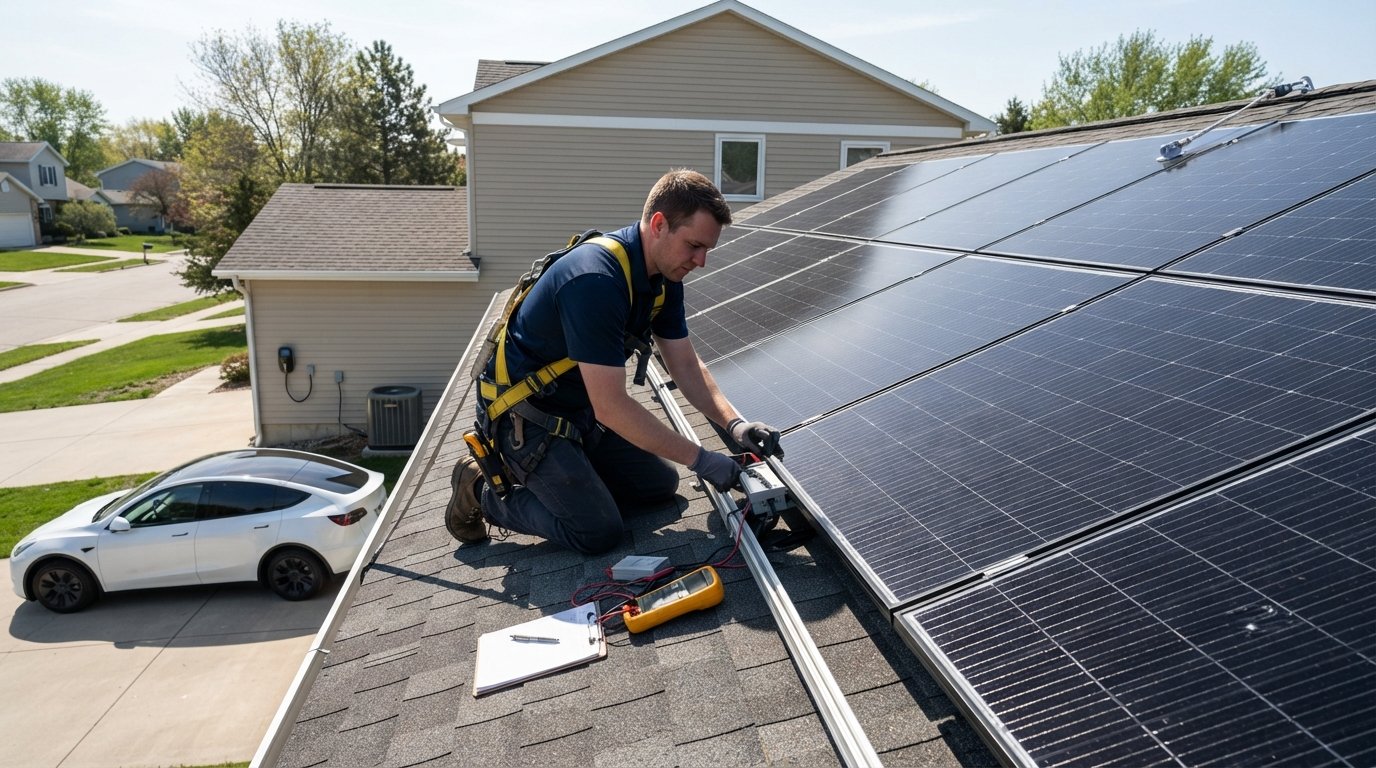
Best Residential Solar Panels for High Efficiency Homes 2026
Compare the best residential solar panels for high efficiency homes 2026 and maximize every roof square foot. Call 8332123715 for free installer quotes.

By Amelia Griffin
Learn more about Solar Panel Installation and Repair for guides, costs, and what to expect.
Compare Solar Panel Installation and Repair Pros Near You

Enter your ZIP code to compare top-rated local professionals and request free quotes.
Your electricity bill keeps climbing, the sun keeps shining for free, and the math on solar has never looked better. But walk into any solar conversation in 2026 and you will hit a wall of jargon: monocrystalline, N-type, TOPCon, HJT, temperature coefficient, degradation rate. For homeowners with high efficiency homes, the stakes are higher than average. A tightly built house with a heat pump, induction cooking, and an EV in the garage draws a specific load profile, and the wrong panels can underserve it for 25 years. This guide cuts through the noise and shows you which modules actually deserve a place on your roof this year.
What Makes a Solar Panel Truly High Efficiency
Efficiency is simply the percentage of sunlight hitting a panel that gets converted into usable electricity. A 22 percent efficient panel turns 22 percent of incoming solar energy into power. The rest is lost as heat or reflected away. That single number matters more on some roofs than others, and it matters enormously for high efficiency homes because these houses often pair modest roof space with above-average electricity demand.
Three engineering details drive real-world efficiency. First, cell technology: modern premium panels use N-type silicon wafers, which resist light-induced degradation better than older P-type cells. Second, cell architecture: TOPCon and heterojunction (HJT) designs layer thin films over the silicon to capture more of the light spectrum and reduce electrical losses. Third, the temperature coefficient, which tells you how much output drops as the panel heats up. A panel with a coefficient of -0.29 percent per degree Celsius holds its production far better on a 95 degree roof than one rated at -0.35 percent.
Here is what separates a genuinely high efficiency panel from a marketing claim:
- Module efficiency of 21 percent or higher, with premium models now reaching 22.5 to 24 percent
- Temperature coefficient better than -0.30 percent per degree Celsius
- Annual degradation of 0.25 to 0.35 percent under a 25 to 30 year performance warranty
- N-type cell construction with TOPCon, HJT, or IBC architecture
- Bifacial design that captures reflected light on the back side
Those five criteria eliminate most budget panels immediately. They also explain why two panels with identical wattage ratings can perform very differently after five summers. For a high efficiency home, where every square foot of roof is doing double duty, choosing modules that meet all five benchmarks is not luxury shopping. It is basic system design.
The Top Contenders for 2026
The 2026 market has consolidated around a handful of manufacturers whose flagship modules consistently clear the 22 percent efficiency bar. Maxeon, spun off from SunPower, still holds the efficiency crown with its interdigitated back contact (IBC) cells, which move all electrical contacts to the rear of the panel so nothing blocks the front face from sunlight. REC's Alpha series pairs HJT cells with a sleek all-black look that appeals to homeowners who care about curb appeal. Panasonic's EverVolt line emphasizes durability and a strong warranty. LG has re-entered the U.S. market with renewed distribution, and Qcells, now manufacturing in Georgia, offers a compelling domestic-content story.
Chinese manufacturers have closed much of the efficiency gap. LONGi's Hi-MO series and Trina's Vertex modules now rival premium Western brands on paper, often at lower cost per watt. The tradeoff is warranty service logistics and, for some buyers, supply chain concerns. Canadian Solar sits in the middle ground with solid performance and wide installer availability.
For a high efficiency home, the practical shortlist usually comes down to four modules. Maxeon 6 leads on efficiency and heat performance. REC Alpha Pure-RX offers the best combination of efficiency, appearance, and warranty terms for most homeowners. Qcells Q.TRON BLK delivers strong performance with domestic manufacturing. LONGi Hi-MO 6 provides near-premium specs at a mid-tier price. If you want to compare specifications side by side, our breakdown of 340 watt solar panels shows how wattage class affects string sizing and inverter pairing, which matters when you are squeezing maximum output from a limited roof.
Why High Efficiency Homes Need High Efficiency Panels
A high efficiency home is not just well insulated. It typically runs on electricity for heating, cooling, water heating, and vehicle charging. That electrification is excellent for the environment, but it concentrates enormous load into a single utility meter. A home with a heat pump, heat pump water heater, induction range, and Level 2 EV charger can easily draw 12,000 to 18,000 kilowatt hours per year, roughly double the national average.
Now add the roof constraint. Many high efficiency homes are newer builds with complex rooflines, dormers, valleys, and shading from trees or neighboring structures. Usable south-facing area might be 400 square feet instead of the 700 square feet a simpler ranch home offers. High efficiency panels solve both problems at once: they generate more power per square foot, and their better temperature coefficients mean they keep producing during the hot afternoons when air conditioning loads peak.
There is a financial dimension too. Installation labor, permitting, and balance-of-system costs are largely fixed regardless of panel count. Fewer, more powerful panels reduce racking, wiring, and labor. On a per-kilowatt-hour basis over 25 years, the premium you pay for top-tier modules often washes out against the savings from a smaller, simpler install.
How to Match Panels to Your Home and Goals
Panel selection is not a beauty contest. It is an optimization problem with four variables: available roof area, annual consumption, budget, and how long you plan to stay. Work through them in order.
Start with a real consumption number. Pull twelve months of utility bills and add up kilowatt hours. If you are adding an EV or replacing a gas furnace with a heat pump, add 3,000 to 5,000 kilowatt hours to your estimate. Next, measure usable roof area. A qualified installer will do this with satellite imagery and a site visit, accounting for setbacks, vents, and shading. Then divide your target system size by available area to find the minimum panel efficiency you need.
Use this sequence to narrow your options:
- Calculate annual kilowatt-hour consumption and add planned electrification loads
- Measure usable roof area in square feet, excluding shaded or obstructed zones
- Divide target system size (in watts) by usable area to get required watts per square foot
- Filter panels that meet or exceed that power density threshold
- Compare warranty terms, temperature coefficients, and installer availability among the survivors
If your required power density lands above 20 watts per square foot, you are firmly in premium panel territory. Below that, a mid-tier module may deliver nearly identical lifetime value for less money. The goal is not to buy the most efficient panel on earth. It is to buy the least expensive panel that fully meets your home's specific demand within your roof's constraints.
Inverters, Batteries, and the Rest of the System
Panels get the headlines, but they are only one component. The inverter converts direct current from your panels into the alternating current your home uses, and its efficiency and features shape your entire experience. String inverters are cheapest and reliable. Microinverters, mounted under each panel, eliminate single-point failure and enable per-panel monitoring, which is valuable on complex roofs with partial shading. Hybrid inverters add battery readiness for future storage.
Battery storage deserves serious consideration in 2026. Utilities across the country have shifted toward time-of-use rates and reduced net metering credits, which means the value of your solar production depends increasingly on when you use it. Pairing high efficiency panels with a home battery lets you store midday surplus and discharge it during expensive evening hours. For a high efficiency home with electrified loads, storage often improves the economics more than upgrading from a 22 percent panel to a 23 percent panel.
Monitoring hardware and software round out the system. Look for per-panel monitoring, consumption monitoring, and a clear mobile app. These tools turn your solar array from a black box into a measurable asset, and they help you catch underperformance before it costs you a full season of production.
Warranties, Durability, and Real-World Performance
Solar panels are built to survive hail, wind, snow, and 25 years of ultraviolet bombardment. The warranty structure tells you how confident the manufacturer is in its own product. A strong warranty includes three parts: a product warranty covering defects (typically 25 years for premium brands), a performance warranty guaranteeing a minimum output percentage (usually 87 to 92 percent at year 25), and a labor warranty from the installer covering removal and reinstallation if a panel fails.
Degradation rates matter as much as starting efficiency. A panel that starts at 22 percent efficiency but loses 0.5 percent per year will underperform a 21 percent panel degrading at 0.25 percent per year within a decade. Premium N-type modules now advertise 0.25 percent annual degradation, which means they retain roughly 92 percent of original output at year 30. That long tail of production is where the real return on a high efficiency system lives.
Durability testing also varies. Look for panels that have passed extended reliability protocols beyond the standard IEC certifications, including potential-induced degradation (PID) testing, damp heat testing, and mechanical load tests rated for your region's snow and wind conditions. Installers in hail-prone states like Texas and Colorado should be able to show you specific hail impact ratings. For a deeper look at how equipment choices fit into overall system economics, SolarEnergy.ai maintains a broad library of solar guides, cost calculators, and industry analysis that complements what your installer will tell you.
Cost, Incentives, and Payback in 2026
Premium panels cost more upfront. Expect to pay roughly 10 to 25 percent more per watt for top-tier modules compared to standard efficiency panels. On an 8 kilowatt system, that premium might add $2,000 to $4,000 to the total project cost. The question is whether the extra production, better heat performance, and stronger warranty justify the difference over 25 years.
Federal incentives remain the biggest lever. The residential clean energy credit covers a substantial percentage of system cost, including panels, inverters, batteries, labor, and permitting. State and utility programs stack on top in many markets, and some states offer additional rebates for high efficiency equipment or domestic manufacturing content. Because incentive rules shift annually, verify current terms with a qualified tax professional and your state energy office before signing a contract.
Payback periods for high efficiency systems in 2026 typically range from 7 to 12 years depending on your state's electricity rates, net metering policy, and available incentives. High-rate markets like California, Massachusetts, and Connecticut see faster paybacks. Lower-rate markets with strong sun, such as Texas and Arizona, still pencil out well when you factor in avoided rate increases over the system's life.
Choosing the Right Installer
The best panel in the world performs poorly if it is installed badly. Roof penetrations must be flashed correctly, wiring must be sized properly, and the system must be commissioned with accurate monitoring. Installer quality varies enormously, and the company that gives you the lowest bid is not always the one that will be around in year fifteen when you need warranty service.
Ask every installer for proof of licensing, insurance, and manufacturer certifications. Request references from projects completed at least three years ago, and ask those homeowners how the system has performed and whether the company responded to service calls. Get at least three quotes on identical system specifications so you can compare apples to apples. And read the contract carefully, especially the sections on production guarantees, escalation clauses, and what happens if the installer goes out of business.
NewSolarQuotes exists to simplify this step. Instead of chasing down installers one at a time, you can request free, no-obligation quotes from certified local professionals who specialize in high efficiency residential systems. You get competing proposals, transparent pricing, and a clear path to the right equipment for your home, without pressure and without guesswork.
High efficiency homes deserve solar systems engineered to match. The panels on the market in 2026 are the best ever built, with efficiency, durability, and warranty coverage that would have seemed impossible a decade ago. Choose modules that meet the five benchmarks, size your system to your real consumption, pair it with the right inverter and storage, and work with an installer who treats your roof like their own. Do that, and your solar array will quietly pay you back every sunny day for the next three decades.