
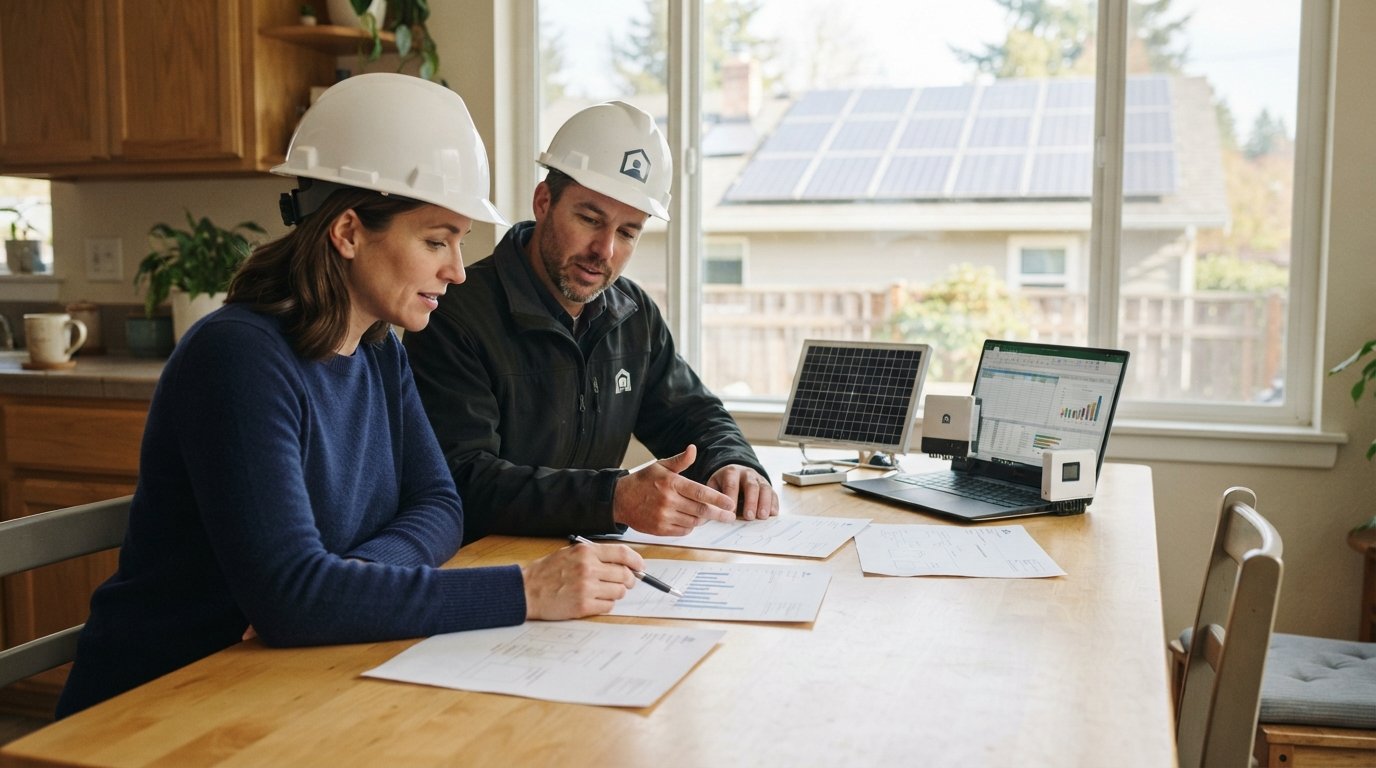
Solar Installation Cost Factors That Change Your Quote
Uncover the solar installation cost factors that change your quote and learn to compare offers smartly. Call (833)-212-3715 for expert guidance.

By Julia Walsh
Learn more about Solar Panel Installation and Repair for guides, costs, and what to expect.
Compare Solar Panel Installation and Repair Pros Near You

Enter your ZIP code to compare top-rated local professionals and request free quotes.
You have done your homework, requested a few quotes, and now you are staring at three different numbers with three different explanations. Why does one installer quote $18,000 while another says $24,000 for what sounds like the same system? The answer lies in the solar installation cost factors that change your quote, and understanding them is your best defense against overpaying or being blindsided by hidden fees. This guide breaks down the real variables that move the needle, from soft costs like permitting to hardware choices like panel and inverter types. By the end, you will know exactly what to ask and how to compare quotes intelligently.
Soft Costs: The Invisible Price Drivers
When homeowners think about solar costs, they usually picture panels and inverters. But soft costs, which include permitting, labor, interconnection fees, and administrative overhead, often account for 50 to 60 percent of the total installed price. These are the behind-the-scenes expenses that vary widely by location, installer, and project complexity. Ignoring them is like buying a car based only on the engine and forgetting about insurance, taxes, and registration.
Permitting alone can range from a few hundred dollars to over a thousand, depending on your city or county. Some jurisdictions have streamlined processes and low fees, while others require extensive documentation, structural reviews, and inspections. Labor costs also fluctuate based on regional wage rates, the availability of certified installers, and the time of year (peak season often commands a premium). Interconnection fees, charged by your utility company to connect your system to the grid, add another layer. These fees are non-negotiable but can differ significantly from one utility to the next.
To keep soft costs in check, ask each installer to itemize permitting, labor, and interconnection fees separately. A transparent quote will break these out, while a lump-sum quote may hide inflated margins. Also, check whether your state or municipality offers expedited permitting or fee waivers for residential solar, as these can shave hundreds off your bottom line.
Roof Characteristics: Labor Pricing by Type, Tilt, and Stories
The physical characteristics of your roof have a direct impact on installation labor, and thus on your quote. A simple, single-story ranch with a moderate pitch and composite shingles is the easiest and cheapest to work on. Conversely, a steep, multi-story roof with tile or slate will require more time, specialized equipment, and safety measures, all of which drive up the price.
Roof type matters because different materials require different mounting hardware and techniques. Asphalt shingles are forgiving and quick to seal, while tile roofs demand careful removal and replacement of tiles, which is labor-intensive. Metal roofs often require specialized clamps that are more expensive than standard mounts. Flat roofs may need ballasted racking systems, which add material costs but can reduce penetration risks.
Tilt and orientation also play a role. A roof with a steep pitch (greater than 8/12) is harder to walk on and may require scaffolding or harness systems, increasing labor hours. Multi-story homes add complexity because installers must haul panels and equipment to higher elevations, often using lifts or cranes. If your roof has multiple planes or obstructions like chimneys and skylights, the layout becomes more intricate, requiring additional mounting hardware and labor time.
Before signing a contract, ask your installer how they account for roof complexity in their quote. A reputable company will perform a site visit or use satellite imagery to assess these factors and provide an accurate estimate. If a quote seems too low, it may be because the installer overlooked these details and will later charge change orders.
Hardware Choices: Panels, Inverters, and Batteries
The equipment you choose is perhaps the most visible cost driver. Solar panels alone range from budget-friendly polycrystalline models to high-efficiency monocrystalline panels with premium pricing. Efficiency matters if you have limited roof space: higher-efficiency panels produce more power per square foot, but they cost more upfront. For many homeowners, the sweet spot is a mid-tier panel that balances cost and performance.
Inverter type is another major decision. String inverters are the most affordable option, but they are less efficient in shaded conditions and have a single point of failure. Microinverters, installed on each panel, offer panel-level optimization and monitoring but cost significantly more. Hybrid inverters, which can work with batteries, fall in between. Your choice should align with your energy goals and budget, but be aware that installers may push certain brands based on their margins, so compare quotes carefully.
Battery add-ons are increasingly popular, especially in areas with frequent outages or time-of-use rates. A single battery can add $8,000 to $15,000 to your quote, depending on capacity and brand. If you are considering storage, clarify whether the quote includes a critical-load subpanel, which is often necessary to power essential circuits during an outage. Also, check if the battery is eligible for the federal tax credit, as this can offset 30 percent of the cost.
When comparing quotes, make sure you are comparing apples to apples. A quote with premium panels and microinverters will naturally be higher than one with budget panels and a string inverter. Ask for the make and model of every component, and research their warranties and performance ratings. For a deeper dive into comparing quotes side by side, see our guide on how to compare solar installation quotes for maximum savings.
How to Compare Quotes When Line Items Differ
Comparing solar quotes is tricky because installers rarely use the same format. One may provide a single lump sum, while another breaks down costs by equipment, labor, and permits. To make a fair comparison, you need to normalize the quotes by extracting the same information from each.
Start by creating a spreadsheet with columns for total cost, system size (in kW), panel brand and model, inverter type, battery capacity, permitting fees, labor, and warranty terms. Then, ask each installer to fill in the missing details. If they hesitate, that is a red flag. A transparent installer will happily provide this information because they have nothing to hide.
Next, calculate the price per watt for each quote. This metric allows you to compare systems of different sizes on a level playing field. Divide the total cost by the system's wattage (e.g., a 10 kW system is 10,000 watts). According to industry data, the national average price per watt for residential solar is around $2.50 to $3.50, but this varies by state and system size. If a quote is significantly higher or lower, dig into why.
Pay attention to what is excluded. Some quotes omit the cost of a main panel upgrade, which can add $1,500 to $3,000 if your electrical panel is outdated. Others may not include monitoring hardware or a production guarantee. Read the fine print and ask about any potential add-ons. Finally, consider the installer's reputation and warranty coverage. A slightly higher quote from a well-established company with a strong warranty may be worth the extra cost.
If you are planning to move soon, keep in mind that solar can increase your home's value, but the transfer of warranty and financing terms can complicate a sale. Resources like Moving.Homes offer practical guidance for homeowners navigating relocation, including how to transfer solar agreements and what buyers need to know.
Other Factors That Influence Your Quote
Beyond the big three (soft costs, roof, and hardware), several other variables can swing your quote. Local incentives and rebates, for instance, are not always reflected in the initial price but can significantly reduce your net cost. Installers may or may not factor these in, so ask if the quote assumes any rebates. Similarly, financing options can change the total price: a cash purchase is typically cheaper than a loan with dealer fees, while leases and power purchase agreements (PPAs) have different cost structures.
Seasonality and demand also play a role. Installers may offer discounts during slower months (often winter) to keep crews busy. Conversely, during peak season (spring and summer), prices may be higher due to demand. If you are flexible on timing, you can negotiate a better deal.
Finally, the installer's business model matters. Large national companies often have higher overhead and sales commissions, which are baked into their quotes. Local installers may have lower overhead but limited warranty coverage if they go out of business. Balance these factors when evaluating quotes.
Understanding the solar installation cost factors that change your quote empowers you to ask the right questions and avoid surprises. By breaking down soft costs, roof complexity, hardware choices, and quote formats, you can compare offers with confidence and choose the best value for your home.