
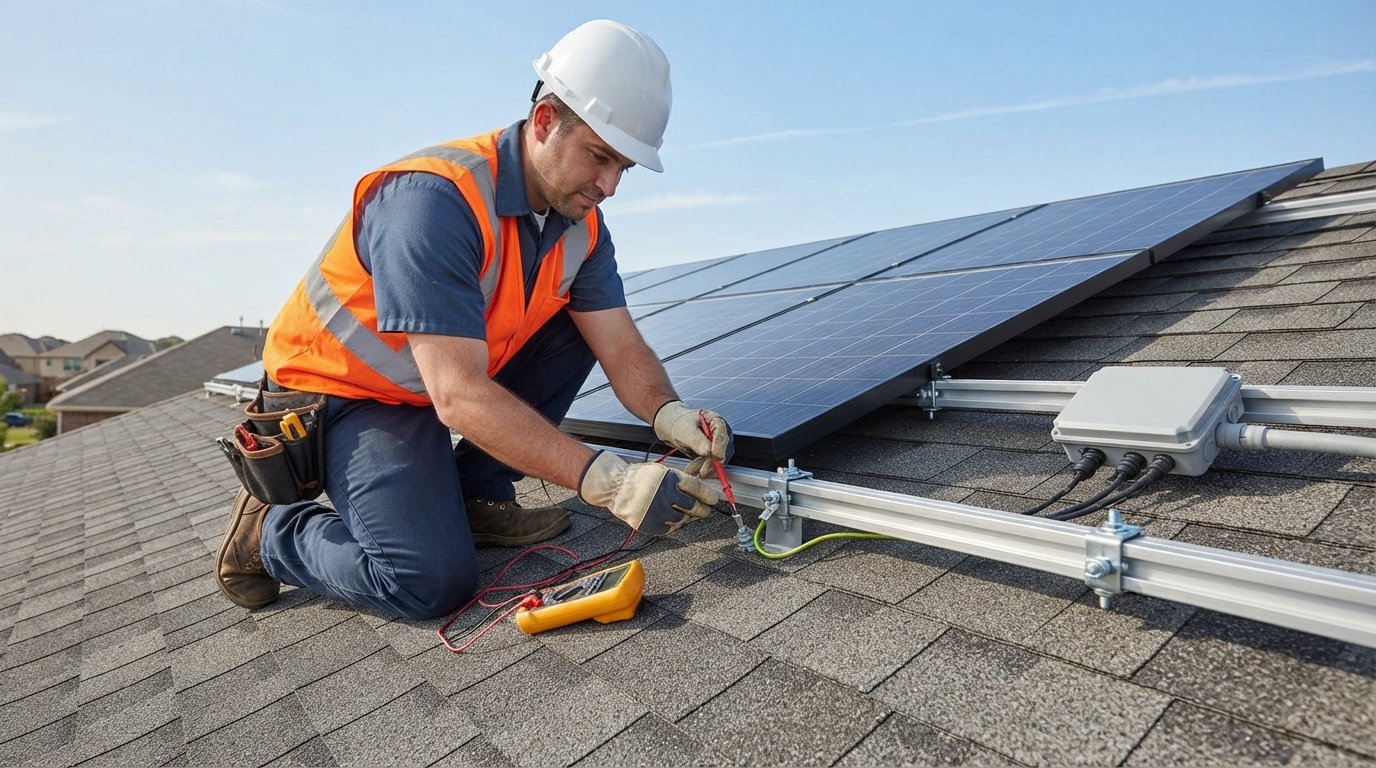
Solar System Grounding and Rapid Shutdown Requirements Explained
Understand solar system grounding and rapid shutdown requirements explained for safer installations. Call (833)-212-3715 for expert guidance.

Learn more about Solar Panel Installation and Repair for guides, costs, and what to expect.
Compare Solar Panel Installation and Repair Pros Near You
Enter your ZIP code to compare top-rated local professionals and request free quotes.
When you review a solar quote or prepare for an inspection, terms like "rapid shutdown" and "equipment grounding conductor" can seem like technical jargon. Yet these code requirements are among the most important safety features of your solar energy system. Understanding them helps you ask better questions, avoid surprise costs, and ensure your installation protects your home and the people who work on it. This guide breaks down solar system grounding and rapid shutdown requirements explained in plain language, so you can navigate your project with confidence.
Rapid Shutdown: What It Is and Why It Matters
Rapid shutdown is a safety feature designed to reduce the risk of electric shock for firefighters and first responders when a solar array is exposed to sunlight. Even when the main breaker is off, solar panels continue to generate direct current (DC) electricity. Rapid shutdown systems quickly reduce the voltage in specific conductors to a safe level, typically within 30 seconds of activation. The National Electrical Code (NEC) outlines these requirements in Article 690.12, and they apply to residential and commercial solar installations.
The code distinguishes between the array boundary (the perimeter of the solar array) and the conductors inside and outside that boundary. For most residential systems, rapid shutdown must limit voltage to 30 volts and 240 volt-amperes within 30 seconds inside the array boundary. Outside the boundary, the requirement is even stricter: conductors must be reduced to 30 volts within 30 seconds. This is why module-level rapid shutdown devices (RSDs) are often required.
Module-level devices, such as microinverters or DC optimizers with rapid shutdown capability, are installed at each panel. They ensure that even if one panel or a section of the array is compromised, the rest of the system can be safely de-energized. Some string inverters have rapid shutdown built in, but they may only de-energize the array at the inverter, not at the module level. For homeowners, this means your quote may include line items for module-level electronics, which add cost but provide critical safety compliance.
Rapid shutdown requirements vary slightly by code cycle adopted in your jurisdiction. The 2017 NEC introduced the 30-volt limit inside the array boundary, and subsequent editions have refined the details. Always confirm with your local authority having jurisdiction (AHJ) which code edition applies to your project. Your installer should be familiar with local amendments and inspection practices.
Grounding and Bonding: The Foundation of Electrical Safety
Grounding and bonding are essential for protecting your solar system from faults, lightning, and power surges. Grounding creates a low-resistance path to the earth, while bonding connects metal parts together to ensure they remain at the same electrical potential. Together, they prevent dangerous voltage differences that could cause shocks or fires.
In a solar installation, several components must be grounded and bonded: the array frames, mounting rails, inverter enclosures, and any exposed metal conduit. The NEC requires an equipment grounding conductor (EGC) to connect these metal parts back to the main electrical service panel. This conductor provides a path for fault current to trip the circuit breaker or blow a fuse, clearing the fault quickly.
Grounding electrode conductors (GEC) connect the system to the earth via ground rods or other electrodes. The size of these conductors is specified in NEC Table 250.122 and depends on the rating of the overcurrent device. Improperly sized or poorly connected grounding conductors are a common inspection failure. Homeowners should verify that their installer uses listed grounding lugs, corrosion-resistant materials, and proper bonding jumpers across rail splices.
Bonding of array frames is often achieved with listed bonding hardware, such as WEEB washers or integrated rail bonding. These components are designed to penetrate the anodized coating on aluminum rails to create a solid electrical connection. Some racking systems come with integrated bonding, which simplifies installation and improves reliability. Your quote may include a line item for "grounding and bonding hardware" or "equipment grounding conductor," reflecting the materials and labor required to meet code.
It is worth noting that grounding requirements differ for grounded versus ungrounded systems. Most modern string inverters are ungrounded (transformerless), which affects how fault protection is implemented. The inverter's internal ground-fault detection and interruption (GFDI) circuitry plays a key role, and proper grounding of the inverter chassis is still mandatory. Understanding these details helps you see why grounding is not a one-size-fits-all task.
Arc-Fault and Ground-Fault Protection in Modern Inverters
Modern solar inverters incorporate advanced protection features that work alongside grounding and rapid shutdown. Two critical functions are arc-fault circuit interruption (AFCI) and ground-fault protection. The NEC requires both for most residential solar systems, and they are built into listed inverters.
Arc-fault protection detects dangerous electrical arcs that can occur in damaged wiring, loose connections, or compromised insulation. These arcs can reach high temperatures and ignite surrounding materials. An AFCI-equipped inverter continuously monitors the DC circuits for arc signatures and quickly interrupts the circuit when an arc is detected. The 2017 NEC expanded AFCI requirements to include solar PV systems, and subsequent editions have clarified the specifics.
Ground-fault protection, on the other hand, detects current leaking from the intended path to ground. In solar systems, a ground fault could occur if a conductor touches the array frame or if moisture enters a junction box. The inverter's GFDI circuitry senses this imbalance and shuts down the system to prevent shock hazards and fires. Ground-fault protection is closely tied to proper grounding and bonding; without a solid grounding path, the protection may not operate correctly.
When you see line items in your quote for "AFCI/GFCI inverter" or "ground-fault protection," you are paying for these safety features. They are not optional add-ons but code-required components for most installations. Inverters with these features cost more than basic models, but they provide essential protection. As you compare quotes, ensure that the inverter model includes both AFCI and GFCI functionality, and that the installer plans to enable and test these features during commissioning.
For a deeper look at how inverters convert DC to AC and manage these safety functions, see our guide on solar inverter function. It explains the role of inverters in your system and how they contribute to overall safety and performance.
Why These Code Items Appear as Line-Item Costs in Quotes
Solar quotes often break down costs into categories such as panels, inverters, racking, labor, and electrical components. Grounding, rapid shutdown, and protection features frequently appear as separate line items because they involve specific materials and labor that vary by system design. Understanding these costs helps you evaluate whether a quote is fair and complete.
Rapid shutdown devices, for example, may be listed as "module-level electronics" or "rapid shutdown equipment." These devices add per-panel costs, and their installation requires additional labor. Similarly, grounding and bonding hardware, such as lugs, jumpers, and conductors, may be itemized. Some installers bundle these costs into the racking or electrical category, while others break them out for transparency.
It is also common to see a line item for "electrical permits and inspection fees." These fees cover the cost of obtaining permits and scheduling inspections, which are necessary to verify code compliance. The inspection process specifically checks grounding, bonding, and rapid shutdown functionality. A failed inspection can delay your system and add costs, so it is worth asking your installer how they ensure these items are correct the first time.
When comparing quotes, do not simply choose the lowest total price. A quote that omits rapid shutdown devices or skimps on grounding may be non-compliant and could fail inspection, leading to costly rework. Ask each installer to explain how their quote addresses NEC requirements for rapid shutdown, grounding, and fault protection. A reputable installer will welcome these questions and provide clear answers.
Practical Steps for Homeowners
Navigating code requirements can feel overwhelming, but you can take practical steps to ensure your project stays on track. Start by educating yourself about the basics, as outlined above. Then use the following checklist when reviewing quotes and talking with installers.
- Verify rapid shutdown compliance: Ask whether the proposed inverter and module-level devices meet NEC 690.12 for your jurisdiction. Confirm the shutdown method and response time.
- Review grounding and bonding details: Ensure the quote includes equipment grounding conductors, grounding electrode conductors, and listed bonding hardware. Ask about the grounding electrode system and whether a new ground rod is needed.
- Confirm AFCI and GFCI features: Check that the inverter model includes both arc-fault and ground-fault protection, and that the installer will test these functions during commissioning.
- Ask about inspection history: Inquire about the installer's experience with local inspections and whether they have had any failed inspections related to grounding or rapid shutdown.
- Request a detailed breakdown: Ask for line-item costs for safety equipment so you can compare quotes fairly and identify any missing components.
These steps help you avoid surprises and ensure your system is safe, code-compliant, and built to last. Remember that local codes can vary, so always confirm requirements with your AHJ and rely on your installer's expertise for final design decisions.
Common Misconceptions and Pitfalls
One common misconception is that rapid shutdown is only needed for commercial systems. In reality, most residential systems also require rapid shutdown, especially when the array is mounted on a roof. Another pitfall is assuming that a single disconnect switch satisfies rapid shutdown; the code requires specific voltage reduction at the module level or within the array boundary, which a simple switch may not achieve.
Grounding is another area where shortcuts can cause problems. Some installers may rely solely on the mounting hardware for bonding without verifying electrical continuity. Over time, corrosion or loosening can compromise the connection. Proper bonding requires listed components and periodic checks. Similarly, using undersized grounding conductors or failing to bond all metal parts can lead to inspection failures and safety hazards.
Homeowners should also be wary of quotes that seem too low. If a quote omits rapid shutdown or grounding line items, it may be cutting corners. Always ask for clarification and insist on code-compliant equipment. The long-term savings from a safe, well-installed system far outweigh any short-term cost reductions from skipped safety features.
How NewSolarQuotes Can Help
At NewSolarQuotes, we understand that safety code requirements can be confusing. Our independent educational resources and network of certified installers can help you navigate the process. We connect you with local professionals who are experienced with NEC requirements and local inspection practices. By requesting quotes through our platform, you can compare proposals that clearly itemize safety features like rapid shutdown and grounding, so you can make an informed decision.
If you are planning a move and need to understand how solar affects your home's value or transferability, resources like Moving.Homes offer practical relocation guides that can complement your solar research. And when you are ready to explore solar options, our team is here to help you find the right installer for your project.
In summary, solar system grounding and rapid shutdown requirements are not just bureaucratic hurdles; they are essential safety measures that protect your home and the people who work on your system. By understanding these requirements, you can ask the right questions, avoid unnecessary costs, and ensure your solar investment is safe and compliant. Take the time to review your quotes carefully, and do not hesitate to seek expert guidance when needed.