
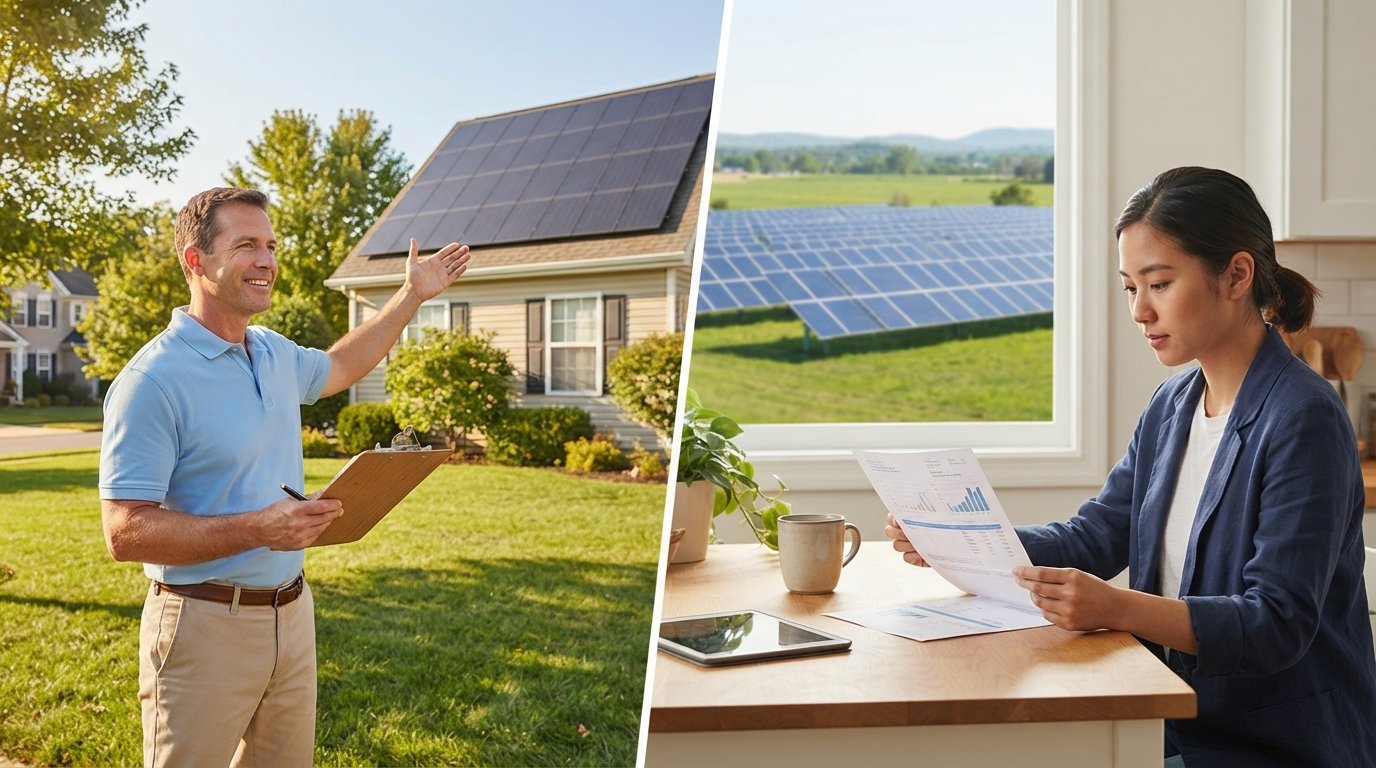
Community Solar Subscription vs Rooftop Solar Costs
Compare community solar subscription versus rooftop solar costs, from bill credits to contract terms. Call (833)-212-3715 for expert guidance on your options.

By Andrew Adler
Learn more about Solar Panel Installation and Repair for guides, costs, and what to expect.
Compare Solar Panel Installation and Repair Pros Near You
Enter your ZIP code to compare top-rated local professionals and request free quotes.
For millions of Americans who rent their homes, live in a shaded apartment building, or simply cannot afford the upfront cost of a rooftop array, community solar has emerged as a practical gateway to renewable energy. Yet the financial comparison between a community solar subscription and a traditional rooftop solar installation is rarely straightforward. One option requires no roof, no installation, and often no credit check, while the other demands a significant capital investment but delivers long-term ownership and potentially higher lifetime savings. Understanding the true costs, contract terms, and savings mechanics of each path is essential before signing on the dotted line, especially as electricity rates continue to climb and federal incentives shift.
This guide breaks down the community solar subscription versus rooftop solar costs equation from every angle: how bill credits work, what you actually pay, which households benefit most from each model, and the hidden fees that can erode your savings. Whether you are a renter in a major metro area or a homeowner weighing a 25-year investment, the numbers below will help you make a confident, informed decision.
How Community Solar Subscriptions Deliver Bill Credits
Community solar, sometimes called shared solar, is a program where multiple subscribers share the output of a single off-site solar farm. You do not install anything on your property. Instead, you subscribe to a portion of the farm's generating capacity, and the utility credits your electricity bill for your share of the solar production. The key mechanic is the bill credit: the solar farm generates electricity, feeds it into the grid, and your utility applies a credit to your account based on your subscription size.
Most community solar providers sell you those credits at a discount. For example, if your subscription produces $100 worth of bill credits in a given month, you might pay the provider $90, netting a $10 savings (a 10 percent discount). Discounts typically range from 5 to 15 percent, depending on the state, the utility, and the provider's contract terms. Some programs offer guaranteed savings, while others fluctuate with market rates. The critical point is that you are not buying solar panels; you are buying a financial product tied to solar production.
Enrollment usually requires nothing more than a utility account number and a valid address within the program's service territory. Many community solar providers do not run a credit check, which makes this option accessible to households with imperfect credit. However, the absence of a credit check does not mean the contract is risk-free. Cancellation terms vary widely: some allow cancellation with 30 to 90 days' notice, while others lock you in for the duration of the subscription, often 10 to 25 years, with early termination fees that can reach hundreds of dollars.
Rooftop Solar Costs: Upfront Investment and Long-Term Payback
Rooftop solar is a capital purchase. You buy a system, either with cash, a loan, or a lease, and it generates electricity directly on your property. The upfront cost for a typical 6-kilowatt residential system ranges from $15,000 to $25,000 before incentives, depending on your location, roof complexity, and equipment choice. The federal solar investment tax credit (ITC) can offset a significant portion of that cost, but the credit is non-refundable, meaning you need sufficient tax liability to use it fully. State and utility rebates can further reduce the net price.
Once installed, rooftop solar has no ongoing fuel cost, but it does have maintenance and insurance considerations. Panels typically carry 25-year performance warranties, and inverters may need replacement around year 10 to 15. Homeowners insurance premiums sometimes rise slightly to cover the added property value. The financial return comes from avoided electricity bills: every kilowatt-hour your panels produce is a kilowatt-hour you do not buy from the utility. With net metering, excess production is credited to your account, though the rate and rules vary dramatically by state and utility.
For a homeowner who plans to stay in the house for at least seven to ten years, rooftop solar often delivers a stronger lifetime return than a community solar subscription. The system adds resale value (studies suggest roughly $15,000 for a typical installation), and once the payback period ends, typically in year 8 to 12, the electricity is essentially free. However, that return is not guaranteed: utility rate changes, net metering policy shifts, and roof replacement needs can all alter the math.
If you are still mapping out the full financial picture of a rooftop installation, our guide on a solar estimate breakdown walks through line-item costs and savings projections in detail.
Comparing Savings Rates and Contract Terms
When you compare community solar subscription versus rooftop solar costs, the savings rates look deceptively simple. Community solar advertises a fixed discount, say 10 percent off your bill credits, while rooftop solar promises to eliminate most or all of your electricity bill after payback. But the underlying economics differ in important ways.
Community solar savings are typically modest but immediate. You start saving in the first month, with no installation, no permitting, and no roof work. The trade-off is that the savings rate is capped by the subscription discount. If the provider offers 10 percent, your annual savings on a $1,200 electricity bill would be roughly $120. That is real money, but it is not life-changing. Some providers offer higher discounts in competitive markets, but those deals often come with longer contract terms or stricter cancellation policies.
Rooftop solar savings are back-loaded. You pay a large sum upfront (or finance it), and then you save every month for 25 years. The total lifetime savings can reach $20,000 to $50,000, depending on local rates and system size. But those savings are not liquid; they accrue slowly, and they depend on you staying in the home long enough to realize them. If you sell the house in year five, you may not recoup the full investment, although the added home value helps offset that risk.
Contract terms are another critical differentiator. Community solar contracts often run 10 to 25 years, with automatic renewal clauses and early termination fees. Some contracts include annual escalators, meaning your subscription price rises by a fixed percentage each year, which can erode the discount over time. Rooftop solar contracts, whether loans or leases, also have terms, but ownership via cash or a loan gives you more flexibility to sell the home or pay off the balance early without penalty.
Here is a quick comparison of the key cost and contract factors:
- Upfront cost: Community solar typically $0; rooftop solar $0 to $25,000 depending on financing.
- Monthly savings: Community solar 5 to 15 percent discount on credits; rooftop solar eliminates most of the bill after payback.
- Contract length: Community solar 10 to 25 years with cancellation fees; rooftop solar loan terms 5 to 25 years, leases 20 to 25 years.
- Credit check: Community solar often none; rooftop solar loans and leases usually require good credit.
- Portability: Community solar moves with you if you stay in the same utility territory; rooftop solar stays with the house.
Notice that the cheapest option upfront is not always the cheapest over time. A community solar subscription with a 10 percent discount and a 20-year term might save you $2,400 total, while a rooftop system could save $30,000 over the same period. But the rooftop system requires capital, credit, and a suitable roof. The right choice depends on your circumstances, not just the headline savings rate.
Eligibility, Credit Checks, and Cancellation Terms
Eligibility for community solar is broad but not universal. You generally need to be a customer of the utility hosting the solar farm, and you need a valid service address within the program's territory. Renters qualify, as do homeowners, businesses, and nonprofits. Some low-income community solar programs offer additional savings or priority enrollment. However, if your utility has no community solar program and no third-party providers operate in your area, you may not have access at all.
Credit checks are a major differentiator. Most community solar providers do not run a credit check because you are not taking on debt; you are signing a subscription agreement. That said, some providers do check credit to reduce churn, and a few require a deposit for customers with poor credit. Rooftop solar is different: cash purchases require no credit check, but loans and leases almost always do. A credit score below 650 can make financing more expensive or unavailable, pushing some homeowners toward community solar by default.
Cancellation terms deserve close scrutiny. Community solar contracts often include early termination fees that equal the remaining value of the contract or a fixed penalty per kilowatt. If you move within the same utility territory, you can usually transfer the subscription to your new address. If you move out of the territory, you may be forced to cancel and pay the fee. Rooftop solar leases can also be difficult to cancel, but loans can be paid off early, and owned systems can be sold with the house. Always read the fine print and ask specifically about cancellation, transfer, and escalation clauses before signing.
For homeowners planning broader property upgrades, it helps to work with a resource that connects you to vetted professionals. ContractorHomeQuotes offers cost guides and contractor matching for home improvement projects, including energy-related upgrades, which can complement your solar research.
Which Households Are Better Served by Each Option?
The community solar subscription versus rooftop solar costs debate ultimately comes down to your living situation, financial capacity, and time horizon. Neither option is universally superior. The table below summarizes which households typically benefit most from each model.
Community solar is often the better fit for:
- Renters who cannot modify the property and want to support renewable energy without installation.
- Homeowners with shaded, older, or structurally unsuitable roofs.
- Households with limited upfront capital or imperfect credit.
- People planning to move within a few years who want savings without a long-term investment.
- Low-income households eligible for enhanced community solar programs.
Rooftop solar is often the better fit for:
- Homeowners with sunny, unobstructed roofs and long-term plans to stay in the home.
- Households with sufficient tax liability to use the federal ITC fully.
- Those who want to own their energy production and maximize lifetime savings.
- Homeowners in states with strong net metering and favorable solar policies.
- People who value the resilience and property value boost of an owned system.
It is also worth noting that the two options are not mutually exclusive. Some homeowners install rooftop solar and also subscribe to community solar to offset remaining usage. But for most households, one path will be clearly more advantageous. Run the numbers with your actual utility bill, roof condition, and tax situation before committing.
Hidden Costs and Fine Print to Watch
Both community solar and rooftop solar have hidden costs that can erode the advertised savings. For community solar, watch for annual escalators (often 1 to 3 percent per year), minimum subscription sizes, and penalties for under-consuming credits. Some providers require you to buy a fixed amount of credits each month, even if your usage drops. If you generate more credits than you can use, you may lose them or receive a lower export rate. Also check whether the provider guarantees savings or merely estimates them; a guaranteed savings contract protects you if the solar farm underperforms.
For rooftop solar, hidden costs include roof repairs or replacement before installation, electrical panel upgrades, permit fees, and inverter replacement around year 10 to 15. Insurance premiums may rise, and some homeowners associations restrict panel placement. Financing costs can add thousands over the life of a loan, especially if you choose a low-interest loan with dealer fees baked into the price. Always compare the cash price against the financed price to see the true cost of borrowing.
Finally, remember that incentives change. The federal ITC is scheduled to step down for residential systems after 2032, and state programs can be modified or defunded. Community solar programs are also subject to utility and legislative changes. Build a margin of safety into your projections and avoid assuming the best-case scenario.
Choosing between community solar and rooftop solar is ultimately a decision about how you want to spend, save, and invest in energy. Community solar offers low-risk, low-friction access to renewable energy with modest but immediate savings. Rooftop solar demands more capital and commitment but can deliver substantially higher lifetime returns for the right household. By comparing the full cost picture, reading the contract terms carefully, and matching the option to your living situation, you can capture the benefits of clean energy without getting trapped by hidden fees or unrealistic savings projections.