
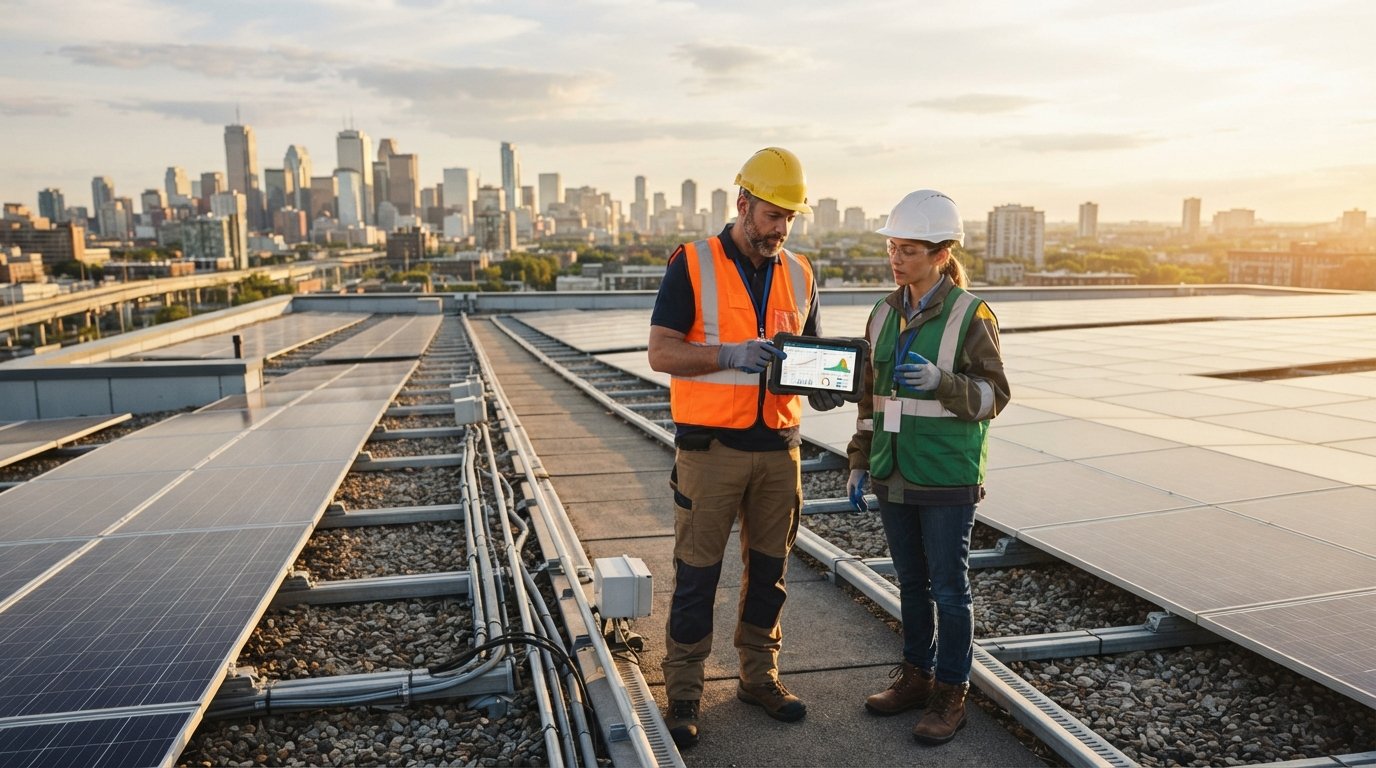
Commercial Solar Planning Considerations for Businesses 2026
Plan your commercial solar project with confidence. Call 8332123715 for expert guidance on commercial solar systems planning considerations for businesses 2026.

By Alexia Mabel
Learn more about Solar Panel Installation and Repair for guides, costs, and what to expect.
Compare Solar Panel Installation and Repair Pros Near You

Enter your ZIP code to compare top-rated local professionals and request free quotes.
Commercial solar systems planning considerations for businesses 2026 are no longer just about environmental goodwill; they are a core financial strategy. With utility rates projected to climb and the federal Investment Tax Credit (ITC) settling into its long-term base rate, the economic case for solar has shifted from a niche experiment to a mainstream capital improvement. For business owners and facility managers, the challenge is no longer whether to go solar, but how to design a system that maximizes returns while minimizing operational disruption. The decisions made during the planning phase will determine whether your solar array becomes a high-performing asset or a maintenance headache for the next 25 years.
As we move deeper into 2026, the landscape of commercial energy is defined by volatility. Businesses are facing increasing pressure from stakeholders to decarbonize, while simultaneously dealing with tightening operational budgets. A well-planned solar installation acts as a hedge against rising energy costs, effectively locking in a portion of your electricity expenses for decades. However, the complexity of commercial solar is significantly higher than residential projects. You must navigate demand charges, interconnection rules, and complex financing structures. This guide outlines the critical factors you must evaluate to ensure your 2026 solar project delivers the expected financial and operational benefits.
Evaluating Energy Consumption and Load Profiles
The foundation of any successful commercial solar project is a granular understanding of your facility's energy usage. Unlike residential homes, which have relatively predictable evening peaks, commercial facilities often have complex load profiles driven by machinery, HVAC systems, and operational schedules. You cannot simply size a system based on a monthly utility bill. You need to analyze interval data (typically 15-minute increments) to understand exactly when and how you consume power.
This data is crucial because commercial electricity billing is not just about total kilowatt-hours (kWh) consumed. It is heavily influenced by demand charges, which are based on the highest rate of electricity usage during a specific period. If your business hits a high demand spike, your utility bill can skyrocket regardless of how much solar energy you produce. To plan effectively for 2026, you must determine if your load profile aligns with solar production. If your facility operates primarily during the day, solar is a perfect match. If you operate heavy machinery at night, you may need to consider energy storage to shift your solar production to the hours when you need it most.
To start this analysis, gather the following data points for the last 12 to 24 months:
- Interval Data: 15-minute or hourly usage data to identify peak demand periods.
- Blended Rate: The total cost of electricity divided by total kWh consumed, giving you a true average price.
- Demand Charges: The specific fees associated with your peak usage spikes.
- Time-of-Use (TOU) Rates: Understanding when your utility charges the most for power.
Once you have this data, you can model how solar production will offset your usage. In many cases, businesses find that solar can shave peak demand charges, which offers a higher return on investment than simply offsetting energy consumption. However, this requires careful engineering and possibly the integration of smart controls or batteries to manage the timing of your energy usage.
Navigating Financing and Incentives in 2026
The financial mechanisms available for commercial solar in 2026 are robust, but they require careful navigation. The federal Investment Tax Credit (ITC) remains a cornerstone of project economics, allowing businesses to deduct a significant percentage of the installation cost from their federal taxes. However, the value of this credit depends heavily on your business's tax liability. If your company does not have sufficient tax appetite to use the credit, you may need to explore alternative ownership structures.
For businesses that cannot utilize the tax credit directly, third-party ownership models such as Power Purchase Agreements (PPAs) or solar leases are viable options. In a PPA, a developer owns the system and sells the power to you at a fixed rate, typically lower than the utility rate. This allows you to go solar with zero upfront capital and immediate savings. However, you forgo the ownership of the Renewable Energy Credits (RECs) and the depreciation benefits. The decision between owning and leasing is a balance of capital availability, tax appetite, and long-term energy goals.
When evaluating the financials, you must look beyond the sticker price. A comprehensive analysis should include:
- Net Present Value (NPV): The difference between the present value of cash inflows and outflows over the project's life.
- Internal Rate of Return (IRR): The profitability metric used to evaluate the attractiveness of an investment.
- Payback Period: The time required for the system to generate enough savings to cover the initial cost.
- Depreciation: Utilizing Modified Accelerated Cost Recovery System (MACRS) to accelerate tax benefits.
It is also vital to consider the impact of local incentives. Many states and utilities offer additional rebates or performance-based incentives (PBIs) that can significantly improve project economics. For a detailed breakdown of current pricing and savings potential, you can refer to our guide on commercial solar system costs and savings in 2026. Understanding these numbers is the first step toward a secure investment.
Roof vs. Ground-Mount: Structural and Spatial Analysis
Determining where to place your solar array is a critical logistical decision. Most commercial solar projects are roof-mounted, utilizing large, flat, unused spaces. However, not all roofs are created equal. Before committing to a roof-mount system, a structural engineer must verify that your roof can support the additional dead load (weight) and wind uplift (live load) of the solar array. If your roof is nearing the end of its useful life, it is often more cost-effective to replace it before installing solar to avoid the high cost of removing and reinstalling panels later.
Ground-mount systems are an excellent alternative for businesses with available land. They offer easier access for maintenance, allow for optimal tilt and orientation, and avoid roof penetration risks. However, ground-mounts require significant space and may face zoning restrictions or environmental impact reviews. You must also consider the cost of trenching for electrical conduits to connect the array to your building's electrical panel.
Space constraints often dictate the size of the system. For businesses with limited roof space, solar carports are an innovative solution. They provide shade for parking lots while generating clean energy, offering a dual benefit of reduced urban heat island effect and renewable power generation. While carports have a higher structural cost than roof mounts, they can be a highly visible symbol of your company's commitment to sustainability.
Interconnection and Utility Coordination
The process of connecting your solar system to the electric grid, known as interconnection, has become increasingly complex. As solar adoption rises, utilities are becoming more stringent about grid stability. In 2026, you must anticipate potential delays in the interconnection queue. Some utilities may require expensive grid upgrades to accommodate your system, which can kill the project's financial viability if not identified early.
Furthermore, the rules regarding net metering are evolving. While many states still offer full retail credit for excess energy sent to the grid, others have moved to avoided-cost rates or imposed export limits. This shift makes it essential to size your system for self-consumption rather than relying on selling power back to the utility. If your utility has punitive export rates, you may need to curtail production or add batteries to store excess energy for later use.
Engaging with your utility early in the planning process is non-negotiable. You need to understand their specific requirements for protection devices, disconnects, and metering. A failure to meet these technical standards can result in costly redesigns and project delays. It is often wise to have your chosen installer handle this coordination, as they are familiar with local utility procedures and can navigate the paperwork efficiently.
Choosing the Right Technology and Partners
Technology is evolving rapidly, but the core components of a commercial solar system remain the same: panels, inverters, and racking. In 2026, the market is dominated by high-efficiency monocrystalline panels and smart string inverters or microinverters. The choice between string inverters and microinverters often comes down to site conditions. If your roof has shading issues or multiple orientations, microinverters or DC optimizers can maximize production. For large, unshaded roofs, string inverters are typically more cost-effective.
Selecting the right installation partner is just as important as selecting the hardware. The solar industry has seen its share of fly-by-night operators. You need a partner with a proven track record, strong financials, and a commitment to service. When requesting quotes, ensure you are comparing apples to apples. Look for detailed proposals that include equipment specifications, production estimates, and warranty terms.
To ensure you are getting the best value, consider using a platform that connects you with vetted professionals. Services like FreeSolarPowerQuotes can help you compare multiple offers from reputable installers, ensuring you find a partner that meets your technical and financial requirements. Do not rush this step; the quality of the installation will determine the system's performance for the next two decades.
Future-Proofing with Storage and EV Infrastructure
As you plan your solar system for 2026, you should also consider future energy needs. The electrification of transportation is accelerating, and many businesses are looking to install EV charging stations for employees and customers. Solar can provide a clean source of power for these chargers, but the load can be significant. You must ensure your solar design and electrical infrastructure can accommodate future EV loads.
Battery energy storage systems (BESS) are also becoming more economically viable. While the primary driver for storage has been backup power, the ability to arbitrage energy (storing cheap solar power to use during expensive peak hours) is gaining traction. In markets with high demand charges, a battery can be programmed to shave peaks, generating significant savings that improve the overall ROI of the solar project. Even if you do not install batteries immediately, designing your system with storage-ready inverters is a smart, low-cost way to future-proof your investment.
Planning a commercial solar system in 2026 requires a holistic approach that balances engineering, finance, and long-term strategy. By thoroughly analyzing your energy usage, navigating the complex world of incentives, and selecting the right technology and partners, you can transform your energy liability into a strategic asset. The transition to renewable energy is not just about keeping the lights on; it is about powering your business's growth in a sustainable and cost-effective manner.