
Emerging Solar Technologies: Perovskite and Bifacial Panels
Perovskite and bifacial panels are reshaping solar efficiency and savings. See how these emerging solar technologies work and which fits your property.

By Andy Pearson
Learn more about Solar Panel Installation and Repair for guides, costs, and what to expect.
Compare Solar Panel Installation and Repair Pros Near You

Enter your ZIP code to compare top-rated local professionals and request free quotes.
Solar power has moved far beyond the familiar blue panels bolted to a roof. Two technologies in particular are reshaping what homeowners and businesses can expect from a solar investment: perovskite solar cells and bifacial solar panels. Perovskite promises a leap in efficiency and lower manufacturing costs, while bifacial panels capture sunlight from both sides to squeeze more energy out of the same footprint. Together, they represent the next wave of emerging solar technologies, and understanding how they work can help you evaluate quotes, compare equipment, and plan a system that performs for decades. This guide breaks down perovskite and bifacial panels in plain language, explains where each stands in 2026, and shows how they fit into real-world solar planning.
Why Emerging Solar Technologies Matter for Your Bottom Line
When you request solar quotes, the equipment behind those numbers determines how much electricity your system produces, how much roof space it needs, and how quickly it pays for itself. Efficiency gains compound over a 25-year system life. A panel that converts 22 percent of sunlight into electricity instead of 18 percent can mean fewer panels, lower installation labor, and more savings per square foot, especially on smaller roofs.
Perovskite and bifacial designs attack the efficiency problem from different angles. Perovskite targets the material itself, replacing or supplementing silicon with a crystal structure that absorbs light more effectively. Bifacial panels target the module design, adding a second glass face so the panel harvests reflected light from the ground, roof, or surrounding surfaces. Both approaches are already appearing in commercial products, and both are expected to influence pricing and performance for years to come.
For anyone comparing solar pricing per watt, these technologies change the math. Higher output per panel can reduce the total number of panels needed, which lowers balance-of-system costs such as racking, wiring, and labor. That does not automatically make a system cheaper, but it shifts where the value sits in a quote. Understanding the technology helps you ask better questions when you compare installer proposals.
Perovskite Solar Cells Explained
Perovskite refers to a family of crystalline materials with a specific atomic structure, not a single substance. In solar applications, these materials are often printed or coated onto a substrate in thin layers, which makes them far thinner and lighter than traditional silicon wafers. Because they can be manufactured with solution-based processes at relatively low temperatures, perovskite cells carry the promise of lower production costs and faster factory scaling.
The real excitement, however, comes from efficiency. In little more than a decade, perovskite solar cells have gone from single-digit laboratory efficiency to performance that rivals mature silicon technology. Researchers have also stacked perovskite on top of silicon to create tandem cells, where each layer absorbs a different part of the light spectrum. Tandem designs have pushed laboratory efficiencies past 33 percent, well above the roughly 27 percent ceiling for mainstream silicon alone.
That said, perovskite has real challenges to solve before it dominates rooftops. The materials can degrade when exposed to moisture, heat, and ultraviolet light, so encapsulation and stability testing are critical. Manufacturers are also working through questions about lead content in some formulations and long-term reliability data. In 2026, perovskite products are entering the market in limited commercial deployments, with tandem modules attracting the most attention for utility-scale and premium residential applications.
Where Perovskite Fits in Home Solar
For most homeowners, perovskite will first appear as a component inside tandem panels rather than as a standalone product. A tandem panel combines a perovskite top layer with a silicon bottom layer, delivering higher efficiency in a module that looks and installs much like a conventional panel. If you have limited roof space or high electricity rates, that extra output per square foot can be worth paying attention to.
Buyers should ask installers whether a quoted panel uses perovskite tandem technology, what warranty covers the perovskite layer, and whether the manufacturer has published third-party degradation data. Early adopters sometimes accept more risk in exchange for higher performance, but a solid warranty and a manufacturer with a track record matter more than a headline efficiency number.
Bifacial Solar Panels Explained
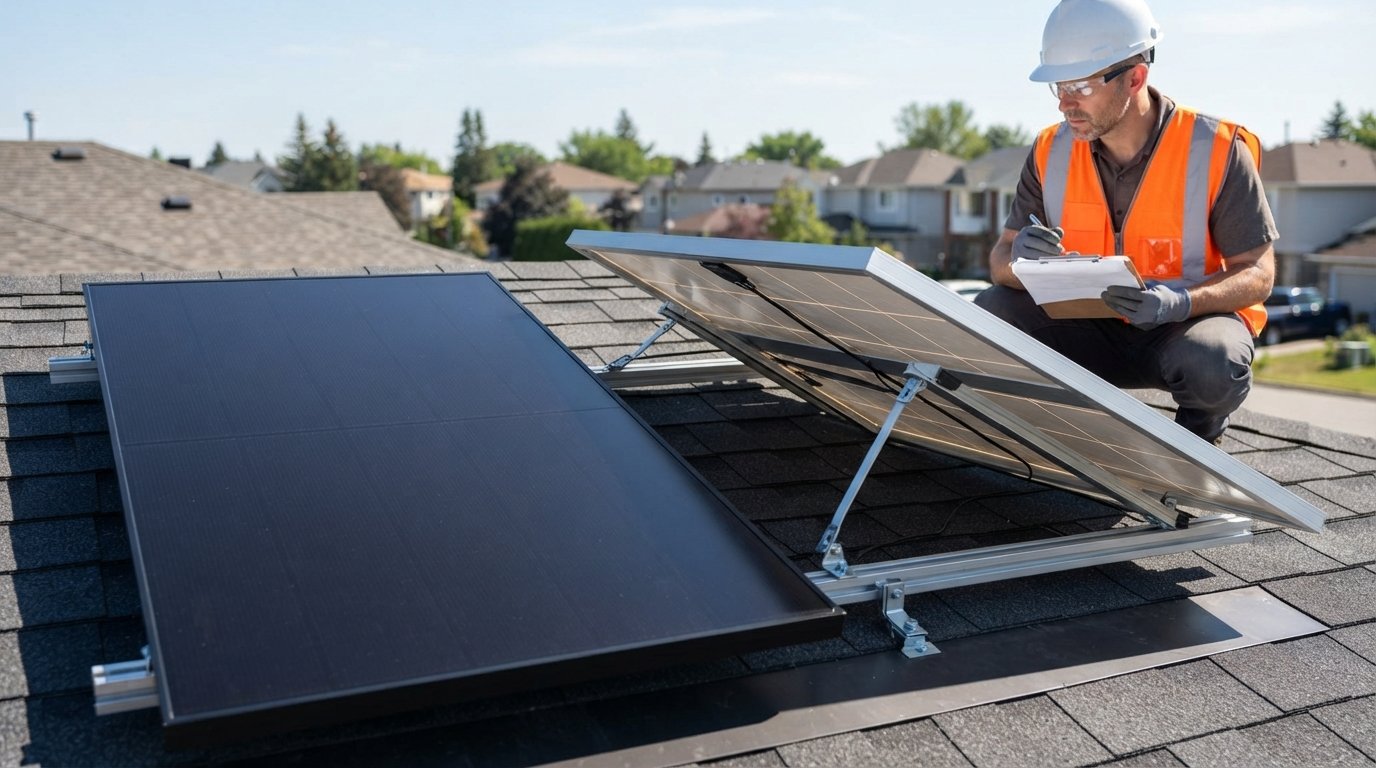
Bifacial solar panels generate electricity from both the front and back sides. The front side works like a standard panel, absorbing direct sunlight. The back side captures reflected and diffuse light bouncing off the ground, a white roof membrane, snow, or even the underside of a raised mounting structure. Depending on the installation, bifacial panels can produce 5 to 30 percent more energy than comparable monofacial panels of the same rated capacity.
The technology relies on transparent backsheets or dual-glass construction, along with cells that are sensitive to light on both faces. Dual-glass bifacial modules also tend to be more durable, with better resistance to moisture and physical damage, which can extend their useful life. That durability is one reason bifacial panels have become common in commercial and utility-scale projects, where ground-mounted arrays with reflective surfaces maximize the backside gain.
On residential roofs, the benefits are more modest. A panel mounted flat against asphalt shingles has little room for light to reach the back side, so the bifacial boost may be only a few percentage points. Raised mounting, light-colored roofing, and open ground mounts improve the picture considerably. Homeowners with ground-mounted arrays, carports, or pergolas often see the strongest return from bifacial modules.
Bifacial panels also interact with other system choices. Because they can produce more power, they pair well with microinverters or power optimizers that manage each panel independently. They are also a natural fit with tracking systems that tilt panels toward the sun throughout the day, since tracking increases the reflected light reaching the back face.
How Perovskite and Bifacial Technologies Work Together
The two technologies are complementary rather than competing. A bifacial module built with perovskite tandem cells could, in theory, capture direct sunlight on the front and reflected light on the back while converting more of that light into electricity at every step. Researchers and manufacturers are actively exploring this combination, and early prototypes suggest it could deliver some of the highest energy yields per square meter ever seen in commercial solar.
In practice, the combination will arrive gradually. Bifacial silicon modules are already widely available. Perovskite tandem modules are entering the market now. A bifacial perovskite tandem panel is a logical next step, but it depends on solving stability and encapsulation challenges for the perovskite layer in a dual-glass format. Buyers in 2026 are most likely to encounter either bifacial silicon or monofacial perovskite tandem, with combined products arriving as the technology matures.
For planning purposes, the key takeaway is that both technologies push in the same direction: more energy from the same roof or land area. That means smaller systems for the same output, more flexibility in system design, and potentially better economics for properties with limited space or high shading.
Real-World Performance and Cost Considerations
Lab efficiency numbers rarely translate directly into real-world performance. Temperature, shading, soiling, inverter efficiency, and wiring losses all reduce output. Bifacial gain depends heavily on the albedo, or reflectivity, of the surface beneath the panels. A white membrane roof or light gravel can boost backside production dramatically, while dark asphalt offers little benefit.
Perovskite tandem modules bring their own variables. Their higher efficiency can justify a price premium, but only if the manufacturer backs it with a strong warranty and published field data. Buyers should compare the levelized cost of energy, not just the sticker price per panel, and should ask how the installer accounts for bifacial gain in production estimates.
When you compare quotes, look for these details in the proposal:
- Panel model, efficiency rating, and whether it is monofacial, bifacial, or tandem
- Production estimate assumptions, including albedo and bifacial gain factors
- Warranty terms for power output, materials, and labor
- Inverter compatibility and whether per-panel optimization is included
- Mounting height and tilt, which affect backside light capture
These details separate a generic quote from one tailored to your property. An installer who understands bifacial and perovskite technology will explain how mounting height, roof surface, and module choice interact, rather than quoting the same equipment for every home.
Which Technology Is Right for Your Property
The right choice depends on your site, your budget, and your tolerance for new technology. If you have a large, unshaded roof with dark shingles, a standard high-efficiency monofacial panel may deliver the best value, because bifacial gain will be limited and perovskite premiums may not pay off. If you have a ground mount, a white roof, or a carport, bifacial panels can capture meaningful extra energy.
If roof space is tight and electricity rates are high, a perovskite tandem module may justify its premium by producing more power per square foot. If you value proven reliability and widely available service, bifacial silicon is the safer bet today. Many homeowners end up with a mix: bifacial panels on a ground array and conventional panels on the roof, or tandem panels on the most productive roof faces.
A good next step is to gather multiple quotes and ask each installer to explain their equipment choices. You can start by requesting free, no-obligation quotes through FreeSolarPowerQuotes, which connects homeowners with vetted solar providers and helps you compare options side by side. The more specific your questions about perovskite and bifacial technology, the more useful those quotes become.
What to Watch in the Coming Years
Perovskite commercialization is the biggest wildcard. If stability and manufacturing challenges are solved, tandem modules could become the default high-efficiency option within a few years, pushing silicon-only panels toward the value end of the market. Utilities and large commercial buyers are already testing perovskite tandems, and their experience will shape what reaches residential rooftops.
Bifacial adoption will likely continue to grow, especially for ground mounts, commercial rooftops, and any installation where reflective surfaces are available. Standards for measuring bifacial gain are improving, which makes it easier to compare quotes fairly. Expect more transparent labeling and better production modeling tools.
For homeowners, the practical advice is simple: stay informed, ask detailed questions, and focus on total system economics rather than any single specification. Emerging solar technologies perovskite and bifacial panels explained here are not just laboratory curiosities. They are shaping the equipment that installers will quote you in 2026 and beyond, and understanding them puts you in a stronger position to make a confident decision.
Solar is a long-term investment, and the technology behind it is evolving quickly. Whether you choose a proven bifacial module, a cutting-edge perovskite tandem, or a conventional panel that fits your budget, the goal is the same: lower electricity costs, greater energy independence, and a smaller carbon footprint. With the right information and a few good quotes, that goal is well within reach.