
How to Find and Vet Solar Installers in Chicago
A complete guide on how to find and vet solar installers in Chicago, with credential checks and red flags. Call 8332123715 for installer matching help.

By Caleb Hayes
Learn more about Solar Panel Installation and Repair for guides, costs, and what to expect.
Compare Solar Panel Installation and Repair Pros Near You

Enter your ZIP code to compare top-rated local professionals and request free quotes.
Chicago homeowners face some of the highest electricity rates in the Midwest, and that reality has pushed thousands of property owners to explore solar power as a long-term financial hedge. But the difference between a solar system that performs flawlessly for 25 years and one that becomes a maintenance nightmare often comes down to a single decision: which installer you hire. The Chicago market is crowded with companies ranging from established regional firms with decades of local experience to fly-by-night operations that disappear after the final payment clears. Learning how to find and vet solar installers in Chicago is not just a smart consumer move, it is an essential protection for what is typically a $15,000 to $30,000 investment.
This guide walks through the entire selection process, from understanding what makes the Chicago solar market unique to running the specific background checks that separate legitimate installers from risky ones. By the end, you will have a clear framework for evaluating any company that knocks on your door or appears in your search results.
Why the Chicago Solar Market Requires Extra Diligence
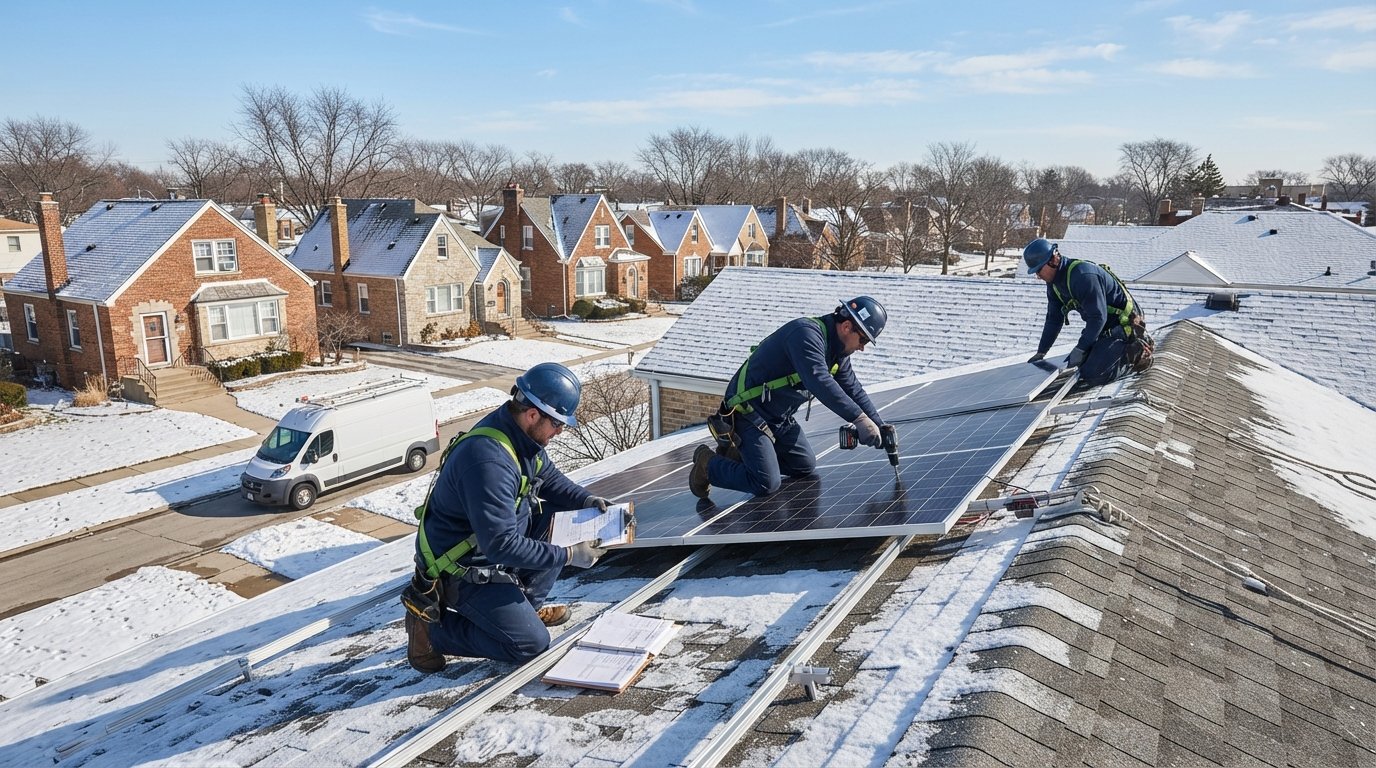
Illinois is not California or Arizona. The state gets roughly 189 sunny days per year, and Chicago winters bring snow loads, ice dams, and temperature swings that stress solar equipment in ways that milder climates do not. This means your installer needs specific expertise in cold-weather system design, including proper snow-shedding panel placement, robust racking that handles freeze-thaw cycles, and inverters rated for extreme temperature fluctuations. A company that primarily installs in Texas or Florida may not have the regional knowledge to optimize a Chicago system.
Illinois also has a distinctive incentive landscape. The Illinois Shines program (also called the Adjustable Block Program) provides Solar Renewable Energy Credits (SRECs) that can significantly offset system costs, but the enrollment process is complex and requires your installer to be an approved vendor. The federal Investment Tax Credit remains available, and ComEd's net metering policies affect how quickly your system pays for itself. An installer who does not understand these programs at a granular level will leave money on the table, and that money comes directly out of your pocket.
Finally, Chicago has specific permitting requirements that vary by suburb and even by neighborhood within the city. Cook County, DuPage County, and surrounding areas all have different inspection timelines and structural requirements. Local expertise is not a nice-to-have, it is a prerequisite for a smooth installation.
Where to Find Qualified Solar Installers in Chicago
The first step in how to find and vet solar installers in Chicago is knowing where to look. Not all sources are equally reliable, and some lead-generation websites sell your contact information to dozens of companies, resulting in a flood of calls that makes comparison shopping overwhelming. The best approach combines multiple vetted sources.
Start with industry certifications. The North American Board of Certified Energy Practitioners (NABCEP) maintains a directory of certified installers, and this certification is the gold standard in the solar industry. A NABCEP-certified professional has passed rigorous exams and demonstrated field experience. Similarly, checking with the Illinois Solar Energy Association (ISEA) can point you toward member companies that have committed to industry best practices.
Another reliable path is through a trusted quote-matching service that pre-screens installers before connecting them with homeowners. Platforms like matching solar installers to save on energy bills can reduce the noise by connecting you only with companies that meet baseline credential requirements. This saves hours of research and ensures you are comparing apples to apples.
Here are the most effective sources for finding Chicago solar installers:
- NABCEP certified installer directory (highest credential standard)
- Illinois Solar Energy Association member listings
- Better Business Bureau with an A+ rating and minimal complaints
- Referrals from neighbors who have had systems installed for at least two years
- Pre-screened quote-matching platforms that verify licenses and insurance
Each source has trade-offs. Referrals give you real-world performance data but limit your options. Directories are comprehensive but do not guarantee quality. Quote-matching services save time but require you to still do your own final vetting. The strongest strategy uses at least two of these sources to build a list of five to seven candidates before narrowing down.
The Credentials That Matter Most in Illinois
Once you have a list of potential installers, the vetting process begins. Not all credentials carry equal weight, and some companies advertise certifications that sound impressive but have little bearing on installation quality. Focus on the following verifiable qualifications.
First, check for a valid Illinois contractor license. The Illinois Department of Financial and Professional Regulation (IDFPR) maintains a lookup tool where you can verify that a company holds the required licenses for electrical and roofing work. Solar installation touches both electrical systems and roof structures, so your installer needs proper licensing in both areas or must partner with licensed subcontractors.
Second, verify insurance coverage. Request a certificate of insurance showing general liability coverage of at least $1 million and workers compensation coverage for all employees. If a worker is injured on your property and the company lacks proper coverage, you could face legal exposure. Do not accept verbal assurances; ask for the certificate directly from the insurance company.
Third, confirm NABCEP certification for at least one principal installer or the company itself. NABCEP offers both individual certification and company accreditation, and either demonstrates a commitment to industry standards that goes beyond the minimum licensing requirements.
Fourth, check the company's status with the Illinois Shines program. Approved vendors have undergone additional screening and can enroll your system in the SREC program. If a company is not an approved vendor, you may lose access to thousands of dollars in incentives.
Finally, look for manufacturer certifications. Major panel manufacturers like SunPower, LG, and Panasonic offer tiered certification programs for installers, and higher tiers often come with extended warranties on labor. A company that holds top-tier certifications from multiple manufacturers has demonstrated consistent quality work.
Red Flags and Warning Signs to Avoid
The solar industry has a persistent problem with predatory companies that target homeowners with high-pressure sales tactics and unrealistic promises. Knowing how to find and vet solar installers in Chicago means knowing what to walk away from, even when the price looks attractive.
One of the most common red flags is a company that demands a large upfront deposit before any work begins. Reputable installers typically require a deposit of 10 to 20 percent, with the balance due after installation and inspection. If a company asks for 50 percent or more upfront, that is a serious warning sign.
Another red flag is pressure to sign immediately to lock in a special price. Legitimate companies provide written quotes and give you time to compare options. If a salesperson tells you the offer expires today or that financing rates will skyrocket tomorrow, you are being manipulated.
Be wary of companies that promise no money down and claim you will pay nothing out of pocket. While solar financing options exist that require no upfront payment, the loan still must be repaid, and some predatory lenders structure deals with escalating payments that become unaffordable after the first year.
Other warning signs include:
- No physical business address in Illinois or the surrounding region
- Reluctance to provide proof of insurance or licensing
- Unsolicited door-to-door sales with immediate sign-up incentives
- Promises of eliminating your entire electric bill (no system can guarantee this)
- Requests for payment in cash or via wire transfer to a personal account
- No verifiable customer reviews or a pattern of unresolved complaints
If you encounter two or more of these signs from a single company, remove them from consideration immediately. The short-term savings are never worth the long-term risk of a poorly installed system or a company that vanishes before honoring its warranty.
How to Compare Quotes Effectively
Once you have narrowed your list to three or four reputable installers, the next phase of vetting involves getting detailed quotes and comparing them on equal terms. This is where many homeowners make mistakes, focusing only on the bottom-line price while ignoring the factors that determine long-term value.
Request a written quote from each installer that includes the following information: system size in kilowatts, estimated annual production in kilowatt-hours, panel manufacturer and model, inverter type and brand, mounting hardware specifications, labor warranty length, and the total price before and after incentives. If any installer refuses to provide this level of detail, that is a red flag.
When comparing quotes, do not simply choose the lowest price. A system that costs $3,000 less but uses lower-efficiency panels or a less reliable inverter may cost you more over 25 years through reduced production and higher maintenance. Look at the estimated production per dollar spent, not just the raw price.
Pay attention to the warranty terms. Panel manufacturers typically offer 25-year production warranties, but the labor warranty from the installer varies widely. Some companies offer 10-year labor warranties, while others offer only one or two years. Given that labor costs for repairs can run $500 to $2,000 per incident, a longer labor warranty has real financial value.
Finally, ask each installer for references from customers who had systems installed at least two years ago. Recent installations do not reveal how a system performs after the honeymoon period. Long-term references give you insight into production performance, warranty responsiveness, and overall satisfaction.
Questions to Ask Before Signing a Contract
Before you commit to any installer, schedule an in-person or video consultation and ask a structured set of questions. The answers will reveal whether the company has the expertise and transparency you need.
Ask how the installer handles roof penetrations and whether they use flashing or sealant-only methods. Flashing is the industry standard for preventing leaks, while sealant-only approaches fail within a few years. Ask about the permitting process and who handles inspections. A company that leaves permitting to you is shifting risk and responsibility onto your shoulders.
Inquire about the monitoring system and what happens if production drops below expectations. Reputable installers provide real-time monitoring and will diagnose and fix underperformance issues. Ask about the process for warranty claims and how quickly the company responds to service calls.
For a broader perspective on how installers are evaluated and matched to homeowners, you can explore resources like SolarEnergy.ai which provides industry insights and educational tools.
Also ask about the timeline. How long from contract signing to installation? How long until the system is connected to the grid and producing power? Delays are common in the solar industry, but a company that provides realistic timelines and communicates proactively about delays is far better than one that overpromises and underdelivers.
Final Steps Before You Commit
After you have gathered quotes, checked references, and asked your questions, take one final step: verify everything independently. Call the Illinois Shines program to confirm the installer is an approved vendor. Check the IDFPR website to confirm licenses are current. Call the insurance company to verify coverage is active. These steps take less than an hour and can save you tens of thousands of dollars in potential problems.
Trust your instincts as well. If a salesperson is pushy, evasive, or dismissive of your questions, that behavior will likely continue after the contract is signed. The best installers welcome scrutiny because they know their work stands up to it.
Choosing the right solar installer in Chicago is one of the most important financial decisions you will make as a homeowner. The market is competitive, and that competition works in your favor when you know how to evaluate it. Take your time, do the research, and do not let anyone rush you into a decision. A well-vetted installer will deliver a system that produces clean energy and saves you money for decades, while a poorly chosen one can turn your roof into an expensive source of frustration.