
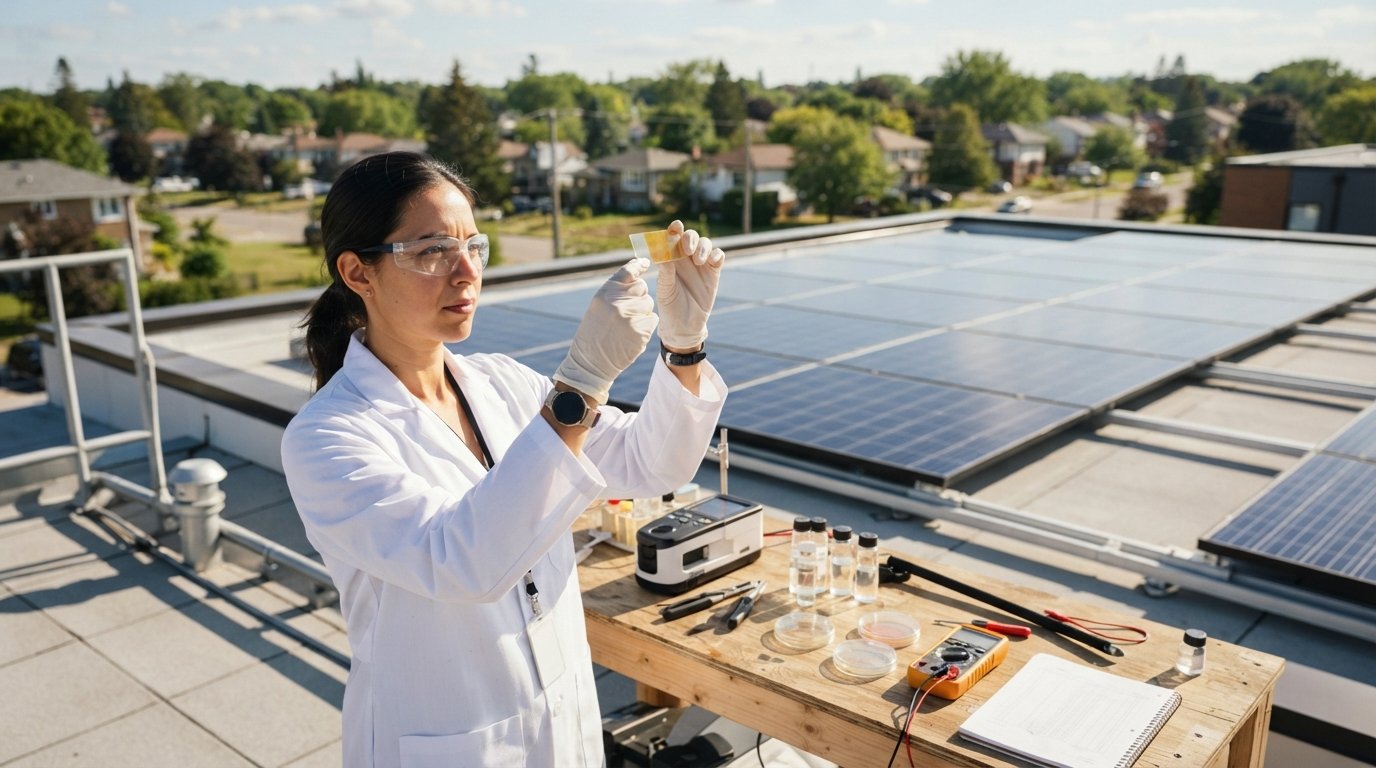
Perovskite Solar Cells: What Homeowners Should Know
Perovskite solar cells promise cheaper, flexible power, but are they ready for your roof? Call 8332123715 for expert guidance on today's solar options.

By Amelia Griffin
Learn more about Solar Panel Installation and Repair for guides, costs, and what to expect.
Compare Solar Panel Installation and Repair Pros Near You

Enter your ZIP code to compare top-rated local professionals and request free quotes.
Solar technology is evolving faster than most homeowners realize. While traditional silicon panels have dominated rooftops for decades, a new contender called perovskite is generating serious buzz in research labs and pilot manufacturing lines. If you are considering solar for your home, understanding what perovskite solar cells are, how they differ from silicon, and when they might reach your roof can help you make a smarter long-term investment. This guide breaks down the essentials without the hype.
What Are Perovskite Solar Cells?
Perovskite solar cells use a class of materials with a specific crystal structure, named after the mineral perovskite, that can absorb sunlight and convert it into electricity. Unlike silicon, which requires high temperatures and energy-intensive purification, perovskite films can be manufactured using solution-based processes at relatively low temperatures. This makes them cheaper and faster to produce in theory. The material is also incredibly versatile: it can be tuned to absorb different wavelengths of light by adjusting its chemical composition. That flexibility has allowed researchers to push efficiency records higher and higher in just a few years.
For homeowners, the key takeaway is that perovskite cells are not yet a mainstream product you can buy at your local installer. They are still in the pre-commercial stage, with companies racing to solve stability and durability issues. However, the potential is enormous. Perovskite could eventually lead to solar panels that are lighter, more flexible, and far less expensive than today's silicon modules.
How Perovskite Differs from Silicon Solar Panels
Traditional solar panels rely on silicon wafers, which are rigid, heavy, and require a thick glass cover. Perovskite cells can be printed onto thin plastic or metal foils, opening the door to flexible, lightweight solar sheets that could be applied to curved surfaces or even windows. In terms of efficiency, perovskite has already surpassed 25 percent in lab tests, rivaling commercial silicon. More importantly, perovskite can be layered on top of silicon to create tandem cells that capture more of the solar spectrum, pushing efficiencies beyond 30 percent.
But there are trade-offs. Silicon panels are known for lasting 25 to 30 years with minimal degradation. Perovskite materials are sensitive to moisture, heat, and UV light, which can break them down quickly if not perfectly encapsulated. That is why you cannot yet buy perovskite panels for your home, they simply have not proven they can survive two decades on a roof. Researchers are testing new barrier films and additives to improve stability, and early results are promising.
Why Homeowners Should Care About Perovskite
Even though perovskite panels are not on the market yet, they matter to anyone planning a solar investment today. First, the technology could drive down prices across the entire solar industry. As manufacturers scale up perovskite production, the cost of solar modules could fall further, making solar affordable for more households. Second, perovskite enables new applications that silicon cannot easily match, such as solar windows, portable solar chargers, and building-integrated photovoltaics that blend into roofing materials.
Third, if you are planning to stay in your home for 10 or more years, you might eventually have the option to upgrade or add perovskite-based products. For example, a future retrofit could involve lightweight perovskite films applied over existing roof tiles, avoiding the need for heavy racking. That said, you should not wait for perovskite if you need solar now. Today's silicon panels are reliable, affordable, and eligible for generous federal and state incentives. To see what is currently available, you can explore top solar panel incentives that can reduce your upfront cost.
Current Limitations and Challenges
The biggest hurdle for perovskite is durability. In real-world conditions, heat and humidity can cause the crystal structure to degrade, leading to rapid efficiency loss. Researchers are working on solutions, including two-dimensional perovskite layers, graphene barriers, and advanced encapsulation. Another challenge is scaling up from small lab cells to full-sized panels without defects. Manufacturing uniformity is critical, and companies are investing heavily in roll-to-roll printing processes.
There are also environmental and health concerns. Some perovskite formulations contain lead, which is toxic. While the amount of lead in a panel is small, safe disposal and recycling systems must be developed. Lead-free perovskites using tin or other elements are in development but currently less efficient. Regulatory approval will require demonstrating that perovskite panels are safe throughout their lifecycle.
Finally, the solar industry is conservative. Installers and financiers want proven products with warranties. Perovskite manufacturers will need to offer 25-year performance guarantees to compete with silicon. That means extensive field testing, which takes time. Most experts expect commercial perovskite panels for residential use to arrive in the late 2020s or early 2030s, though niche products like solar chargers may appear sooner.
How to Evaluate Perovskite Claims as a Homeowner
When you see headlines about record-breaking perovskite efficiencies, keep a few things in mind. Lab efficiencies are measured on tiny cells under ideal conditions. Commercial panels are much larger and must perform across temperature swings, clouds, and dust. Also, efficiency alone does not matter if the panel degrades quickly. Look for third-party certifications and real-world degradation data before trusting any new technology.
If a salesperson tries to sell you perovskite panels today, be skeptical. Unless they can provide independent test results and a bankable warranty, you are likely being offered a silicon panel with a perovskite marketing spin. Instead, focus on established silicon brands with strong track records. You can always add perovskite later if it proves itself.
Perovskite vs. Silicon: A Quick Comparison for Homeowners
To help you weigh the differences, here is a side-by-side look at key factors:
- Efficiency: Silicon panels range from 18 to 22 percent; perovskite lab cells exceed 25 percent, and tandem cells can reach over 30 percent.
- Cost: Silicon manufacturing is mature and cheap; perovskite promises lower material costs but current production is limited.
- Durability: Silicon lasts 25 to 30 years; perovskite stability is improving but unproven in long-term field tests.
- Flexibility: Silicon is rigid; perovskite can be made flexible and lightweight.
- Availability: Silicon is widely available; perovskite is not yet commercially available for residential roofs.
As you can see, silicon remains the practical choice for now. Perovskite is a future option that could eventually complement or replace silicon, but it is not ready for your roof today.
When Will Perovskite Solar Cells Be Available for Homes?
Several companies, including Oxford PV and Saule Technologies, are working on commercial perovskite products. Oxford PV has started producing tandem cells for specialized applications, but residential panels are still years away. Industry analysts predict that perovskite modules for homes could enter the market between 2028 and 2032, depending on how quickly stability issues are solved and manufacturing scales.
In the meantime, the smart move is to install proven silicon solar now if you want to cut your electric bills. You can always add perovskite later as a supplemental technology. For expert guidance on choosing the right system and comparing quotes from certified installers, SolarEnergy.ai offers comprehensive resources and tools that can simplify your decision.
What This Means for Your Solar Investment Today
Perovskite solar cells represent an exciting leap forward, but they are not a reason to delay your solar installation. Silicon panels are more efficient than ever, prices have dropped dramatically, and federal incentives like the 30 percent tax credit remain available. Waiting for perovskite could mean missing years of savings and leaving money on the table.
Instead, consider a phased approach: install a high-quality silicon system now, and keep an eye on perovskite developments. When the technology matures, you might be able to add perovskite films or replace aging panels with next-generation modules. The key is to start saving on electricity today while staying informed about tomorrow's innovations.
If you are ready to explore solar for your home, request free quotes from certified installers in your area. They can help you size a system, calculate savings, and take advantage of current incentives. Perovskite may be the future, but silicon is the smart choice for the present.