
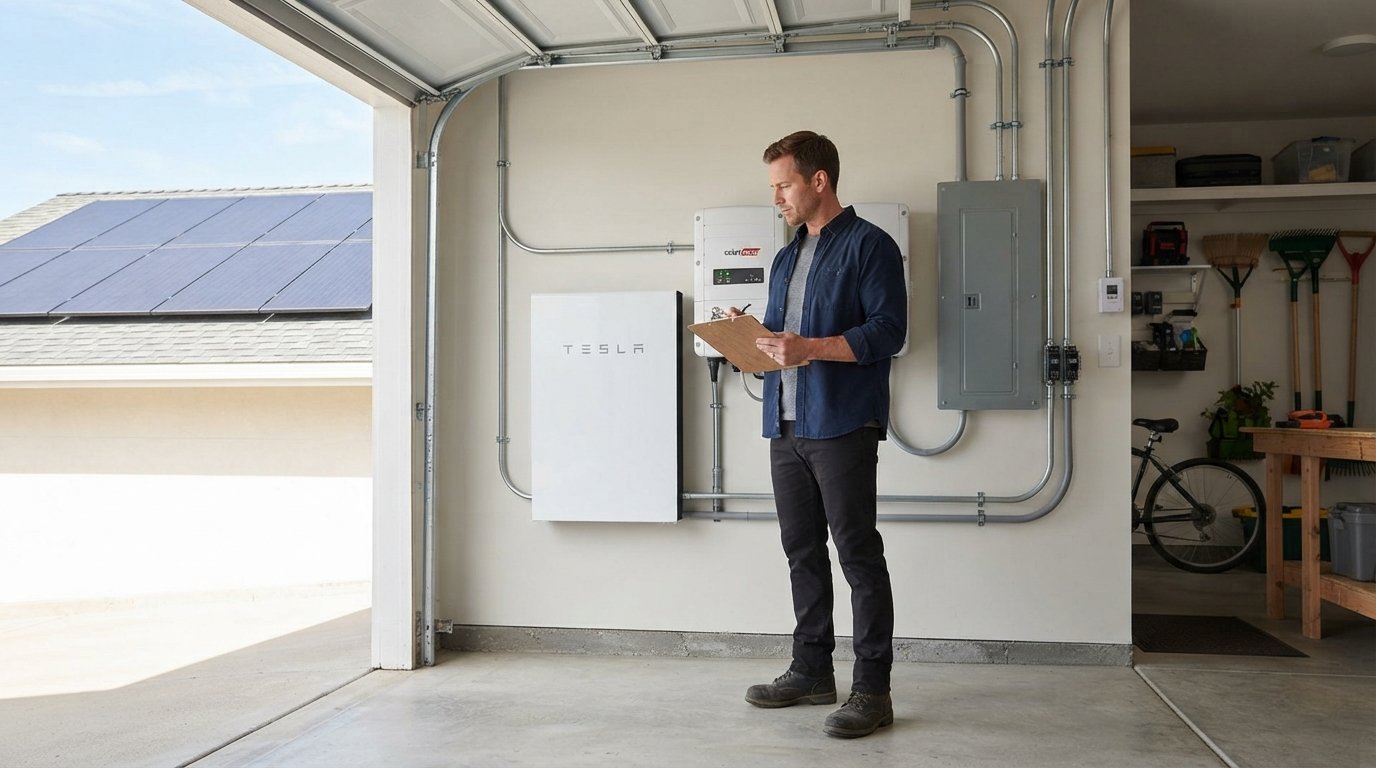
Solar Plus Storage for Grid Outage Resilience Planning
Plan solar plus storage for grid outage resilience with confidence. Call (833)-212-3715 to size your backup system and keep critical loads running.
Learn more about Solar Panel Installation and Repair for guides, costs, and what to expect.
Compare Solar Panel Installation and Repair Pros Near You

Enter your ZIP code to compare top-rated local professionals and request free quotes.
When the grid goes down, a solar array alone will not keep your lights on. Without a battery or a generator, most grid-tied solar systems shut off automatically to protect utility workers. That reality surprises many homeowners who invest in panels expecting uninterrupted power. The missing piece is storage, and the planning behind it determines whether your home hums through a blackout or sits dark like everyone else's. Solar plus storage for grid outage resilience planning is not just about buying a battery; it is about sizing the system to your critical loads, configuring backup circuits intelligently, and understanding how weather and usage patterns affect your ability to ride out multi-day outages.
This guide walks through the practical decisions: whole-home versus partial backup, load panel configuration, storage calculations for refrigeration and medical devices, generator pairing, and realistic expectations for recharging during cloudy or winter days. The goal is to help you design a system that matches your actual resilience needs without overspending on capacity you will rarely use.
Whole-Home Versus Partial Backup: Choosing Your Resilience Scope
The first decision in any resilience plan is scope. A whole-home backup system powers every circuit in your house exactly as it operates on the grid. A partial backup system, by contrast, powers only a subset of circuits, typically those serving essential loads. The choice affects battery size, inverter requirements, wiring complexity, and cost. Whole-home backup usually requires a larger battery bank and a high-output inverter to handle simultaneous loads like air conditioning, electric water heating, and EV charging. Partial backup can often be accomplished with a smaller, less expensive system because it isolates only the circuits you designate as critical.
For many homeowners, partial backup strikes the best balance. You can keep the refrigerator, freezer, internet router, a few lights, medical equipment, and perhaps a window air conditioner or furnace blower running without powering the entire house. This approach reduces battery capacity needs and extends the duration of backup during an outage. Whole-home backup makes more sense if you have complex medical needs, work from home with critical equipment, or simply want the convenience of not thinking about which circuits are live. It also avoids the need to rewire your electrical panel with a dedicated backup subpanel, though it demands a larger investment.
Load panel configuration is where this decision becomes concrete. For partial backup, an electrician installs a backup load panel (sometimes called a critical load panel) that receives power from the battery inverter during an outage. The main panel remains connected to the grid, and the backup panel is fed either by the grid or by the battery system through a transfer mechanism. Circuits you want backed up are moved from the main panel to the backup panel. This requires careful mapping of your home's circuits and an understanding of which loads can run simultaneously without overloading the inverter. For whole-home backup, a service-rated automatic transfer switch or a meter-mounted transfer switch disconnects the entire house from the grid and connects it to the battery inverter, allowing all circuits to operate as normal, subject to the battery's capacity and the inverter's power rating.
When planning, consider future loads. If you might add an electric vehicle or a heat pump water heater later, partial backup may become limiting. Conversely, if your goal is simply to avoid spoiled food and keep a few rooms comfortable, partial backup with a modest battery is often the most cost-effective path. The key is to match the scope to your actual outage history and comfort thresholds, not to an abstract idea of total independence.
Calculating Storage for Refrigeration, HVAC, and Medical Devices
Sizing a battery for outage resilience starts with an energy audit of your critical loads. You need to know how many watt-hours each device consumes per day and which devices run simultaneously. Refrigeration is a common starting point: a typical full-size refrigerator uses about 1 to 2 kWh per day, while a chest freezer might use 1 to 2.5 kWh per day depending on its efficiency and usage. These loads cycle on and off, so their average draw is lower than their peak, but during an outage you want to minimize opening doors to preserve cold. Adding a second refrigerator or a large freezer increases the daily energy requirement proportionally.
HVAC is the largest variable. A central air conditioner might draw 3 to 5 kW when running, and in hot climates it could run for many hours per day, consuming 20 to 40 kWh daily. A furnace blower uses far less, perhaps 0.5 to 1 kWh per day for intermittent operation, but a heat pump or electric resistance heat can be a major load. For resilience planning, many homeowners choose not to back up central air conditioning with a battery alone, instead pairing the battery with a generator or designating a single room with a window unit or mini-split for cooling. Medical devices such as CPAP machines, oxygen concentrators, or infusion pumps have specific requirements that must be met reliably; their daily energy use is often small (0.5 to 2 kWh) but their criticality demands a dedicated circuit and enough battery capacity to cover the longest expected outage plus a safety margin.
To calculate storage needs, follow a simple framework:
- List each critical load and its running wattage (found on the device label or manual).
- Estimate daily hours of operation for each load and multiply to get daily watt-hours.
- Sum the daily watt-hours for all critical loads to get total daily energy need.
- Multiply by the number of days of autonomy you want (for example, 2 or 3 days) to get required battery capacity.
- Add a 20 to 30 percent buffer for battery efficiency losses, depth of discharge limits, and unexpected usage.
For example, a refrigerator (1.5 kWh/day), a freezer (1.5 kWh/day), lights and electronics (1 kWh/day), and a medical device (1 kWh/day) total 5 kWh/day. For two days of autonomy with a 25 percent buffer, you need about 12.5 kWh of usable battery capacity. Most residential batteries have usable capacities between 10 and 20 kWh, so a single unit might suffice for this scenario. If you add a window air conditioner (5 kWh/day), the total jumps to 10 kWh/day, requiring roughly 25 kWh for two days, which typically means two batteries or a larger single unit. These calculations should be refined with a professional load analysis, but they illustrate the importance of prioritizing loads and setting realistic autonomy goals.
Generator Pairing and Automatic Transfer for Extended Outages
Batteries are excellent for short outages, but extended blackouts lasting several days can deplete even large battery banks, especially if solar production is low. Pairing a battery with a generator creates a hybrid resilience system that combines the quiet, instant response of battery backup with the long-duration energy of fossil fuel or propane. The generator can recharge the battery during prolonged outages, allowing you to run critical loads indefinitely as long as fuel is available. This pairing also lets you size the battery for typical outages (a few hours to a day) while relying on the generator for rare, multi-day events, reducing battery cost.
Automatic transfer switches (ATS) are the glue that makes this seamless. An ATS monitors the grid and automatically switches your home's power source to the generator or battery when an outage occurs. For a battery system, the inverter itself often includes a built-in transfer switch that disconnects from the grid and forms an island. When a generator is added, a more complex transfer scheme may be needed to ensure the generator and battery do not backfeed the grid or conflict. Some advanced inverters can accept generator input and manage the charging and load sharing automatically. The goal is to have a system that requires no manual intervention: the battery carries the load instantly, and if the outage persists and battery state of charge drops, the generator starts automatically to recharge the battery and power the home.
When selecting a generator for pairing, consider fuel type, noise, maintenance, and sizing. A generator that is too small cannot recharge the battery while carrying loads; one that is too large wastes fuel. Many homeowners choose a generator in the 7 to 12 kW range for partial backup, or larger for whole-home backup with central air. Propane and natural gas generators offer clean-burning, on-site fuel storage, while diesel and gasoline require more maintenance and fuel rotation. The generator should be sized to handle the battery charger plus the critical loads simultaneously, and the transfer switch must be rated for the combined output. Regular exercise and maintenance are essential to ensure the generator starts when needed, and fuel storage should be adequate for the longest expected outage plus a margin.
For homeowners planning solar plus storage for grid outage resilience planning, the generator pairing decision often comes down to budget and outage frequency. If outages are typically short (a few hours), a battery alone may suffice. If you live in an area with frequent multi-day outages from hurricanes, winter storms, or wildfire-related shutoffs, a generator adds a layer of security that batteries alone cannot match without significant oversizing. The combination also provides redundancy: if the generator fails, the battery still covers short outages; if the battery is depleted, the generator can recharge it. This layered approach is the gold standard for resilience.
Recharging from Solar During Cloudy or Winter Days
A common misconception is that solar plus storage provides indefinite power during any outage. In reality, the battery must be recharged by solar production, and cloudy or winter days can significantly reduce that production. A residential solar array might produce 30 to 50 kWh on a sunny summer day but only 5 to 15 kWh on a heavily overcast winter day, depending on location and system size. If your critical loads consume 10 kWh per day and the solar array produces only 8 kWh, the battery will slowly deplete even with solar charging. Understanding this dynamic is essential for setting realistic expectations and designing a system that can recover.
Several strategies improve resilience during low-sun periods. First, reduce loads aggressively during outages: turn off non-essential circuits, use LED lighting, and avoid high-power appliances. Second, orient and tilt panels for optimal winter production if you live in a northern climate; snow cover can be managed with ground-mounted arrays or careful roof design. Third, consider a larger battery bank to bridge multiple cloudy days, though this increases cost. Fourth, pair with a generator as discussed above, which can recharge the battery regardless of weather. Finally, some inverters allow you to prioritize battery charging from solar during an outage, ensuring that any production goes first to the battery before serving loads, which can help recover state of charge when sun returns.
It is also important to model worst-case scenarios. A resilience plan should consider the longest expected outage and the least favorable weather during that period. For example, if you live in an area prone to winter ice storms, plan for several days of heavy clouds and short daylight. In that case, a battery sized for two days plus a generator might be more practical than a massive battery bank that is rarely fully utilized. Software tools and installer expertise can help simulate solar production and load profiles to size the system appropriately. The key is to avoid overpromising: a solar plus storage system will dramatically improve your resilience compared to no backup, but it is not a perpetual motion machine. It requires thoughtful design and realistic usage during outages.
For businesses with fleet vehicles, the same planning principles apply, and you can explore solar plus EV charging for business fleets to understand how to integrate transportation energy into your resilience strategy. Whether residential or commercial, the core equation remains: match storage and generation to critical loads, plan for worst-case weather, and incorporate backup charging if outages are long.
When planning a move or a new home purchase, it is wise to consider resilience upgrades early. Resources like Moving.Homes relocation guides can help you evaluate a property's energy infrastructure and plan for solar and storage additions during a move, ensuring your new home is prepared for outages from day one.
Bringing It All Together: A Practical Planning Sequence
Designing a resilient solar plus storage system follows a logical sequence. Start by documenting your outage history and comfort requirements: how often does the grid fail, for how long, and which loads are non-negotiable? Then perform a load audit to quantify daily energy needs for critical circuits. Next, decide on backup scope (whole-home or partial) and identify the circuits to include. After that, size the battery for your desired autonomy period, adding a buffer for efficiency and degradation. Evaluate whether a generator is needed for extended outages, and select an automatic transfer scheme that integrates seamlessly with the battery inverter. Finally, model solar production during worst-case weather to confirm the battery can recover, and adjust loads or add generation if needed.
Throughout this process, engage a certified installer who can perform a site assessment, verify electrical panel capacity, and recommend equipment that meets your goals. Solar plus storage for grid outage resilience planning is a specialized field, and the details of load panel configuration, transfer switch compatibility, and inverter generator support matter enormously. A qualified professional will also help you navigate incentives and financing, which can make the investment more accessible. Remember that the cheapest system is not always the most resilient; focus on matching capacity to your actual needs and building in redundancy where it counts.
With careful planning, a solar plus storage system can keep your essential loads running through most outages, provide peace of mind during extreme weather, and even add value to your property. The key is to approach it as an engineering problem rather than a product purchase: define your resilience goals, calculate your loads, choose the right architecture, and plan for the worst-case weather. When done right, your home becomes a small island of stability when the grid goes dark.
Learn more about Solar Panel Installation and Repair for guides, costs, and what to expect.
Compare Solar Panel Installation and Repair Pros Near You
Enter your ZIP code to compare top-rated local professionals and request free quotes.