
Solar Panel Cleaning Cost Versus DIY Savings
Weigh solar panel cleaning cost versus DIY savings and learn when professional cleaning pays off. Call (833)-212-3715 for expert guidance.

By Andy Pearson
Learn more about Solar Panel Cleaning for guides, costs, and what to expect.
Compare Solar Panel Cleaning Pros Near You

Enter your ZIP code to compare top-rated local professionals and request free quotes.
Your solar panels are an investment in lower energy bills and a smaller carbon footprint, but dust, pollen, bird droppings, and soot can quietly erode those returns. The decision between hiring a professional and cleaning the panels yourself comes down to a simple equation: solar panel cleaning cost versus DIY savings. Understanding the real numbers, the risks, and the situations where each approach makes sense will help you protect your system and your wallet.
The Real Cost of Professional Solar Panel Cleaning
Professional solar panel cleaning typically ranges from $150 to $500 per visit, depending on your location, system size, and the complexity of the job. For a standard residential array of 20 to 30 panels (roughly 6 to 9 kilowatts), most homeowners pay between $200 and $350. In regions with high dust or pollen, such as Arizona or parts of California, prices can climb toward the upper end of that range. Commercial systems and steep roofs cost more due to safety requirements and specialized equipment.
Regional pricing varies significantly. In Houston, where humidity and pollen are constant challenges, a typical cleaning might cost $250 for a two-story home. In Phoenix, dust storms necessitate more frequent cleanings, and competitive markets keep prices around $200 for a single-story ranch. California's stricter labor regulations and higher cost of living push prices to $300 or more in the Bay Area, while rural areas of Colorado might see $180 for a simple ground-mounted array.
These figures usually include inspection, deionized water rinsing, and sometimes a light scrub with soft brushes. Some companies bundle cleaning with annual maintenance contracts, offering a discount per visit. It is important to get quotes from multiple providers, and you can use a solar system estimate platform to understand how cleaning costs fit into your overall solar savings picture.
DIY Solar Panel Cleaning: Costs and Savings
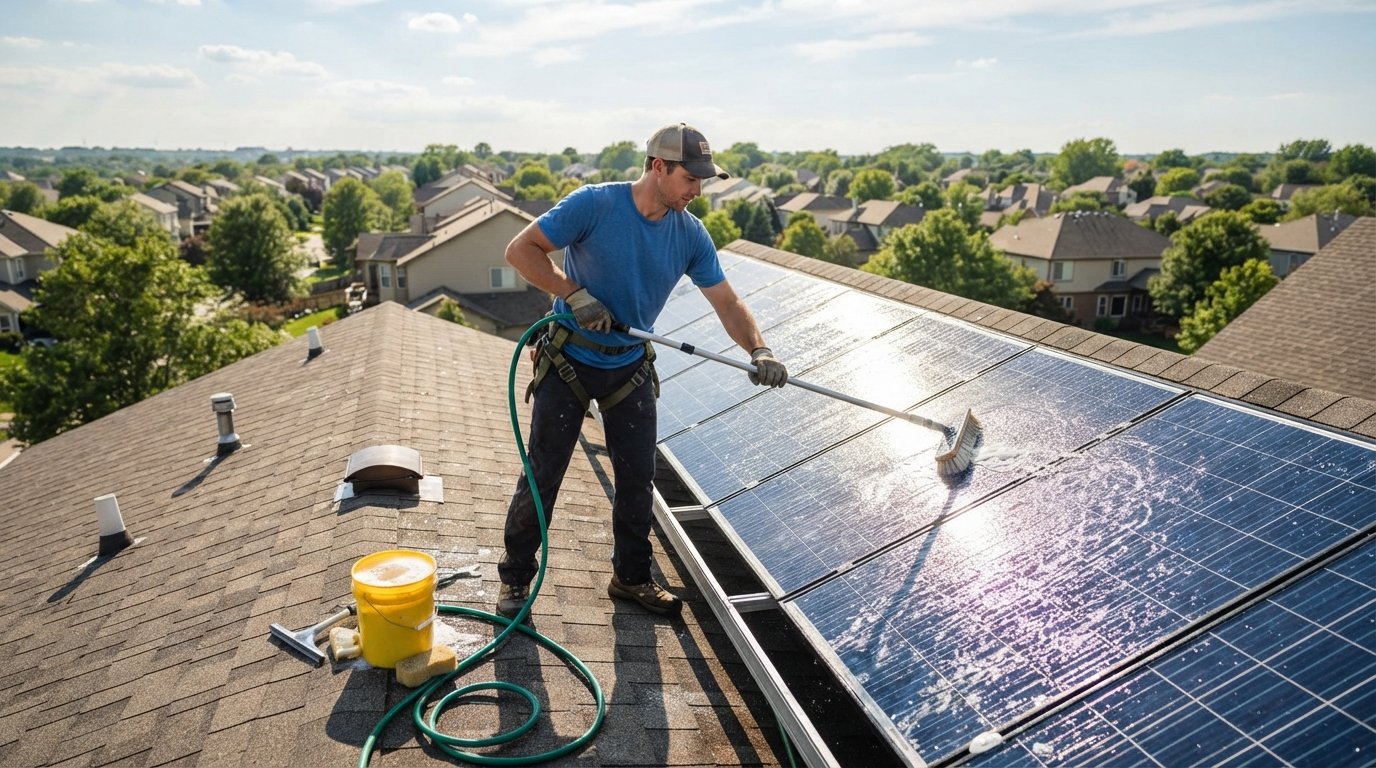
DIY cleaning costs are minimal: a long-handled soft brush ($30 to $50), a garden hose, mild soap (avoid abrasive detergents), and safety gear if you are working at height. For ground-mounted or low-slope arrays, you can clean your panels in about an hour with no specialized skills. The savings versus professional cleaning are substantial: if you clean twice a year, you could save $400 to $700 annually.
However, DIY savings come with hidden risks. Climbing on a roof to reach panels on a pitched surface is dangerous; falls are a leading cause of home injuries. Moreover, using hard water can leave mineral deposits that are difficult to remove and may void warranties. Scrubbing with abrasive materials can scratch the anti-reflective coating, permanently reducing efficiency. Many manufacturers recommend professional cleaning to maintain warranty coverage, especially for roof-mounted systems.
For ground-mounted arrays or those on a single-story low-slope roof, DIY is a safe and cost-effective choice. You can reach the panels with a long brush from the ground, use a hose with a spray nozzle, and avoid harsh chemicals. Just be sure to clean early in the morning or late evening when panels are cool to prevent thermal shock.
When Soiling Losses Justify Paid Cleaning
Solar panels lose efficiency when dirt accumulates, but the rate varies by location and weather. In dusty areas, soiling can reduce output by 1% per week without rain. A study by the National Renewable Energy Laboratory found that in the southwestern U.S., soiling losses can average 0.5% per day during dry spells. For a 7 kW system that generates $1,200 worth of electricity annually, a 5% loss equals $60 per year. If professional cleaning costs $250, it only makes sense if the soiling loss exceeds that amount, or if cleaning is part of a broader maintenance plan.
Paid cleaning is justified when: your panels are visibly dirty (a layer of dust or bird droppings), your energy production has dropped noticeably (check your monitoring app), you live in an area with frequent wildfires or construction dust, or your system is large and the cumulative losses add up. For example, a 10 kW system with a 10% soiling loss could be losing $150 to $200 per year, making an annual professional cleaning worthwhile.
Conversely, if you live in a rainy climate with regular afternoon showers, natural cleaning may suffice, and paying for cleaning is rarely cost-effective. Similarly, if your panels are steeply tilted (40 degrees or more), rain tends to wash away most dirt, reducing the need for manual cleaning.
Safe DIY Methods for Ground-Mounted and Low-Slope Arrays
If you decide to clean your panels yourself, follow these steps to do it safely and effectively. First, assess your roof pitch and height: if you cannot reach the panels from the ground or a stable ladder without stepping on the roof, hire a professional. For ground-mounted or low-slope arrays, use a soft-bristled brush with an extension pole, a garden hose with a spray nozzle, and a mild soap solution (a few drops of dish soap in a bucket of water).
Here is a simple procedure:
- Shut off the system if possible (consult your manual) to avoid any risk of shock, though most residential systems are safe to clean while operating.
- Spray the panels with water to loosen dirt and cool the glass.
- Dip the brush in soapy water and gently scrub the surface, working from top to bottom.
- Rinse thoroughly with clean water to prevent soap residue.
- Use a squeegee or soft cloth to remove excess water and prevent spotting.
Never use a pressure washer, as it can damage the panels and void warranties. Avoid cleaning during the hottest part of the day; early morning is best. And always prioritize safety: if you are uncomfortable on a ladder, call a professional.
How to Book Panel Cleaning Through NewSolarQuotes Specialists
NewSolarQuotes connects homeowners with certified solar specialists who can handle panel cleaning and other maintenance tasks. By using their free quote request system, you can compare local professionals, read reviews, and choose a vetted expert. This is especially valuable if you have a roof-mounted system or if you want to ensure warranty compliance.
The process is straightforward: visit the NewSolarQuotes website, fill out a short form with your system details and location, and receive quotes from up to three local specialists. You can also call their team at (833)-212-3715 for guidance. These specialists are trained to clean panels safely, inspect for damage, and even optimize your system's performance. While there is a cost, the peace of mind and potential warranty protection often outweigh the DIY savings, especially for larger or harder-to-reach arrays.
For those planning to move or who need relocation resources, Moving.Homes offers comprehensive guides and checklists to reduce stress, though it is not directly related to solar maintenance.
Weighing the Trade-Offs: Cost Versus Savings
To make an informed decision, calculate your potential savings from cleaning versus the cost. Start by monitoring your system's output before and after cleaning; many inverters or monitoring apps show daily or weekly production. If you see a 5% or greater increase after cleaning, and that increase persists, the cleaning was likely worthwhile. For a typical 6 kW system in a sunny state, a 5% increase in production might add $50 to $75 per year in electricity savings. That means a $250 professional cleaning would take three to five years to pay back, which may not be attractive unless you also value the convenience and safety.
DIY cleaning costs almost nothing but requires time and carries risk. If you are physically able and your panels are easily accessible, DIY can save you hundreds per year. However, if your roof is steep, your panels are high, or you have a large system, the risk of injury or damage makes professional cleaning the smarter financial choice in the long run.
Consider also the value of your time. If you earn $30 per hour and cleaning takes two hours, your time is worth $60. Add the cost of equipment and the risk of falls, and the DIY savings shrink. For many homeowners, the break-even point favors professionals when the system is large or access is difficult.
Finally, think about frequency. In most U.S. climates, cleaning once or twice a year is sufficient. If you live in a dusty area, you might need quarterly cleaning, which makes DIY more appealing to avoid recurring costs. But if you can negotiate a maintenance contract with a professional, the per-visit cost may drop enough to make it competitive.
Ultimately, the solar panel cleaning cost versus DIY savings decision hinges on your specific circumstances: system size, roof accessibility, local climate, and your tolerance for risk. By understanding the numbers and options, you can keep your solar investment performing at its best without overspending.