
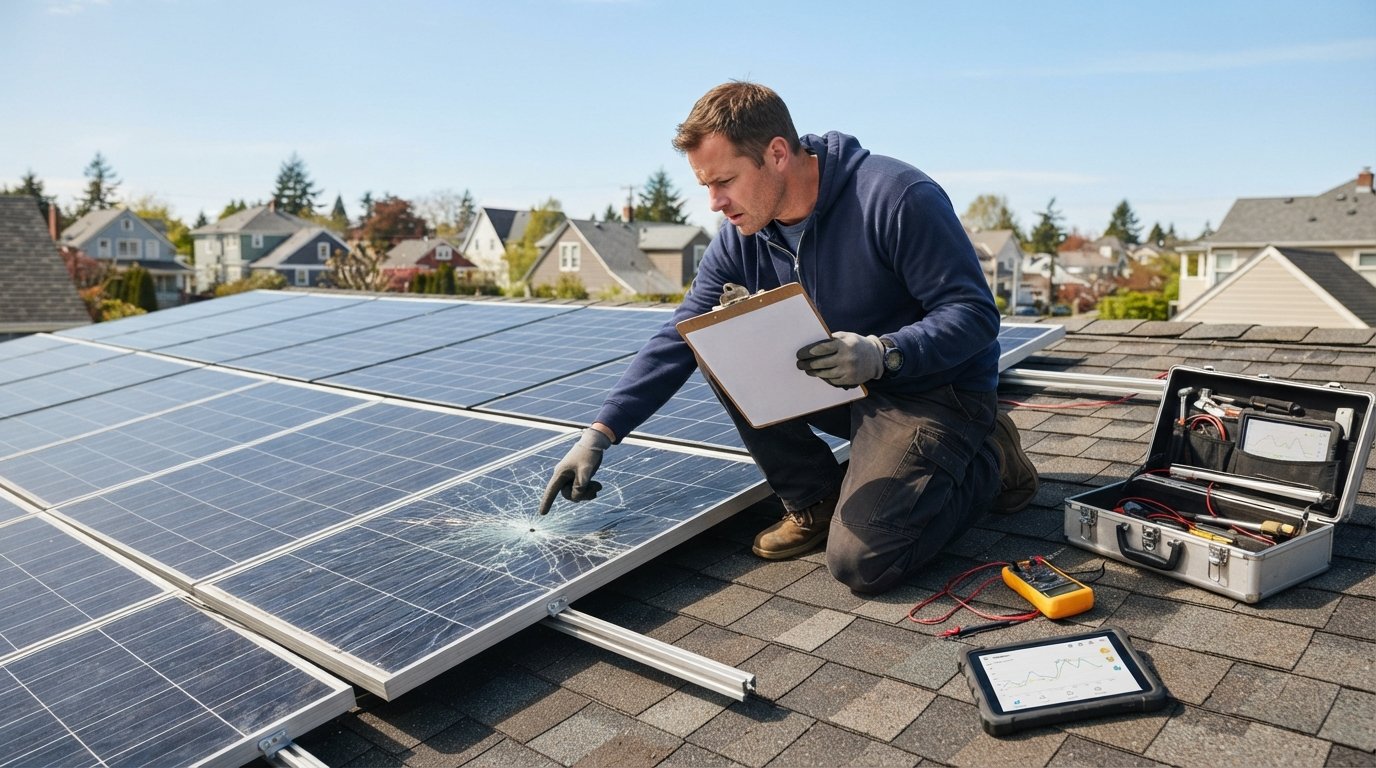
Solar Panel Warranty Claims: Step by Step Process
Master the solar panel warranty claims process step by step and protect your investment. Call (833)-212-3715 for expert guidance today.

By Amelia Griffin
Learn more about Solar Panel Installation and Repair for guides, costs, and what to expect.
Compare Solar Panel Installation and Repair Pros Near You

Enter your ZIP code to compare top-rated local professionals and request free quotes.
Your solar panels came with promises: 25 years of power production, 12 years of workmanship coverage, and a product warranty that should outlast your mortgage. But when a panel cracks, an inverter fails, or your system suddenly underperforms, those promises only matter if you know how to enforce them. The solar panel warranty claims process step by step is not complicated, but it is detail-driven. Miss a document, skip a diagnostic step, or contact the wrong party, and a legitimate claim can stall for months. This guide walks you through the entire sequence, from the day you sign your installation contract to the moment a remediation check clears. You will learn how to distinguish coverage types, what records to keep, how to prove underperformance with data, and what to do if your original installer is no longer in business.
Know Which Warranty You Are Claiming Under
Before you send a single email, identify the warranty that actually covers your problem. Solar warranties come in three distinct layers, and each has a different responsible party, a different claims path, and a different definition of what counts as a defect. Mixing them up is the most common reason claims get denied or bounced between manufacturers and installers.
Product warranty (equipment coverage). This is the manufacturer's guarantee that the hardware itself is free from defects in materials and workmanship. It typically covers panels for 10 to 12 years, inverters for 5 to 12 years, and racking for 10 to 25 years. If a panel develops delamination, a junction box fails, or microcracks appear without physical damage, the product warranty applies. The manufacturer, not your installer, is the responsible party.
Performance warranty (power output coverage). This guarantees that your panels will produce a minimum percentage of their rated power over time. Most Tier 1 manufacturers promise at least 80% to 87% of nominal output at year 25, with a linear degradation curve of roughly 0.5% per year. A performance claim is not about a broken part; it is about measurable underproduction. You will need production data and a baseline to prove it.
Workmanship warranty (installation coverage). This covers the quality of the installation itself: roof penetrations, flashing, wiring, conduit, and labor. If a leak develops around a mounting foot or a connection corrodes because of poor installation, the workmanship warranty applies. The installer is the responsible party, which creates a problem if that installer has closed down. Typical workmanship coverage runs 5 to 10 years, though some premium installers offer 25 years.
Once you know which layer applies, you can direct your claim to the right entity and cite the correct warranty document. Keep all three documents in one folder, because a single failure (for example, water intrusion that damages a panel) can trigger both a workmanship claim against the installer and a product claim against the manufacturer.
Build Your Documentation File Before You Need It
The strongest warranty claims are won before a problem ever appears. Manufacturers and installers routinely deny claims that lack proof of purchase, proof of installation quality, or proof of ongoing system performance. Assembling a complete documentation file at commissioning takes an afternoon and saves weeks later.
At minimum, your file should contain the following records. Store digital copies in cloud storage and keep one physical folder with your home documents.
- Signed installation contract, change orders, and final invoice showing the system price and payment date.
- Equipment serial numbers for every panel, inverter, and battery, photographed directly from the nameplate labels.
- Warranty certificates and registration confirmations for each manufacturer, including the date each warranty was activated.
- Commissioning documents: the structural permit, electrical inspection sign-off, and the final commissioning report with initial production readings.
- Monitoring platform credentials and at least one full year of baseline production data exported to a spreadsheet.
The baseline production data is the piece most homeowners overlook, and it is the piece that wins performance claims. Without a record of what your system produced when it was healthy, you cannot demonstrate that current output represents a decline. Export monthly production totals from your monitoring app at least twice a year, and note any environmental events (hailstorms, extended snow cover, wildfire smoke) that could explain temporary dips. This habit also helps you spot real underperformance early, while the warranty clock still has decades left on it.
Measure Underperformance and Prove a Performance Claim
Performance warranty claims fail for one reason: the homeowner cannot separate a genuine panel defect from weather, shading, soiling, or inverter clipping. To build a defensible claim, you need to show that your system is producing meaningfully below its expected output under comparable conditions.
Start with a clean comparison. Pull the same calendar month from your baseline year and the current year, then compare total kilowatt-hours produced. If the current year is 10% or more below baseline and there have been no major weather anomalies, you have a signal worth investigating. Next, check the monitoring portal for panel-level data if your system supports it. A single underperforming panel in an otherwise healthy array points to a hardware defect; a system-wide decline points to an inverter issue or a measurement problem.
Before filing, eliminate the easy explanations. Clean the panels, confirm the inverter is not in a derated mode, and verify that no new shading (a growing tree, a new construction) has appeared. If production is still low, request a professional IV curve trace from a certified technician. This test measures the actual electrical characteristics of each panel and produces a report that manufacturers accept as evidence. The cost of the test, typically a few hundred dollars, is often recoverable if the claim is approved, and it transforms a vague complaint into a documented defect.
When you file, submit the following package to the manufacturer's warranty department: the completed claim form, your proof of purchase, the serial numbers of the affected panels, the IV curve trace report, and a side-by-side production comparison showing baseline versus current output. State the specific performance threshold from your warranty document that has been breached, and request either replacement panels or a prorated refund per the warranty terms. Manufacturers respond to organized, data-backed claims far faster than to emotional appeals.
File the Claim and Follow the Response Timeline
With documentation in hand, the solar panel warranty claims process step by step moves into the filing phase. Each manufacturer has its own portal or claims email, and each installer has its own service request process. Submit through the official channel and keep a record of every submission.
- Submit a written claim through the manufacturer's warranty portal or certified mail, and request a claim number.
- Send a parallel service request to your installer if the issue involves workmanship or if the manufacturer requires an installer inspection.
- Log every communication: date, representative name, claim number, and what was promised.
- Respond to requests for additional information within 48 hours to keep the claim moving.
- Escalate in writing if you receive no substantive response within the timeline stated in your warranty document.
Typical response timelines vary by manufacturer, but most acknowledge a claim within 5 to 10 business days and complete an initial review within 30 days. Workmanship claims handled by installers often move faster, sometimes within two weeks, because the installer controls the labor. If the 30-day mark passes without a decision, send a written escalation email to the manufacturer's customer service manager and reference your claim number. For workmanship disputes, a written notice to the installer citing your state's contractor licensing board is often enough to prompt action, because licensed contractors take board complaints seriously.
If the manufacturer approves the claim, confirm in writing whether they are shipping replacement equipment, issuing a credit, or dispatching a service technician. Ask who covers labor, shipping, and disposal of the failed equipment, because these costs are frequently excluded from product warranties and can add hundreds of dollars to a repair you thought was free. Get the approval terms in writing before any work begins.
Handle Installer Insolvency and Workmanship Gaps
The hardest scenario in the solar panel warranty claims process step by step is discovering that your installer has gone out of business. Workmanship warranties are only as strong as the company backing them, and installer closures have become more common as the industry consolidates. If your installer is gone, you still have options, but you need to act deliberately.
First, check whether the installer was acquired by or merged into another company. Many closures are actually acquisitions, and the successor company often inherits warranty obligations. Search your state's business registry and the installer's old website for forwarding notices. Second, check whether the manufacturer has an installer network or a labor reimbursement program. Some Tier 1 manufacturers will honor workmanship-related labor costs through their own certified installer network even when the original installer has vanished, provided the system was registered properly.
Third, look to your state contractor licensing board. Most states maintain a recovery fund or require a surety bond from licensed contractors, and homeowners can file a claim against that bond for defective work. The process requires proof of the contract, proof of the defect, and evidence that the contractor is unreachable. Fourth, check whether your homeowner's insurance policy covers damage resulting from faulty installation, particularly water intrusion. Finally, if the system was financed through a lender or leased through a third party, that company may hold warranty obligations under the financing agreement, so review those documents carefully.
To avoid this situation in the first place, ask prospective installers for proof of financial stability, check their licensing history, and confirm whether their workmanship warranty is backed by a third-party insurance policy. A warranty is only valuable if the company behind it will still exist in year ten. When you compare installer quotes, treat warranty backing as a primary criterion, not an afterthought. Resources like a solar panel selection tool can help you evaluate equipment quality, but the installer's longevity deserves equal scrutiny.
Escalate Smartly and Protect Your Rights
Most claims resolve within the first two escalation steps, but some require more pressure. Knowing the escalation ladder keeps you from wasting months on a stalled claim. The sequence generally runs from customer service representative to warranty manager to manufacturer regional representative, then to third-party dispute resolution.
At each step, put your request in writing and set a clear deadline. State the facts, reference the warranty clause, attach the evidence, and specify the remedy you are seeking. Avoid emotional language; a calm, documented record is more persuasive and becomes valuable evidence if the dispute later moves to arbitration or small claims court. Many solar contracts include binding arbitration clauses, so read your contract before threatening legal action, and note the deadline for filing a formal dispute, which is often one year from the date you discovered the defect.
If the manufacturer or installer still refuses to act, contact your state attorney general's consumer protection division and your state's contractor licensing board. These agencies do not resolve individual disputes directly, but a complaint on file often prompts a company to reopen a claim. For performance warranty disputes involving large sums, consider a professional solar consultant who specializes in warranty mediation; their report carries weight with manufacturers. Throughout the process, keep paying your solar loan or lease if you have one. Stopping payments damages your credit and gives the other party leverage, even when the equipment is underperforming. The warranty claim and the financing obligation are separate legal matters.
Finally, remember that relocation does not void your warranty. If you sell your home, transfer the warranty documents to the buyer as part of the sale, and if you move to a new property, the same documentation habits apply. Resources for managing a home move can help you organize warranty transfers alongside your other closing paperwork. A well-documented system with a clean warranty history is also a selling point, so keep that file updated until the day you hand over the keys.
The solar panel warranty claims process step by step rewards preparation over urgency. Build your documentation file at commissioning, monitor production against a baseline, file claims through official channels with complete evidence, and escalate in writing when timelines slip. Do that, and the warranties you paid for will do the job they were written to do: protect your investment for the full life of your system.
Learn more about Solar Panel Installation and Repair for guides, costs, and what to expect.
Compare Solar Panel Installation and Repair Pros Near You
Enter your ZIP code to compare top-rated local professionals and request free quotes.