
Solar Panel Warranty Claims: What to Do When Panels Fail
When solar panels fail, a strong warranty claim protects your investment. Follow these steps to document defects, file claims, and maximize recovery.

By Alex Carter
Learn more about Solar Panel Installation and Repair for guides, costs, and what to expect.
Compare Solar Panel Installation and Repair Pros Near You

Enter your ZIP code to compare top-rated local professionals and request free quotes.
A solar panel that stops producing power in year seven is not just an inconvenience. It is a financial and emotional test of everything you were promised when you signed the installation contract. Most homeowners assume the manufacturer will simply replace a failed panel without friction. In reality, filing a successful solar panel warranty claim requires documentation, patience, and a clear understanding of who covers what. This guide walks you through the exact steps to take when panels fail, from the first performance dip to the final resolution, so you can protect your investment and avoid paying out of pocket for defects that should be covered.
Understand What Your Solar Warranty Actually Covers
Solar warranties are not a single document. They are a stack of overlapping guarantees from different parties, each with its own duration, exclusions, and claims process. Before you contact anyone, locate your paperwork and separate the coverage into its distinct layers. The two primary categories are product warranties and performance warranties, and they protect against very different problems.
A product warranty (sometimes called an equipment warranty) covers defects in materials and workmanship. If a junction box corrodes, a backsheet peels, or a diode fails internally, the product warranty should cover repair or replacement. Most Tier 1 manufacturers offer 10 to 25 years on product defects, though the specifics vary widely. A performance warranty guarantees that your panels will produce at least a certain percentage of their rated output over time. Typical terms promise 90 percent output at year 10 and 80 percent at year 25. If your panels fall below those thresholds, the performance warranty may entitle you to compensation or replacement.
Beyond the panel manufacturer, you also have an installation warranty from the contractor who mounted the system. This usually covers labor, roof penetrations, wiring, and workmanship for 5 to 10 years. If a panel fails because of a poor racking installation, the manufacturer may deny the claim and point to the installer instead. Understanding this division of responsibility is the first step in any solar panel warranty claim.
- Product warranty: Covers defective materials and manufacturing flaws, typically 10 to 25 years.
- Performance warranty: Guarantees minimum power output, usually 25 years.
- Installation warranty: Covers contractor workmanship, often 5 to 10 years.
- Inverter warranty: Separate coverage, usually 5 to 12 years, sometimes extendable.
Gather every document you received at installation: the signed contract, the manufacturer warranty certificates, the commissioning report, and any monitoring login credentials. If you cannot find them, contact your installer or the manufacturer directly. Most manufacturers can look up your system by serial number, which is printed on the back of each panel and sometimes included in your monitoring app.
Spot the Warning Signs of Panel Failure Early
Panels rarely fail overnight. They degrade slowly, and the earliest signs are often hidden in your monitoring data. If you check your energy production app only when the utility bill arrives, you may miss months of underperformance that could have been corrected sooner. Set a calendar reminder to review your system output at least once per quarter, and compare it against the same period in previous years.
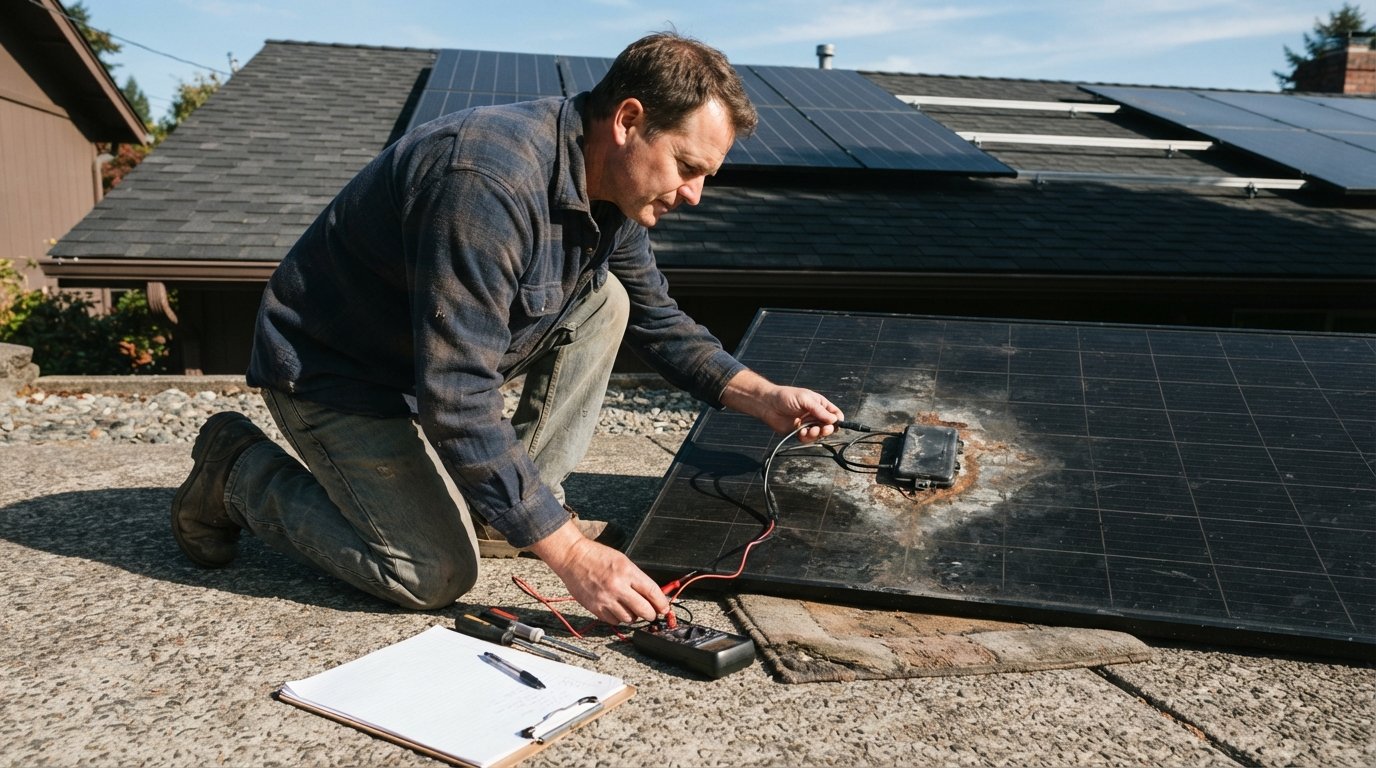
Common indicators of failure include a sudden drop in one panel's output, a persistent gap between string performance, physical damage such as cracks or discoloration, and error codes on the inverter. Hot spots, snail trails, and delamination are visual clues that a panel is deteriorating internally. If your inverter reports a ground fault or arc fault, stop and contact a professional immediately, because those conditions can be safety hazards.
Document everything you observe. Take dated photos of any physical damage and screenshot your monitoring graphs showing the performance decline. This evidence becomes the backbone of your warranty claim. Without it, manufacturers may argue that the issue is due to shading, soiling, or normal degradation rather than a covered defect.
Follow the Step-by-Step Warranty Claim Process
Once you have identified a problem and gathered your evidence, the claim process follows a predictable path. Knowing the sequence helps you avoid wasted time and prevents the manufacturer from stalling. Here is the framework that works for most residential solar systems.
- Contact your installer first. They are your primary point of contact and often handle the initial diagnosis. Many installation warranties require you to go through the original contractor before approaching the manufacturer.
- Submit a written claim to the manufacturer. If the installer is unresponsive or out of business, contact the panel maker directly. Include your serial numbers, proof of purchase, monitoring data, and photos.
- Schedule a third-party inspection if needed. Some manufacturers require an independent assessment to confirm the defect. Ask who pays for this inspection before you agree.
- Track all communication. Keep a log of every phone call, email, and representative name. Reference your claim number in every follow-up.
- Escalate if the claim stalls. If you receive no response within 30 days, escalate to a supervisor, file a complaint with your state consumer protection office, or seek help from a solar advocate.
The timeline for resolution varies. Simple product defect claims may be resolved in a few weeks, while performance warranty disputes can take months because they require detailed production analysis. Do not accept a verbal denial. Ask for the denial in writing with the specific warranty clause cited. That written record is essential if you need to escalate.
If your system is still under installation warranty but your original contractor has gone out of business, you are not without options. Some manufacturers honor their product warranty regardless of who installed the panels. You can also hire a certified solar professional to perform the repair and then seek reimbursement from the manufacturer for the defective equipment. If you need help finding a qualified installer to take over, you can compare free solar quotes from vetted local professionals who can assess the failure and handle the replacement.
Common Reasons Warranty Claims Get Denied
Many claims are rejected not because the panel is fine, but because the homeowner missed a procedural requirement or the damage falls outside the covered categories. Understanding the most common denial reasons helps you build a stronger case from the start.
Improper installation is the leading cause of denied claims. If the panels were mounted incorrectly, wired without proper grounding, or installed on a roof that was already damaged, the manufacturer may classify the failure as an installation defect rather than a product defect. In that case, your recourse is against the installer, not the manufacturer. This is why it is critical to work with certified professionals who follow manufacturer guidelines.
Physical damage from external causes is another frequent denial. Hail, falling branches, rodent chewing, and power surges are typically excluded from product warranties. Your homeowner insurance policy may cover these events, so file a claim with your insurer if the manufacturer denies coverage. Keep in mind that insurance deductibles and policy limits may apply.
Finally, unauthorized repairs or modifications can void your warranty entirely. If you or a non-certified technician opens a junction box or replaces a component without manufacturer approval, the warranty for that panel may be voided. Always get written authorization before anyone touches your system.
What to Do When the Manufacturer Is Unresponsive
Solar manufacturers are not immune to financial trouble. Several well-known brands have gone bankrupt in recent years, leaving thousands of homeowners with orphaned systems. If your manufacturer has ceased operations or simply will not respond, you still have paths forward.
First, check whether the manufacturer's assets were acquired by another company. Sometimes the acquiring firm assumes warranty obligations, at least partially. Search for news about the bankruptcy or acquisition and contact the new owner. Second, look at your installation contract. Some installers offer their own workmanship warranty that covers labor even if the equipment warranty is dead. Third, consider your homeowner insurance policy. Some policies cover sudden and accidental damage to rooftop solar, though they rarely cover gradual degradation.
If all else fails, you may need to pay for replacement panels out of pocket. This is painful, but it may be less expensive than a lengthy legal battle. Before you buy new panels, get quotes from multiple installers and ask about warranty transferability on the new equipment. A reputable installer will explain exactly what is covered and for how long.
For homeowners comparing replacement options, our solar panel selection tool can help you evaluate efficiency, durability, and warranty terms side by side. Choosing panels from a manufacturer with a strong track record and a clear claims process reduces the risk of repeating the same problem in a few years.
How to Strengthen Your Position Before a Panel Fails
The best time to prepare for a warranty claim is before you need one. A few proactive steps can make the difference between a smooth resolution and a frustrating dead end. Start by registering your panels with the manufacturer immediately after installation. Registration ensures the warranty is active in their system and gives you a direct line for future claims.
Keep digital and physical copies of all documents in a dedicated folder. This includes the contract, warranty certificates, serial numbers, installation photos, and monitoring records. If you sell your home, transfer the warranty to the new owner in writing, because most manufacturers require notification to keep coverage valid.
Monitor your system consistently and address small issues before they become big ones. A single underperforming panel may be a loose connection that a quick service visit can fix. Ignoring it for a year could turn a minor repair into a major claim. Finally, choose your installer carefully. A certified, experienced contractor is more likely to honor their workmanship warranty and to advocate for you with the manufacturer when a product defect appears.
Solar panels are remarkably reliable, but failures do happen. When they do, a calm, organized approach to solar panel warranty claims what to do when panels fail will save you time, money, and stress. Document everything, follow the process, and do not give up if the first response is a denial. With persistence and the right evidence, most legitimate claims get resolved in your favor.