
Commercial Solar Systems 101 for Small Business Owners
Commercial solar systems 101 for small business owners: compare ownership, PPA, and lease options, then request free quotes. Call (833)-212-3715 for guidance.

By Benjamin Kalif
Learn more about Solar Panel Installation and Repair for guides, costs, and what to expect.
Compare Solar Panel Installation and Repair Pros Near You
Enter your ZIP code to compare top-rated local professionals and request free quotes.
Electricity is one of the few business expenses that never seems to shrink, and for many small business owners, the monthly utility bill feels like a leak in the budget that nobody can patch. Commercial solar systems offer a way to turn that leak into a predictable, often lower cost center, but the terminology, financing structures, and paperwork can feel like a second job. This guide is designed to cut through the noise with a practical, plain-English walkthrough of what commercial solar is, how it differs from residential systems, and the first steps you should take before signing anything.
The good news is that solar for small businesses has matured dramatically. You no longer need a warehouse-sized roof or a seven-figure capital budget to participate. Financing products, tax incentives, and streamlined grid interconnection rules have made solar accessible to restaurants, retail shops, dental offices, machine shops, and multi-tenant properties. The key is understanding the moving parts so you can ask better questions and avoid expensive mistakes.
How Commercial Solar Differs from Residential Systems
The most obvious difference is scale. A typical home solar installation runs between 6 and 12 kilowatts (kW), while a small business system often starts around 20 kW and can climb past 250 kW depending on roof space and energy consumption. That jump in size changes everything from the structural engineering required to the type of inverter you need and the way the system connects to the grid. Commercial systems frequently use three-phase power, higher-voltage equipment, and ballasted or elevated racking that is uncommon in residential work.
Financing and ownership structures also diverge. Homeowners usually choose between a cash purchase, a loan, or a solar lease. Small businesses have those options plus power purchase agreements (PPAs), which let a third party own the system and sell you the electricity at a fixed rate. PPAs can be attractive because they often require little or no upfront capital, but they come with long-term contracts that may complicate a property sale or refinance. Ownership, by contrast, maximizes tax benefits and long-term savings but puts the maintenance and performance risk on your balance sheet.
Grid interconnection is another major differentiator. Residential systems often qualify for simplified permitting and net metering. Commercial systems face a more rigorous review from the utility, including load studies, potential upgrades to transformers or service panels, and sometimes expensive interconnection fees. These costs are not trivial, and they are one reason why early conversations with your utility and an experienced commercial installer matter so much.
Typical System Sizes and Mounting Options for Small Businesses
Small business energy use varies wildly, so there is no one-size-fits-all system size. A small retail shop with efficient lighting and moderate HVAC might need a 25 kW system, while a restaurant with walk-in coolers and commercial kitchen equipment could need 80 kW or more. A machine shop or light manufacturer might need 150 kW or higher. The right size is determined by your annual kilowatt-hour consumption, the available space, and your budget or financing capacity.
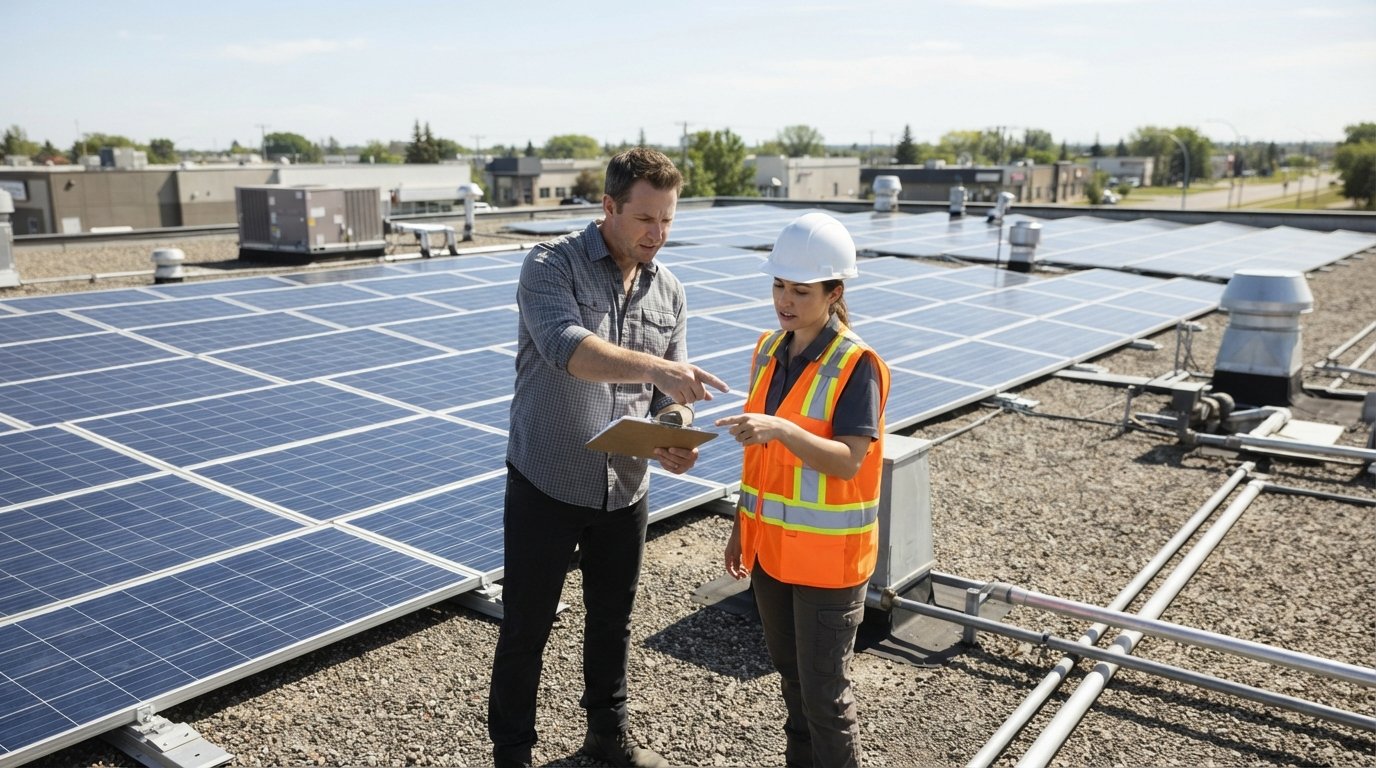
Roof mount is the most common choice because it uses existing real estate and can be installed without disrupting parking or operations. Commercial roofs are often flat, which allows tilt-up racking to optimize panel angle and access for maintenance. However, roof age and condition matter: if your roof is within five to seven years of needing replacement, it usually makes sense to replace it before or during solar installation to avoid the cost of removing and reinstalling panels later. Ground mount is an option for businesses with extra land, and it can be easier to service and expand, but it requires more permitting and may trigger stormwater or zoning reviews. Carport and canopy mounts are popular for businesses with large parking lots because they provide shade for customers and employees while generating power.
When sizing a system, installers look at more than your total annual usage. They examine your demand profile: the peaks and valleys of your electricity consumption throughout the day. A business that runs heavy loads during the day benefits more from solar because the generation matches the consumption. Businesses with high evening loads may need battery storage to capture excess solar and use it later, which adds cost but can also provide resilience against outages.
Key Decision Points: Ownership vs PPA vs Lease
The ownership question is the single biggest financial decision in a commercial solar project. Ownership means you pay for the system upfront or finance it with a loan, and you keep the federal investment tax credit (ITC), accelerated depreciation, and any state or utility incentives. You also pay for maintenance and insurance, though most systems have low maintenance costs and long warranties. Over a 25-year horizon, ownership typically produces the highest total savings, but it requires capital or credit capacity.
A power purchase agreement (PPA) flips that model. A third-party developer owns the system and sells you the electricity at a rate that is usually lower than your utility's retail rate, often with an annual escalator of one to three percent. You avoid upfront costs and maintenance headaches, but you do not get the tax benefits, and the contract can run 15 to 25 years. If you sell the building, the PPA must be transferred or bought out, which can complicate the transaction. Leases are similar to PPAs but you pay a fixed monthly rent for the equipment rather than a per-kilowatt-hour rate. Leases are less common in the commercial space than PPAs.
To choose, consider your tax appetite, available capital, expected tenure in the building, and risk tolerance. A profitable business with tax liability and a long-term hold often benefits most from ownership. A business with tight capital or a short lease on the building may prefer a PPA. A hybrid approach, such as owning part of the system and financing the rest, is also possible with some lenders.
First Steps to Request Commercial Solar Quotes
Before you request quotes, gather a few basic documents: twelve months of electricity bills, a recent roof inspection or warranty information, and a sense of how long you plan to stay in the building. With those in hand, you can start the quote process. The best starting point is an independent educational resource that connects you with certified commercial installers. At NewSolarQuotes, you can request a free, no-obligation quote from vetted professionals who specialize in commercial systems, which saves you the time of vetting contractors on your own.
When comparing quotes, look beyond the headline price. Ask each installer to break down equipment costs, labor, permitting, interconnection fees, and financing charges. Confirm the expected annual production in kilowatt-hours, the degradation rate of the panels, and the warranty terms for both equipment and workmanship. Also ask how they handle utility coordination and whether they have completed projects of similar size in your area. For a deeper look at panel manufacturers and performance, see our guide to the best commercial solar panel brands for businesses in 2026, which can help you evaluate the equipment quoted.
If you are planning a move or expanding to a new location, it is worth understanding how a solar investment interacts with your real estate plans. Resources like Moving.Homes relocation guides can help you think through the logistics of a business move, including how to handle existing energy contracts and whether solar should be part of your new property search. Planning ahead prevents surprises when you sell or relocate.
Incentives, Tax Treatment, and Payback
The federal investment tax credit (ITC) remains the cornerstone incentive for commercial solar. For systems placed in service in 2026, the base credit is 30 percent of the installed cost, and additional credits may be available for domestic content, energy communities, or low-income projects. Businesses can also use accelerated depreciation, such as the modified accelerated cost recovery system (MACRS) or bonus depreciation, to deduct a large portion of the system cost in the first year. State and utility incentives vary widely, so verify current programs with your state energy office and your accountant.
Payback periods for commercial solar typically range from four to eight years for owned systems, depending on your electricity rate, incentives, and system cost. After payback, the electricity is essentially free for the remaining 20-plus years of the system's life. For PPAs, the savings show up immediately as a lower per-kilowatt-hour rate, but the total savings over time are lower than ownership. A simple way to evaluate any proposal is to ask for a 25-year cash flow projection that includes incentives, financing costs, and expected utility rate escalation.
Common Pitfalls and How to Avoid Them
One frequent mistake is sizing a system based on last year's bills without accounting for planned changes, such as new equipment, added square footage, or a shift to electric vehicles. An undersized system leaves savings on the table, while an oversized system may produce more power than you can use or export at a low rate. Another pitfall is ignoring roof condition. Installing solar on a roof that needs replacement within a few years can turn a smart investment into a costly do-over. Finally, be wary of quotes that omit interconnection costs or assume unrealistic utility approvals. A reputable installer will be transparent about these variables and build contingencies into the proposal.
It also pays to understand your utility's net metering or export compensation rules. Some utilities credit exported solar at the full retail rate, while others pay a lower avoided-cost rate. If export rates are low, pairing solar with battery storage or adjusting your load profile to use more solar on-site can improve the economics. Your installer should be able to model these scenarios for you.
Financing Options Beyond the Basics
Commercial solar financing has become more competitive. Traditional bank loans, credit union loans, and Small Business Administration (SBA) loans can all be used, though SBA loans may have restrictions on how the solar equipment is treated as collateral. Equipment lenders and specialty green banks offer terms tailored to solar, sometimes with no money down and payments structured to be lower than your current electric bill. Property assessed clean energy (PACE) financing is available in some states and allows you to repay the cost through a property tax assessment, which can be attractive for long-term owners but may complicate a sale.
When comparing financing offers, look at the annual percentage rate (APR), the term length, and whether there are prepayment penalties. Also ask about the lender's experience with solar projects and whether they require additional collateral. A good installer will have relationships with multiple lenders and can help you compare options side by side. Remember that financing costs are part of the total project cost, so a low equipment price with expensive financing can be worse than a slightly higher equipment price with cheap financing.
Maintenance and Performance Monitoring
Commercial solar systems are generally low maintenance, but they are not maintenance-free. Panels need occasional cleaning in dusty or snowy environments, and inverters may need replacement around year 10 to 15. Most systems come with monitoring software that alerts you to underperformance, which is valuable for catching issues early. Budget roughly 1 percent of the system cost per year for maintenance and set aside a reserve for inverter replacement. If you choose a PPA or lease, maintenance is typically the provider's responsibility, but confirm that in writing.
Performance monitoring also helps you verify savings. Compare the system's actual production to the estimated production in your proposal, and track your utility bills to confirm that the solar is offsetting consumption as expected. If you notice a persistent gap, contact your installer while the system is still under warranty.
Ready to Move Forward?
Commercial solar is a long-term investment, but it does not have to be complicated. Start by understanding your energy use, evaluating ownership versus PPA or lease, and gathering the documents you need for quotes. Then request quotes from certified commercial installers through NewSolarQuotes, where you can compare proposals side by side and get independent guidance. With the right preparation, your business can lock in lower energy costs, reduce its carbon footprint, and turn a recurring expense into a strategic asset.