
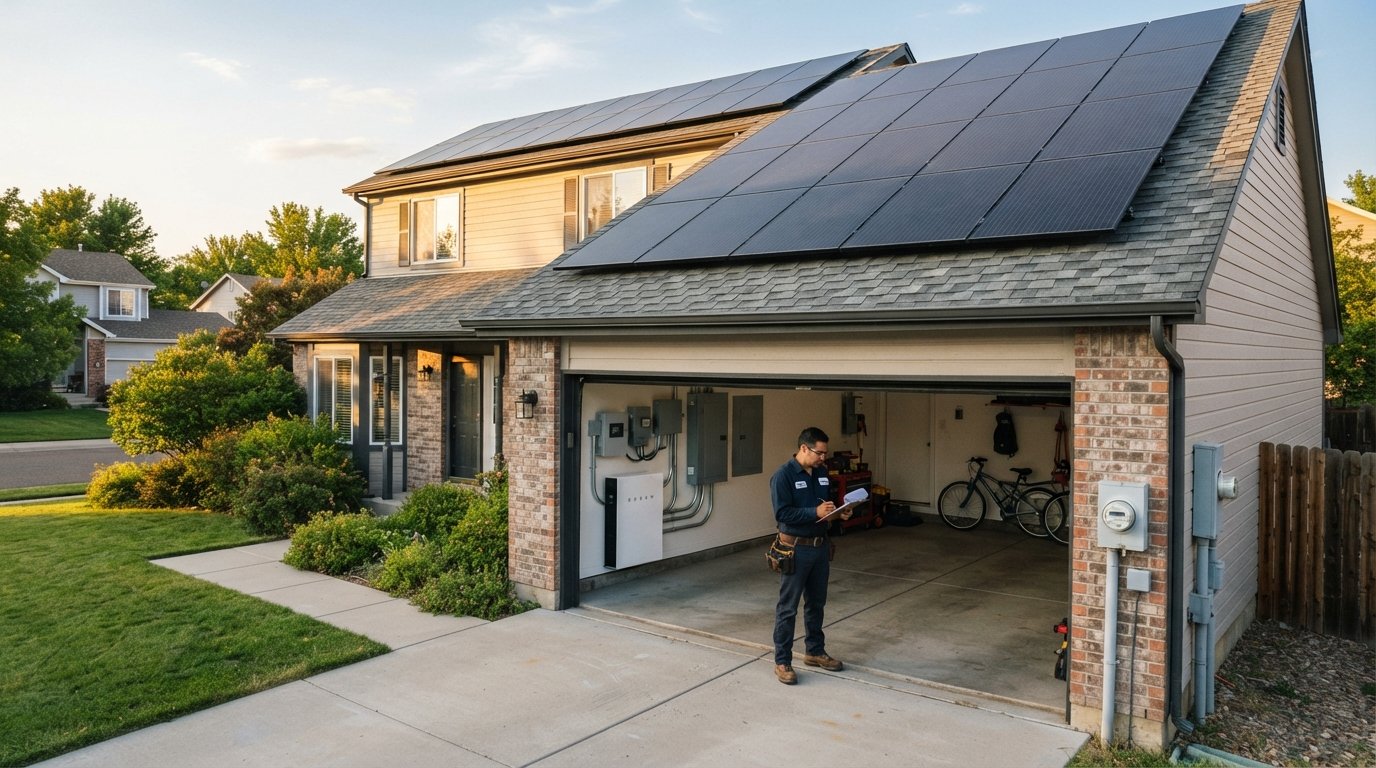
Residential Solar Microgrid Design for Energy Independence
Design a home microgrid that keeps critical loads running for days. Call (833)-212-3715 to compare vetted solar installers and size your backup system.

By Alex Carter
Learn more about Solar Panel Installation and Repair for guides, costs, and what to expect.
Compare Solar Panel Installation and Repair Pros Near You

Enter your ZIP code to compare top-rated local professionals and request free quotes.
When the grid goes down, most rooftop solar systems go down with it. That hard truth surprises many homeowners who assumed their panels would keep the lights on during an outage. The culprit is a safety feature called anti-islanding, which shuts off grid-tied inverters the moment utility power disappears. A residential solar microgrid changes that equation. By pairing solar panels with battery storage, a critical load panel, and intelligent transfer equipment, you create a home that can operate independently from the utility grid, sometimes for days at a time. This guide walks through the design decisions, costs, and regulatory hurdles that separate a standard grid-tied system from a true microgrid built for home energy independence.
What Makes a Home a Microgrid?
A standard grid-tied solar system is a one-way street. Panels generate electricity, an inverter converts it to usable AC power, and any surplus flows to the utility. When the grid fails, the inverter must shut down to protect line workers from backfeed. That is why a homeowner with ten kilowatts of panels and no battery sits in the dark during a blackout.
A microgrid adds three capabilities that a basic solar array lacks. First, it can disconnect from the utility (island) and continue operating. Second, it has on-site energy storage to balance supply and demand when the sun is not shining. Third, it manages loads intelligently, deciding which circuits receive power and which stay off to conserve energy. Together, these features transform a passive solar installation into an active energy system that prioritizes resilience.
The distinction matters for design because each capability imposes specific equipment requirements. Islanding demands a transfer mechanism, storage demands batteries sized for your critical loads, and load management demands a dedicated panel or smart controller. Homeowners exploring larger arrays should review guidance on solar panel systems for large homes, since bigger homes often carry larger critical loads and need proportionally more storage.
Islanding, Critical Load Panels, and Transfer Switching
Islanding is the technical heart of any microgrid. The system must detect a grid outage, disconnect from the utility, and form its own voltage reference so the solar inverter and battery can continue supplying power. There are two common approaches: a backup gateway or transfer switch that isolates the whole home, or a dedicated critical load subpanel that powers only selected circuits.
Whole-home backup is the simplest to live with but the most expensive to build, because the battery and inverter must handle peak demand from every appliance at once. A critical load panel is the more common design choice. An electrician moves essential circuits (refrigerator, furnace blower, well pump, internet router, selected lighting, and medical equipment) into a separate panel fed by the microgrid. Non-essential loads like the electric dryer, hot tub, or central AC compressor stay on the grid side and go dark during an outage.
Automatic transfer switching ties these pieces together. When the utility drops, the switch opens within milliseconds to seconds, the battery inverter forms a new grid reference, and the critical panel stays energized without homeowner intervention. Manual transfer switches cost less but require someone to be home and physically throw a breaker, which defeats the purpose of an automatic resilience system. Most modern designs specify a smart gateway that also communicates with the battery and can shed loads dynamically as state of charge falls.
Sizing Solar and Storage for Multi-Day Outages
Sizing a microgrid is a different exercise than sizing a grid-tied array. For grid-tied systems, the goal is offsetting annual consumption. For a microgrid, the goal is surviving a worst-case outage scenario, often two to five days, while keeping critical loads running. That requires modeling both daily energy use and the solar production available during the outage season.
Start by measuring critical load consumption in kilowatt-hours per day. A typical critical load panel draws between 8 and 15 kWh per day depending on climate and appliances. Then estimate usable battery capacity, remembering that most lithium batteries should not be discharged below about 10 to 20 percent state of charge. A 13.5 kWh battery with 90 percent usable capacity delivers roughly 12 kWh, so a single unit may cover one day of critical loads with little margin. Two to three batteries provide meaningful multi-day resilience, especially when paired with solar that recharges during daylight hours.
Solar sizing must account for winter production, snow cover, and cloudy stretches. A system that produces 40 kWh on a sunny June day might manage only 12 kWh in December. Designers often size the array so that a single sunny winter day can recharge the battery bank, which may mean a larger array than annual consumption alone would suggest. EV charging adds another dimension: charging a 75 kWh vehicle from a microgrid battery is usually impractical during an outage, so most designs treat EV charging as a grid-only load or schedule it during peak solar production with surplus capacity.
Costs, Permitting, and Utility Interconnection
Microgrid equipment adds real cost to a solar project. A grid-tied system with no backup might run $2.50 to $3.50 per watt installed, while adding batteries, a smart gateway, and a critical load subpanel can push the total to $4.50 to $6.50 per watt or more depending on battery capacity. A typical three-battery system with a 10 kW array often lands between $35,000 and $55,000 before incentives, though pricing varies widely by region and equipment choice. The federal residential clean energy credit can offset a substantial portion of that investment, and some states and utilities add battery-specific rebates.
Permitting involves the usual electrical and building permits plus a utility interconnection application. Utilities review microgrid designs for anti-islanding compliance, often requiring certified inverters and visible lockable disconnects. Some utilities impose fees, additional insurance requirements, or capacity limits on battery systems. A few jurisdictions have adopted streamlined interconnection rules for storage, but timelines still range from a few weeks to several months. Homeowners should confirm local rules before signing a contract, because a design that fails utility review can delay the project significantly.
Financing options mirror standard solar: cash purchase, loans, and in some cases battery-specific leases. Because microgrids deliver resilience value that pure bill savings do not capture, many homeowners justify the investment through avoided outage costs, medical equipment needs, or simply peace of mind. For a broader look at solar information and tools, SolarEnergy.ai offers calculators and guides that complement installer quotes.
Design Steps for a Resilient Home Microgrid
Approaching the project as a sequence of decisions keeps the process manageable. The following framework reflects how experienced designers typically structure a residential microgrid build.
- Audit critical loads and outage goals: list essential circuits, measure daily kWh, and decide how many days of autonomy you want.
- Size the battery bank for usable capacity, not nameplate capacity, and confirm the inverter can handle surge loads from motors and pumps.
- Size the solar array for winter recharge, then verify roof space and structural capacity.
- Select the islanding and transfer equipment, typically a smart gateway plus a critical load subpanel.
- Confirm utility interconnection rules and permitting requirements before finalizing equipment.
- Commission the system with a test outage to verify automatic transfer and load shedding work as designed.
Each step feeds the next. A homeowner who wants five days of autonomy will need a larger battery bank and possibly a generator or additional array capacity, which in turn affects permit applications and cost. Skipping the load audit is the most common design error, because it leads to batteries that are either oversized and expensive or undersized and disappointing during the first real outage.
Common Pitfalls and Practical Tips
Several recurring mistakes undermine microgrid performance. Homeowners sometimes assume any battery will provide whole-home backup, then discover their central air conditioner cannot start on a modest inverter. Others forget that a tankless electric water heater can draw 18 kW or more, far beyond typical backup capacity. Designers should verify surge requirements for well pumps, furnaces, and compressors, and should consider soft starters where equipment allows.
Another pitfall is neglecting maintenance and monitoring. Batteries degrade, firmware needs updates, and transfer switches should be tested annually. A microgrid that is never exercised may fail when it matters most. Setting a calendar reminder to simulate an outage, review battery health reports, and confirm the gateway is online is a small habit with outsized payoff.
Finally, homeowners should treat installer selection as a design decision, not an afterthought. A microgrid requires electrical expertise beyond basic solar installation, including load calculations, subpanel work, and utility coordination. Comparing multiple quotes from certified professionals, asking for references on backup systems specifically, and reviewing the proposed single-line diagram are practical ways to vet a contractor. NewSolarQuotes connects homeowners with vetted local installers through a free quote request, which simplifies that comparison process.
Residential solar microgrid design for home energy independence rewards careful planning. The difference between a system that merely lowers bills and one that keeps the refrigerator running through a three-day storm comes down to islanding capability, honest load sizing, and a contractor who understands how the pieces fit together. Homeowners who invest in that design work end up with an energy system that delivers both savings and genuine resilience.