
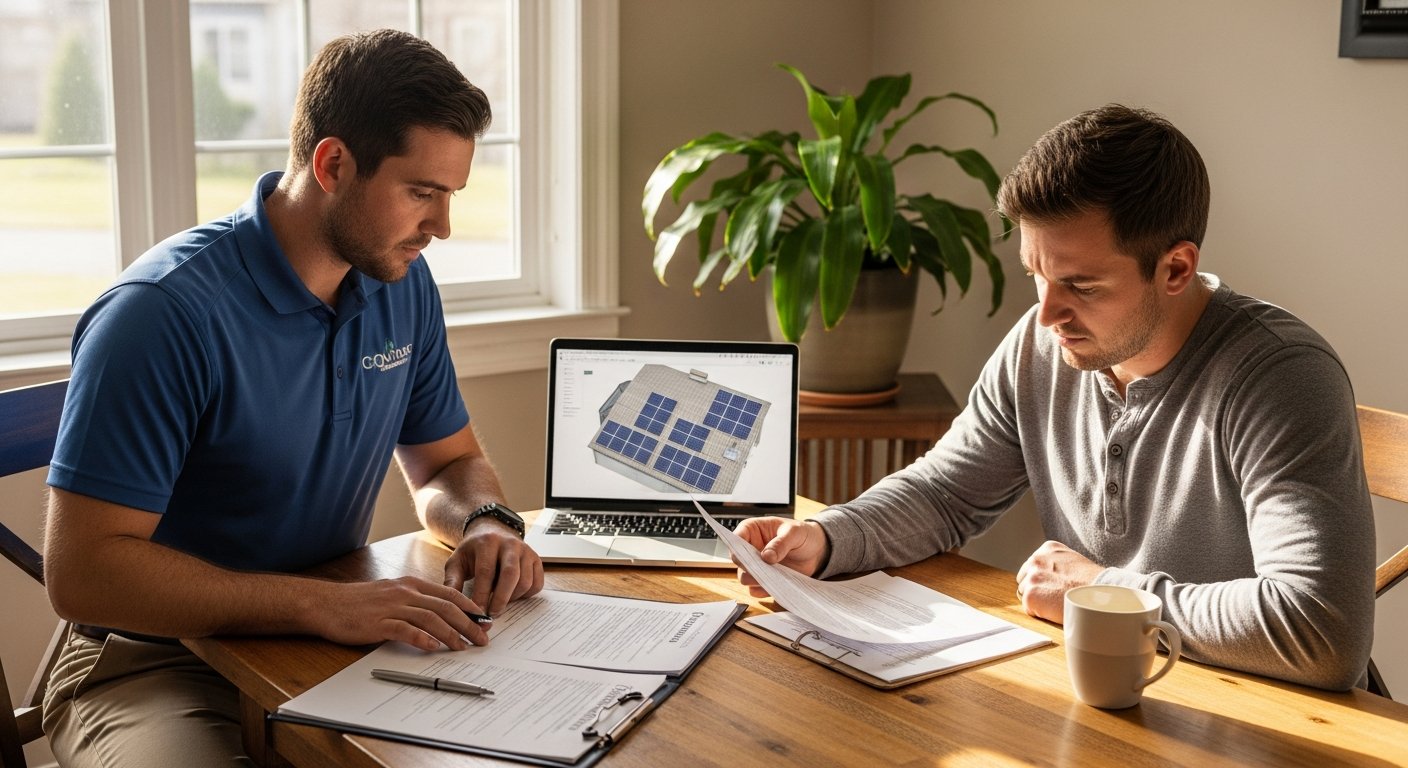
Critical Questions to Ask Solar Installers Before Signing
Learn the critical questions to ask solar installer companies before signing any contract. Avoid hidden fees and get the best system for your home.

By Benjamin Kalif
Learn more about Solar Panel Installation and Repair for guides, costs, and what to expect.
Compare Solar Panel Installation and Repair Pros Near You
Enter your ZIP code to compare top-rated local professionals and request free quotes.
You have decided to go solar. You have read the guides, checked your roof orientation, and even looked at the federal tax credit. Now you are ready to talk to installers. But here is the problem: solar contracts can be dense, and a smooth-talking salesperson can make a 25-year commitment sound like a no-brainer. The difference between a great solar experience and a costly mistake often comes down to the specific questions you ask before you sign anything. Asking the right questions protects your investment, ensures you get a system that actually performs, and helps you avoid hidden fees or underperforming equipment.
This article walks you through the most important questions to ask solar installer companies. We cover equipment, financing, warranties, installation timelines, and ongoing support. By the end, you will have a clear checklist to use during your next consultation. Whether you are shopping for your first rooftop array or expanding an existing system, these questions will help you compare quotes on a level playing field.
Why the Right Questions Matter More Than the Lowest Price
Many homeowners focus almost exclusively on the total cost or the monthly payment. Price is important, but the cheapest quote often hides trade-offs in panel quality, inverter type, or installation standards. A system that saves you $30 per month but fails after eight years is far worse than a slightly more expensive system that produces reliably for 25 years. The goal is not the lowest price. The goal is the best value over the life of the system.
When you ask detailed questions, you force the installer to reveal their expertise and transparency. A reputable company will answer clearly and provide documentation. A less scrupulous company may dodge, overpromise, or give vague answers. The questions below act as a filter. If an installer cannot explain their own equipment or warranty terms in plain language, that is a red flag.
Equipment and Component Questions
Which Solar Panels and Inverters Are You Proposing?
Solar panels are not all the same. They vary in efficiency, degradation rate, temperature coefficient, and manufacturer warranty. Ask for the exact make and model of the panels and inverters in your quote. Do not accept generic terms like "premium panels" or "high-efficiency modules." You want a specific brand and model number.
For inverters, you have three main options: string inverters, microinverters, and power optimizers. Each has pros and cons depending on your roof layout and shading. Ask why the installer chose that particular inverter type for your home. A good installer will explain how your roof's sun exposure and tilt angle influenced the decision.
Here are the key equipment details you should get in writing:
- Panel brand, model, wattage, and efficiency rating
- Inverter brand, model, and type (string, micro, or optimizer)
- Panel degradation warranty (typically 80-87% output after 25 years)
- Product warranty length (usually 12-25 years)
- Temperature coefficient (how much output drops in heat)
Once you have these details, you can compare them against independent reviews on sites like EnergySage or the Clean Energy Reviews database. Do not rely solely on the installer's claims. Verify the specifications yourself.
Warranty and Performance Guarantees
Warranties are a major point of confusion. Many homeowners assume the panel warranty covers everything, but that is not true. There are three separate warranties you need to understand: the panel product warranty, the panel performance warranty, and the installation workmanship warranty. The installer may also offer a production guarantee on the total system output.
Ask for the duration and coverage of each warranty. The panel product warranty covers defects in manufacturing. The performance warranty guarantees that the panel will produce a certain percentage of its rated power after 10, 20, and 25 years. The workmanship warranty covers the installer's labor and roof penetration seals. A typical workmanship warranty is 5 to 10 years, though some top installers offer 25 years.
Also ask what happens if the installer goes out of business. This is a real concern in the solar industry, where company closures are not rare. Find out if the panel and inverter warranties are backed by the manufacturer (not just the installer) and if there is a third-party service network that can honor the workmanship warranty.
Financing Details and Hidden Costs
Solar financing can be complex. You might see offers for $0 down, low monthly payments, or no payments for 18 months. These deals often include hidden costs like dealer fees, prepayment penalties, or escalator clauses that increase your payment each year. You must ask for the all-in cost of the system, including financing charges.
Ask for the cash price versus the financed price. Many installers mark up the system cost when you finance through a third-party lender. This markup covers a "dealer fee" that the lender charges the installer. That fee gets passed to you as a higher principal. A system that costs $25,000 cash might cost $30,000 or more when financed. You should know both numbers before comparing loans.
Here are the financing questions to ask:
- What is the cash price for this system?
- What is the total financed price including all fees and interest?
- Is there a prepayment penalty if I pay off the loan early?
- Does the monthly payment escalate each year?
- What is the APR and loan term?
If the installer uses a lease or power purchase agreement (PPA), ask about annual escalator clauses. Some PPAs increase your rate by 2-3% each year. Over 20 years, that can add thousands of dollars to your total cost. Compare that against a loan where your payment is fixed.
Installation Process and Timeline
Knowing what happens on installation day helps you prepare and reduces surprises. Ask for a step-by-step overview of the installation process. Who handles the permits? Who works with the utility company for interconnection approval? How long does each step take?
Most installations take one to three days for the physical work, but the entire process from contract to activation can take four to twelve weeks. Delays often happen during permitting, utility approval, or city inspection. Ask the installer for a realistic timeline based on your local jurisdiction. Some areas have fast permitting, while others take months.
Ask about the crew size and qualifications. Will the work be done by employees or subcontractors? If subcontractors are used, ask how the installer vets and supervises them. Subcontractor quality varies widely, and a bad installation can lead to leaks, electrical issues, or poor panel placement.
Monitoring and System Performance
Once your system is running, how will you know it is performing correctly? Most modern solar systems include monitoring software that shows real-time and historical production. Ask what monitoring platform the installer provides and whether it is included in the price or requires a monthly fee.
Ask how you will be notified if the system underperforms or stops working. Some monitoring systems send alerts to your phone. Others require you to check a web portal. A good installer will also monitor your system remotely and proactively reach out if they see a problem.
Also ask about the expected annual production in kilowatt-hours (kWh). The installer should provide a production estimate based on your roof's orientation, tilt, shading, and local weather data. This estimate is not a guarantee, but it should be realistic. Be wary of quotes that promise unusually high production compared to other installers. That is often a sales tactic to make the deal look better.
Maintenance and Cleaning Requirements
Solar panels require very little maintenance, but they are not zero maintenance. Dirt, leaves, bird droppings, and snow can reduce output. Ask the installer what they recommend for cleaning and how often. In most climates, rain is enough to keep panels clean. In dusty areas or places with heavy bird activity, occasional cleaning may boost production.
Ask about the warranty coverage for cleaning or repairs. Some workmanship warranties include one free cleaning per year. Others exclude cleaning entirely. Also ask about the cost of removing panels if you need to replace your roof. That is a common scenario that homeowners forget to plan for. Panel removal and reinstallation can cost $2,000 to $5,000 depending on system size and roof complexity.
Company Reputation and References
You are entering a long-term relationship with the installer. Their reputation matters. Ask how long the company has been in business. Solar is a young industry, and many companies fail within a few years. A company with at least five years of operating history and a track record of completing hundreds of installations is generally more reliable.
Ask for references from recent customers in your area. A reputable installer will provide three to five names and phone numbers. Call those references and ask about their experience. Was the installation on time? Did the system perform as promised? How did the company handle any issues? Online reviews are helpful, but a direct conversation with a past customer gives you deeper insight.
Also check the company's licensing and insurance. Ask for their contractor license number and verify it with your state's licensing board. Ask for proof of general liability insurance and workers' compensation insurance. If a worker gets injured on your property, you do not want to be held liable.
Comparing Multiple Quotes
You should get at least three quotes from different installers. Use the questions from this article to evaluate each quote side by side. Do not compare only the monthly payment. Compare the total cost, equipment quality, warranty terms, and company stability. A slightly higher upfront cost may be worth it for better panels and a stronger warranty.
When you compare quotes, look for outliers. If one quote is dramatically lower than the others, ask why. It might be because they use lower-quality equipment, have shorter warranties, or plan to use unlicensed subcontractors. If a quote is dramatically higher, ask what value justifies the premium. Sometimes a higher quote includes premium components or a longer workmanship warranty.
Remember that the installer you choose will be on your roof and in your electrical panel. You need to trust them. The questions you ask are your best tool for building that trust and making an informed decision.
Your solar system is a long-term investment that can save you thousands of dollars and reduce your carbon footprint. By asking the right questions before signing, you set yourself up for decades of reliable, clean energy. Use this list during your consultations, take notes, and compare answers. The time you spend now will pay off every time you see your electric bill shrink.