Factors That Reduce Solar Panel Output Beyond Shading
Heat, soiling, and wiring losses can cut solar output by 10-20 percent. Identify these hidden culprits to protect your investment and maximize savings.

By Alexia Mabel
Learn more about Solar Panel Installation and Repair for guides, costs, and what to expect.
Compare Solar Panel Installation and Repair Pros Near You
Enter your ZIP code to compare top-rated local professionals and request free quotes.
Your solar panels are basking in full sun, yet the monitoring app shows a stubbornly low production curve. Shading is the usual suspect, but it is far from the only one. In fact, a growing number of homeowners discover that heat, dust, wiring losses, and even the angle of their roof can quietly shave double-digit percentages off their system's output. Understanding these hidden culprits is the first step toward protecting your investment and maximizing every kilowatt-hour.
This article breaks down the most common factors that reduce solar panel output beyond shading. You will learn how temperature, soiling, voltage drop, inverter behavior, and seasonal shifts interact, plus practical steps to diagnose and fix each issue. Whether you already own a system or are comparing quotes, this knowledge helps you set realistic expectations and avoid costly surprises.
Temperature and Heat: The Silent Efficiency Killer
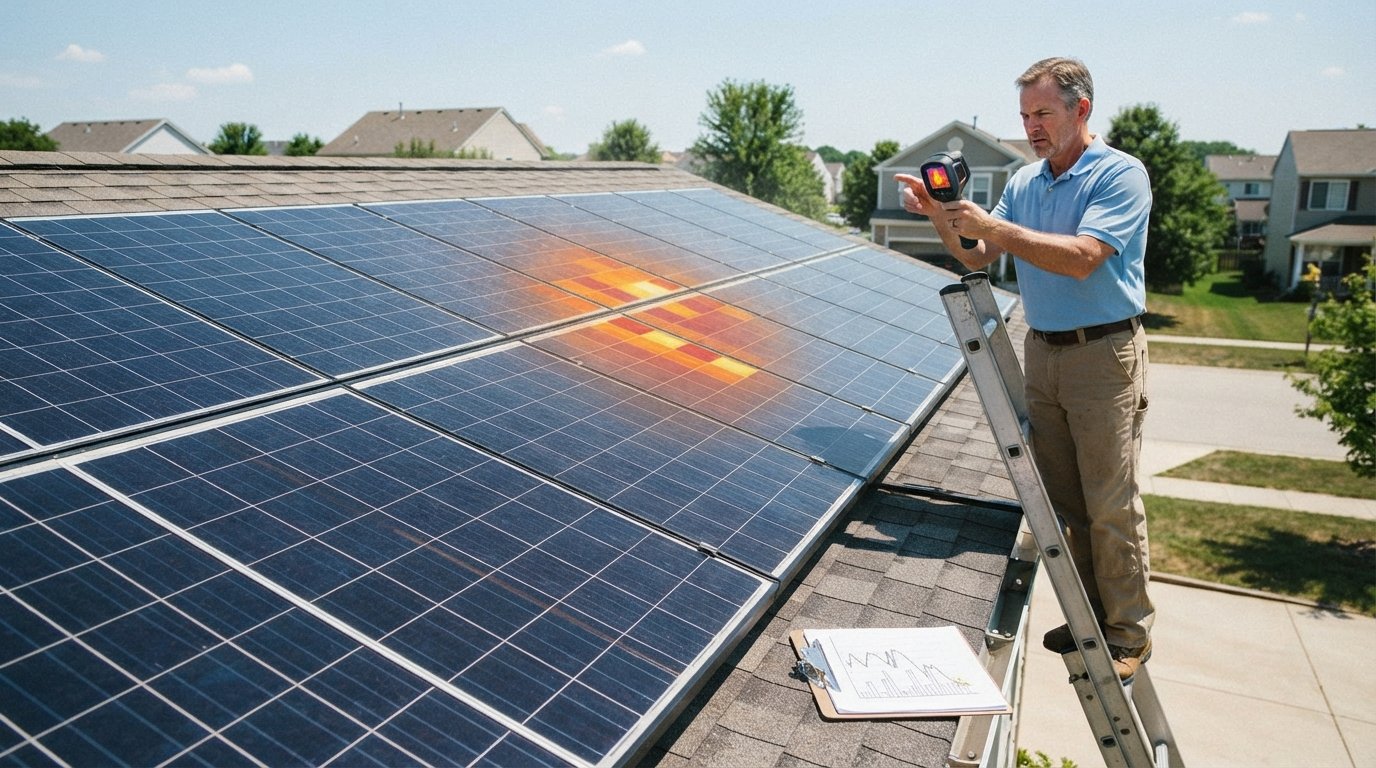
Solar panels are tested at 25 degrees Celsius (77 degrees Fahrenheit) under standard conditions. Every degree above that threshold reduces voltage and, consequently, power output. Depending on the panel technology, you can lose 0.3 to 0.5 percent of production for each additional degree Celsius. On a 95-degree Fahrenheit day, a dark rooftop can easily reach 140 degrees Fahrenheit, cutting output by 10 to 15 percent.
Heat-related losses are often invisible because they happen gradually. Your system still produces, just less than the nameplate rating. The effect is more pronounced on roofs with poor airflow or dark shingles that absorb and radiate heat. Panels mounted flush to the roof surface trap heat underneath, while elevated mounts allow convection to carry heat away.
To mitigate thermal losses, consider these strategies:
- Choose panels with a lower temperature coefficient (expressed as a negative percentage per degree Celsius).
- Ensure at least 4 to 6 inches of clearance between the panel and roof surface for airflow.
- Avoid installing panels over dark, unventilated attic spaces if alternative roof planes are available.
- Use microinverters or power optimizers that can better manage heat-induced voltage fluctuations.
While you cannot control the weather, you can design and select equipment that tolerates heat gracefully. A qualified installer will factor local climate into the system design, often oversizing the array slightly to compensate for summer losses.
Soiling and Environmental Debris
Dust, pollen, bird droppings, and agricultural spray create a film that blocks sunlight. Unlike shading from a tree, soiling is diffuse and may not trigger a dramatic drop. A light layer of dust can reduce output by 5 percent, while heavy accumulation of bird droppings or leaves can cause hot spots and permanent damage.
Rain provides some natural cleaning, but it is rarely sufficient in arid regions or areas with sticky pollen. In the southwestern United States, soiling losses of 10 to 20 percent are common between rainfalls. Coastal areas face salt spray, and agricultural zones deal with fertilizer dust that bonds tightly to glass.
Regular cleaning is the obvious solution, but timing and method matter. A soft brush and deionized water are ideal; abrasive cleaners or hard water can scratch the glass or leave mineral deposits. If your roof is steep or your system is large, professional cleaning may be safer and more effective. Many homeowners find that scheduling cleaning just before the high-production summer months yields the best return on investment.
Monitoring software can help you distinguish soiling from other losses. If production drops gradually over weeks without corresponding weather changes, soiling is likely. A sudden drop, however, points to a more acute issue like a failed inverter or a broken connection.
Voltage Drop and Wiring Losses
Electricity loses energy as it travels through wires, a phenomenon known as voltage drop. In solar systems, this loss occurs in the DC circuits between panels and the inverter, and in the AC circuits between the inverter and your main panel. Poorly sized or excessively long wires exacerbate the problem.
Voltage drop is expressed as a percentage of the nominal voltage. The National Electrical Code recommends keeping voltage drop below 3 percent for optimal efficiency, but many systems exceed that, especially when installers cut corners on wire gauge to save money. A 5 percent voltage drop means 5 percent of your solar production is wasted as heat before it ever reaches your appliances.
To minimize wiring losses, installers should:
- Use larger gauge wire for long runs, even if it costs more upfront.
- Keep DC runs as short as possible by placing the inverter near the array.
- Avoid unnecessary connections and junction boxes that add resistance.
- Verify voltage drop calculations during the design phase and after installation.
If you suspect wiring losses, a qualified electrician can measure voltage at the array and at the inverter. A significant difference indicates excessive drop. Upgrading wire or relocating equipment can recover those lost kilowatt-hours.
Inverter Clipping and Mismatch
Inverters are sized to handle a specific amount of DC power. When the array produces more than the inverter can convert, the excess is clipped, meaning it is simply lost. This is intentional in many designs to reduce cost, but excessive clipping can waste a noticeable portion of potential production.
Clipping typically occurs on cool, sunny days when panels operate near their peak efficiency. If your inverter is undersized relative to the array, you might see a flat top on your production curve during midday. While some clipping is acceptable (often 1 to 2 percent annually), a poorly matched system can lose 5 percent or more.
Module mismatch is another subtle loss. When panels have slightly different electrical characteristics, the weakest panel can drag down the performance of the entire string. This can happen due to manufacturing tolerances, uneven soiling, or partial shading that affects only one panel. Power optimizers and microinverters mitigate mismatch by allowing each panel to operate independently.
If you are planning a new system, ask your installer how they handle clipping and mismatch. A well-designed system balances equipment cost with energy harvest, and are solar panels worth it depends heavily on getting these details right.
Seasonal and Angular Effects
The sun's path changes throughout the year, altering the angle at which sunlight strikes your panels. In winter, shorter days and a lower sun angle reduce production even in sunny climates. Snow cover can completely halt output for days or weeks, and the reflective glare from snow is not enough to compensate.
Roof pitch and orientation also play a role. Panels facing due south at a latitude-tilt angle perform best in the northern hemisphere. Deviations of 15 degrees can reduce annual output by 5 to 10 percent. East- or west-facing arrays produce less overall but may offer better alignment with time-of-use rates.
Tree growth is a seasonal factor that mimics shading but is often overlooked. A tree that was small at installation can grow into a significant obstruction within a few years. Regular trimming or strategic panel placement can preserve production.
To assess seasonal impacts, review your monitoring data month by month. A dip in winter is normal, but a dip in summer suggests a problem. Tools like SolarEnergy.ai offer calculators that estimate production based on location, tilt, and orientation, helping you set realistic expectations.
Aging, Degradation, and Maintenance Gaps
Solar panels degrade slowly over time, typically losing 0.5 to 0.8 percent of their output per year. After 25 years, a panel might produce 80 to 85 percent of its original rating. This degradation is gradual and predictable, but it accelerates in harsh environments or if the panels suffer physical damage.
Microcracks, delamination, and failed bypass diodes can cause disproportionate losses. These issues often stem from manufacturing defects, extreme weather, or improper handling during installation. Regular inspections can catch problems early, before they affect the entire array.
Maintenance gaps also extend to the balance of system components. Corroded connectors, loose mounts, and failing junction boxes add resistance and reduce output. A annual professional inspection is a wise investment, especially in areas with high humidity or temperature swings.
If your system is underperforming, start by reviewing the monitoring data and comparing it to expected production. Many issues, from soiling to inverter faults, can be diagnosed remotely. For a deeper dive into whether your system is living up to its potential, see our guide on solar panel value.
Real-World Diagnosis: A Step-by-Step Approach
When production lags, a systematic approach saves time and money. Begin by ruling out shading, then move through the other factors. Here is a simple framework:
- Check monitoring data for patterns: gradual decline suggests soiling or degradation; sudden drop suggests equipment failure.
- Inspect the array visually for debris, damage, or loose wiring.
- Measure voltage and current at key points to identify wiring losses or mismatch.
- Review inverter logs for clipping, faults, or error codes.
- Compare current output to historical data for the same weather conditions.
If you are not comfortable performing these checks, a certified solar technician can conduct a thorough audit. Many installers offer performance assessments as part of a maintenance package.
Remember that no system operates at 100 percent of its nameplate rating. Losses from heat, soiling, wiring, and inverter efficiency are normal. The goal is to minimize them and ensure your system performs within a reasonable range of its predicted output.
By understanding the factors that reduce solar panel output beyond shading, you can take proactive steps to protect your investment. Clean panels, well-designed wiring, and proper equipment selection all contribute to a system that delivers reliable savings for decades. SolarEnergy.ai