
Ground Source vs Air Source Heat Pumps for Homes
Compare ground source vs air source heat pumps residential pros, costs, and savings before you upgrade. Call (833)-212-3715 for expert guidance today.

By Alexia Mabel
Find Local Pros Near You

Enter your ZIP code to compare top-rated local professionals and request free quotes.
You are staring at a quote for a new heating and cooling system, and two acronyms keep appearing: GSHP and ASHP. One promises rock-steady efficiency by borrowing heat from the earth itself. The other promises a simpler, cheaper install that still slashes your fossil fuel habit. The choice between a ground source vs air source heat pump for your residential property is one of the biggest energy decisions a homeowner can make, and it is easy to get lost in the jargon, the drilling talk, and the eye-watering upfront numbers. This guide cuts through the noise. We will compare how each system actually works, what they cost to buy and run, which homes suit which technology, and how to stack available incentives so the payback math looks far friendlier than the sticker price suggests.
How Ground Source and Air Source Heat Pumps Actually Work
Both technologies are heat pumps, which means neither one burns fuel to create warmth. Instead, they move existing heat from one place to another using a refrigerant cycle, the same principle your refrigerator uses to chill food. The difference lies in where they harvest that heat. An air source heat pump pulls thermal energy out of the outdoor air, even when temperatures drop well below freezing. A ground source heat pump, sometimes called a geothermal heat pump, extracts heat from soil or groundwater, which stays at a remarkably stable temperature year round, typically between 45 and 75 degrees Fahrenheit depending on your region and depth.
That stability is the ground source system's superpower. Because the earth's temperature barely fluctuates, a geothermal unit does not have to work nearly as hard to capture usable heat in January or to dump unwanted heat in July. Air source units, by contrast, face a moving target: they perform beautifully in mild weather but lose capacity and efficiency as the mercury plunges. Modern cold-climate air source models have narrowed that gap considerably, yet physics still favors the ground loop when the outdoor air turns brutal.
In cooling mode, the roles reverse. A ground source system absorbs heat from your home and transfers it into the cooler earth, while an air source system rejects heat into the outdoor air. Here the ground loop again enjoys an advantage during long summer heat waves, since soil temperatures remain moderate while outdoor air can climb past 100 degrees, forcing an air source condenser to work harder. If you want a deeper primer on how these systems fit alongside other renewable upgrades, our overview of solar system repair and efficiency explains how clean energy equipment tends to interact over its lifespan.
Installation Requirements and Site Suitability
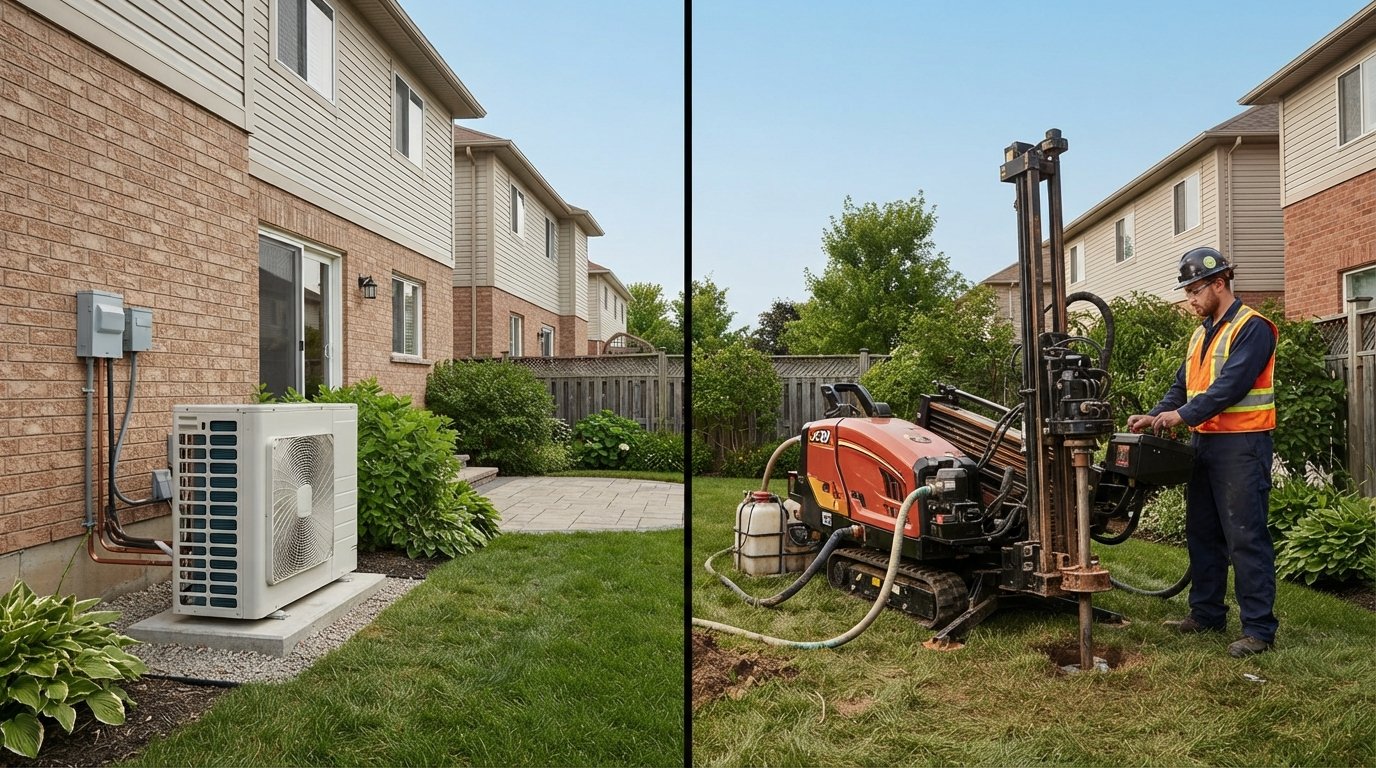
Air source heat pumps are the easier sell for most existing homes. An outdoor condenser unit sits beside the house, similar in footprint to a central air conditioner, and connects to an indoor air handler or ductwork. If your home already has ducts, the changeover can often happen in a day or two. Ductless mini-split versions avoid ductwork entirely, using wall-mounted heads in each room, which makes them a strong fit for older homes without existing duct systems. The main practical constraints are clearance around the outdoor unit, noise considerations for close neighbors, and a dependable electrical supply.
Ground source systems demand more from your property. You need either enough land for horizontal trenches, typically several hundred feet of loop buried four to six feet deep, or a drilled vertical borehole for tighter lots. Installation involves excavation or drilling rigs, which drives much of the cost and means your yard will look like a construction site for a week or more. Afterward, the loop is invisible and the indoor equipment is quieter than a refrigerator.
Before committing, it helps to evaluate your site against a short checklist:
- Available land area and soil type, since rocky or shallow bedrock can complicate trenching
- Local drilling and excavation costs, which vary enormously by region
- Existing ductwork condition if you plan a central system
- Electrical panel capacity for the new equipment
- Local climate extremes, which tilt the efficiency argument toward one technology
Homes on large rural lots, new builds with planned landscaping, and properties in harsh northern climates tend to favor ground source. Urban infill lots, rentals, and homes where budget or disruption is a concern usually lean toward air source. There is no universal winner, only the system that fits your dirt, your ducts, and your dollars.
Upfront Costs, Rebates, and Long-Term Savings
Price is where the two technologies diverge most dramatically. A typical residential air source heat pump installation ranges from roughly $4,000 to $12,000 depending on size, efficiency tier, and whether ductwork modifications are needed. A ground source system commonly lands between $15,000 and $35,000 or more, with drilling or trenching often accounting for a third to half of the total. That gap is real, and it is the single biggest reason homeowners hesitate on geothermal.
Incentives close part of the distance. The federal tax credit for qualified heat pumps has covered a meaningful percentage of project cost in recent years, and many states, utilities, and even some lenders add rebates or low-interest financing on top. Because rules and percentages shift with legislation and location, always confirm current figures with a certified installer or your state energy office before you sign anything. Stacked correctly, incentives can turn a frightening geothermal quote into a plausible long-term investment.
Operating costs tell the other half of the story. Ground source systems routinely deliver coefficients of performance in the range of 3 to 5, meaning they move three to five units of heat for every unit of electricity consumed. Air source units typically range from about 1.5 to 4 depending on outdoor temperature and model. Over a 15 to 25 year lifespan, the ground source unit's steadier efficiency can translate into thousands of dollars in lower utility bills, especially in climates with long, severe winters. Air source systems cost less to service and replace, and their components are easier to source, which matters if a compressor fails in year twelve.
A simple way to frame the decision is to run three numbers side by side: total installed cost after incentives, projected annual operating cost, and expected lifespan. If the ground source premium pays itself back within your planned ownership window, geothermal wins. If you might move in five years, the air source system usually wins on pure financial pragmatism.
Efficiency, Comfort, and Cold Climate Performance
Comfort is subjective, but the differences are tangible. Ground source systems deliver steady, gently warmed air and hold indoor temperatures with minimal swing because the earth's temperature never spikes or crashes. They also dehumidify effectively in summer and run quietly enough to sit near living spaces. Homeowners often describe the result as the most even comfort they have ever had.
Air source heat pumps have improved enormously. Inverter-driven compressors and vapor injection technology let modern cold-climate models keep running at temperatures that would have shut down older units. Still, in a deep freeze, an air source system may lean on a backup electric resistance element, which spikes energy use exactly when demand and prices peak. Ground source systems avoid that backup penalty almost entirely, which is why they remain popular in northern states and Canada.
Maintenance needs differ too. Air source units expose their outdoor coil to leaves, snow, pollen, and debris, so they need periodic cleaning and clearance checks. Ground loops are buried and essentially maintenance free, though the indoor compressor and pump still require routine service. For homeowners who value a low-touch system and plan to stay put, geothermal's hands-off nature is a genuine lifestyle benefit, not just a line on a spreadsheet.
Environmental Impact and Whole-Home Energy Strategy
Both systems cut carbon emissions compared with gas furnaces or oil boilers, and both get cleaner as the electric grid adds renewables. Ground source units hold a modest edge because their higher efficiency means fewer kilowatt hours consumed per unit of heat delivered. If your electricity comes from solar panels on your roof, that edge widens into a genuinely near-zero-emission heating system.
Pairing a heat pump with rooftop solar is one of the most powerful upgrades a homeowner can make, and it is a natural fit for anyone already researching renewable energy. If you are planning a move or a major renovation and want to coordinate energy upgrades with your relocation, resources like Moving.Homes relocation guides can help you plan the transition without losing track of contractor timelines. The order of operations matters: weatherize first, size the heat pump second, and add solar or battery storage third so your new load profile is accurate.
For homeowners weighing broader renewable investments, heat pumps and solar complement each other beautifully. The heat pump converts electricity into comfort far more efficiently than resistance baseboards or space heaters, and solar generates that electricity at a fixed cost for decades. Together they shrink both your utility bill and your carbon footprint, which is precisely the outcome most homeowners are chasing when they start comparing ground source vs air source heat pumps for residential use.
Making the Right Choice for Your Home
There is no single correct answer, only the answer that fits your climate, lot, budget, and timeline. Ground source heat pumps reward homeowners with land, patience, and a long ownership horizon, delivering unmatched efficiency and quiet comfort for decades. Air source heat pumps reward homeowners who need a faster, cheaper, less invasive upgrade that still dramatically outperforms fossil fuel heating.
Whichever path you choose, the smartest first step is gathering real quotes from certified local installers who can assess your home, calculate load requirements, and verify which incentives you qualify for right now. A professional quote turns abstract efficiency ratings into actual dollars and cents for your address. Compare at least three proposals, ask each contractor to explain their sizing assumptions, and confirm warranty terms in writing before you commit.
Your heating and cooling system will run every day for the next two decades. Choosing between ground source and air source heat pumps is really a question of how you want to spend your money: more upfront for maximum efficiency, or less upfront for a faster, simpler win. Either way, you are moving toward lower bills, steadier comfort, and a smaller environmental footprint, which is a decision no homeowner regrets.