
How Residential Solar Integrates With the Smart Grid
See how residential solar integrates with the smart grid to unlock real-time savings, backup power, and new utility programs for homeowners.

By Alexia Mabel
Learn more about Solar Panel Installation and Repair for guides, costs, and what to expect.
Compare Solar Panel Installation and Repair Pros Near You

Enter your ZIP code to compare top-rated local professionals and request free quotes.
Your rooftop solar panels do more than lower your electric bill. They turn your home into a tiny power plant that talks to the electric grid in real time. That conversation, known as smart grid integration, is reshaping how utilities balance supply and demand, how homeowners get paid for extra energy, and how resilient your home can be during outages. Understanding how residential solar integrates with the smart grid helps you choose the right equipment, ask installers better questions, and capture every available financial benefit.
What the Smart Grid Actually Is and Why It Matters for Solar
The smart grid is an upgraded electricity network that uses digital sensors, two-way communication, and automated controls to manage power flow from many sources. Unlike the old one-way grid, where electricity flowed only from a central power plant to your home, the smart grid accommodates power flowing in both directions. That bidirectional capability is exactly what residential solar needs to send surplus electricity back to the grid.
At its core, the smart grid combines advanced metering infrastructure, distribution automation, and communication networks. Smart meters record your energy use and solar production in short intervals, often every few seconds or minutes. Those readings travel to utility systems that can adjust voltages, reroute power, and even call on home batteries or electric vehicles to help stabilize the grid. For solar homeowners, this means your system is no longer an isolated asset. It becomes a participant in a larger, coordinated energy ecosystem.
The U.S. Department of Energy notes that smart grid investments improve reliability, reduce peak demand, and enable faster integration of renewable resources. For you, the practical result is more accurate billing, better outage detection, and new programs that pay you for grid services your solar and storage can provide.
The Key Technologies That Connect Home Solar to the Smart Grid
Integration does not happen by magic. A handful of hardware and software components work together to link your solar array to the utility network. Understanding these pieces helps you evaluate quotes and avoid compatibility headaches later.
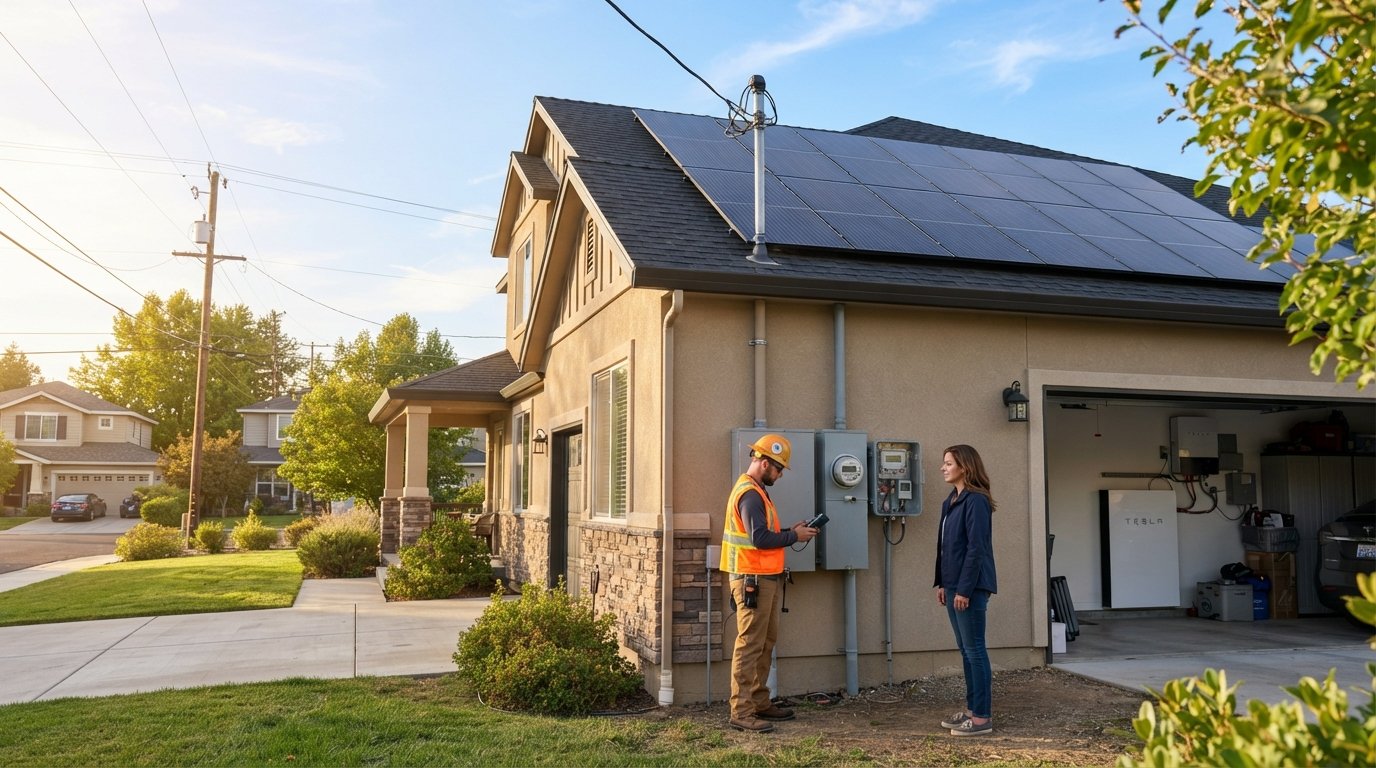
- Smart meters: These digital meters measure both the electricity you consume and the excess you export, sending data to the utility in near real time.
- Advanced inverters: Modern inverters convert DC solar power to AC and can communicate with the grid, adjust output, and support voltage regulation.
- Home energy management systems: These platforms coordinate solar, batteries, EV chargers, and smart appliances to optimize self-consumption and respond to utility signals.
- Communication networks: Wi-Fi, cellular, or powerline connections carry data between your equipment and the utility or third-party aggregators.
- Distributed energy resource management systems: Utility software that monitors and controls thousands of home solar and storage systems at once.
Each component plays a distinct role. Smart meters provide the data foundation. Inverters act as the gateway for grid interaction. Home energy management systems give you control and automation. Communication networks keep everything connected. And utility-level software turns all those individual systems into a flexible resource that can support the grid during peak demand or emergencies.
When these technologies work together, your solar system can respond to grid conditions automatically. For example, if a cloud passes over your neighborhood, your inverter can adjust output smoothly instead of causing voltage fluctuations. If the grid needs extra power during a heat wave, your battery can discharge at the right moment, and you can earn credits for that support.
How Net Metering and Smart Grid Data Work Together
Net metering is the billing arrangement that credits you for electricity your solar panels send to the grid. In a smart grid environment, net metering becomes more precise and more flexible. Traditional net metering used a single meter that ran backward when you exported power. Smart meters now record exports and imports separately, often in short intervals, which enables time-of-use rates and real-time pricing.
With interval data, utilities can see exactly when you export power and how valuable that power is at that moment. Solar production peaks in the middle of the day, when wholesale electricity prices are often lower. If you add a home battery, you can store that midday solar and discharge it during the evening peak, when prices are higher. The smart grid makes this arbitrage possible by communicating price signals to your home energy management system.
Many states and utilities are moving toward performance-based compensation for solar exports. Instead of a one-to-one credit, you might receive a rate based on the avoided cost of electricity or the locational value of your solar. These rates can vary by time of day and season. Smart grid data makes such granular pricing feasible, and it rewards homeowners who pair solar with storage and smart controls.
Real-Time Communication: Inverters, Meters, and Utility Signals
Advanced inverters are the unsung heroes of smart grid integration. They do more than convert DC to AC. They also provide grid support functions like voltage and frequency ride-through, reactive power compensation, and ramp rate control. These capabilities help maintain stability as more solar comes online.
In many regions, utilities require smart inverters that comply with standards such as IEEE 1547 and UL 1741. These standards define how inverters must behave during grid disturbances. For instance, if grid voltage drops, the inverter must stay connected for a short period to help ride through the event, rather than immediately shutting off. This prevents cascading outages and keeps more solar online when the grid needs it.
Communication flows both ways. Utilities can send signals to your inverter or home energy management system to curtail production or discharge a battery during grid emergencies. In exchange, you may receive payments through demand response or virtual power plant programs. These programs aggregate thousands of home systems to act like a single large power plant, providing capacity and ancillary services to the grid.
If you want to maximize these opportunities, choose equipment that supports open communication protocols like OpenADR and SunSpec Modbus. These protocols ensure your devices can talk to utility systems and third-party aggregators without proprietary lock-in.
Battery Storage and Smart Grid Resilience
Battery storage transforms residential solar from a daytime-only resource into a round-the-clock asset. When paired with smart grid controls, your battery can charge from solar or the grid when prices are low, then discharge when prices are high or when the grid needs support.
During outages, a battery with backup capability can keep critical loads running. Some utilities also offer programs that use your battery to support the grid during peak demand, compensating you for each kilowatt-hour dispatched. These programs, often called virtual power plants, are expanding rapidly in California, Texas, and other solar-friendly states.
Smart grid integration also improves resilience at the neighborhood level. If a fault occurs on a distribution feeder, automated switches can isolate the problem and restore power to unaffected areas faster. Solar and storage systems that can island safely (operate independently from the grid) may continue to serve local loads, though this requires specialized equipment and utility approval.
How to Prepare Your Home for Smart Grid Integration
Getting the most from smart grid integration starts before installation. The choices you make during the quoting and design phase determine how well your system can participate in utility programs and respond to price signals.
- Request quotes from certified installers who understand smart grid capabilities. Ask specifically about inverter features, communication protocols, and compatibility with your utility's programs. You can start by comparing vetted local professionals through trusted resources.
- Choose a smart inverter and, if possible, a battery. Look for models that support remote firmware updates, open protocols, and grid support functions.
- Confirm your utility's interconnection requirements. Some utilities require specific settings or additional equipment for solar plus storage systems.
- Enroll in available programs. Ask about net metering, time-of-use rates, demand response, and virtual power plant incentives.
- Set up monitoring and automation. A home energy management system can optimize when your solar, battery, and appliances operate based on price and carbon signals.
Taking these steps helps you avoid common pitfalls, such as purchasing an inverter that cannot be updated or missing out on utility programs that pay for grid services. It also positions you to benefit from future smart grid developments, including real-time pricing and peer-to-peer energy trading.
Benefits and Challenges of Smart Grid Solar Integration
The benefits of integration are substantial. You gain more control over your energy use, more opportunities to earn revenue, and greater resilience during outages. The grid gains flexibility, lower peak demand, and reduced need for fossil-fuel peaking plants. Society gains a cleaner, more reliable electricity system.
Challenges remain. Interconnection processes can be slow, and not all utilities offer the same programs. Cybersecurity is a growing concern as more devices connect to the grid. And without proper standards, some homeowners may face compatibility issues or limited choices. Staying informed and working with experienced installers helps mitigate these risks.
If you are exploring solar for the first time, a good starting point is a guide that explains residential solar quotes and savings. It covers how to compare offers and what to ask about smart grid features.
For deeper technical and policy insights, resources like SolarEnergy.ai provide analysis of solar technology and grid integration trends. These can help you evaluate installer proposals and understand the broader energy landscape.
The Future of Residential Solar and the Smart Grid
The smart grid is evolving quickly. Advanced metering, distributed energy resource management systems, and vehicle-to-grid technology are opening new possibilities for homeowners. In the near future, your solar system, battery, and electric vehicle could work together to power your home, support the grid, and generate income.
Regulatory changes will also shape how residential solar integrates with the smart grid. As more states adopt performance-based rates and allow aggregations, the value of smart, responsive solar systems will grow. Homeowners who invest in flexible, communicable equipment today will be best positioned to take advantage of tomorrow's programs.
Ultimately, smart grid integration turns your home into an active participant in the clean energy transition. It is not just about saving money on your bill. It is about strengthening the grid, reducing emissions, and gaining more control over your energy future.