
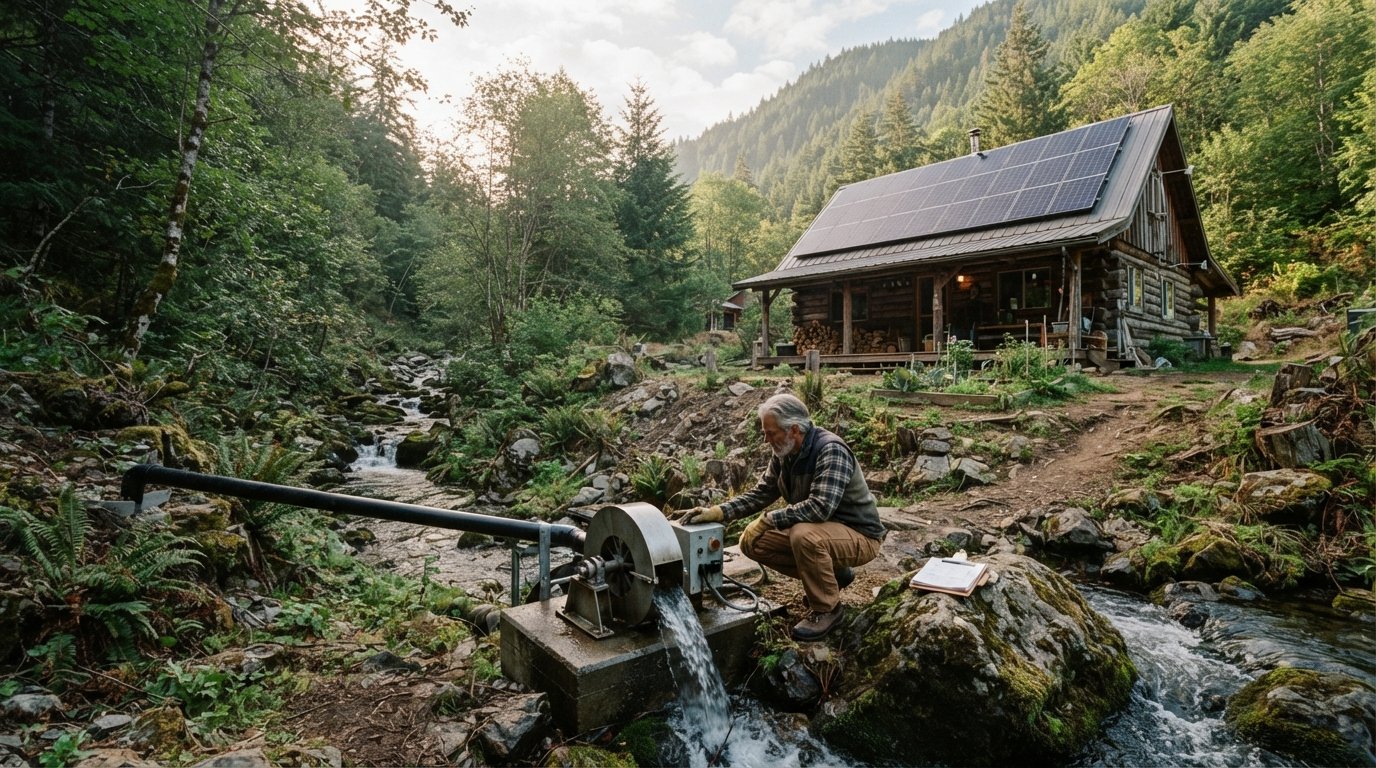
Micro Hydropower vs Solar: Best Rural Property Power?
Compare micro hydropower versus solar for rural property power, from head and flow to winter output. Call (833)-212-3715 for expert guidance.

By Wendy Keller
Learn more about Solar Panel Installation and Repair for guides, costs, and what to expect.
Compare Solar Panel Installation and Repair Pros Near You

Enter your ZIP code to compare top-rated local professionals and request free quotes.
When you live beyond the reach of a reliable utility grid, every watt you generate matters. Rural property owners with access to flowing water often face a pivotal decision: invest in a micro hydropower system that runs day and night, or blanket the south-facing roof with solar panels that shine only when the sun does. The stakes are high, because the wrong choice can mean tens of thousands of dollars wasted, a winter of shivering in the dark, or a permitting nightmare that drags on for years. This guide cuts through the hype and gives you a practical framework for comparing micro hydropower versus solar for rural property power, so you can size the right system for your land, your budget, and your seasonal needs.
How Head and Flow Determine Whether Micro Hydropower Is Even Possible
Unlike solar, which works almost anywhere with adequate sun exposure, micro hydropower is site-specific in the strictest sense. You cannot manufacture head or flow, and no amount of money can make a dry creek produce electricity. Before you compare costs or output, you need to measure two physical parameters on your property. The first is head, which is the vertical drop between your water intake point and the turbine. The second is flow, which is the volume of water passing a given point per second, usually expressed in gallons per minute or cubic feet per second.
A rough formula used by installers is that power output in watts equals head in feet multiplied by flow in gallons per minute, divided by ten, then multiplied by an efficiency factor between 0.5 and 0.7 for small systems. That means a site with 20 feet of head and 100 gallons per minute could theoretically produce around 100 to 140 watts, which is enough for a cabin but not a full household. To run a typical off-grid home with refrigeration, well pumping, and electronics, you generally need at least 10 feet of head and 50 to 100 gallons per minute, or a combination that yields a kilowatt or more. If your water source is a slow-moving creek with only two feet of drop, micro hydropower is likely off the table, and solar becomes the default choice.
Measuring head accurately requires a level and a tape measure, or a handheld altimeter if the terrain is steep. Flow can be estimated with a bucket and a stopwatch at a small waterfall or by using a weir in a channel. Many installers will perform these measurements for free as part of a site assessment, and it is worth requesting multiple assessments before you commit. For a deeper feasibility walkthrough, see this guide on micro hydropower home feasibility, which covers the math and site conditions in more detail.
Seasonal Output: Why Hydro and Solar Peak at Different Times
Solar and hydro behave like opposite seasons in many climates. Solar output peaks in summer when days are long and the sun is high, then drops sharply in winter due to shorter days, lower sun angles, and snow cover. Micro hydropower often peaks in spring during snowmelt or the rainy season, and it can decline in late summer when creeks run low. In cold climates, hydro can also be affected by ice formation at the intake, though a well-designed system with a screened intake and a diversion can keep running through winter.
That seasonal mismatch is actually a strategic advantage if you pair the two technologies. A hybrid system can lean on hydro in winter and spring when solar is weak, then rely on solar in summer when water flow drops. Rural properties in the Pacific Northwest, New England, and the Appalachian Mountains often see exactly this pattern, with strong winter flows and decent summer sun. In the desert Southwest, hydro may be seasonal or nonexistent, and solar dominates year-round.
You also need to consider daily output patterns. Solar produces only during daylight, so you need batteries or a generator for nighttime loads. Micro hydropower, by contrast, can run 24 hours a day as long as water flows, which makes it a natural fit for continuous loads like refrigeration, well pumps, and security systems. That round-the-clock reliability is one of the strongest arguments for hydro on a rural property, especially if you want to avoid a large battery bank.
Permitting and Water Rights: The Hidden Hurdle for Hydro
Solar permitting is usually straightforward: a building permit, an electrical permit, and sometimes a utility interconnection agreement. Micro hydropower is a different animal. Water rights in the United States are governed by a patchwork of state laws, and even a small residential system can trigger review by state water resources agencies, the Army Corps of Engineers, or local conservation districts. In prior appropriation states like Colorado, you cannot legally divert water without a decreed right, and a new small hydro project may require a new water right or a change of use permit.
Environmental regulations also come into play. The Federal Energy Regulatory Commission (FERC) has jurisdiction over most hydropower projects, though there is an exemption for small systems under 10 megawatts in some cases. Even exempt projects may need to address fish passage, water quality, and wetland impacts. In practice, many rural homeowners avoid the regulatory maze by using a closed-loop system that does not divert water from the stream, or by installing an in-conduit turbine inside an existing water pipeline or irrigation ditch. These designs can reduce permitting burden, but they still require diligence.
Solar, by contrast, rarely faces water rights issues, though it may require a visual or environmental review in historic districts or protected areas. If your property has a legal water right and a suitable drop, hydro is feasible; if the water rights are unclear or shared, expect a longer and more expensive approval process. Budget at least three to six months for hydro permitting, and consult a local water rights attorney before you buy equipment.
Hybrid Configurations: Pairing Hydro, Solar, and Batteries
The most resilient rural power systems combine multiple sources rather than betting everything on one technology. A hybrid micro hydro and solar setup with a shared battery bank and inverter can deliver reliable power year-round, often at a lower total cost than oversizing either system alone. The design logic is simple: size the hydro system to cover your winter base load, size the solar array to cover summer and shoulder-season loads, and size the battery bank to smooth gaps and run critical loads overnight.
Here is a practical configuration sequence that installers often follow:
- Measure winter base load in kilowatt-hours per day, including refrigeration, well pump, and lighting.
- Size the hydro turbine to meet at least 60 to 70 percent of that winter base load, assuming minimum seasonal flow.
- Size the solar array to cover summer loads plus a surplus for battery charging, typically 1.2 to 1.5 times daily consumption.
- Select a battery bank sized for one to two days of autonomy, with a charge controller that accepts both hydro and solar inputs.
- Choose a hybrid inverter or separate inverter and charge controller combination that can manage multiple DC sources safely.
This approach lets you downsize the battery bank compared to a solar-only system, because hydro can carry the night load. It also gives you redundancy: if the creek dries up or the turbine needs maintenance, solar still produces, and vice versa. The tradeoff is added complexity and cost in charge controllers and wiring, but most off-grid homeowners find the reliability worth it.
Capital Cost and Maintenance Expectations
Upfront costs for micro hydropower vary widely with site conditions. A small do-it-yourself turbine and penstock setup for a cabin might cost $3,000 to $8,000, while a professionally installed 1 to 5 kilowatt system with civil works, intake, penstock, turbine, and grid-tie or off-grid electronics can run $15,000 to $40,000 or more. Solar, by comparison, has become remarkably cheap: a 5 kilowatt off-grid array with batteries might cost $12,000 to $20,000 installed, and a grid-tied system can be half that before incentives. For a broader look at feasibility and cost, the micro hydropower home feasibility guide breaks down typical budgets by system size.
Maintenance is the other side of the ledger. Solar has no moving parts, so maintenance is mostly cleaning panels a few times a year and checking connections. Inverters may need replacement after 10 to 15 years, and batteries after 8 to 12 years depending on chemistry. Micro hydropower, by contrast, has a turbine, bearings, seals, and an intake screen that must be cleared of debris, especially after storms. Expect annual maintenance of a few hours for a small system, plus periodic replacement of bearings and wear parts every 5 to 10 years. In cold climates, you also need to manage ice at the intake and penstock.
Despite the maintenance burden, hydro systems often last 20 to 30 years or more with proper care, and the fuel is free and continuous. Solar panels degrade slowly, typically losing about 0.5 percent of output per year, and many carry 25-year performance warranties. Both technologies have low operating costs once installed, but hydro demands more attention and a proactive approach to debris and seasonal changes.
Practical Decision Factors for Rural Properties
When you weigh micro hydropower versus solar for rural property power, the decision usually comes down to site conditions and regulatory reality. If you have a reliable water source with at least 10 feet of head and year-round flow, and you can secure the necessary water rights and permits, hydro offers continuous generation that reduces battery needs and provides winter resilience. If your water source is seasonal, low-head, or legally complicated, solar is the simpler and often cheaper path.
Consider these key factors as you decide:
- Site feasibility: Confirm head and flow with measurements, not guesses, and verify water rights before investing.
- Seasonal load profile: Match hydro output to winter base load and solar output to summer peaks.
- Permitting burden: Budget time and legal fees for hydro; solar is usually faster and less risky.
- Battery strategy: Hydro can shrink battery bank size because it runs at night; solar-only systems need larger storage.
- Maintenance capacity: Are you willing to clear intake screens and service a turbine, or do you prefer low-touch solar?
For many rural homeowners, the best answer is a hybrid system that uses hydro as the baseload workhorse and solar as the seasonal booster. That combination maximizes reliability and often delivers the lowest lifecycle cost, even if the upfront price is higher than a single-source system.
If you are still in the planning stage, it also helps to get transparent pricing on related property improvements. Resources like ContractorHomeQuotes offer cost guides and contractor selection advice that can inform your broader project budget, from trenching for penstock to mounting solar racks. And when you are ready to compare installer quotes for either technology, NewSolarQuotes can connect you with certified professionals who understand off-grid and rural systems.
The right choice between micro hydropower and solar for rural property power is rarely about which technology is universally better. It is about which technology fits your water, your sun, your legal landscape, and your willingness to maintain equipment. Measure carefully, permit patiently, and design for the worst season, not the best one. That approach will keep your lights on and your investment sound for decades.