
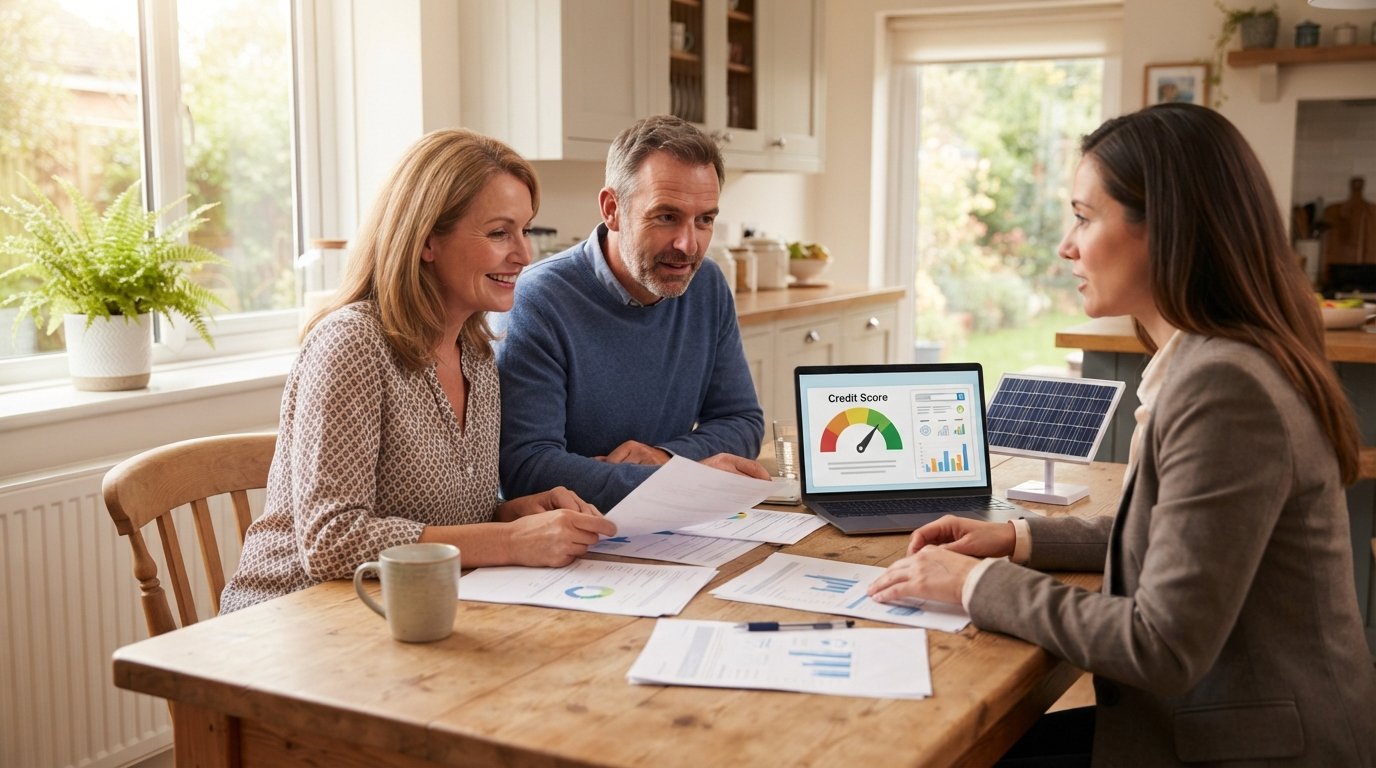
Solar Financing with Low Credit Scores: 2026 Options
Explore solar financing with low credit scores options, from credit union loans to leases. Call (833)-212-3715 for expert guidance on your best path forward.

By Alex Carter
Find Local Pros Near You
Enter your ZIP code to compare top-rated local professionals and request free quotes.
Your credit score is not a locked gate when it comes to going solar. Thousands of homeowners with scores in the 500s and 600s install panels every year by choosing the right financing path for their profile. The key is understanding that solar lenders look at more than just a three-digit number: they weigh your income stability, home equity, and the size of the system against the risk they take. This guide walks through the realistic options for solar financing with low credit scores, highlights the trade-offs of each route, and shows you how to avoid the high-pressure pitches that turn a clean energy upgrade into a costly mistake.
How Lenders Actually Evaluate Low Credit Solar Applications
When you apply for a solar loan, the lender is not just checking your FICO score. They are building a risk profile that includes your debt-to-income ratio, the amount of equity you hold in your home, your employment history, and sometimes your utility payment record. A 620 credit score with a 20 percent debt-to-income ratio and ten years at the same job often looks stronger to an underwriter than a 700 score with maxed-out cards and a recent job change.
Income matters because solar loans are secured by the equipment, not always by the home. If the lender has to repossess a solar array, recovery costs are high, so they lean heavily on your ability to pay. Home equity is the second lever: a homeowner with 30 percent equity can often access a secured loan or a home equity line of credit even with a subprime score, because the lender has a claim on real property. Understanding this hierarchy helps you target the products where your strengths outweigh your score.
Another factor is the loan-to-value ratio on the system itself. Some lenders cap solar loans at a certain dollar amount for lower credit tiers, which may mean you need a smaller system or a larger down payment. Others use alternative credit data, such as rent or utility payment history, to supplement a thin file. Before you apply anywhere, pull your credit reports and correct errors, because a single mistaken collection account can drop your score by 40 points and close doors unnecessarily.
Credit Union and Local Bank Solar Loans
Credit unions and community banks are often the most flexible source of solar financing with low credit scores. Unlike national solar lenders that rely on automated scoring models, many credit unions use manual underwriting, which means a loan officer reviews your full financial picture and can make exceptions for members with strong income and a good history with the institution. If you have been banking at the same credit union for years, your relationship is an asset that a faceless algorithm cannot see.
Local banks may also offer secured solar loans that use your home or the solar equipment as collateral, which lowers the lender's risk and can expand approval odds for borrowers in the 580 to 640 range. These loans typically come with fixed rates and terms of five to fifteen years. The trade-off is that they may require a larger down payment or a co-borrower, and the application process can take longer than an online approval. Still, the interest rates are usually far below what you would pay on a personal loan or a credit card.
Start by calling three local institutions and asking two questions: Do you offer solar loans, and do you do manual underwriting for members? If the answer to the second question is yes, schedule an in-person meeting and bring your last two tax returns, recent pay stubs, and a utility bill showing your current electricity costs. That documentation lets the loan officer calculate your savings and frame the loan as a cash-flow improvement rather than a new debt obligation. For borrowers exploring broader low-income pathways, our guide on solar financing options for low income households covers additional programs and community resources that pair well with credit union loans.
Lease and Power Purchase Agreement Credit Thresholds
Solar leases and power purchase agreements (PPAs) are third-party ownership arrangements where a company owns the panels and you pay for the power or the right to use the equipment. Because the provider keeps the tax credits and incentives, they can afford to approve customers with lower credit scores than traditional lenders. Many lease and PPA providers set a minimum FICO score around 600 to 650, and some work with scores in the 550 range if you have a clean payment history and stable income.
The credit check for a lease or PPA is typically softer than a loan application, and the approval process is faster. However, these products come with long terms (usually 20 to 25 years) and can complicate a home sale if the buyer does not want to assume the agreement. You also forgo the federal solar tax credit, which goes to the system owner. For homeowners who cannot qualify for a loan and do not want to wait, a lease or PPA can be a practical bridge, but you should read the escalation clause carefully: some contracts raise your payment by 1 to 3 percent every year, which can erode the savings over time.
When comparing lease and PPA offers, ask for the effective annual percentage rate and the total cost over the full term. A low monthly payment can hide a high total cost, and some providers bundle administrative fees that are not obvious at first glance. Also confirm whether the agreement is transferable and what happens if you sell your home. If the provider requires the buyer to qualify for the lease, a low credit score on your part may not matter, but the buyer's score will.
Co-Signers, Secured Loans, and Alternative Underwriting
Adding a co-signer with a stronger credit profile is one of the most direct ways to unlock solar financing with low credit scores. A co-signer, often a family member or a close friend, agrees to be responsible for the loan if you default. This reduces the lender's risk and can move your application from a denial to an approval with a competitive rate. The catch is that the co-signer's credit is on the line, and the loan appears on their credit report, which can affect their ability to borrow for their own goals. Have an honest conversation about the commitment before you apply.
Secured loans are another path. If you have equity in your home, a home equity loan or a home equity line of credit (HELOC) can finance solar at rates that are often lower than unsecured personal loans. Because the loan is secured by your property, lenders may approve borrowers with scores in the 600 to 640 range, especially if the combined loan-to-value ratio stays below 80 percent. Remember that a HELOC puts your home at risk if you cannot repay, so treat it with the same seriousness as your first mortgage.
Some lenders now use alternative underwriting that considers your utility payment history, rent payments, and cash flow rather than a traditional credit score. These programs are more common for energy efficiency upgrades and may be offered through state housing agencies or green banks. If you have a low score but a long record of on-time utility payments, ask whether the lender can use that data. A simple phone call can reveal options that are not advertised on the website.
Avoiding Predatory Solar Financing Pitches
High-pressure sales tactics are a real risk in the solar industry, especially for homeowners with imperfect credit who may feel they have few choices. A predatory pitch often includes a promise of "no credit check" financing with a very low teaser rate that balloons after a year, or a dealer fee that is rolled into the loan balance without clear disclosure. Some salespeople will push you toward a lease with an escalator clause that increases your payment every year, while comparing it only to your current utility bill rather than the total cost of the system.
Protect yourself by following a few ground rules. First, never sign a contract during the first sales visit, no matter how good the offer sounds. Second, ask for the annual percentage rate (APR), the total amount financed, and the total interest paid over the life of the loan, in writing. Third, compare at least three offers from different lenders, including a local credit union or bank. Fourth, check whether the installer is certified and whether the financing company is licensed in your state. Finally, be wary of any lender that asks you to inflate your income or sign documents you do not understand.
If a salesperson pressures you to apply for financing before you have seen the full system design and savings estimate, walk away. A reputable installer will give you a detailed proposal with production estimates, equipment specifications, and a clear breakdown of costs before you discuss financing. The financing should fit the project, not the other way around. And if you are planning a move in the next few years, consider how a solar loan or lease will affect your sale: our resource on planning a stress-free move explains how to transfer or pay off solar agreements when you relocate.
Building a Stronger Application Before You Apply
You can improve your approval odds and your interest rate before you submit a single application. Start by pulling your credit reports from all three bureaus and disputing any errors. Pay down revolving balances to lower your credit utilization ratio, which is the second-largest factor in your FICO score. Avoid opening new credit accounts in the months before you apply, because each new inquiry can ding your score. If you have a thin credit file, consider a secured credit card or a credit-builder loan to establish a positive payment history.
Save for a larger down payment. A 10 to 20 percent down payment reduces the lender's risk and can offset a lower credit score. Some lenders have tiered pricing where a higher down payment moves you into a better rate bucket even if your score stays the same. Also, gather your documentation in advance: two years of tax returns, recent pay stubs, bank statements, and a utility bill. A complete application moves faster and signals responsibility to the underwriter.
Finally, consider starting with a smaller system or a phased installation. A lower loan amount is easier to approve, and you can add panels later as your credit profile improves. Some lenders allow you to refinance a solar loan after 12 to 24 months of on-time payments, which gives you a path to a lower rate once your score recovers. The goal is to get the system installed and start saving, then optimize the financing later.
Solar financing with low credit scores is not a single product but a set of trade-offs. Credit unions and local banks reward relationships and income stability. Leases and PPAs lower the credit bar but trade long-term savings for access. Co-signers and secured loans can bridge the gap if you have equity or a willing partner. The common thread is preparation: know your numbers, compare offers in writing, and refuse to be rushed. With the right approach, a lower credit score does not have to keep you on the grid.
Find Local Pros Near You
Enter your ZIP code to compare top-rated local professionals and request free quotes.