
Solar for Multi-Family Residential Buildings: Opportunities and Challenges
Explore solar for multi-family residential buildings: opportunities and challenges, from financing to installation. Call (833)-212-3715 for expert guidance.

By Andy Pearson
Learn more about Solar Panel Installation and Repair for guides, costs, and what to expect.
Compare Solar Panel Installation and Repair Pros Near You

Enter your ZIP code to compare top-rated local professionals and request free quotes.
Property owners and managers of apartment complexes, condominiums, and mixed-use residential buildings face a unique set of energy decisions. Electricity costs for common areas, tenant spaces, and shared systems can consume a significant portion of operating budgets. Solar for multi-family residential buildings presents opportunities to stabilize expenses, attract environmentally conscious residents, and increase property value. However, the path to installation involves challenges that differ substantially from single-family home projects. Understanding both sides of the equation helps stakeholders make informed decisions about whether solar makes sense for their specific property.
Why Multi-Family Properties Are Prime Candidates for Solar
The economics of solar for multi-family residential buildings have improved dramatically over the past decade. Panel costs have declined, efficiency has increased, and financing options have expanded. For properties with high electricity consumption, whether from hallway lighting, laundry facilities, elevators, or central HVAC systems, solar can offset a meaningful portion of utility bills. The larger the building, the more significant the potential savings, provided the roof or available land can accommodate sufficient panel capacity.
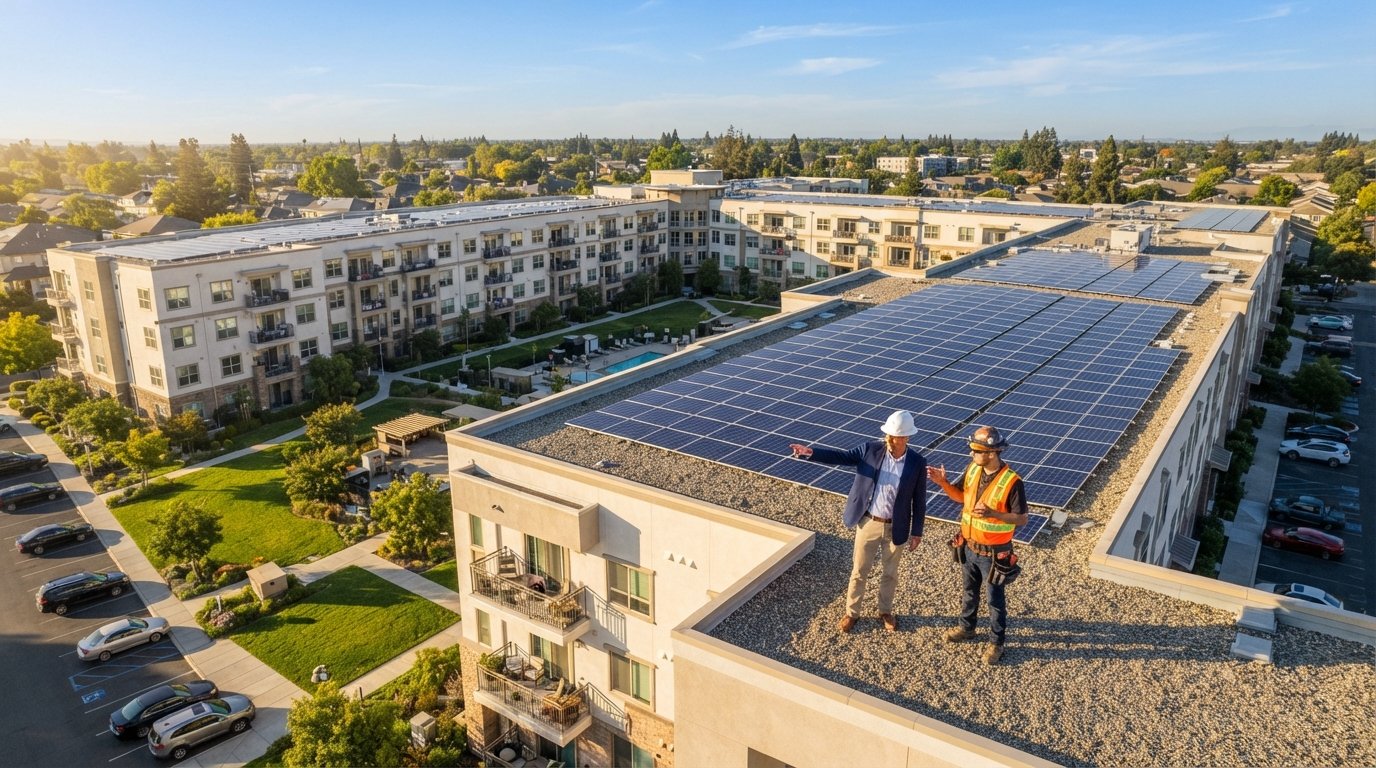
Beyond direct energy savings, multi-family properties offer advantages that single-family homes often lack. Many apartment buildings have large, flat roofs that can host substantial arrays without aesthetic concerns. Commercial-grade mounting systems allow for optimal panel orientation and tilt, maximizing production per square foot. Additionally, the concentration of tenants in one location creates opportunities for community solar arrangements or virtual net metering, where credits are distributed across multiple accounts.
Property owners also benefit from federal incentives. The Investment Tax Credit, currently at 30 percent for qualifying projects, applies to solar installations on multi-family residential buildings. This credit can significantly reduce upfront costs and improve return on investment. State and utility incentives may add further savings, depending on location. For owners in markets with high electricity rates, such as California, Massachusetts, or New York, the payback period can be surprisingly short. If you are planning a solar project, understanding the solar installation timeline and how it saves you money can help you set realistic expectations from contract signing to system activation.
Key Opportunities for Multi-Family Solar Adoption
The opportunities extend beyond simple bill reduction. Solar can serve as a differentiator in competitive rental markets. Buildings with solar-powered amenities or lower utility costs for tenants often command higher occupancy rates and can justify premium rents. In cities with aggressive climate goals, solar-ready buildings may qualify for expedited permitting or additional incentives.
Another opportunity lies in resilience. Pairing solar with battery storage allows critical systems, such as emergency lighting, elevators, or water pumps, to remain operational during grid outages. For properties in regions prone to extreme weather or grid instability, this resilience value can be substantial. Battery storage also enables time-of-use optimization, storing excess solar production for peak-rate periods when electricity is most expensive.
Financing structures have evolved to accommodate multi-family projects. Options include:
- Power Purchase Agreements (PPAs), where a third party owns the system and sells power to the property at a discounted rate
- Property Assessed Clean Energy (PACE) financing, which ties repayment to the property tax bill
- Commercial loans secured against the building or the solar asset itself
- Owner-owned cash purchases for properties with available capital
Each structure has implications for tax liability, ownership, and long-term savings. PPAs and leases shift maintenance responsibility to the system owner, which can simplify operations for property managers. Cash purchases, while requiring upfront capital, deliver the highest lifetime returns and allow the owner to claim depreciation and tax credits directly.
Challenges Unique to Multi-Family Solar Projects
Despite the opportunities, solar for multi-family residential buildings faces hurdles that single-family projects rarely encounter. The first major challenge is ownership and decision-making complexity. Apartment buildings may be owned by a single entity, a partnership, or a real estate investment trust. Condominiums involve multiple owners, each with a stake in common areas. Securing approval from all relevant parties can be time-consuming and politically sensitive.
In condominium settings, the roof is typically a common element. Installing solar requires either an amendment to the governing documents or a clear legal pathway under state law. Some states have passed solar access laws that prevent homeowners associations from unreasonably restricting solar installations, but these laws vary widely. Property managers must navigate these legal frameworks carefully, often with input from attorneys specializing in community association law.
Metering and billing arrangements present another layer of complexity. In a building with a single master meter, solar production offsets the owner's electricity costs directly, which is relatively straightforward. However, when tenants have individual meters, the solar system may not benefit them unless a virtual net metering or submetering arrangement is in place. Setting up these configurations requires coordination with the utility and may involve additional costs for metering equipment and billing software.
Roof condition and structural capacity are practical concerns. Solar panels have a lifespan of 25 to 30 years, so the roof should ideally be in good condition before installation. If the roof needs replacement within a few years, it makes sense to replace it first to avoid the cost and disruption of removing and reinstalling panels later. Structural engineers may need to verify that the roof can support the added weight of panels, mounting hardware, and ballast, particularly on older buildings.
Navigating Installation and Logistics
Installing solar on a multi-family building involves more planning than a typical residential project. Access to the roof, staging areas for equipment, and coordination with tenants are all considerations. Large arrays may require cranes or other heavy equipment, which can disrupt parking or common areas. Working with an experienced commercial solar installer who understands multi-family logistics is essential.
Utility interconnection can also be more complex. Larger systems may trigger additional review under utility interconnection rules, especially if the system size exceeds certain thresholds. In some cases, the utility may require upgrades to transformers or distribution infrastructure, adding cost and time to the project. Early engagement with the utility can help identify potential issues before they become roadblocks.
Another consideration is the split between owner and tenant benefits. In rental properties, the owner typically pays for common area electricity but not tenant in-unit consumption. Solar may offset common area loads, but tenants may not see direct savings unless the building is master-metered or has a cost-sharing arrangement. Owners must decide how to allocate the benefits of solar, whether by reducing common area charges, offering discounted rent, or simply improving net operating income. When relocating to a new property, whether for a fresh start or to be closer to family, the moving process itself can be streamlined with resources like Moving.Homes, which offers checklists and guides for a smoother transition.
Financial Analysis and Incentives
Before committing to a multi-family solar project, a thorough financial analysis is essential. This should include a review of historical electricity consumption, utility rate structures, available roof space, and local solar production estimates. Tools like the National Renewable Energy Laboratory's PVWatts calculator can provide preliminary production estimates, but a professional site assessment is necessary for accurate projections.
Incentives and financing options vary by state and utility. The federal Investment Tax Credit is a cornerstone, but additional programs may be available through state energy offices, green banks, or utility rebate programs. Some states offer property tax exemptions for solar installations, preventing the added value from increasing property taxes. Others provide sales tax exemptions on equipment purchases. These incentives can materially affect project economics.
It is also important to consider the impact on property valuation. Studies have shown that buildings with solar systems can command higher sale prices, though the premium varies by market. Appraisers may use income capitalization or comparable sales approaches to value the solar asset, depending on whether the system is owned or leased. For owners planning to sell within a few years, the ownership structure and remaining contract terms can influence buyer interest.
For those exploring solar for multi-family residential buildings, opportunities and challenges must be weighed against the specific circumstances of the property. Buildings with high electricity costs, strong roof conditions, and favorable local policies are often excellent candidates. Those with complex ownership structures, uncertain roof life, or unfavorable utility rates may find the economics less compelling. Working with experienced professionals and conducting a detailed feasibility study can clarify the best path forward.
Steps to Evaluate Solar for Your Property
Property owners considering solar should follow a structured evaluation process. First, gather at least twelve months of electricity bills to understand consumption patterns and rate structures. Second, assess the roof's age, condition, and available area. Third, research local incentives and utility policies related to multi-family solar. Fourth, obtain multiple quotes from installers experienced with commercial and multi-family projects. Fifth, model the financial returns under different financing scenarios. Finally, review legal and ownership considerations, especially for condominiums or properties with multiple stakeholders.
Engaging a solar consultant or requesting quotes through a trusted platform can simplify this process. NewSolarQuotes connects property owners with certified installers who understand the nuances of multi-family projects. By comparing quotes and asking detailed questions about experience, warranties, and financing, owners can make confident decisions that align with their financial and sustainability goals.
Solar for multi-family residential buildings represents a growing segment of the renewable energy market. As technology improves and incentives evolve, more properties will find that solar makes both environmental and economic sense. The key is to approach each project with clear eyes, understanding both the opportunities and the challenges, and to work with partners who can navigate the complexities successfully.